STUART MILLSON ranges from Manon Lescaut to Mystical Songs
Sumptuous sound – yet with pin-sharp detail – is the order of the day in the new Chandos issue of orchestral works by Puccini. Scaling the heights of dazzling audio-demonstration-level engineering, the Chandos engineers bring John Wilson’s Sinfonia of London into sharp focus – highlighting the brilliant solo playing of sections and section leaders (musicians all handpicked by the conductor) and the sheer unanimity of a sound that truly gels and sparkles. Puccini is just the right choice of composer for artists who set out to re-create what is, possibly, a lost style of orchestral playing – or at least, that resonant richness associated with the large London ensembles of the 1970s and ‘80s.
Listen out for the immaculate, tenderness of the woodwind at the opening of the Act II Prelude to Manon Lescaut, with graceful violins leading us on to the emotional blaze at the height of the piece. Likewise, a soft breeze from the Italian coast wafts through the Prelude to Act III of Edgar, a Puccini opera we hear very little. An old-world charm, reminiscent of Grieg’s Holberg Suite, is to be found in the Tre Minuetti (from about 1881, revised seven years later). This gem of a sequence started life in string quartet form, but John Wilson saw its potential for larger forces and so duly orchestrated it. From the thrilling, orchestral ‘attack’ in the short Scherzo (18812-83) to the famous, nostalgic, sepia, bittersweet Crisantemi, the Puccini collection will greatly appeal even to those who are not naturally followers of opera, but who nonetheless relish a tug of the heartstrings.
In a different era of recording, yet with an equally striking sound, but finely remastered, is SOMM Records’ Sir Thomas Beecham archive. Sir Thomas was one of a group of great inter- and post-war British conductor-knights, often known for their biting wit and somewhat authoritarian presence on the podium. At one rehearsal with the Royal Philharmonic, the position of the chair and music-stand on the conductor’s rostrum was not to Sir Thomas’s liking, and he became a little irritated by the arrangement. “Do you think I’m Samson?” he remarked, as he tried to adjust the heavy podium apparatus. “Sometimes, we do wonder, sir?” replied a brave member of the orchestra. Beecham saw the funny side, fortunately. Yet the conductor was a musical titan, as can be heard in Richard Strauss’s grand symphonic odyssey and autobiography, Ein Heldenleben.
For Strauss, his music rooted in Wagnerian willpower, the ‘Hero’s Life’ of the title referred not to a sword-wielding Siegfried, but to the German artist himself – fighting battles for recognition, for artistic truth, against sniping and snarling critics (Das Helden Widersacher – The Hero’s Adversaries). Heldenleben is, perhaps, Strauss’s version of Beethoven’s Eroica Symphony, although the work ends not in exultation, but in the sense of the artist having satisfied many of his desires. Sir Thomas Beecham revels in the almost operatic texture of the music – the grand sound of French horns and martial trumpets; the music striding on as if accompanying both Zarathustra and Don Juan, all in one. Once again with SOMM, Lani Spahr’s audio restoration leaves us in no doubt as to the mission of this record label: to establish for all-time, one of the most remarkable conductors’ and composers’ sound archives to be found anywhere in the catalogue. Also on the CD is Beethoven’s Eighth, a work of beauty, lightness, diversion – a recapitulation of all the good things we find in the Symphony No. 1 – and just the prelude needed before the mighty Ninth, the Choral Symphony. Lovers of vintage records will enjoy the mid-1950s sound, and it is truly enriching for us to be able to reconsider and re-assess the legendary musicians of 70 years ago.
But SOMM’s musical exploration of the past goes even further back in time: their first volume of Elgar from the Archives presenting two recordings from the 1920s of the Enigma Variations – one conducted by the composer himself; the other by the founder-conductor of the Proms, Sir Henry Wood. Given that the recording techniques here involved the Royal Albert Hall Orchestra – and Wood’s own Queen’s Hall Orchestra – performing in front of what looks like a large Trinity House foghorn, the sound quality is remarkably clear. Again, sound-supremo, Lani Spahr has done a wonderful job of “French-polishing” this (English) music, and because of it, we can enjoy the glorious playing of the orchestras’ woodwind and string principals in this most famous symphonic warhorse.
The Elgar disc is completed by delicate and sensitive recordings of the Violin Sonata and String Quartet, both works the products of Elgar’s stay in the woodland of West Sussex at the end of the First World War. For Lady Elgar, the slow movement of the Quartet captured the essence of sunshine; and Sir Edward’s chamber music from this southern sojourn was often generally referred to as showing a mysterious “wood magic”. Marjorie Hayward, violin, and Una Bourne, piano, are the soloists in this 1919 acoustic recording, while the String Quartet in E minor recorded two years later, shows the virtuosity and understated English emotion of the London String Quartet.
Finally, again from our own land, the words and music of Easter, and poet, George Herbert, set by Ralph Vaughan Williams. In Five Mystical Songs we sense the growth of flowers, of the daffodil – the Lent lily – and experience the quiet revelations of resurrection and renewal, although not through the usual choral and orchestral forces associated with the work, but in the composer’s own arrangement for baritone, piano and string quartet. The songs were first performed in Worcester at the 1911 Three Choirs Festival, that gathering so associated with such masters of our musical renascence as Howells, Elgar and ‘RVW’ himself. On a new recording from Albion Records and the Vaughan Williams Society, Roderick Williams, baritone, gives a warm-hearted, clearly-articulated interpretation of the songs, accompanied by the Sacconi Quartet – a performance of intimacy and reflection, reminding the listener a little of the atmosphere of Butterworth’s song-cycle A Shropshire Lad. Here, England at Easter-time lies before us: “Rise heart, thy Lord is risen. Sing his praise without delays, / Who takes thee by the hand, that thou likewise, / With him may’st rise…”
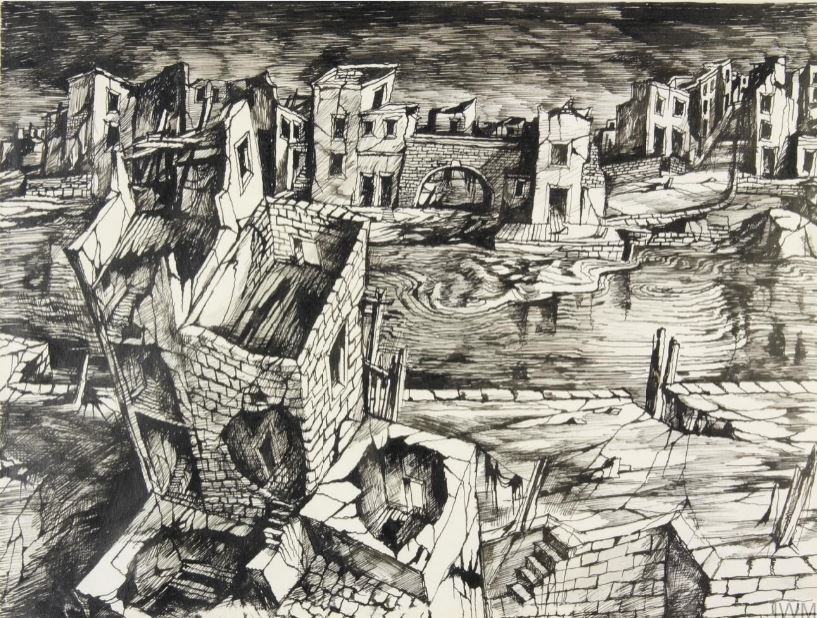
A Town Destroyed, Poplar 1941, by John Minton. Art.IWM ART 15910
Beauty and Destruction: Wartime London in Art
Imperial War Museum, March 20 – November 1
NICK BOOTH is impressed and moved by images of London under attack
Critics tend to rush by British art of the Second World War: for them there is no contest with the art of the First World War, which was revolutionary and packed with their favoured ‘isms’ – futurism, vorticism, cubism, the aesthetic fallout from Roger Fry’s post-impressionist movement in the years before Western civilisation’s headlong dégringolade to slaughter in 1914.
The art of the 1939-45 war has been judged unambitious and even, in the case of Edward Ardizzone’s work, ‘cosy’. This is unfair. This rather too small exhibition at the Imperial War Museum makes no effort to mount a counter-argument but nonetheless contains many good and affecting things. Probably there wasn’t space to lay out key conversions away from abstractionism and surrealism in the interwar period: that having hymned the world of machinery and progress some artists recoiled from the realisation that technological advances could have very nasty side effects. Thus the world of humans and nature came back into focus.
Then the war cut off Britain from the Continent, and her artists inevitably fell back towards an English tradition for the particular and the romantic. Beauty and Destruction: Wartime London in Art settles for paintings as record, sometimes almost as journalism – but many of the works operate on a much higher level. The show is worked up from Suzanne Bardgett’s excellent Wartime London in Paintings, which came out a few years ago and which is worth getting hold of if you are interested in this subject.
Two beautiful John Minton ink drawings appear early, A Town Destroyed, Poplar, and Looking Down on a Bombed Building by the Thames, Poplar 1941, are small and dreamlike, taking blitzed London and turning it into an inner landscape of melancholy emotion, a sort of visual analogue to Elizabeth Bowen’s wartime stories such as Mysterious Kôr, in which wrecked London ‘is drenched in moonlight’ and looks like ‘the moon’s capital, shallow, cratered, extinct’, and The Demon Lover, in which the evil ghost of a soldier – symbolic stand-in for the malign spirit of war visiting twice in a life – terrorises a woman in her closed-up London home.
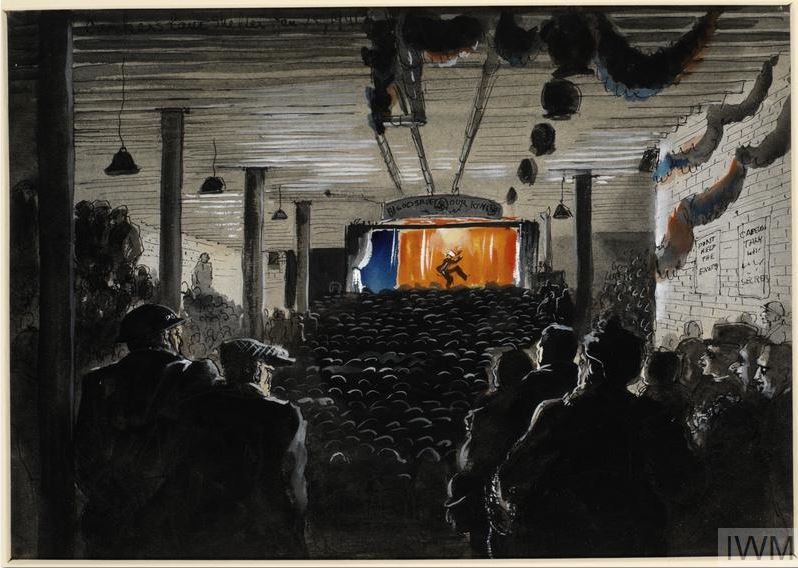
A Concert in a Shelter, St. Pancras Borough (1941) by Olga Lehmann. Art.IWM ART LD 1900
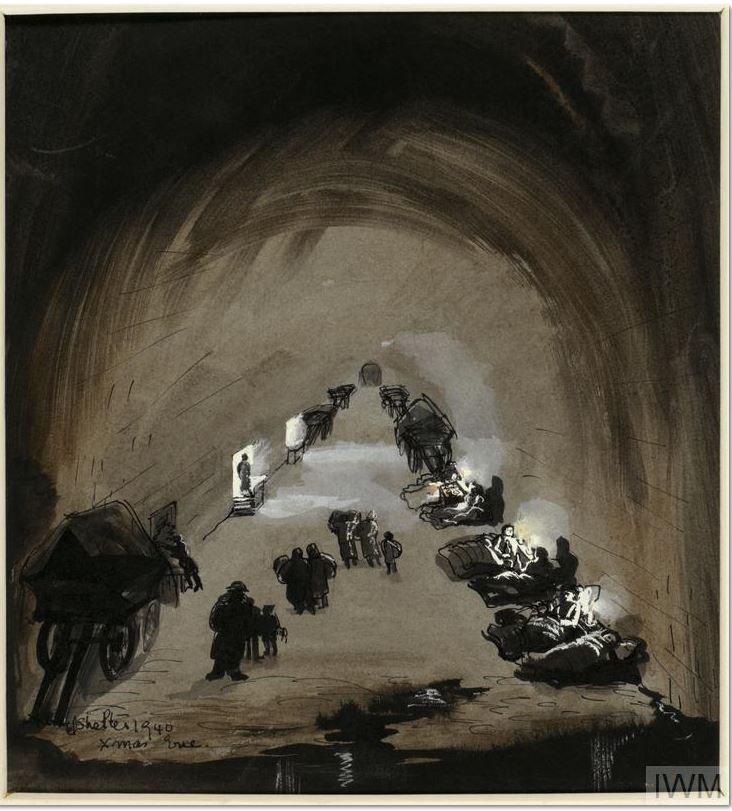
A Shelter in Camden Town under a Brewery: Christmas Eve, 1940 by Olga Lehmann. Art.IWM ART LD 1899
Two ink-and-wash paintings by Olga Lehmann portray the subterranean experience of sheltering from air raids. In the swift, brilliantly realised A Concert in a Shelter, St Pancras Borough (1941), the distant stage is a flash of colour in dark, overcrowded cellar. You can almost hear the ‘shelter cough’. Lehmann’s A Shelter in Camden Town under a Brewery: Christmas Eve, 1940, evokes the dingy grimness and looming terror endured under the streets.
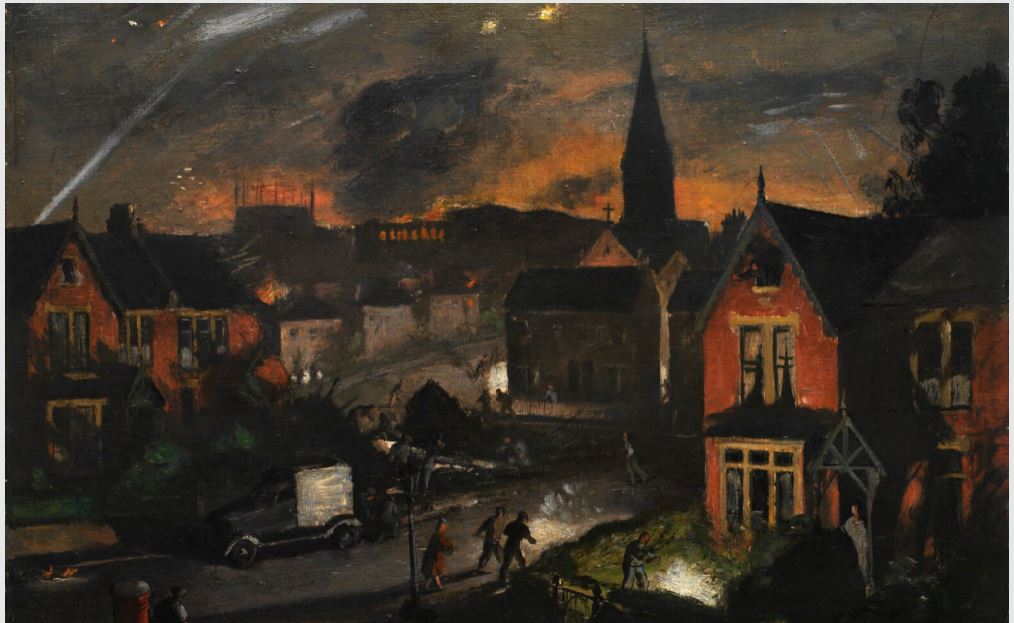
Incendiaries in a Suburb (1941) by Henry Carr. Art.IWM ART LD 1518
The prolific, technically brilliant and now largely forgotten Henry Carr gets a good showing. St Clement Dane’s Church on Fire after being Bombed crackles away – Carr lights up the Aldwych with the eerie glow of a big blaze. The newspaper publisher Cecil King saw the church burning on the night of May 10, 1941, and said the flames and sparks shooting from its spire was “an odd and rather beautiful spectacle”. Familiar Silhouettes shows squaddies lighting up fags in Piccadilly Tube; A Railway Terminus, a tour de force rendering of St Pancras Station vast and dimmed for the blackout, is blown up to wall size; and Incendiaries in a Suburb conveys the horrific surrealism of war without recourse to actual surrealism. There are the silent, blacked-out, deeply usual London homes but the horizon is orange with a demonic inferno, a searchlight roams the sky in which snarls AA fire, a church and its crucifix stands in silhouette, and piercingly bright alien incendiaries land in gardens, the UFOs of 1941. Humans scramble in the gloom. It is more strange and affecting than Magritte’s Empire of Light.
Priscilla Thorneycroft’s tiny ink drawing from the London Underground, Soldier with Child in the Tube (1940-1941), shows the weariness and strain of the Blitz in the soldier’s face. Kenneth Rowntree’s CEMA Canteen Concert, Isle of Dogs, London, E14 (1941), memorably records the tea-and-sandwiches collectivism of wartime entertainment. Graham Sutherland’s The City: A Fallen Lift Shaft (1941) is more fascinating in the flesh than it ever is on the page. When he saw the broken shaft in a ruin near St Paul’s Cathedral Sutherland said it “suggested a wounded tiger in a painting by Delacroix”.
With a collection as large as the IWM’s it seems strange the show is quite modestly sized. Space should have been found for Charles Mozley’s vivid The Thames Embankment (1940) a favourite of mine. Through misty blue winter London light, we see the view from the Savoy above Embankment Gardens with the National Liberal Club and Parliament in the distance underneath insect-like barrage balloons. A tram whirrs up the road, in the gardens below another barrage balloon is tethered, and to the right looms the ghostly dome of the National Gallery. This was London at the start of her agonies. The pre-war city would take many terrible blows and sustain heavy losses in every sense of the word. Mozley’s ‘monument to a moment’ in time, to use the great David Bomberg’s phrase, is the beginning of the end of the old capital, the city that was so brilliantly brought to life in Vaughan Williams’s London Symphony. The absence of Mozley’s painting is a glaring omission. You can see it here: https://www.iwm.org.uk/collections/item/object/19851
The Haberdashers Hall, 8th May 1945, by C. Eliot Hodgkin. Art.IWM ART LD 5311
Eliot Hodgkin’s wonderful The Haberdashers’ Hall, 8th May 1945, appears, though not at the end of the exhibition where logically it should be. This quiet, almost ironic view of the ruins of the hall with the lantern of St Paul’s rising behind is a sort of understated companion to Paul Nash’s 1918 We Are Making a New World. In Hodgkin’s painting here is the end of the European war, the last day; overgrown with weeds and littered with rubble and bent iron; huge and terrible things have happened; nothing will ever be the same again; meanwhile there is silence save for, perhaps, the faint merry singing of VE Day celebrants in the distance. The future will be along in due course.
On that point it’s a shame the IWM does not possess Carl Giles’s prophetic cartoon from the Sunday Express, August 5, 1945, (the uranium atom bomb ‘Little Boy’ was dropped on Hiroshima the next morning) called It’s Quicker By Rail showing the first appearance of his soon-to-be-famous Family trudging towards or back from their first peacetime holiday along a trainless railway track. https://blogs.kent.ac.uk/specialcollections/files/2020/08/ga5447.jpg The British were moving out of the ruins and into new challenges.
[iii] From 1945 – 1975: arguably the maximum period of post-war hope – during which (for one example) ecological concerns were fully realised but insufficiently acted upon. During which, global corporations became too powerful and greed became a virtue.
“It is the purpose of this paper to interpret the legend of St. George and the Dragon in terms of alchemical symbolism. While the victory of the Christian hero over the Dragon is traditionally interpreted as symbolic of the triumph of good over evil, it is argued that both combatants represent the four alchemical elements: air, water, earth and fire. Instead of a duel of opposites their combat transmutes the coiled-up energy of the dragon into solar light, which manifests as the beautiful princess of the myth. The conclusion is drawn that there is a dialectical movement of force in the battle between St. George and the dragon. The hero releases the antithetical power of the dense, dark matter symbolised by the dragon so that the elements of a polarity do not remain contrasted but are resolved creatively.”
[xi] Link Span, BTF film of 1956, directed by Michael Clarke. See: www.imdb.com/title/tt1754135/ “This documentary from British Transport Films, follows 24 hours in the life of three British Railways Channel ferry services.”
[xii] Colin Wilson paraphrasing Arnold Toynbee in Religion and the Rebel (1957) reprinted by Aristeia Press in 2017, page 130.
[xiii] Charlton village is the one here of many.
[xiv] https://en.wikipedia.org/wiki/Graham_Sutherland While Sutherland’s Pembrokeshire landscapes may not be “realistic”, personally, I wouldn’t think of them generally as “surreal” – which word to me indicates an element of attitude, even a degree of literary willing, more evident in (for example), Paul Nash’s gently surrealist, Landscape from a Dream, or in Dorothea Tanning’s, Eine Kleine Nachtmusik (A Little Night Music) www.tate.org.uk/art/artworks/tanning-eine-kleine-nachtmusik-t07346
Sutherland’s best Pembrokeshire work celebrates the mystery and reveals the hidden power and primeval qualities of the landscape. However, I can see how, given that his landscapes are often ‘more real than reality’, this can easily be associated with surrealism, and at times he does utilize a more surreal approach. In fact, it could be argued that the most relevant aspect of surrealism, is not the exaggerated drama of melting watches and so on, but simply an ability or a moment in which one sees and notices things more vividly. Walking through a suburb of Heysham yesterday, gradually moving into a heightened sense of seeing, I was reminded how ‘surreal’ so many houses and gardens can look in bright daylight, the layout of shrubs and pots, the window surrounds and porches etc – all those aspects of daily life it is so easy to take for granted or disregard. Down on the prom, I was reminded of Paul Nash’s short essay Swanage, or Seaside Surrealism published in The Architectural Review (Volume LXXIX, April 1936, pp. 161-4). Nash himself distinguished between the work of artists belonging to a Surrealist group, distinguishing their work by a capital ‘S’, and “artworks, situations, objects or locations that have a dreamlike character or incongruous settings that evoke disquiet or the uncanny. These, he describes, as surreal with a small ‘s’.” See: www.paulnashdorset.co.uk/timeline/1936#
LAWRENCE FREIESLEBEN, Film & Television Editor of The Brazen Head, has beenan artist and writer as long as he can remember – cycling away at weekends from the council estate where he grew up, to paint the countryside as an escape from the restrictive tedium of the school week. Leaving home at 16, he has lived in 17 different areas of the UK – from Devonshire to Northumberland – painting and writing, always vigilantly questioning the interior light of landscape, cityscape and wider atmosphere. Living virtually off-grid with his large family, both remote locations and urban visits have formed the backscene to a passion for film which has intertwined with art and writing throughout his career. Films remain a key creative focus since childhood, resulting in encyclopaedic folders and clippings as well as a constant stream of home-made film festivals. He currently lives in a dilapidated Lancashire seaside town
IAN C SMITH’s work has been published in BBC Radio 4 Sounds, Cable Street, Griffith Review, North of Oxford, Rundelania, The Spadina Literary Review, Stand, & Westerly. His seventh book is wonder sadness madness joy, Ginninderra (Port Adelaide). He writes in the Gippsland Lakes area of Victoria, and on Flinders Island
Arriving back in England after so many years I first visit my birthplace near London where even the smells have me reminiscing. From here the plan is to travel south along the Thames Estuary, then north along the coast.
As we were freed from Sunday school we all heard the short screech of brakes. A boy who lived near me was known for scaring drivers by sauntering saucily in front of them. I think I disliked him because he was bolder than me. I feared being run over after seeing a stricken dog’s blank eye bulging from its stilled face in the gutter. The jam factory closed until Monday, its usual burnt sugar smell diminished, my parents chose to potter in our miniature garden while our roast dinner bubbled in the oven, contributing to the neighbourhood olfactory menu change, rather than cleansing their sins. Our junior scripture, wasted on us, was their chance for a break. My mother had no idea of my commitment to her.
Riding his luck, that silly boy had also ridden a car’s grille. We both had sensible older sisters. I had already crashed my sister’s bike, breaking my arm. His travelled to the hospital in the ambulance, comforting him. He wasn’t badly hurt. The rest of us rocketed home with our dramatic news. My mad dash was impeded by a stitch from clutching my collar. My sister, perhaps not always so sensible, had instilled in me the belief that when you see an ambulance you must hold your collar until you see a dog, lest your mother died. Like some of us, the American T-shirt had yet to emigrate. Due to regular unwanted sightings of ambulances, often from buses, and dogs, although numerous, hiding when I needed them most, I only disproved my sister’s morbid dictum much later, a tardy laxness ending with guilty relief.
My family emigrated to Australia where that boy’s family also headed, where he became a policeman. An early school leaver, like him, I also found employment in an asteroid belt of hazards, a welding shop, where I fantasised about travelling. Sparks arced from steel melted by heat in that flashy crackling ghetto, shadows pulsing where men toiled to make ends meet. Tension simmered beneath crude camaraderie like a live nerve, with me Rilke’s panther trapped in a cage. I kept quiet there about my burgeoning reading solace. In that acrid netherworld of freckled light immigrants padded their vocabularies. That masquerade of spectral figures with shields and wands wearing identical overalls, who could have been space warriors, or prisoners, did little for the immigrants’ language education. Morale was weary, likewise, morality.
A newly-wed German listened to, asked, and copied us, occasionally with odd results. He managed to explain about an impending weekend visit to his English aunt, another immigrant, but, unlike us, well-to-do. Grasping a finger-printed mug of sweet black tea I tried to help with advice he sought regarding manners, etiquette, while others competed to hector us with vulgar suggestions. On the Monday after his social call the German raged in pent-up, back-to-front mispronounced oaths that doubled up the blue-flashed denizens of our Tartarus, the molten metal mob, in guffaws. The posh aunt had cut him like an oxy-acetylene torch in front of his bride, felling him with outraged scorn when, uncomfortable in his pressed suit, the German lad had suggested: ‘Would you please shift your slack arse to pass the fucking jam, Auntie?’ Or words to that effect.
Overcoming my velleities, bridges burned, finally educated but love still elusive, I feel so alive back where I started with my boyhood imagination. Driving through England looking hard at everything, I wonder about all I have missed while away, their shadows and echoes, now, in this cliché, my supposed mid-life crisis, albeit early. Anxious, I, now we, move on, never stopping long in my ancestral land of ancient sorrow. In Norfolk, an argument east of The Wash, ours no larksong at break of day arising, we approach an old man wearing a cloth cap with a horse, both their noses whiskery in grey light. A man, a horse, a cart, a sign. Should be a palindrome. Yes, my argumentative partner, her Australian accent rapid, twangier than mine, wants to take the ride, but with the reins in her experienced hands. English caution irritates her. The old man hears us out before agreeing to a test drive. He watches, worried. But I understand the need for money. Scavenging gulls also scrutinise her merry-go-rounding Wells-next-the-sea’s otherwise empty carpark. Sticking close to the old man, deferential, I talk her up as if sharing secret knowledge. You’d think she was Clancy of the Overflow’s direct descendant.
Our high seat a magic carpet, carriage erect, pert bottom sticking out like Chaucer’s Alisoun’s, her impatience with the Brits is ever-present. The morning air, still, with few cars, brings to mind Eliot’s certain half-deserted streets, and regular glimpses of the North Sea captivate me, horseshoes echoing on tarmac. That horse taking over, I ask my abrasive Queen Boudicca – East Anglia’s own – how she knows where to navigate her chariot. ‘The horse does,’ she says. ‘We’re just along for the ride,’ a fair description of our relationship. Early shoppers like figures in a Lowry painting stop, stare at the strangers with the familiar horse, its pace increasing. I wave to them languidly. ‘We must be heading back,’ my woman says. Wanting to believe her compelling logic, concerned, I ask if she is in control. ‘Hardly,’ she says. ‘Stop waving like the queen, you show-off.’ She does seem happier. In her element, I suppose. Beyond the horizon I picture Europe, geography as reality, mind fizzing only with travel’s romance, not the errancy of our ways. Then the old man looking lonely. Flushed with success, she is kind to him. Relief in his tone, he says he knew we would be all right, his demeanour a wavering lighthouse beam of warning we might well heed.
IAN C SMITH’s work has been published in BBC Radio 4 Sounds, Cable Street, Griffith Review, North of Oxford, Rundelania, The Spadina Literary Review, Stand, & Westerly. His seventh book is wonder sadness madness joy, Ginninderra (Port Adelaide). He writes in the Gippsland Lakes area of Victoria, and on Flinders Island
Wenguang Shao, Newsstand, distributed by 300tangpoems.newsstand.co.uk
RICHARD DOVE can hear classical China in his garden
Maybe it was the gentle splutter of rain on the greenhouse roof and the weak rays of sunlight squeezing through the clouds that focused my attention on the Tang poetry book. Perched on a stool that had probably never seen better days, I took a break from gardening to read Inked Echoes: Tang verse for Young Readers by Wenguang Shao. This beautifully produced large format book seemed, at first, to be a little out of place in my well worn greenhouse. But the poetry did not.
“On a quiet night, with no neighbour in sight.
A yellow-leafed tree in the cold steady rain,
Or a lamp’s dying glow, with grey hairs that remain.”
Tang poetry is widely regarded as China’s golden age of cultural achievement. The poems were composed during the Tang Dynasty (619-907 AD) when poets were revered and occupied lofty status. In this time of immense political and artistic endeavour, we could do with poets in Parliament now more than ever, I reflected. I had been listening to Radio 4 and needed to escape from Epstein and Mandelson: “Human affairs endure vicissitudes, with turns and twists: / Events, betwixt centuries, emerge like sudden mists. / On sites of history, words of insight are soberly chiselled.”
We need far more words of insight in these turbulent times. This poem by Men Haoran tells me that “fierce winds take their toll”. Clearly, politically and physically – Prime Minister Keir Starmer facing calls for his resignation, and this greenhouse has been reassembled two or three times after fierce winds.
Tang poetry embraces what nature offers us and more generally, our emotional response to the world around us. Being both a Mandarin and English scholar, Dr. Shao captures the nuances in the translation. A flock of noisy Canadian geese has just flown overhead and what do I read: “Falling leaves compel wild geese to southward flight; / The rivers chill beneath the northern wind’s bite.”
A van pulls up in a lane near the greenhouse and I hear pop music blaring and shouted greetings. I read on: “The music dances, echoing on tranquil streams, / Carried by sad winds across the Lake of Light. / The final strains dissolve, the player gone in a dream, / Only a few green peaks remain, spellbound in sight.”
Am I reading an account of the here and now? Tang poetry is clearly both ancient and modern. It whispers great truths across the centuries. This book is written primarily for young readers but the young at heart should not feel excluded. I loiter over the elegant calligraphy of the poems (Dr. Shao’s own hand here) and the gardening is set aside for another day. This is a book for regular dipping and diving. Take in two or three poems every day and the world will shift a little into the light.
I will leave the last words with Liu Changqing: “The dying sun descends, and dazzles men’s pride. / Birds roam unaware of hills and vales estranged, / Returning at dawn and dusk o’er streams unchanged.”
I close up the greenhouse and head down the garden path. The garden can wait, the poet told me so.
ETHAN MCGUIRE is a writer and computer scientist whose essays, poems, short stories, and translations have appeared in Blue Unicorn, The Dispatch, Emerald Coast Review, New Verse News, VoegelinView, and other publications. He is an editor at Tar River Poetry, Literary Matters, and New Verse Review and the author of Songs for Christmas (Harmonia Mundi) and Apocalypse Dance (Wipf & Stock). Ethan lives with his wife and children in Fort Wayne, Indiana.
Original author’s bio:
Chinese folk hero YUE FEI (AD 1103-1142) was a warrior poet of the highest order – a master and a founder of multiple martial arts, a dedicated Confucianist, a Taoist student, a great military strategist, a successful Song Dynasty general, and a poet. However, Yue Fei began to experience bouts of depression after the 1127 “Humiliation of Jingkang,” a turning point of the Jin-Song Wars in which Jurchen forces from the Jin Dynasty conquered the northern Song Dynasty capital of Kaifeng, captured two Song emperors, and isolated the remaining emperor and his armies to the South. Yue Fei fought a long campaign against the invading Jurchens to protect the Southern Song people and to recapture their northern Song territory, but just before he retook Kaifeng, the Emperor recalled him, to seek peace with the Jin Dynasty. To prevent a civil war and avoid exile, Yue Fei returned to the southern Song capital of Lin’an, where the Emperor imprisoned him in compliance with Treaty of Shaoxing requirements and eventually had him executed on false charges. Amidst these troubles, Yue Fei wrote some of the Song Dynasty’s most memorable poems, including “Red River” (“Man Jiang Hong”) which is still beloved throughout China today.
A POEM ON THE WALL OF XIAO TEMPLE NEAR QINGNI MARKET
Hear me!
My spirit’s strong—majestic!—
Piercing through the bull in battle.
Great heaven’s gods shall be my witnesses:
Today, I vow I will avenge our faithful emperor
With my straight sword: I—will!—cut down, wipe—out!—
The stubborn wicked, and—
returning from the war
Triumphant in my chariot, ignoring fame—
Restore our temples, and repair
Ten thousand households’ torn-down doors.
A POEM AT THE TEMPLE OF THE EMERALD CLIFF
The harvest winds have halted
the royal army’s river journey,
Forcing us to slowly march
toward the emerald mountains.
As clouds descend, I think:
the righteous loyalty we need!—
To guard clear boundary waters—men
desiring glory and honor.
There’s no use fleeing to the howling
mountain forests now.
The desert bandits will wreak havoc
anyway. Let us, instead,
March back through the three mountain passes,
to rescue the three sages,
Those golden chieftains—harried, captured—
returned then to their people.
SENDING OFF MASTER ZHEN TO MOUNT LUSHAN
Where do the sage’s forest paths,
in clouds, become confused?
The wise ones said, “The trails
at hand are—the—paths—we—have used!”
Vegetable leaves, from time
to time, drift with the river’s flow,
Reminding me of all the huts
near Cui Wei thatched with reeds.
It’s not a waste, with drink in hand,
to talk till night recedes;
The mist, the rain, the snow—
these likewise come and, unrushed, go.
Like them, though suddenly,
in all directions, we set out
Again, into the countless mountains,
jade dust strewn throughout.
TOURING THE TOWERING ROCK MOUNTAIN TEMPLE
Before the mountain stones, a temple stands,
Hidden amidst the woods, sat by a spring.
The Buddha’s image there is purple and gold;
White snow has gathered on the old monks’ heads.
A pond’s cold water nightly births the moon;
The wind through bands of pines bears Autumn’s chill.
I’ve come this way to share the dragon’s words,
To serve, as rain, to ease this people’s worries.
SEEING OFF MASTER ZHENG OF PURPLE ROCK ON HIS WAY TO THE NORTHERN CAMPAIGN
An exhortation
The commands come on the wind, in thunderclaps—
The orders from the heavens shake the mountains—
The drive is long across the Luo River—
The storm-attack goes to the underworld—
The horses hooves splash through red-trampled blood—
The banners soar like owls o’r chieftains’ heads—
Go give this clear report to our wise ruler—
Keep fighting to restore the ancient realm.
ONE THOUSAND REBUKES FROM THE CLASSIC PAVILION
Three hundred poems from the great Tang masters;
Six hundred verses holding old Han rhymes:
The ancient gods, ghosts, monsters haunt the land;
The mothers, fathers weep and wipe their last tears.
This morning, my own tears wet my cheeks and hand—
I must remind my country of those times. . .
A QUICK POEM AT SHANGZHU TEMPLE
Written impromptu and tacked to a wall at the temple—
When passing by—
While returning to attend to my duties—
Barbarians surged through the golden gate
And only stopped once south of Yangtze River.
One emperor has vanished, two souls vanquished;
Their minister alone fights in a fervor.
Yet even with sword of magic, mind-state of Siddhartha,
ETHAN MCGUIRE is a writer and computer scientist whose essays, poems, short stories, and translations have appeared in Blue Unicorn, The Dispatch, Emerald Coast Review, New Verse News, VoegelinView, and other publications. He is an editor at Tar River Poetry, Literary Matters, and New Verse Review and the author of Songs for Christmas (Harmonia Mundi) and Apocalypse Dance (Wipf & Stock). Ethan lives with his wife and children in Fort Wayne, Indiana.
CHRISTOPHER SANDFORD relives an extraordinary encounter
“Don’t mention the war,” my grandfather advised me a few minutes before our guest, an old friend from the faculty of the nearby University of Puget Sound, joined us for lunch. This was Tacoma, Washington, about twenty miles south of Seattle in America’s Pacific Northwest, in mid-August 1975 (I was visiting from Cambridge) and thus about ten weeks before John Cleese immortalised the phrase in ‘The Germans’ episode of Fawlty Towers, which I see was first broadcast on 24 October that year. Among other distinctions my grandfather ended up as the US’s oldest active full-time professor, but that aside he was always a man ahead of his time, and I think would have enjoyed the happy coincidence of this use of the line that entered into the shared folklore of my generation of Brits.
Our guest that day in Tacoma was Colonel Burton C. Andrus (US Army, Ret), and, true to his military calling, he arrived with us precisely on time. Or, to be more literally true, he didn’t. About fifteen minutes before the appointed hour, my grandfather called me over to the front window and, with an amused smile, pointed to a large-finned old Cadillac parked directly across the street. I could see a bespectacled, grey-haired man sitting bolt upright in the driver’s seat, reading a newspaper. My grandfather and I then stood waiting for the hands of the living-room clock to reach exactly 12.30pm. During these minutes, the figure in the car continued reading the paper, as though he were in fact sitting unobserved in a chair in his own home, and not parked immediately opposite our front door, ten yards away. Then, precisely at 12.30pm, the man got out of the car, walked briskly to the door, and rang the bell. “Ah, Colonel,” my grandfather greeted him. “Punctual as ever.”
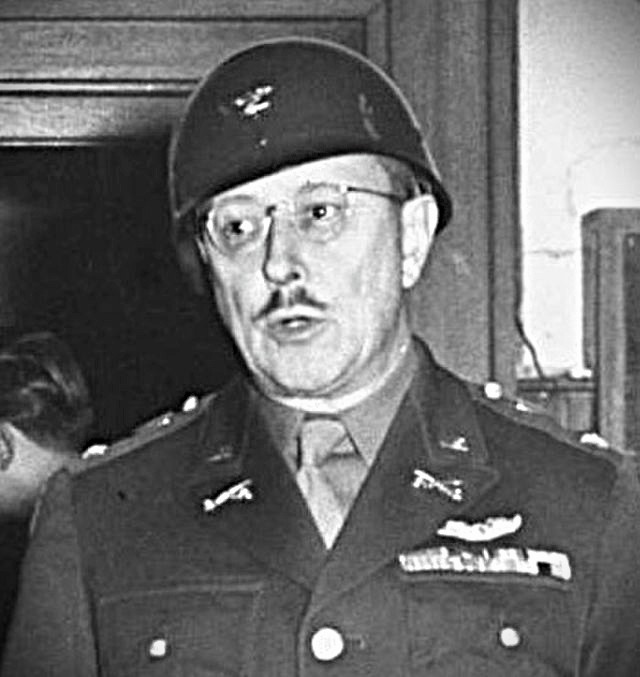
Colonel Burton C. Andrus
Colonel Andrus was then 83, and it was immediately apparent that he retained his decisive, soldierly approach to life. An October 1946 issue of Time, which I’d read in my grandfather’s scrapbook the previous evening, gave a rather unflattering account of our guest. It described him as “a pompous, unimaginative, if thoroughly likeable officer who wasn’t up to his job … Every morning his plump little figure, looking like an inflated pouter pigeon, moved majestically around, impeccably garbed in his uniform and highly shellacked helmet.” Now, thirty years later, Andrus retained the same crispness of dress – I seem to remember a funereally dark suit and tie – but there was little about him that was plump or inflated. He was, if anything, a trim, wiry figure who could have passed for twenty years younger than his real age (and, incidentally, nothing like the actor John Slattery, who impersonated him in the recent film Nuremberg), and I could immediately see how formidable, in fact frightening, a character he once must have been.
When introduced, the colonel eschewed the traditional handshake and instead seized my arm near the elbow for a second in a grip of steel, as if making a sudden arrest. He then gazed fiercely around the room, which he remarked, rightly, if a shade caustically, had ‘a lot of possessions’ in it. His relentlessly critical eye had been trained over the decades to spot weakness, and he could still be abrupt in noting any blemishes or other details that failed to meet his exacting standards. I was glad that I had had a haircut the day before.
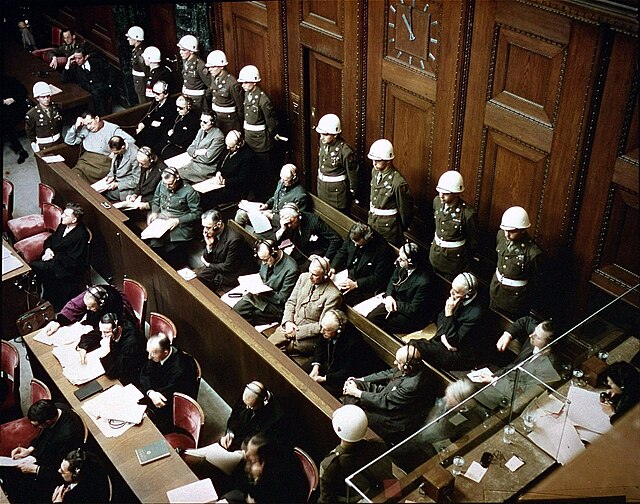
Born about 300 miles away in Spokane, Washington, in 1892, Andrus had a successful early career working for Standard Oil. He volunteered for the army on America’s entry into the First World War, and an officer’s report on him even in this youthful period praised both his “iron self-will” and “ability to inspire the fighting man which endear[ed] him to their hearts.” Although not posted overseas, Andrus was to foreshadow his later career when in July 1919 he was promoted and sent to the Presidio in Monterey, California, where he served as Prison and Intelligence Officer. Various staff and administrative posts followed in the inter-war years. In September 1941, then Lt-Col Andrus was sent to Great Britain to study its air-ground operations, and did a “thoroughly conscientious” job there, as even Time acknowledged. His was a world of briefing notes, technical manuals, dockets, manifests and fussily annotated guidelines on military procedure – a gift for detail that did not diminish with age. Andrus returned to Britain in January 1944 to serve as Commanding Officer of the 10th Traffic Regulation Group in the run-up to D-Day. In December of that year, he transferred to Allied field headquarters in liberated France as a Combat Observer. In May 1945, Col. Andrus was appointed governor of the Mondorf-les-Bains facility in Luxemburg, an interrogation centre for Nazi war criminals popularly known by its code name ASHCAN. When the inmates were moved to a new prison built at the back of the Nuremberg Palace of Justice, Andrus joined them there as their Commandant.
Notwithstanding my grandfather’s proverbial words of warning, Col. Andrus, once settled in a chair and fortified by a dynamite-strength martini, positively enjoyed talking about the war. And talk he did. Thrillingly. At length. In a dry, crisp voice he told us how military discipline and morale among the staff on his arrival at Nuremberg had been “a joke”, and that one night early on in his tenure a fellow officer had announced that he was leaving the post with the 200 men of his battalion, as he felt they could be of more service to the Allied cause elsewhere. At that, Col. Andrus quick-marched down to the motor-pool. “I posted guards overlooking it and I said: ‘The first man to drive out of that pool tonight – shoot him.’ No one moved. That particular officer soon found himself transferred out of Nuremberg, and sent to a less desirable posting than he might have wished,” the Colonel smiled. The two hundred men of his unit remained behind to become the nucleus of the prison staff.
Not long after that, Andrus went to deliver the formal indictments to the men in their cells. “They were a motley crew,” he remembered. “You looked at them and wondered how they could possibly have terrorised so many millions of people.” The colonel came to the conclusion that
…it was largely a matter of image. These gangsters had always strutted about with retinues of boot-licking aides. No one questioned them. They created an impression which, through newspapers, radio, and movie films, became a cult. This cult had to be lived up to. To increase their lustre, the men had to keep going forward – in the end, they so lost track of right and wrong that in prison they felt not guilt but a kind of indignation at their confinement.
The only one of the indicted men who had mildly impressed him was Field-Marshal Wilhelm Keitel, until lately the Head of the German Armed Forces and de facto War Minister. “He at least snapped to attention when receiving the papers I handed him,” Andrus allowed.
Like other prisoners before and after them, some of the inmates at Nuremberg turned to the solace of religion. Hans Frank, the former Governor-General of Poland, and as such thought to be responsible for the deaths of up to two million Polish Jews, “used to pray at all hours of the day, and I have no doubt genuinely felt that the Church had relieved him of guilt,” Andrus said. Several others among the accused preferred the more secular consolation of the law. Keitel and his colleagues Field-Marshal Kesselring and Grand Admiral Doenitz all addressed letters to the Supreme Allied Commander that Andrus felt would almost have been comic but for the circumstances. Many quoted the Geneva Convention, and some asked that their former aides and orderlies be sent to join them in prison. Kesselring had wanted a more comfortable bed and bigger windows in his cell to alleviate his rheumatism, a request that Andrus had felt it within himself to refuse.
The prisoners themselves weren’t the only ones to suffer the particular stress of life at Nuremberg. To my surprise, Andrus told us that when he arrived,
…most of the rest of the jail was already occupied by German civilian prisoners. It would have been easy for any of them to infiltrate our wing, and the prospect kept me awake at night until I finally got permission to erect a barrier. For that matter, the security outside the compound wasn’t any better, and if some fanatical pro-Nazis had taken it on themselves to load a truck with TNT and send it speeding through the outer wall to the cell-block itself, we would all have been blown sky high.
Andrus had also been worried about the morale of the Nuremberg jailers, or ‘sentinels’ as he called them. “These men were often 19 or 20 years old, and they were to stand in shifts in dark concrete walkways watching the prisoners day and night. It wasn’t a job for sissies. Over my whole term of duty, I experienced a 600 per cent turnover in staff,” Andrus remarked, not bothering to hide a faint snort of derision. Adding to the sombre atmosphere, two of the Nuremberg inmates, the so-called Reich Health Leader Leonardo Conti, and head of the Labour Front Robert Ley, committed suicide in captivity, while the Luftwaffe chief and Reichsstatthalter of Prussia (though he acquired offices of state almost at will) Hermann Goering later cheated the hangman by biting down on a cleverly concealed cyanide capsule only hours before his scheduled execution in October 1946.
But by far the most enigmatic – and troublesome – of Col. Andrus’s charges at Nuremberg was the former Deputy Fuhrer, Rudolf Hess. Hess was then 51, and had been in Allied hands since famously flying to Scotland in an apparent solo attempt to broker peace with the United Kingdom in May 1941. Was he mentally unhinged, as his bizarre flight, and subsequent real or feigned amnesia, seemed to suggest? The colonel’s first encounter with “this beetle-browed little man who arrived in a grey suit and a crumpled felt hat” was far from promising. Hess was being marched down a corridor in the jail when he saw Goering and his guard coming towards him. “Conveniently forgetting to forget, he immediately snapped to attention and threw up his arm in the Nazi salute to greet his old comrade.” The black comedy of the scene struck me, and I asked the colonel what he had done. “I instructed Hess, ‘Do not raise your arm like that again. I consider it a vulgar gesture.’ ‘The Nazi salute is not a vulgar gesture,’ he said. ‘It is now,’ I told him.”
“I knew right away that he was faking it,” the colonel continued. When later questioned about his family, “Hess was able to answer in very great detail about events that had happened 40 years earlier. The fact that he was reading two highbrow books a day while in custody also told me that he must have retained some of the background of his education in order to understand them.” A US Army psychiatrist examined all the Nuremberg prisoners. His report found that Hess was “passive, suggestible and naïve … Like the typical hysterical personality, he was incapable of facing reality and escaped by developing a functional disorder” – in this case, selective amnesia. “I looked him in the eye and told him I knew he was a sham. Hess just glared at me. He was ‘mad’ all right, mad at me for disbelieving him,” the colonel said.
As for Goering himself, ‘he came to me as a 300-pound hophead,’ Andrus remarked, employing the terminology of the day. “He had sixteen suitcases, wore a Cartier watch, and his fingernails were painted bright red.” After several months of the colonel’s regimen, Goering was cured of his morphine addiction, and his weight was down to something approaching normal. Even so, the table in his cell was deliberately built so that it would have collapsed had he tried to use it to reach the small barred window with a sheet or towel as a possible means of suicide. Andrus admitted that he had found Goering “a cunning and not always disagreeable internee, whom you could never turn your back on.” One morning in March 1946, the Nuremberg prisoners were being taken out of their cells to be marched to the nearby courtroom. “Goering took the opportunity to reach out and strike the sentinel several times on his arm and shoulder. The soldier hit him back with his billy-club. Goering then went loco and started screaming in German, and using his hands with incredible speed to lash out at the man. It took four GIs to subdue him.” A few years later, I was uncomfortably reminded of this incident when I sat watching the scene of Hannibal Lecter maniacally attacking his guards in The Silence of the Lambs.
After being condemned to death, Goering had made a request to face a firing squad rather than the gallows. The Allied control commission rejected his petition. “In my mind, that was the moment he took the decision to kill himself,” Andrus said. The colonel would not be drawn on the rumour that a sympathetic GI had palmed the cyanide capsule to his prisoner, and rather stiffly repeated the formal conclusion of the enquiry that “Goering had the poison in his possession when apprehended”, that “he may have hidden it in an obscure recess in the inside of his toilet under the overhanging rim,” and that “no blame for dereliction of duty is ascribed to any prison guard.” The colonel repeated the words verbatim, and I could tell that the matter still rankled all these years later. To have lost three men at Nuremberg by their own hand was the one obvious regret of this proud and supremely capable soldier. Twenty years after the event, the colonel received a letter out of the blue from the National Archives in Washington, DC. It attached a photocopy of the suicide note Goering had personally addressed to him. This, too, concluded: “None of those charged with searching [for the cyanide] is to be blamed, for it was practically impossible to find it. It would have been pure accident. [The army psychiatrist] informed me that the control board has refused the petition to change the method of execution to shooting.”
Given our continued fascination both with the Nazis and with prison dramas, it’s hard to imagine anything that could make the events of the early hours of 16 October 1946 more morbidly compelling. The execution by hanging of ten condemned men at Nuremberg (Goering was to have been the eleventh) had it all: a long walk through a rainswept prison yard into a starkly lit gymnasium, where one by one the condemned men were escorted up the steps (there were thirteen) to the gallows. Colonel Andrus read the formal sentence to each one moments before the end, and even he admitted that “It was a terrible task.” The Reich foreign minister Joachim von Ribbentrop was the first to be dispatched and, like most of the others, he met his fate with a certain dignity. “My last wish is that Germany’s unity shall be preserved and that an understanding be reached between East and West,” he said. As the rope was then tightened around Ribbentrop’s neck, he turned to the army Lutheran chaplain at his side and whispered: “I’ll see you again.”
“The military men went to their deaths impeccably,” Col. Andrus said. When his turn came, Arthur Seyss-Inquart, formerly Chancellor of Austria and later Nazi commissar of the occupied Netherlands, remarked in a level voice: “I hope that this execution is the last act of the tragedy of the Second World War, and I hope that out of this disaster wisdom will inspire the people, which will result in understanding between the nations and that peace on earth will be finally established. I believe in Germany.” Then he, too, was hanged. The only difficulty had come in the case of the former publisher of the rabidly antisemitic newspaper Der Stürmer, Julius Streicher – a “very shapeless man in a baggy suit with a large bald head and short legs.” Once at the scaffold, Streicher had screamed “Heil Hitler!”, and then made some further unappreciative remarks about the Jews. As the executioner stepped forward to the lever, the condemned man had hissed at him through his black hood: “The Bolsheviks will hang you one day!” After these blood-chilling events, Andrus insisted that the bodies, including Goering’s, had been taken to Dachau and cremated in the same concentration camp ovens where tens of thousands of Jews and others had met their end, although some historians doubt this detail. The ashes were secretly dispersed in a river. The colonel had nothing to say on the long-standing rumour that the executions had been botched, meaning that some of the men had fallen with insufficient force to snap their necks and had instead slowly suffocated to death.
I was then a remarkably vain and self-absorbed 18-year-old, but even so I like to think I realised how lucky I was to be included at the lunch table that day. The time seemed to fly by. Precisely at 2.30pm, Colonel Andrus stood up, thanked us for our hospitality, and announced that he would now go home for his scheduled nap and a walk. You saw again the rigid self-discipline, and remembered that this was a man who had lived his whole adult life in a world ruled by punctuality, professionalism and unswerving devotion to duty. As he left, the colonel seized my arm once more and looked me hard in the eye. “I hope I haven’t bored you too much,” he said. I assured him he hadn’t.
Colonel Burton Andrus died on 1 February 1977, at the age of 84. It’s said by his son that his last recorded thoughts were of Nuremberg. “I think that it haunted him … ‘Goering has committed suicide. I must report it to the Commission,’ he said. I told him it was the middle of the night, and it could wait until morning. Four hours later, my father died.”
The Spanish vega from Caceres. Image: Derek Turner
STUART MILLSON enjoys music by Granados and Ginastera, Alfvén and Rautavaara
New from the ever-exploring divine art label comes a collection of often sultry songs by a group of 20th-century Latin composers, beginning with a name that is, perhaps, not at all well-known: Fernando Obradors (1897-1945) a Catalan conductor who, in his relatively short life, does not seem to have strayed far from his native Barcelona.
Six of his short songs, from a large-scale collection – Canciones clásicas españolas – launch the CD, and we are at once in a world of captive hearts, “kisses as unaccountable as the number of hairs on my head”, passionate beating hearts, “rash and painful love”. This is music to mirror a landscape, a climate, a temperament, but also demonstrates the desire of a Spanish national – or nationalist? – composer to establish a lieder/songbook tradition for his country. However, without an equally passionate interpretation of the work, the stories distilled into these intriguing songs would probably not communicate quite as well. That is why we would do well to celebrate the CD’s artists, two US West Coast-based musicians: Esther Rayo, a dramatic soprano voice, accompanied by Sydney-born pianist, Peter Grunberg, who clearly holds the piano part here to be a voice in its own right. Sometimes shimmering, as if in the world of Ravel, or at other times with all the ease of a cabaret song, the piano emerges on this album as belonging to the centre of the stage.
Yet it is Esther Rayo’s voice which leads this CD of seduction – a voice known in the world of opera (Tosca and La Bohème in Italy) and sacred oratorio – an instrument able to switch between the sighs of the song, El majo celeso (“From the lovely person I’m falling for”) to the painful, fatal love of La maja dolorosa (The Sorrowful Woman) by Enrique Granados (1876-1916) – a composer fascinated by the Spain of Francisco Goya. A more modernist vitality informs the music of Xavier Montsalvatge (1912-2022) and two of the South American composers who are also featured on the album, Mexico’s Consuela Velazquez (1916-2005) and Argentina’s Alberto Ginastera (1916-1983) – the latter composer actually having heard the young Peter Grunberg toward the start of his career performing Gershwin’s Rhapsody in Blue.
The spirit of Spanish folk-poetry is again to the fore in six songs by Manuel de Falla, possibly the best-known of the composers featured here – a figure often spoken of in the same breath as Stravinsky, Ravel and Debussy, whose earthy ballet suites combine all the energy of The Rite of Spring, yet mixed with the dances and raw emotions of the rural folk of Iberia – at least, the folk who live in our and the composer’s imagination. This journey through a culture and people ends with the song from which the CD takes its name: Estrellita – Little Star – by Mexico’s Manuel Ponce (1883-1948) – in which the singer implores the light shining in the heavens to: “Come down and tell me if he loves me a little, because I cannot live without his love”.
I listened to these works and wrote this review as the snow settled in early January, the weather service announcing the movement of a “cold front across the country”. But closing one’s eyes and sinking into the warm hillsides and dusty village streets of Spain, Mexico, Argentina, it was as if music had the power to take me to another dimension. The CD, a firm recommendation.
Image: Derek Turner
Yet the cold front did come, musically, too, in the form of a release by Chandos Records of the Gothenburg Symphony Orchestra under the baton of Neeme Jarvi, summoning us on a sleigh ride to the cold Baltic/Nordic coastal areas of Einojuhani Rautavaara’s Cantus arcticus, written in 1972, and involving slow-moving clouds of orchestral sound, occasionally interrupted by the flight of flocks of birds – their calls, recorded, and played over the sound of the Gothenburg orchestra. The composer helpfully demarcates the score with headings such as: The Bog (Think of autumn and of Tchaikovsky) and Swans migrating. Rautavaara seems to bridge the time-span between the world of Sibelius and our own era, responding to the powerful imagery and sounds of Nature in a way which suggests the contemporary preoccupation with ecology, conservation, and an attempt – not to imitate birds – but to make them a living part of music.
Rautavaara’s drifting rhapsody and meditation, though, seems slightly out of place alongside the other two pieces presented by Chandos: the much more 19th-century-sounding ceremonial music of Hugo Alfvén’s Festpel (Festival Play) – all trumpets and courtly pride – and a score to historic derring-do at the time of the Thirty Years War, the Suite to a theatrical production from 1932 of Gustav II Adolf. A sense of national destiny flutters like a battle-standard throughout this telling of the story of the heroism and death of Sweden’s great monarch. The Gothenburg players rise to the occasion, with fervour and brassy pride – but also with some of the clouds and laments of men facing death the next day on the battlefield, but still able to fortify themselves with a tankard and a lively folk-dance.
With orchestral colour and a definite sense of place – and with a cover picture of Northern snows, migrating swans and forests of fire trees – no lover of rich orchestral music would want to be without this excellent Chandos recording.
CD details
Estrellita, Esther Rayo and Peter Grunberg, piano, divine art, ddx 21145
Alfvén, Festpel, Suite from Gustav II Adolf; Rautavaara, Cantus Arcticus, Gothenburg Symphony Orchestra, conducted by Neeme Jarvi. Chandos Super Audio CD: CHSA 5386
RAHUL GUPTA explains the history and tradition of a venerable poetic form. This article was first published in Forgotten Ground Regained, New Series, Issue 8, Fall 2025, focusing on modern English poems imitating Old Norse and Icelandic forms, and is reproduced with permission
RAHUL GUPTA holds a PhD from the University of York for a thesis on Old English and Norse poetry and the 19th-20th century mediævalist alliterative revival. His poems, prose, and translations have been published in Agenda, Acumen, Eborakon, Equinox, Molly Bloom, Spectral Realms, and Wiðowinde, among other journals, and online by British Intelligence, and The Society of Classical Poets. His main enterprise is a reinterpretation of the Arthurian legends retold as an epic in ‘the most accomplished, imaginative and technically-correct alliterative verse in Modern English since Tolkien’ (Tom Shippey), from which two excerpts have appeared hitherto, in The Long Poem Magazine, Issue 15, May 2016, and, ‘one of the truly great mythic works of our time’ (John Matthews) in The Temenos Academy Review, Issue 21, 2018. Forthcoming publications include a volume of metrically-imitative verse-translations from Old English and Norse, seeking faithfully to retain the style and versification of the originals whilst being accurate and performable aloud, from Reaktion Books
MICHAEL YOST is a poet and essayist living in rural New Hampshire with his wife and children. His essays and poems have been published in places like Modern Age, First Things, The University Bookman, Dappled Things, The Brazen Head, and others. He substacks at The Weight of Form