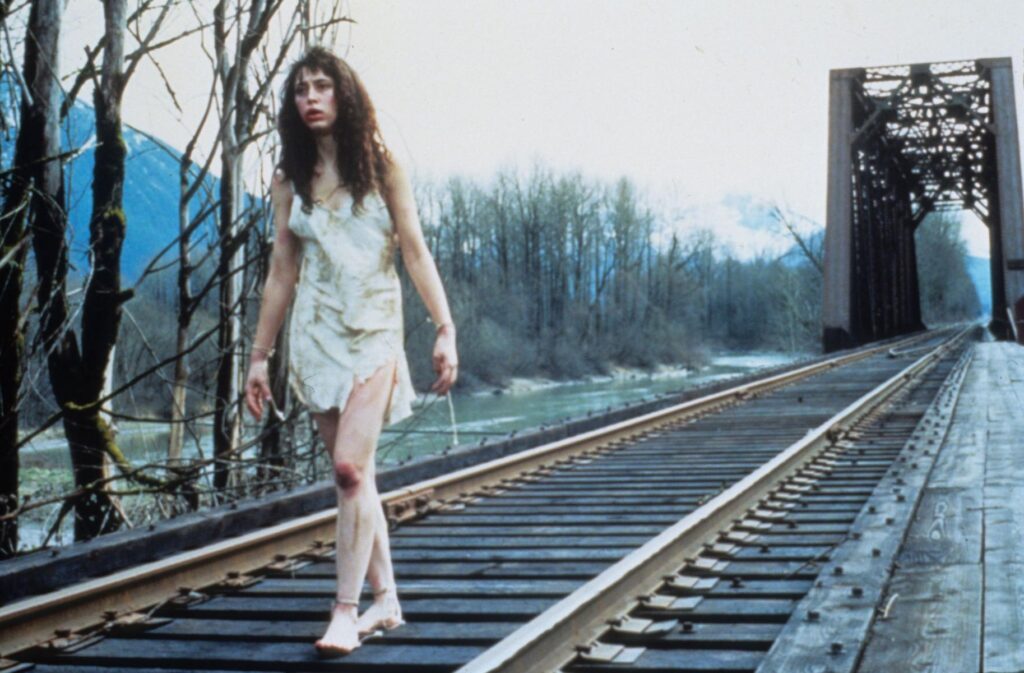
A Z-A of films: Zabriskie Point

[Caution: plot is of minor concern, either to the filmmakers or the thoughts which follow]

Travelling backwards from the end of the alphabet, three other Z films initially clamoured their alternative directions: the Hammer-esque Dracula adaptation from Pakistan directed by Khwaja Sarfraz, Zinda Lash, 1967[i]; Jake Gyllenhaal in David Fincher’s Zodiac, 2007; and Z, directed by Costa-Gavras in 1969. As if glimpsed on signs or billboards during Zabriskie Point’s early flashing road-journey sequence (00:10:00 – 00:11:56), with its distorted rear-view mirror alternatives, the presence of these other films insisted, reminded, recurred and haunted . . . but eventually fell behind.

“Zabriskie Point lives on as Antonioni’s moody meditation about freedom curdling into emptiness” ends one concise and informative appreciation of the film online[ii], a reasonable, if skin-deep conclusion to an expert precis – for it has reached its principal concern: an article about fashion and style.

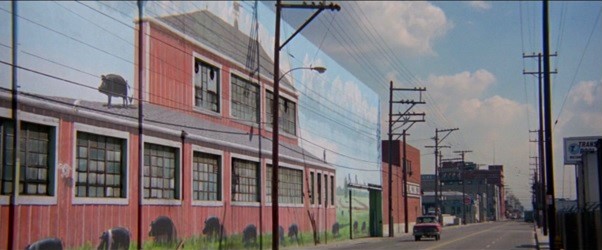
White Lund Industrial Estate, Morecambe, April 2022

How common is the assumption that all lead characters in films exist as centre points to be either identified with or rejected? Can such a generally reasonable idea apply to Zabriskie Point? Even if Antonioni and his collaborators had sought so conventional an objective, their sounds and images would have escaped. There are far more enlivening things to be found here.
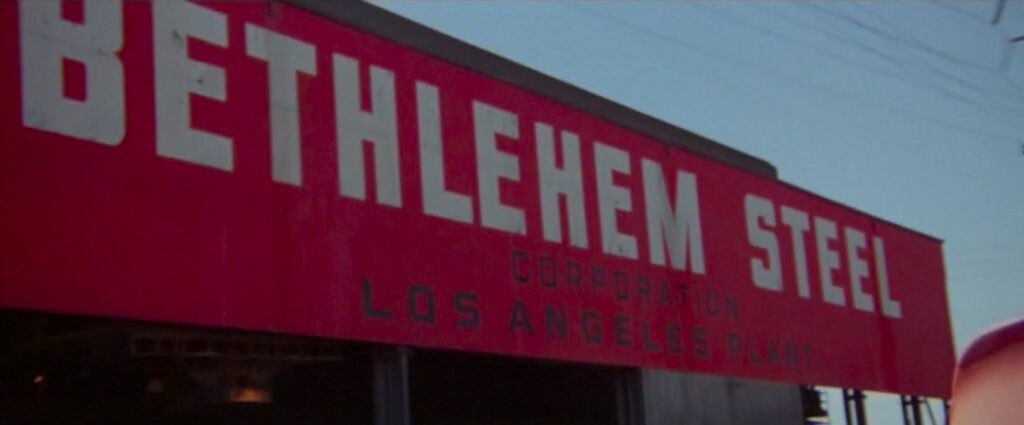
Zabriskie Point at 00:11:01

Back to that first road-journey sequence scored to cacophonous noises and experimental music[iii]: all through the LA suburbs of exhilarating colours and forms amongst dusty wires, lampposts and warehouses, eventually to the stroboscopic verticals of Mexican fan palms towering above the vying traffic, Zabriskie Point’s vibrant overwhelm of colours and shapes here make a symphony from the tangible presence of a vanished world. This is common to films and television of the period: it’s there in John Boorman’s outstanding Point Blank (1967), Peter Bogdanovich’s notable debut, Targets (1968) and the rickety Raquel Welch vehicle, Flareup[iv] (1969). It’s there through much of the superior Rockford Files TV series of 1974-1980. It might seem incidental, but it’s rarely accidental. Filmmakers look for such backgrounds tirelessly. The difference is that Antonioni often made foregrounds of the background. Setting becomes as vital as character – and while this is also true of films such as, for example, Edward Scissorhands (1990), I Start Counting (1970) or Rear Window (1954), Antonioni did not limit himself to one or two distinctive places, he tried to use the whole wider landscape and ambience – occasionally allowing its significance to equal or exceed that of the human foreground. This was not a failure to fully realise the characters, nor was it carried out with only the intention of satirising the world depicted – even if that might be as far as some viewers care to look.
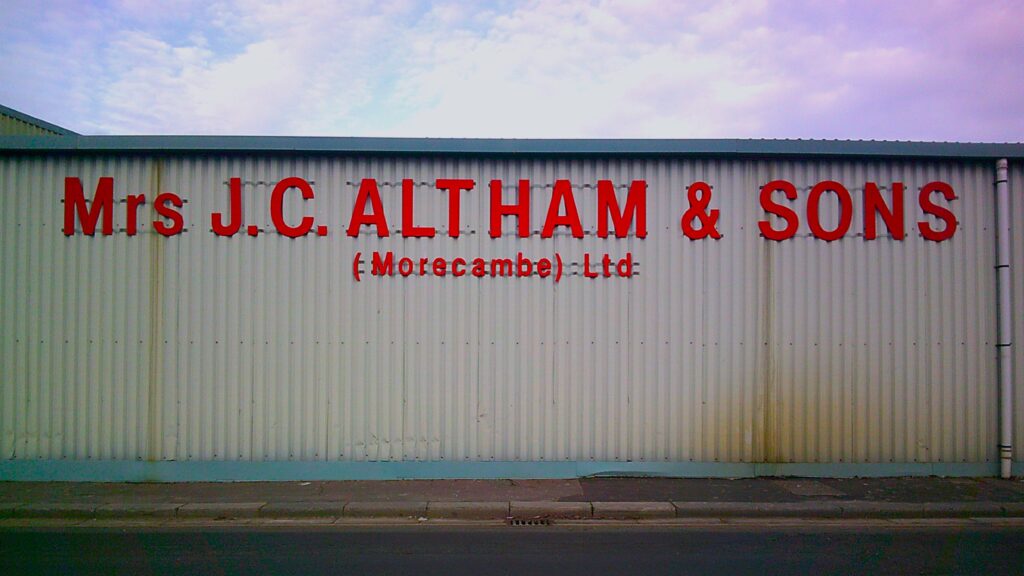
White Lund Industrial Estate, Morecambe, April 2022

To me, Antonioni’s viewpoint is metaphysical. In films such as L’Avventura (1960) this can feel remote. Watched from a “normal” human angle his films are often regarded as alienating. Yet whatever Antonioni’s personal views on faith or doubt, presence or absence, the films are almost bound to feel alienating if one struggles too hard to identify (positively or negatively) with the characters – which of course is precisely what, as spectators of TV and film, we are expected to do.
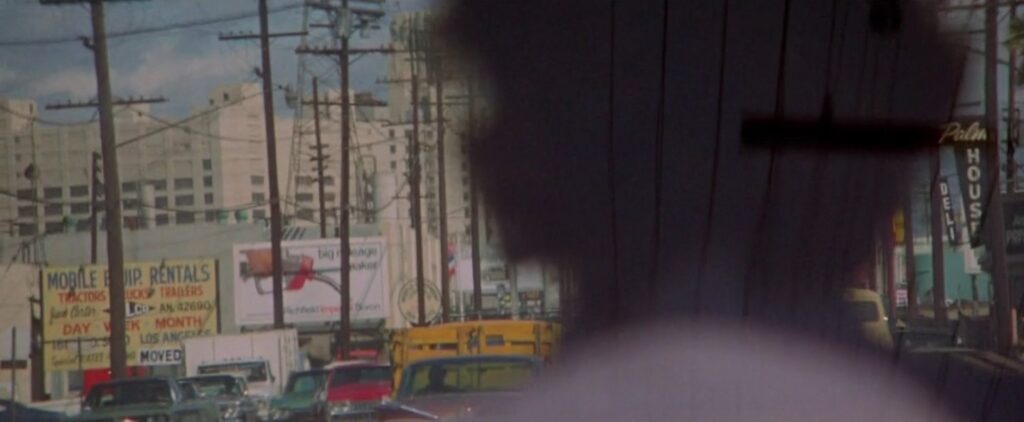
Zabriskie Point at 00:11:37

Heartbreakingly beautiful in retrospect, as with the London of Blow-Up[v](1966), the Los Angeles of Zabriskie Point may be sadly or safely gone, depending on your viewpoint. Delusional rationalisation – both economic and psychological – combined with the reckless notion of constant progress, have created a force towards a future which cannot curb either the blandness or destruction inherent in it. The inadvertent society marches on[vi].
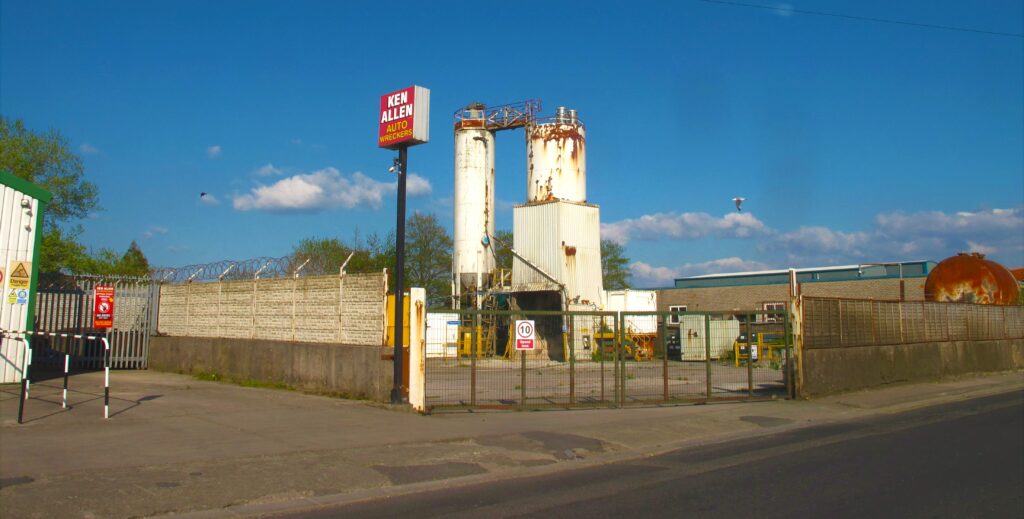
White Lund Industrial Estate, Morecambe, April 2022

Vanished suburban and industrial backgrounds are like treasure and many artists in different media have richly enshrined and celebrated such visual and auditory fairground rides, but in Zabriskie Point’s first of many journeys – lasting less than two minutes of screen time – as well as throughout the film as a whole, this is more than a time machine visit by an acutely observant[vii] foreigner, it is a sociological and historical document, not just – in passing – for its period, but also for America’s distorted idea of itself . . . yet more relevant today under a dangerously unhinged president[viii]. How dismayed the radical students in the assembly for action at the beginning of Zabriskie Point (00:00:07 – 00:08.46) would be to discover, just how “pell-mell into fascism” (00:04:46) their country has fallen under Trump.

Amongst the joy and sadness, the hurtling traffic and bustle of vanished lives, in search of the overlaps when certain films or experiences strike some kind of well or mineshaft . . .

Aiming for the visionary / Instead, a lead mine has been drilled down inside my neck / to flooded levels I can’t keep clear. / Grid confined, primal force without bearings, craving the sky / Far from meadows or moors / Is there no choice but downward?[ix]…

Then, everything – all the fleeting side-thoughts and impressions triggered by Zabriskie Point, went calm as I remembered Leighton Buzzard sand quarries . . .

Leighton Buzzard Sand Quarries. Stock image: M O’Brien Group

Several illicit Sunday trips to Leighton Buzzard sand quarries in hot summers of the mid and late 70s, deposited vivid geological strata in my mind, a dream of deserts – or even distant planets which remains undimmed. This was both the surface and the inside of the land itself. Climbing over fences and sneaking down into cuttings and pits, following rusting rails alongside the severe blues of ponds and lakes, pushing the small mineral wagons along tracks we chose to believe abandoned, collecting sandstone rocks which were like red-ochre asteroid landscapes in miniature . . . This was one of those moments when a truer sense of priority emerges – to disregard time and the usual human goals. These moments are part of what Antonioni is trying to embody in Zabriskie Point.

Despite later, tamer visits with my children to the narrow-gauge railway (first opened in 1919) that had become a noticeable tourist attraction by the 1990s[x], the archetype was not dislodged. An unearthly place vastly expanded from its dimension in reality. Just how many landscape experiences, direct or second-hand, this archetype has helped intensify is impossible to calculate. Antonioni’s misunderstood Zabriskie Point (1970) is one of them, even though the titular Death Valley desert viewpoint, in yellows browns and whites has little in common with the vibrant reds and oranges of Leighton Buzzard. The temperate Bedfordshire location became a long-running family joke. Scenes in Lawrence of Arabia (1962), Ice Cold in Alex and Sea of Sand (both 1958)would all be met with “Look! Leighton Buzzard sand quarries!”  Zabriskie Point (1970) however, was not a family film and what Peter Bradshaw positively describes in The Guardian[xi] as a meeting between a radical student on the run and a “hippy chick” which leads to a “sexual epiphany, psychodramatised as an orgy” would not have gone down well, if indeed it was ever shown on T.V. before my sister and I left home.

In Antonioni’s last full-length feature film, Beyond the Clouds[xii], (1995) John Malkovich as ‘The Director’ serves – largely in voiceover – as the alter ego of Antonioni. Some of his thoughts are rhetorical, others enigmatically intriguing, if whimsically vague[xiii]. Near the beginning of the film comes this self-deprecating statement: “Don’t get me wrong: I’m not a philosopher. On the contrary, I’m someone who is profoundly attached to images.” [Does this rule out the philosophical impulse?]  “I only discovered reality when I began photographing it. Photographing and enlarging the surface of things that were around me. I tried to discover what was behind them. I’ve done nothing else in my career.” While it’s hardly true that Antonioni did “nothing else”, this element of exploration is undoubtably true of Zabriskie Point.

If alienation – intended to trigger observation and thought rather than emotional empathy – appears key to almost all mid-career Antonioni’s films, it follows that his characters often dispense with excessive . . . character. Many of them remain partially or severely blank – inscrutable to the point of being elsewhere. This is taken to a constructed extreme within the partial road movie, partial romance, partial thriller of The Passenger, (1975). As Locke, Jack Nicholson – one of the least camouflageable stars that ever grinned! – takes Antonioni’s concept and distancing literally: attempting to lose himself by exchanging identities with an acquaintance who dies unexpectedly in their shared shabby hotel on the edge of the Sahara in Chad.

Although they were not professionals and, in some ways, exist in the film on an attitudinal surface, Mark (Mark Frechette – virtually playing himself it would seem[xiv]) and Daria (Daria Halprin) remain increasingly memorable. Towards the end of the film, Mark is predictably martyred by the aggressive trigger-happy cops lurking at the airfield, cops too overcharged or dim to wait until he stops and gets out of the plane. Meanwhile, Daria becomes the projected soul or alternative hope of the film . . . at least in her final, satisfying, explosive daydream. This is a moment we are encouraged to identify with – and carries us with it even when it digresses from repeatedly destroying the building to a series of more abstract, increasingly impossible detonations – sky-blue backdropped[xv] interior spaces conjured from the ether, to blithely destroy consumerism’s unlimited contents, comforts and gadgets.
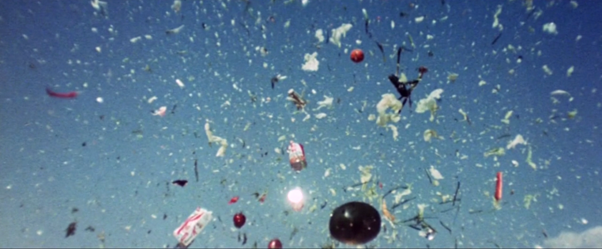
Blithe destruction at 01:48:02

The clash in so many ways (ideological, physical, temperamental) between Daria and her middle-aged boss, Lee, (good old Rod Taylor) is harsher than either of them seem to realise. Fiercely ambitious and materialistic, Lee seems to be a deliberately jarring, no-nonsense advocate from an older generation, a patient bull who has left Bodega Bay and The Birds (1963)[xvi] far behind. He seems stranded – as if at some point he set his Time Machine[xvii] for 1969, and abandoning it, has swapped his clothes in some trendy boutique for the uniform of a square!  

Sometimes, I have the feeling that the best films, indeed the best art, only appears to have faults. Eventually we realise that it’s the imperfections and the sections we can never explain or understand which create “perfection”. Experienced often enough, faults can become serendipities[xviii]. If this doesn’t happen, then it’s the underlying limitations which are revealed: those films which complete themselves in the watching and die; those too well-constructed novels or poems; the over-skilful or over-stylish paintings. Years ago – as well as wishing that Zabriskie Point had used all 23 minutes of The Grateful Dead’s, Dark Star[xix]  – I was unhappy with the main cast, now they seem ideal . . . just as Kim Novak’s woodenness in Vertigo (1958) has been widely reappraised[xx].

Having not seen it since 2017, would Zabriskie Point amount to less than the sum of its parts? Another problem with getting older is realising how not only individuals, but more-importantly, the human race, so often dismally fails to achieve what it could[xxi] – our cleverness progressively drained of wisdom, while the summits of art become rarer or more piffling. Also, fewer of the past’s claimed summits look as valid as they once did. The best of everything becomes increasingly elusive, hidden beyond the surface of reality or inside yourself. It is not wholly present in the art (if it ever was) but depends on what the individual’s experience enables them to apply – as Leighton Buzzard’s sand quarries helped me. It’s the interaction that counts, rather than any end product. As our cultural ability to appreciate any form of art declines – dulled or made intolerant in the film world by an over-indulgence of blockbuster or franchise trash (as mobile screen overuse is dimming the capability to concentrate on anything much longer than a moment) – so its past value becomes veiled or lost.

Hopefully, it’s not just on a personal level that Zabriskie Point contradicts this general decline. Although I must’ve seen the film six or seven times, almost everything is better than I remember – the characters more present in their ambiguity, the atmosphere vividly real. Instances of droll humour – such as the policeman writing Carl Marx when Mark states his name upon being arrested (00:16:43) occur quite often. The unforced satire of advertising and billboards showing family, is as clear as crystal, yet the irony is, at this point, forgiving. The same goes for the entire sequence (00:18:18 – 00:19:38) cross-cutting between the Sunny Dunes, Board of Directors, smoking or contemplating, and their absurd promotional film presenting desert development as an innocently offered chance for wealthy customers to receive what they’ve always wanted: “Why be caught up in the rat race of city life when you can enjoy life the Sunny Dunes way?” Emerald green tennis lawns beckon beneath red rocks[xxii]. “Drink fresh mountain water from oaken buckets” (00:18:36), “Breathe the unpolluted air of the high desert”. A grinning boy mannequin (00:18:43) who resembles, minus the glasses, that idealistic nerd, Joe 90[xxiii], armed with six-shooters and dreaming of outdrawing a quail or a mountain lion!

Even this fictional real-estate advertisement mocking the ersatz nature of modern consumerism – always more lavish and go-ahead in the US of A – seems forbearing. Perhaps Antonioni was trying hard not to believe that society as a whole could so pathetically fall into such sterile traps? Or that the ludicrous twisting of the idea of freedom fuelling this commercialisation, the corralling of the free spirit of the desert, would be obvious to all intelligent people? “Forge a life of your own, like the pioneers who molded [sic] the West” (00:18:54). Like some gross escalation of Metro-land’s[xxiv] fading echo of the Edwardian period (which from 1919 until the early 1930s, sold a pastoral dream situated in the fields and wooded hills north-west of London) the Sunny Dunes Corporation aims to conquer the desert itself.

At 00:19:39 an impressionistic travelling sequence interrupted by a rear-view mirror’s abstract oblong in space, comes into focus on Lee (Rod Taylor). A radio report records that the total number of US servicemen killed in Vietnam is nearing 50,000. Oblivious, Lee’s almost identical colleague (same clothes, same profile, same haircuts) reads a newspaper article noting that California now has seven “centimillionaires”.  An overlapping radio item moves to Mark’s house and his decision to go to the campus “to see for himself” (00:20:47). As he leaves in his battered truck, Lee and identikit colleague arrive at the Sunny Dunes office tower block. Meanwhile, Daria is escaping the city.
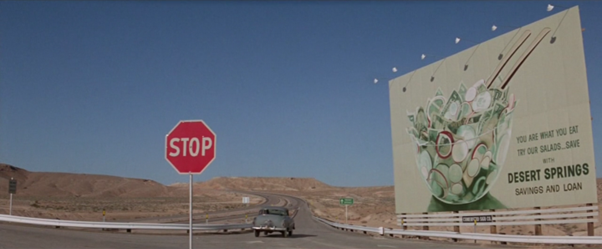
Daria drives into the desert at 00:23:13.

In the late 60s and into the 70s, Hollywood films briefly overlapped with searching art cinema[xxv]. Like other films of the period, Zabriskie Point is so complex and remarkably edited that subsequent mainstream cinema often tastes vacuous.

Fleeing the campus shootings of protester and police officer (00:29:24 – 39) Mark takes a bus to the “end of the line” – the suburb the driver announces, sounds like “Rockway and Kirby,” although no such place or intersection appears to exist. Attempting to cadge a sandwich “if I trusted you, I’d have to trust everybody in the whole world”, he later sits by an Official SMOG Inspection Station. Wandering towards a used car lot, a light aircraft drones over, leaving a billboard of family behind . . . Flags, more planes, a remembered airfield, the chance of escape . . .
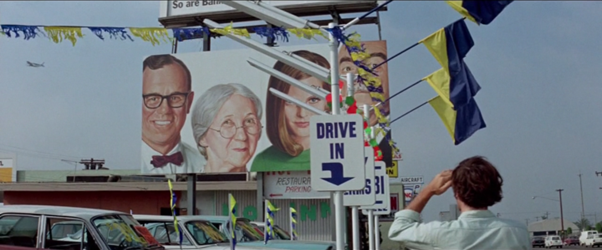
Mark at 00:32:47

The flight from Los Angeles, leaving its traffic-spiraling cloverleaves and dreary grids behind to an excerpt of The Grateful Dead’s Dark Star (00:36.15 – 00:37:14) lowers the stress and melds into a helicopter sweep over Daria’s borrowed and well-weathered 1952 Buick to Pink Floyd’s Crumbling Land (00:37:25).
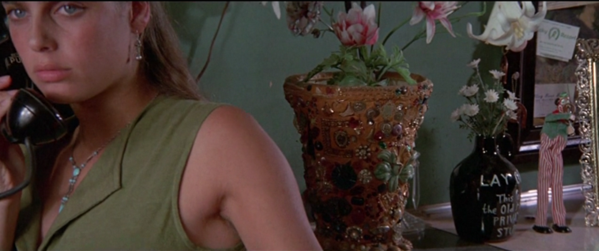
 Daria at 00:38:27

A brief story from toddler to youthful soldier is told as the camera begins a short pan across colourful knick-knacks (00:38:24) before Daria’s bar phone connects to Lee’s grey office paraphernalia. The bar from which she rings could be seen as pre-Lynchian, albeit in Wes Anderson palette, but remains distinctly real. The pending ghost town settlement outside is a wasteland outpost with little more than a gas station, short railway platform, a grain silo (or obese ICBM hiding in plain sight?) the remains of an outdoor dance deck[xxvi] and a gaggle of “emotionally sick” children – all boys – who later, unconvincingly set upon her. Slightly reminiscent of the killer dolls sequence in Barbarella[xxvii], she escapes easily enough, never meeting her friend “Jimmy”[xxviii].

Although Mark’s aerial escape was based on a real-life incident[xxix], the whole section of his unlikely meeting with Daria, raises questionable aspects of their backgrounds. As a revolutionary student says at the beginning (00:04:18): “That’s why black people are, like you say, in another bag.” For Daria and Mark, (although not for Mark Frechette in real life[xxx]) their antiestablishment stance is, comparatively, a lifestyle choice, even a “bourgeois individualism” (00:08:39). If only we could all choose “to get off the ground” (00:54:05) when we needed to. If only it were ecologically justifiable.
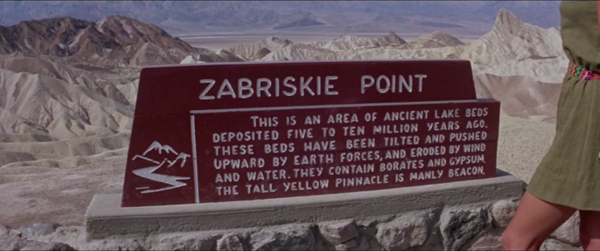
 Zabriskie Point at 00:56:17

To Daria the desert is peaceful, to Mark it’s dead (01:02:06). Daria’s idea about planting only good thoughts in people’s head (01:03:45 – 01:04:02) is a clear precursor to Gretchen’s IMG (Infant Memory Generators[xxxi]) in Donnie Darko (2001)[xxxii] but Mark is as sceptical about such an idea as Donnie and Gretchen’s science teacher is in Donnie Darko. Only good thoughts are important to Daria: 

              Daria: “That’s the point, nothing’s terrible!”

              Mark (ironically): “Far out.”

As for the “sexual epiphany, psychodramatised as an orgy[xxxiii]” Peter Bradshaw could be enjoying his exaggeration? I see this long scene (01:06:46 – 01:14:48) as archetypal or symbolic. Correct me if I’m wrong, but you never see Mark or Daria with anyone else, only cross-cut with other wigged and dressed-alike couples. To me it has an idealised people-through-time suggestion. Despite chiming with the counterculture and free-love attitudes of its day, it is more about kissing, choreography and sand play. It ends before the multiple couplings, sunburn and sex gets too serious. The kaleidoscopic crowd disappears leaving Mark and Daria alone and the idyll begins to dissolve when Mark reveals that he is thinking more about the desert than love (01:14:59). It’s finally shattered at 01:15:14 by the crass image of consumer tourism at its worst. A truck roamer-home with boat attached and a satirical family from some suburban hell or perhaps from Billy Bob’s Diner, Preston[xxxiv] take a stroll around the car park: “They should build a drive-in up here. They’d make a mint”. The screech of a plane timed with a left-panning zoom, (01:15:58 – 0 1:16:09) briefly implies that the despoilation of the world by unrestricted jet travel is already well underway.

Zabriskie Point could often be paused as a painting: sometimes figurative, sometimes abstract. The red toilets at 01:16:35, are an instance where Antonioni, with the instincts of both painter and storyteller, switches abruptly from a strong abstract visual primary to figurative human tension with the arrival of the cop. Many will remember the menacing cop who quizzes Marion in Psycho (1960) – hilariously echoed, (along with Kiss Me Deadly, 1956), by Alex Cox in Repo Man[xxxv] 1984. Yet this cop is not so bad after all (01:18:08) and with the influence of Daria – a fairly practical and sensible “hippy chick” – you wonder if things can be made right?

Jumping on to 01:28:18, as Mark nears the airfield where the police cars lie in wait, I have that feeling common towards films watched and admired before, of hoping the ending will be different[xxxvi]. If Mark had not phoned his friend at 00:31:25, would he have stayed in Los Angeles? If the sandwich man had trusted him (00:31:58) would his intuition about human nature have shifted? At 01:32:49, Daria hears the news of his death – effectively an execution without trial – on her car radio. She hesitates, but drives on.
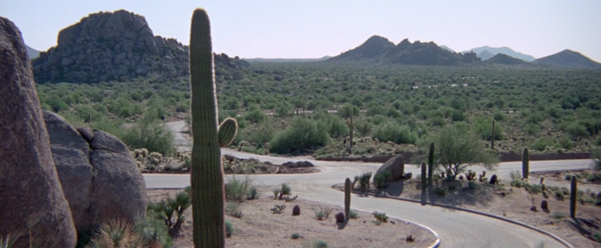
Zabriskie Point at 01.35.00

The road junction at 01:35:00 is worthy of a Graham Sutherland[xxxvii] composition. But for the grace of climate, so the bucolic hay fields of West Wales pictured below, might become the desiccated, be-cactused view shown in Zabriskie Point – in which the treacherous wilderness which encircles earlier Westerns such as Yellow Sky (1948), are now laughably ‘controlled’ by roads. Such threads of tarmac are there and yet not there. Sutherland frequently employed lanes in a similar manner, perhaps unconsciously, as more than a structural device, in an attempt to control the primeval, erupting from the past?
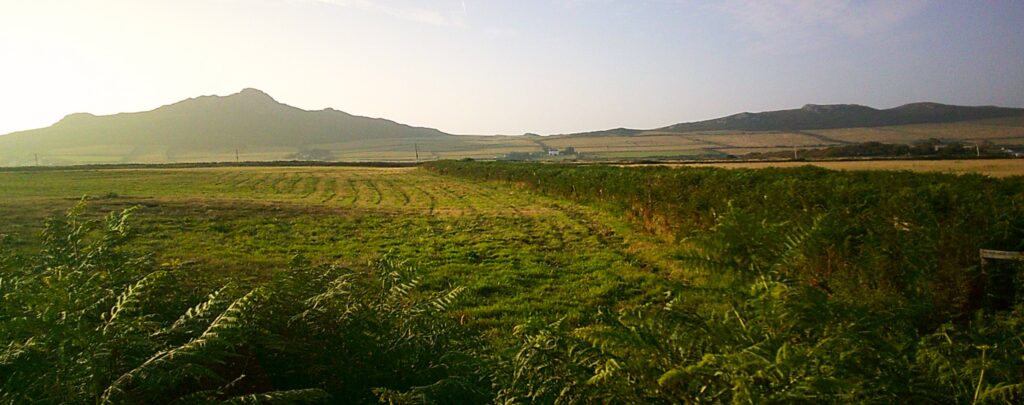
Carn Llidi, north of St. David’s, Pembrokeshire, 24 July 2025

The highly skilled but constricting etching techniques of Sutherland’s early years, were shattered, almost it seems against his will, by his discovery of Pembrokeshire in 1934. What exploded upon him in West Wales, rather than echoing the softer bucolic reality Romantically idealised by Samuel Palmer[xxxviii] – an antecedent he revered – could often be as unsettlingly prehistoric as the desert locations in Zabriskie Point[xxxix]:
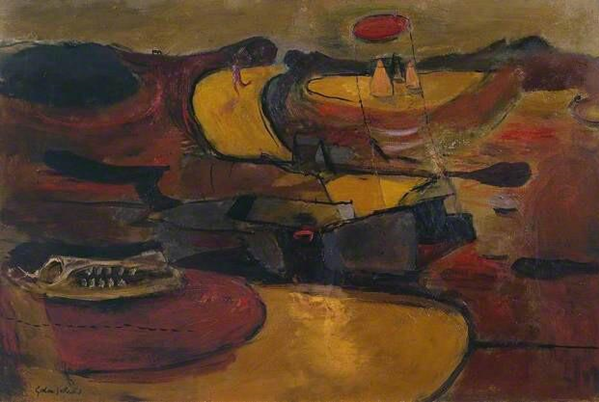
Welsh Landscape with Roads by Graham Sutherland (1936)

But while the Sunny Dunes Corporation wishes to suppress the desert, Sutherland knew he could not contain the time fracture which perhaps derailed his nature in Wales[xl]. What is the suggestion of the human figure in Welsh Landscape with Roads (1936) fleeing from or to? Is it a kind of messenger? A Hermes running from history, trying to reach the present? As Daria drives through the desert landscape, there is often a sense of time fracture, as if she crosses both a distant primordial landscape, the near past of the black and white Western, and the approaching future of the colonial crescents and closes projected by the Sunny Dales Corporation – which will only ever float upon the surface of the land. I suspect it was such a fracturing (or dismissal) of time which first struck me as a child at Leighton Buzzard sand quarries.

Back in Arizona, Daria crosses the junction and continues to the heat-struck modernist mansion, visually and psychologically cooled by artificial waterfall and swimming pool and nestled into a collection of huge boulders, as a desert overlook. Despite the human forcing required to live in such places, the landscapes themselves remain beautiful.

The Boulder Reign residence[xli] at Carefree, Arizona, was the pioneer for a real-life Sunny Dunes[xlii]. Here, relaxing by a pool (01:36:14), are housewives slightly more real than the dummies featured in the promotional film. Having parked her car aslant two spaces, as if she knows she will not be staying or as mute protest, Daria passes behind the women without being noticed, as if she is invisible, or taken for one of the servants[xliii] – who appear to be women of Native American descent . . . this Sunny Dunes acquisition being one of the final nails in the coffin of their dispossession. Inside the shadow of the red rocks[xliv], Daria pauses, then painfully reflects (01:37:02), embracing water and rock, almost taking sustenance from them, before finding the will to continue, half-wet, through the boulder corridor.
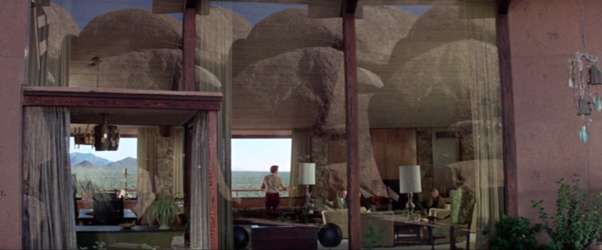
Zabriskie Point at 01:37:44

As often in Antonioni, ellipses can be long and without warning. At one moment Daria, near the film’s start, is a temporary secretary at the Sunny Dunes Corporation tower block, asking permission from an authoritarian receptionist to retrieve a book, from “the roof” (00:09:01). When we next meet her, she has gone AWOL on a road trip through the desert to Phoenix and is presumably Lee’s casual mistress? Although she finally meets Lee (Rod Taylor) at the boulder house, she never answers his questions there, and in fact, throughout the film, is only ever heard talking to him twice: at their first meeting as strangers in the Sunny Dunes office foyer scene above, and then on the phone from the bar on her desert digression. On this second occasion, concerned that if she gives away her location, he’ll send a helicopter to fetch her, she hangs up. Now, at the boulder house, she remains mute. After Lee amusedly directs her to her room, she resentfully heads downstairs. Out of his sight, half-sharing a smile with one of the servants (01:41:52), she reflects again on the situation before hurrying from the house and driving away (01:42:10). 

Although perhaps the film’s conscience resides in Daria, does she remain representative of a generational, middle-class American future? It seems unlikely she’ll object to the status quo for long, she is too sensible – and even if she rejects the exploitational upward mobility of Rod Taylor’s Lee, she will be back one day, to take her place in some Sunny Dunes or other, not so different from the women in The Stepford Wives (1975). Or am I being unduly cynical?

Boulders Resort & Spa, Scottsdale: The real Sunny Dales 50 years later.

Essence of the free spirit![xlv]

For the ending sequence [xlvi] a prop replica of the Boulder mansion was built on the back lot at Southwestern Studios in Carefree, Arizona for $100,000. The explosions (01:44:40 to 01:49:52 with a premonition at 01:43:49) are the film’s political, social and spiritual climax. Repeated over and over from different angles and distances, the explosion, simultaneously captured by 17 cameras, is reminiscent of those grim films of nuclear detonations and the effects of blast on mock-up towns and structures in the Nevada desert[xlvii] – mostly carried out approximately 70 miles to the east[xlviii] of Zabriskie Point. With explosion, blast damage and the sound of flames fading into Pink Floyd’s Come in Number 51, You’re Time is Up[xlix] this sequence remains gravely, majestically powerful. Deriding the aspirational society, at moments it can appear amusing – when you feel like raging or crying about the state of the world what else can you do but laugh? – and yet it continues to project a wish-fulfilment retribution. Embodying Mark’s rage as well as Daria’s, with the segue into music haunting and ethereal to begin with, sound and image together suggest some kind of everything. The slow-motion shots of things blown apart are reminiscent of protozoa yet often resemble late Kandinsky paintings[l] such as Sky Blue (1940)[li] and Tempered Elan (1944) . . . 

              through this collision of worlds

              and pavement chalk urges us to Be Happy XXXX

              how staunchly we must embrace hope

              to sustain the mirage of progress[lii].

The later explosions mark a sleight of hand into the abstract, into pale blue. The victims: clothes, furniture, objects of conspicuous consumption as well as food, have lost connection with their natural environments. While remaining a wish-fantasy attack on consumerism, it is more than that. It is an attack on the inadvertent society[liii] itself. The colours have changed it. It is both more humorous – the lobster, the slowly revolving chicken and Wonder bread, the books at 01:49:14 – and yet more profound. A whole library follows. We are nothing but a waste of space to the Earth. 

Music and vengeance are abruptly cut off at 01:49:52 as the scene reverts to a sunset desert silence without time or place.

We look at Daria’s face, glad, wistful, satisfied? Then, realistic, she turns away.

“Who really cares to catch the thoughts of another person’s existence, to feel their inner life? To catch the thought of them, or there, or then, instead of the habitual self-interest. To feel what they felt, you need to become possessed. After which feverish infatuation, may come a deeper empathy or identification – perhaps reviving what you once had yourself, your own lost space, your own inner time travel?…How little of what remains enigmatically important inside every individual, means to anyone else.”[liv]  

At the end[lv], is the Roy Orbison song intended to reassure or mock departing cinema audiences? Either through the existence of an alternative version of Zabriskie Point without this gratuitous element; poor memory; or having willfully wiped it from said memory, this song was unfamiliar. It mars the finality of the explosion sequence and the unearthly yet beautiful desert sunset; the sense of a peace thankful to be rid of human influence.

              Anyplace for those who care, Zabriskie Point is anywhere. . .  

I wasted a certain amount of time brooding upon why this song was here. Was its echo of the 50s deliberate? Was it an early instance of the crosscurrent texturing of irony, nostalgia and unease that both Dennis Potter and David Lynch later utilized so effectively[lvi]? Then, I discovered, apparently[lvii], that it was added by MGM during post-production. Unravelling possible influences is often conjectural, yet it is interesting to wonder whether MGM’s clumsy use of Orbison’s song over Antonioni’s sublime atmosphere, might inadvertently have influenced either Potter or Lynch . . . which thereby, thirty or fifty years later, has come to make the added ending song more acceptable to viewers? It might have been appropriate for the song to play (ironically) after a gap, over the closing titles on black, to the bang of folding seats and the muted murmur of conversation as the cinema emptied. Time runs out so fast on love too good to last . . .

But no. The song’s presence panders to the swamping mainstream tradition of embellishing or entombing everything in music. Love is space in life / A place in time a state of mind too late I find . . .

No.

Silence would be preferable.

© Lawrence Freiesleben, Heysham, May 2026

NOTES


[i]  Often referred to as The Living Corpse

[ii]  bamfstyle.com/2026/02/05/zabriskie-point-mark/

[iii] I was forcefully reminded here, of an abstract interlude in the middle of Night Mail, 1936 (from 00:12:17 to 00:12:05) imdb.com/title/tt0028030/ which despite being in black and white and possessing a strident documentary voiceover, is visually and audibly arresting in a very similar manner – its shattered sounds including a work siren or hooter, echoed by Zabriskie Point 34 years later

[iv] My review from July 2021: “After too much dancing in the first half of Flareup, everything falls apart in the second, leaving only the dramatic immolation of psycho, Alan, to galvanise it. Suffering understandable trauma throughout the film, Raquel recovers remarkably rapidly from incinerating Alan – literally burning him alive. Surely that is not why the film is called Flareup? The finale becomes dreary when, yearning for home and kids, nice-guy Joe Brodnek puts his foot down: It’s me or Mexico. Restless Raquel revs away before U-turning into a happy-ever-after. Please spare us! The best aspects of Flareup are the 60s locales, the signs and neon nightscapes – plus the bar in LA, so aptly named The Losers”

[v]  For Blow-Up, see: stridemagazine.blogspot.com/2025/12/five-films.html and internationaltimes.it/blow-up-a-london-walk-of-august-2020-and-its-consequences/

[vi] I was interested to read recently, Henry K Miller’s Shoot to Thrill, interview with Kathryn Bigelow in Sight and Sound, December 2025, Volume 35. It struck me that perhaps there was some overlap between the “inadvertent society” (an endlessly revisited old phrase of mine) and Foucault’s image/idea of the panopticon, which he defined in “Schizo-Culture” (in 1975) as a machine “in which everyone is caught, those who exercise the power as well as those who are subjected to it… Power becomes a machinery controlled by no one”

[vii] With input from other writers: Sam Shepard, Franco Rossetti, Clare Peploe and Tonino Guerra

[viii] Donald Trump – referenced in the hope that before long he will be a disgrace lost in history

[ix] Paraphrasing of stanza 15 of No Error, (2022, L W Freiesleben, unpublished)

[xi] theguardian.com/film/2014/oct/23/zabriskie-point-review-michelangelo-antonioni

[x] buzzrail.uk/about-us/ It continues to grow in popularity: livingmags.info/great-start-to-season-for-leighton-buzzard-railway/

[xii] Unlike Zabriskie Point, as a whole, Beyond the Clouds feels redundant. Perhaps this is understandable given that it was made with help from Wim Wenders after Antonioni, disabled by a stroke, was unable to speak. A blend of lesser Antonioni and lesser Wenders, the script and voiceovers, sometimes taken from Antonioni’s writings (see sensesofcinema.com/2002/great-directors/antonioni/  last paragraph) try to say important things and occasionally succeed, but despite its many beautiful images, locations, atmospheres, and actors, the film is undermined by its glib, lightweight style and perhaps by too many celebrity cameos? It’s as if everyone is kindly gathering around Antonioni for an uncensored, off-season Miss Marple adventure.

[xiii] “I believe that one moves forward driven by that vital impulse which is manifest in all things, that which originated in life, created the past and will create the future . . . while we will always remain in the present and keep on deceiving ourselves that we too change along with the world . . . whereas, I fear that we remain irreparably ourselves, as we were when we began to live.”  

[xiv] bamfstyle.com/2026/02/05/zabriskie-point-mark/  

[xv] Only the poolside furniture is recognizably connected to the house and able to have happened during the repeated detonations of the house. The open wardrobe, the surreal TV with a vase of flowers on top and attendant armchair, the outdoor fridge and food – lobster and chicken etc – the clothes, the Wonder bread, books and library shelves, all blown up against a Graham Sutherland 1950s blue sky of crucifixion: “blue skies are more powerfully horrifying.” See: etsy.com/uk/listing/1669704274/preparatory-sketch-for-christ-carrying or many of the Thorn Cross paintings and earlier studies for the Northampton Crucifixion: stmatthewsnorthampton.org.uk/art-and-history-the_crucifixion.php

[xvi] Is Hitchcock showing his age by The Birds (1963) – which feels a less modern film than Vertigo (1958)?

[xvii]  The Time Machine (1960), perhaps the film which along with The Birds, Taylor is most associated?

[xviii] I’m thinking particularly of the wobble in Yehudi Menuhin’s 1969 performance of the Violin Concerto by William Walton, with the composer himself conducting the London Symphony Orchestra. At first, I could not believe my ears: the slight but distinct wobble off-key for a second at the highest romantic climax, would surely have scotched it? I wondered if it was written into the piece or deliberate on Yehudi’s part, but could not hear it on other recordings and realised how much I missed it. It heightened the emotion – as if the violinist himself were overcome. Mind you, perhaps I should have checked it wasn’t a scratch on my L.P.! en.wikipedia.org/wiki/Violin_Concerto_(Walton)

[xix] youtube.com/watch?v=-Xic-CHInek

[xx] rogerebert.com/reviews/great-movie-vertigo-1958

[xxi] Obverse to this, at times it seems miraculous that community exists at all – that we can, for example, organize the orderly collection of rubbish . . .

[xxii] Come in under the shadow of this red rock – line 26 of T.S Eliot’s The Wasteland is most directly invoked by the moment towards the end of the film, 01:36:47, when Daria in the wasteland of the Boulder house, does literally that

[xxiii] en.wikipedia.org/wiki/Joe_90

[xxiv] en.wikipedia.org/wiki/Metro-land

[xxv] en.wikipedia.org/wiki/New_Hollywood

[xxvi] This fascinating piece is about Anna Halprin’s dance deck. Anna Halprin was Daria’s real-life mother. She died at the age of 100 in May 2021. https://flash—art.com/2020/05/anna-   halprins-dance-deck/

[xxvii] youtube.com/watch?v=AzZr_GRz6kQ

[xxviii] Daria’s friend, James Patterson, is considered to be based on Mel Lyman of the Fort Hill Community near Boston

[xxix]  https://www.imdb.com/title/tt0066601/trivia/?item=tr0772643

[xxx]  See this tragic piece: madinamerica.com/2025/09/fifty-years-of-grief/

[xxxi] maninbetweenthemoon.wordpress.com/2015/05/11/donnie-darko-and-gretchens-influence/

[xxxii] internationaltimes.it/donnie-darko-a-digression-on-universality-and-inevitable-nostalgia/

[xxxiii] Ibid: theguardian.com/film/2014/oct/23/zabriskie-point-review-michelangelo-antonioni

[xxxiv] billybobsparlour.com/diner/ 

[xxxv] youtube.com/watch?v=HZjZbJuhPAo

[xxxvi] See the Billy Liar (1963) reference and note: internationaltimes.it/things-behind-the-sun-a-digression-on-memory-trauma-and-mystery/

[xxxvii] en.wikipedia.org/wiki/Graham_Sutherland

[xxxviii] theartnewspaper.com/2016/01/08/an-unconventional-pastoralist-on-samuel-palmer

[xxxix]  How you see Sutherland’s reimagining of West Wales (or Antonioni’s films), is perhaps down to your own temperament – “with delight or with horror, as with the taste of bittersweet fruit” – a phrase the artist once used about reactions to his work in a TV documentary

[xl] Some commentators view Sutherland’s early Welsh landscapes as by far his best work – when in a sense he was carried away by the genius loci or spirit of the place

[xli] Designed by Hiram Hudson Benedict for Carl Hovgaard and situated 34 miles north of Phoenix

[xlii]  To quote an excellent article, sadly not found until I’d virtually finished: “The desert around Phoenix today is filled with one suburb after another, but what Rod Taylor glimpses from the terrace of Boulder Reign is merely a mirage, a memory of the future. Today, a brief virtual tour on Google Earth around these coordinates confirms that this location has turned into just what the Sunny Dunes company had dreamed of.”  See zabriskie+point%3a+the+metaphysical+pop+of+michelangelo+antonioni+dr.+joël+mestre-froissard

[xliii]  At 01:38:18-19 her reflection briefly merges with the older Native American woman

[xliv] Ibid – see note xxi above

[xlv] hilton.com/en/hotels/phxrsqq-boulders-resort-and-spa-scottsdale/

[xlvi] youtube.com/watch?v=bJsW6ta4X8o

[xlvii] en.wikipedia.org/wiki/Nevada_Test_Site

[xlviii]  The Nevada National Security Site (formerly the Nevada Test Site) “is located very close to Death Valley National Park, with the southern boundary of the test site situated less than 50 miles from the park”

[xlix]  A rerecording of Careful With That Axe, Eugene youtube.com/watch?v=tMpGdG27K9o

[l] internationaltimes.it/in-her-kingdom-by-the-sea-part-8/

[li] wassilykandinsky.net/work-55.php

[lii]   End of A Detour to Avoid Tragedy (2025, L W Freiesleben, unpublished)

[liii] Ibid – see note vi above

[liv] A paraphrasing from pages 41-2 of Maze End (2013, L W Freiesleben, unpublished)

[lv] According to IMDb imdb.com/title/tt0066601/trivia/?item=tr0772643 “Antonini’s original ending was a shot of an airplane sky-writing the phrase “Fuck You, America,” which was cut by MGM president Louis F. Polk.” This seems out of character, unless Antonioni did it as an (expensive) joke?

[lvi] In works such as Pennies from Heaven (TV Mini Series 1978-79) and Blue Velvet (1986)

[lvii]  With the internet, so much information is not to be trusted that I hesitate to expand on this. It appears that MGM commissioned Roy Orbison (with Mike Curb and Roger Christian) to write the song for the end credits rather than it being Antonioni’s choice. Since Orbison was under contract to MGM from 1965 to 1973, this would not presumably have been difficult. It was not included on the official soundtrack album

Small town nightmares

Twin Peaks: Fire Walk With Me (1992)
Twin Peaks: The Return (2017)

David Lynch’s Twin Peaks: Fire Walk With Me was the moment when the town of Twin Peaks was revealed to be a dark hellhole of occult mystery, sexual abuse, intrigue, murder and underhand business dealings as opposed to simply a cozy backdrop to a strange detective story involving demon possession and sexual intrigue.

Although the first two television series had some shocking episodes, particularly the reveal of the evil spirit Bob and Leland’s death, along with the final episode (produced at short notice under instruction from the TV company), viewers’ memories seemed mostly of a quirky and occasionally surreal soap opera whose characters were fuelled by coffee and doughnuts, had high libidos and were very good looking – not to mention a friendly visiting detective who was prone to visions and intuitive investigation.

It wasn’t all sweetness and light by any means, but the darkness was leavened by humour and friendship, not to mention the haunting soundtrack, but Twin Peaks: Fire Walk With Me was having none of it. Billed as a prequel, the film was also a kind of reveal of what was actually going on, ostensibly before the TV series started but allowing us to project several of the stories into that time frame as well.

Nobody, not even Agent Cooper and his fellow police force members, seemed to come out well. Everybody was conniving with somebody else, had a dodgy deal going on, and seemed complicit in prostitution, smuggling and drug running. There was a lot of looking the other way and a lot of non sequiturs and references to things we’d missed, not been shown or that Lynch felt we should know about. This included more dreams and a meet-up of demons in an upstairs room.

At the time, many of us felt cheated. My friends and I came out of the arts centre where we saw it in shocked silence. I don’t watch or like horror films, but we had just seen one that seemed to take away any pleasure we’d had whilst watching the two TV series. That seemed to be the general public and critical response, and although there was and still is a sustained discussion about Lynch’s work, and a recognition that he had done something amazing for TV, that was Twin Peaks done with.

Twenty-five years later, that turned out not to be the case. Twin Peaks: The Return was even more surreal and fragmented than the original two TV series, and although presented in 18 episodes, Lynch claimed he thought of it as one 18-hour film. Although a few storylines were continued from the 1990s, most weren’t, and the film was full of new character, including three versions of Agent Cooper, those present in one-off scenes, not to mention aliens and godlike beings and a complete blurring of reality and dream states.

In fact Twin Peaks: The Return seemed mostly a kind of return to Lynch’s Eraserhead, a disturbing and unfathomable monochrome nightmare with a deformed baby and a (literally) industrial soundtrack that highlighted Lynch’s love of photography and the fleshy paintings of Francis Bacon. It highlighted and picked up on occult connections and cultivated its own lines of influence and diversion. Whilst it offered a creation story for evil in our world (or at least, the Twin Peaks world), it also opened up an impossible number of possibilities of what was going on and why.

Interest in Twin Peaks had never really gone away, but the announcement of series 3 saw a renewed interest. Discussion forums sprang up online, a number of academic volumes were published (there would be more after The Return ended) and co-writer/director Mark Frost published two hardback volumes – The Secret History, labelled as a novel, and The Final Dossier – which sought to flesh out some of the loose ends but also act as bait for the forthcoming series.

Twin Peaks: The Return was not easy or lighthearted viewing. There were trips into space, out of time, to cities and gangland underworlds – visions, prophecies and dreams – a giant pepper-pot that was David Bowie’s character – and Audrey Horne (Sherilyn Fenn) seemingly trapped in a loveless marriage, or locked up in an asylum. There were doppelgängers, demons, a hybrid frog-insect alien, visiting bands and songwriters, and a new gang of young people forming their own romantic and sexual liaisons whilst taking new, contemporary drugs. Oh, and there was a slow-motion atomic explosion too.

And there was electricity, snaking through, by and over the land, sparking, hissing and humming. And the woodsman, an unwashed and obsessed tramp, who broadcast a poem over the radio once he had killed the DJ. No-one who hears it knows if the poem is a sacred text, a warning or a magical spell; it hypnotizes them and sends them to sleep. And there are mystical beings trying to balance and juggle good and evil, sending spirits and signs to earth to sort things out. One of the beings is the giant from Agent Cooper’s dreams in earlier series, now called the Fireman in the closing credits.  And there is the Experiment, momentarily appearing in a glass box in New York City. And, and, and…

And hundreds of walk-on parts: passers-by or passers-through, and those confined to the background. But no sign of Agent Cooper, and only tantalising glances of the town of Twin Peaks itself. Versions of Cooper are busy out in the world whilst the good/original Cooper remains trapped in the Red Room or White Lodge. Another Cooper squeezes himself through an electrical socket as a doorway from space to Earth, and comes out as a simpleton. Evil Cooper is intent on amassing a fortune and facilitating evil on the world.

The Return seems to refer to Cooper himself, since he takes most of the 18 hours to find his way back, before leaving again. He tries to undo Laura Palmer’s murder, which kicked off the whole Twin Peaks series, by finding a version of Laura and travelling back in time, forgetting all his zen ideas of acceptance and living in the moment. The version of Laura he finds (or creates) does not seem to know him or her own history, is only shocked into realisation at the end of the series, indeed the whole show, which ends with a scream.

David Lynch. Image: Wikimedia Commons

There is no resolution, although fans, critics and film buffs have used up thousands of words trying to find one, contorting ideas and scenes into ridiculously tangled cats-cradles of even more impossible narratives, story lines and time loops. Some of it, of course, makes sense: there are repetitions, similarities and repeats in the plots and filming, there are what seems to be codes and signs on the likes of stray lamp posts and campsite notice boards, and the pylons do look like owls. Nothing is what it seems, but nobody is sure what they seem to be. And nobody seems sure who they are any more either, how to get where they want to be, or why things are happening the way they are.

This time round, however, the deaths and violence, the visitations from the spirit world, the hauntings and occult leanings, all the unexplained mysteries, are once again leavened with humour and wit. Twin Peaks: The Return may not be the return we expected, and is definitely not a return to the Twin Peaks we first enjoyed visiting, but its strangeness and unknowability, its twists and turns, surprises and senseless signposts, leaven it, along with a roster of musical visits to the Roadhouse, some come-uppances and happy endings. By embracing the surreal and the senselessness of our lives and juxtaposing it with chance and the unknown, Lynch reinvented television again, just as he had 25 years earlier, producing an extended film to sit alongside his other career highlights: Eraserhead, Lost Highway and Mulholland Drive.

King and Conqueror – taking the history out of historical fiction

The dust has settled and King and Conqueror has faded away to wherever TV series go to be forgotten. Nominally based on the events leading up to the Norman Conquest, it attracted criticism for its many historical inaccuracies. The history was wrong; the changes to chronology dizzying; characterisation was preposterous; the costumes and the armour were bad; men said fuckalot and everyone and everything was permanently dirty. Some of its defenders pointed out that it was not a documentary but “historical fiction”. 

If the history was so inaccurate it can’t be called ‘historical’, the fiction was the latest instalment in a collective infantilisation of the Middle Ages. Instead of the rich strangeness of the past appearing in historical dramas, film makers insist on confusing history with fantasy while erasing the differences between past and present. By leaning on the tropes of modern film, and fantasy films in particular, they present an adolescent version of the past which is rarely as dramatic as the reality it pretends to dramatize.

There’s a probably apocryphal story about the screening of the film, Titanic. Someone in the audience started to object, loudly, because the pattern of the rivets on the ship’s hull was not historically accurate.

Every historical film brings out the Rivet Counters. Harold’s cloak is fastened incorrectly. The armour is wrong. The hairstyles are wrong. It gives people with specialised knowledge the opportunity to air their expertise. King and Conqueror has given the Rivet Counters many reasons to object. You will find their objections on YouTube.

Not all historical objections are rivet counting, and more is at stake than the lack of colour in the clothing or the preposterous attempts at ‘armour’, especially in this case because those involved with the production have repeatedly claimed their version is historically accurate.

A consulting company called SceneSpan claims on its website:

King And Conqueror.

In this project, history was the script. Brought in during early development, we advised across the script to ensure historical authenticity from the ground up: story arcs, character motivations, political dynamics, and cultural detail. Set during the Norman Conquest, the series required careful navigation of both Anglo-Saxon and Norman worldviews. Our role helped ground the drama in the lived realities of 11th-century power and identity.

[Emphasis theirs][i] 

What grounds a story in the ‘lived realities’ of the past is a question: in this place and time, would a character of this rank say this, or act in this way?[ii] The failure to consider this ruins King and Conqueror and almost every other film set in and around this period.

In the first episode characters are ignorant of their own history. When William and Matilda are arguing with the king of France, the latter scornfully suggests that only a fool would try to sail an army across the channel. It’s meant as dramatic irony, given that we all know that’s what William will do, but the historical king of France would have known armies had been sailing back and forth across the Channel and the North Sea for centuries. How else did he think Sweyn Forkbeard conquered England or the ‘Normans’ got to ‘Normandy’?

At other times characters act with no knowledge of the lived reality of their world. William rides away from the coronation on his own. He’s a Duke. In a culture where public display was essential, there should be a retinue and all the other signs and symbols of his wealth and status. He’s also a royal guest, which meant the king was responsible for his safety and would have provided guides and an escort. He had been ambushed on the way there, but apparently this doesn’t make him cautious on the return journey. How was he going to find his way to Pevensey on his own? Did the writer imagine a modern road with signposts?[iii]

The changes to chronology are dizzying. William was born in 1028. Even if he had attended the coronation (he didn’t) you can work out his age. In King and Conqueror an adult William leaves the pregnant wife he didn’t marry until the 1050s to attend the coronation in 1043, where he is introduced as the victor of Val es Dunes, a battle he didn’t fight until 1047. The events at Dover, which are being plotted at the coronation, and which will lead to Godwin being banished, happened in 1051.

If time is treated loosely, characters are melded together, their names are changed, or they are left out. The evil Earl of Mercia is called Morcar. At the time of Edward’s coronation, Leofric, was earl of Mercia. His grandson, Morcar, became earl of Northumbria when the locals rose against Tostig and deposed him in 1065. Making him earl in 1043 means the devious goings on of 1065, which potentially reveal so much about Harold’s character, have been erased[iv].

The defence against these objections, and even in the first episode there is so much more to object to, is that this is not a documentary, but historical fiction. It’s a sound defence. Some historical inaccuracies need not ruin a film, and accuracy does not guarantee a film will be entertaining.

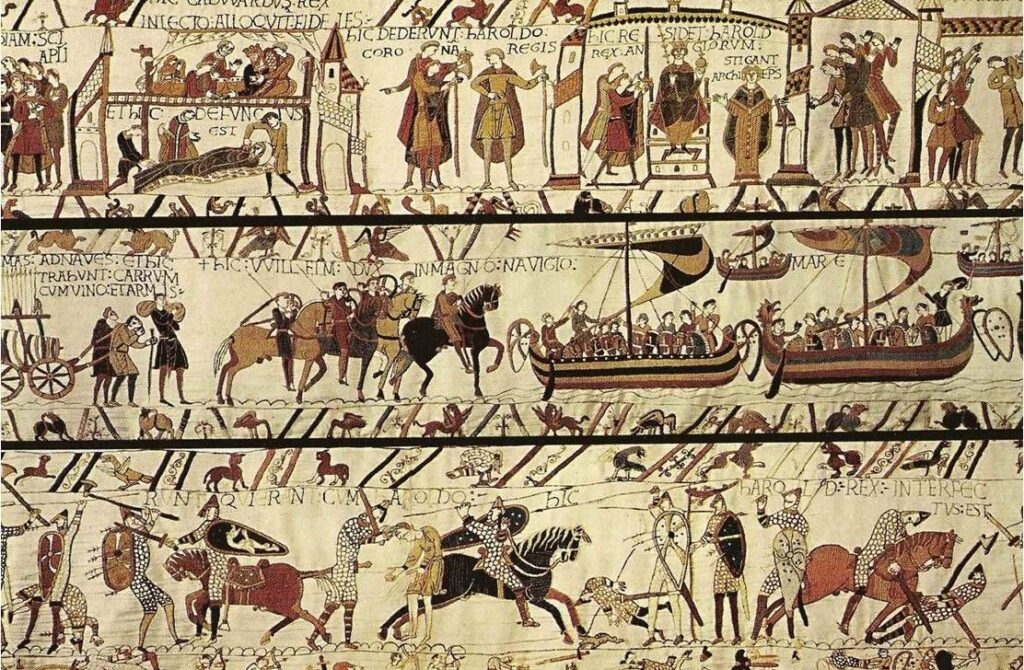
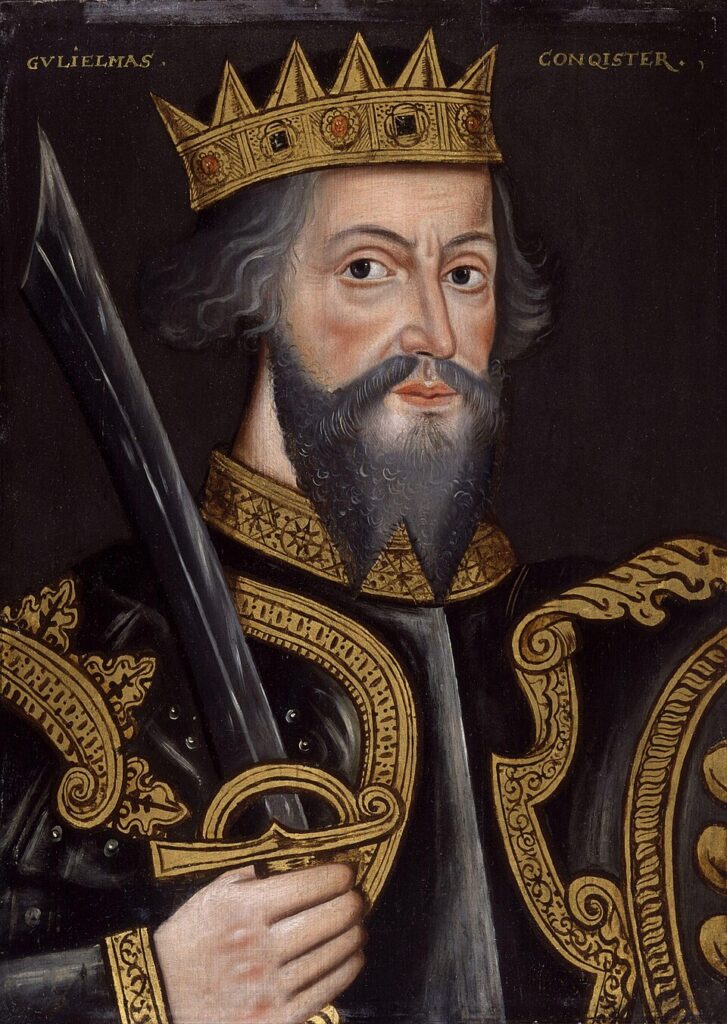
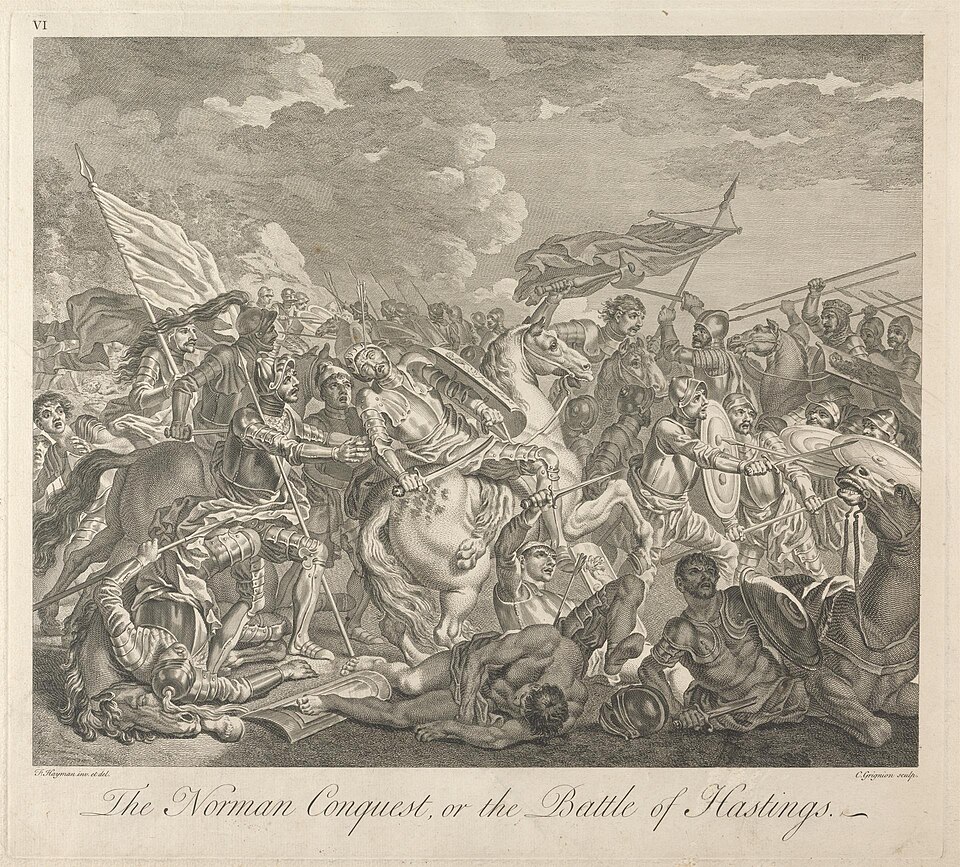
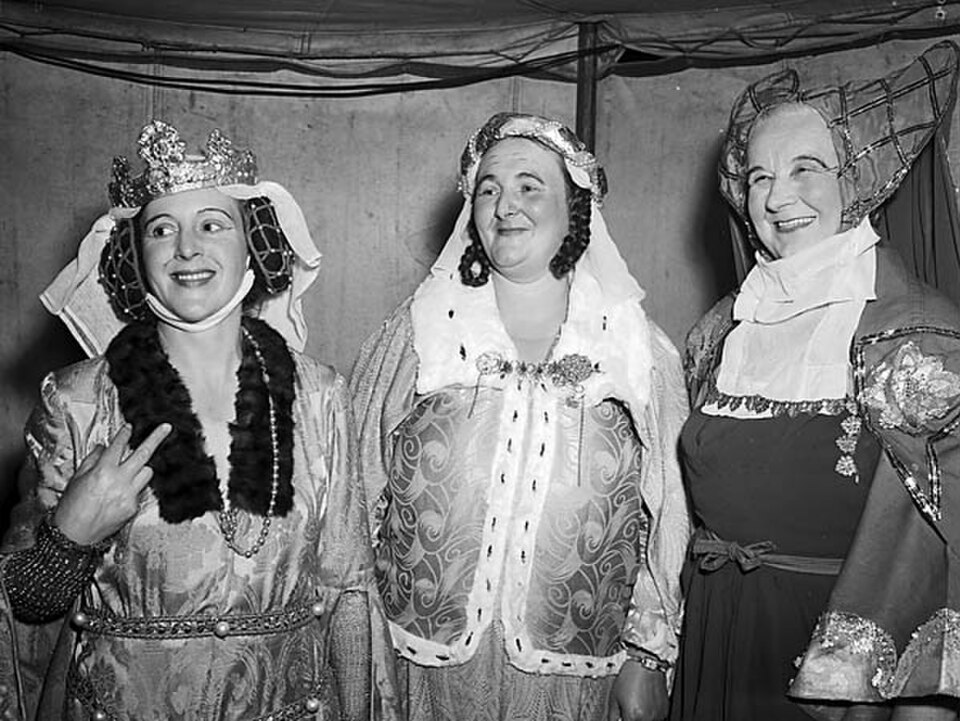
The Middle Ages have often been caricatured or infantilised. First image: William the Conqueror by an unknown artist, c. 1580. Second image: The Battle of Hastings by Francois Vivares (c. 1780). Third image: Llandaff Historical Pageant, 1952 by Geoff Charles. All: Wikimedia Commons

If you take the history out of historical fiction the characters are left flapping in the wind. In the complex context of their time, their choices and actions defined them. Remove that context and the characters are just names. Remove the history as context, and something must replace it. In King and Conqueror, the replacement is always so much less than what it replaces.

The period between the coronations of Edward the Confessor and William 1st is covered by well-written, historically accurate books aimed at a non-specialist audience. Without learning Old English, Anglo-Norman and Latin, it’s easy to stack a shelf and be up to date with the current knowledge of the time and the characters. It is depressing to think that the writer and producers of King and Conqueror didn’t bother. It is even more depressing to think that they did and then decided to throw out the history because they thought their version was better.

Godwin was banished in 1051 because of an incident in Dover. The facts are murky. Different versions of the Anglo-Saxon chronicle give slightly different versions of the events. Returning to the continent, Eustace of Boulogne and his men were involved in an altercation with the inhabitants of the town. There were deaths on both sides. Eustace seems to have raced to the king and given his version of the story. Without waiting to ask Godwin to investigate, Edward called on him, as the relevant earl, to reestablish the king’s justice by punishing the town[v].

When Godwin refused, and according to some versions demanded Eustace’s men be punished, he was called on to answer charges of treason. Turning up to court without guarantees of safe conduct, including the formal exchange of hostages, was never a good idea. Godwin was old enough to remember at least one culling of the earls. He refused to appear and called out his armed supporters. The king was expected to keep the peace and punish wrongdoing. Edward could not withdraw the order without losing face. Edward and the Witan found Godwin guilty of treason. The other earls sided with Edward. Godwin fled and his family scattered into exile. [vi]

Earls were not kings, they were the king’s appointed officers, and their job was to enforce the king’s rule. When Godwin refused the order to ravage Dover he was challenging the king’s authority. For nearly ten years he had been the most powerful man in the country. His daughter was the queen. He must have thought he was secure enough to ignore a royal order.

Why did Godwin refuse a direct order from his king: arrogant self-confidence that reveals his own bad judgement and his poor opinion of Edward? Or was he feeling his influence slide, his advice ignored, his proteges passed over and trying to assert himself? Did he have a personal dislike of Eustace, or of the ‘foreigners’ who Edward seemed to be favouring?

Was Edward overconfident? Not thinking clearly? Desperate to please a foreign relative? Was he looking for an excuse to break Godwin’s hold over him. Did he expect Godwin to protest and then back down and was taken by surprise when he didn’t?  

No ‘personal’ records survive from this period. We don’t know what the characters were thinking. The writer of historical fiction is free to explore the possibilities within the framework of the historical events. 

King and Conqueror replaces this with simplistic nonsense about Godwin being accused of ‘breaking The Treaty’. It’s clear to the audience that whatever happened in Dover was due to the machinations of the Evil Mercian Morcar and the Wicked Queen Mother. Godwin becomes the ‘Good Guy’ done over by ‘The Baddies’. It’s childish in the most derogatory sense of that term.

Fictional characters don’t have to be realistic, but they need a coherent story world in which to operate. Mangle the history, and the possibilities of coherence become increasingly small. The fashion for presenting characters in ‘the past’ as though they were modern people with the approved attitudes and fashionable responses adds to the mess[vii].

In the first episode, Sweyn has sex with a bride on her wedding night as it’s his ‘right as her lord’[viii]. His brothers are disgusted, and he has to threaten Tostig to prevent him from telling their father. Their disgust is a modern reaction. If it were his right, legal and customary (which to be clear, it wasn’t) why would they have been disgusted? They would have normalized the behaviour.

Harold promises his mistress he’ll never let his father force him into a ‘church marriage’ with anyone else. This is the romantic, individualistic modern lover of popular fiction speaking. If Harold Godwinson ever said that to Edith Swanneck, they would have both known that he was lying[ix]. 

Without the historical context, King and Conqueror settles for importing the adolescent tropes of modern fantasy. The result is fiction as bad as the history.

Emma, the queen mother, is the only woman in history to have married two kings of England and had two sons, by different fathers, who ruled the country. She survived the reigns of five kings before Edward, her son by her first marriage, was crowned. Matilda alludes to all this before William leaves for England. Yet the writers do not have Emma behave with the subtlety of a survivor and successful political operator. She is a strident pantomime witch. Harold is a tousled haired womble with daddy issues. He likes to bite noses during combat. He’s dominated by his mistress and portrayed as an untrustworthy liar. You’d think twice about following him to the pub.

The characters are juvenile, leaning heavily on the tropes of popular film. We know these are hard men because they say fuckalot. Both William and Godwin have wandered in from a film about gangland struggles for control of the neighbourhood. Godwin seems to be the last survivor of the Kray Brothers gang. And there’s the ‘Bromance’[x].

The film industry has a long record of treating the Middle Ages as a vague backdrop and mangling history in the process. In the general slop of cheap art chasing money at a time of rising historical ignorance, it would be surprising if King and Conqueror wasn’t the mess it was.

Does it matter that King and Conqueror is less true to the eleventh century than House was to a modern American Hospital?

We knew House was fiction. But King and Conqueror has been presented as history. This is not a story about fictional characters in the past. It uses the names of historical persons in a way that suggests this is a representation of those people in their specific historical setting. Publicity for the series made repeated claims for its accuracy as history.

Responding to criticisms about historical inaccuracies, James Norton, the actor who plays Harold, stated:

The truth was, they were friends. They met at the coronation, we know that William invited Harold over to Normandy to fight against the Baron of Brittany, he did swear, he acknowledged William’s rightful claim to the crown over the relics – whether he meant it or not, we don’t know. But so much of what we tell, in terms of their relationship and friendship, is true.[xi] 

It is not the truth. They were not friends. They did not meet at the coronation. They probably didn’t meet in person until 1065 when Harold was (possibly shipwrecked) on the continent [xii].We don’t know why he was on that ship but none of the suggested reasons include an invitation from William ‘to fight against the baron of Britanny’. We do know Harold was in William’s custody. We do not know what oath Harold made, if he made an oath, over relics while he was there. William had no ‘rightful claim’ to the crown of England.

Whether this is ignorance or indifference, the insidious lie, ‘This is true’, is where the damage is done. One can guarantee that there are now people who believe this is ‘the real story’ because James Norton said so, and for them an actor is a more reliable source of information than any historian. There are people who believe Clive Owen’s King Arthur revealed the identity of the real king Arthur because the film was advertised as “The untold true story that became the legend”[xiii]. No amount of fact-based refutation is going to change their minds. They saw it on the screen. 

Perhaps it’s a minority view, but King and Conqueror turns a period of unusual historical importance into a pantomime. It would be naïve to expect any film maker to treat the past with respect or have any respect for people who do. Art chasing money doesn’t have a conscience. The idea art should, or could, be responsible, seems quaintly, almost embarrassingly, old fashioned. The period between the coronations of Edward and William I is crucial in the history of the British Isles. Old fashioned as it seems, it’s possible to believe it deserves better than to be presented as a second-rate episode of Game of Thrones or Bored of the Rings without the attempted humour.


[i] https://scenespan.com/our-work/ Their emphasis in bold. The kindest thing to say about this quote is that perhaps they worked on a different King and Conqueror to the one we all watched.

[ii] To be very clear I don’t mean they should be speaking Old English or a faked version of it.

[iii] William never learnt to speak English, so he couldn’t ask for directions either.

[iv] Tostig, was unpopular as Earl of Northumbria. In October 1065, while he was away at the royal court, the locals killed his followers, and marched south. They were joined by the Mercians under their earl, Edwin (Eadwine). The Northumbrians then offered the earldom to Morcar, Edwin’s brother. King Edward wanted to call out the army and crush the rebellion. The army refused to muster. Harold acted as mediator, and Morcar became earl and Tostig was banished. The date is not known but either before or after the uprising Harold married the sister of Edwin and Morcar. Harold swore he was not involved in planning the uprising. Tostig was probably not the only person who didn’t believe him.

[v] Ravaging towns that broke the King’s peace was not unusual. Godwin, Leofric and Seward ravaged Worcester for three days under the previous king after two of the king’s men had been killed in the town.

[vi]  King and Conqueror begins by stating that England is emerging from decades of ‘bloody civil war’.  This is historically wrong. Cnut had ruled from 1016-1035, and while there was disagreement over the succession, it didn’t lead to ‘a civil war’. Despite the popular idea that medieval people went to war at the drop of hat, there is evidence to suggest that those in power in England at the time preferred to avoid armed conflict. Thismight explain why the Earls first sided with Edward, and then the ease with which Godwin was allowed to return.

[vii] For an extreme example, see ‘The King’ (2019) in which Henry V is presented as a pacifist who is shocked to discover his courtiers are making money from the war against France.

[viii] The idea of ‘Premier Noce’ or ‘Droit de seigneur’ or ‘jus primae noce’ has been shown to be a myth invented by much later writers. The historical Sweyn was banished after eloping with an Abbess and murdering his cousin.

[ix] Calling Edith his mistress is unavoidably and unintentionally derogatory. She was his wife ‘after the Danish fashion’.  This was a marriage that was not sanctioned by the church but regarded by everybody else as a marriage. It allowed aristocratic men to choose a wife, knowing that when the time came and they entered into a church marriage for political reasons, (and all aristocratic marriages were political), they would not be entering into a bigamous relationship.

[x] I dislike this term as it cheapens friendship but it’s exactly what is presented in King and Conqueror.

[xi] https://www.huffingtonpost.co.uk/entry/king-conqueror-stars-address-criticism-nikolaj-coster-waldau-james-norton_uk_68b034efe4b0bbcc3f8e4d8a For similar claims see https://www.televisual.com/news/james-norton-on-king-conqueror/

[xii] There is not only disagreement about what happened but about when it happened. Edward’s most recent biographer puts it in 1065. William’s opts for 1064.

[xiii] This phrase appeared on the poster for the film, popularising the candidature of L. Artorius Castus for the role as ‘the real king Arthur’. However, King Arthur is a good example of a film that is both entertaining and historically inaccurate.

From ‘Glorious Devon’ to Orthodox Estonia

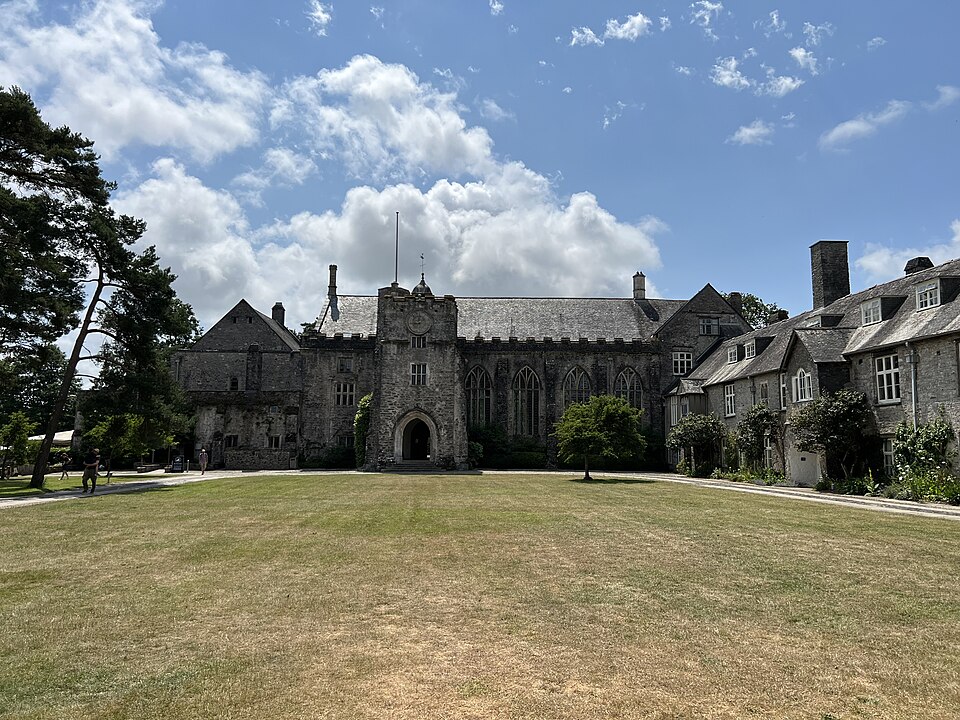
Dartington Hall. Image: Wikimedia Commons

With funding for the serious, civilised arts in short supply in modern Britain (no Arts Council of Wales money for Mid-Wales Opera; the City of Birmingham Symphony Orchestra, de-funded by Birmingham City Council) the English Music Festival – EMF – is an inspiration and hope in the face of general adversity. As one of the Festival’s regular conductors, Hilary Davan Wetton, pointed out, if this were France, the government there would be pouring hundreds of thousands of Euros into a French music festival – a contrast to our own political elite, with their freebies for Britney Spears gigs and obsessions with ‘diversity’. The nineteenth English Music gathering took place, escaping this year to that utopian, rural setting of Dartington Hall in Devon – a magnificent structure built by the first Duke of Exeter in the 14th century, and turned into a prototype agrarian and arts community in the 1920s by monied visionaries, Leonard and Dorothy Elmhirst. A College of Arts flourished here between 1961 and 2010, and traces of the Elmhirsts’ William Morris-type outlook still survive in this idyll of garden and performance spaces.

EMF Founder-Director, Em Marshall-Luck, welcomed for her late May Spring bank holiday extravaganza artists of the calibre of the London Mozart Players, the University of Exeter Chapel Choir and numerous soloists and chamber musicians, all performing in the impressive and resonant Dartington Great Hall.

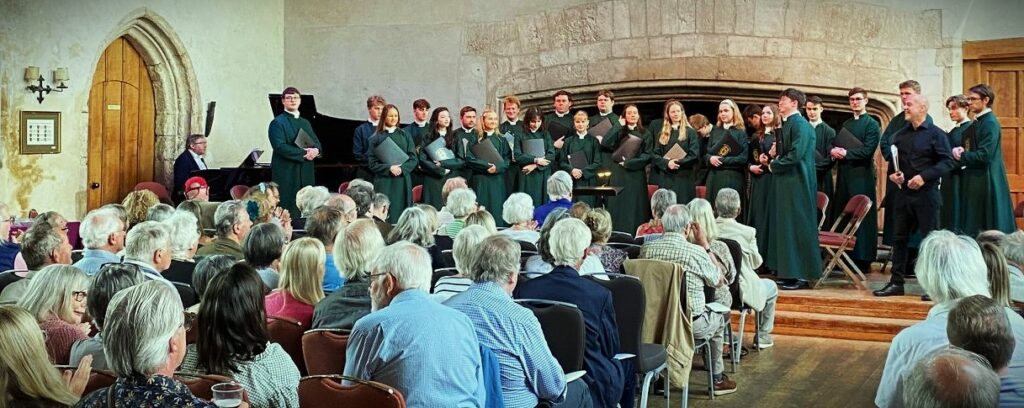
The University of Exeter Chapel Choir. Image: Stuart Millson

Saturday the 23rd May was a day of brilliant sunshine and intense heat, so Festivalgoers enjoyed the coolness of the old mediaeval building, filled as it was by the ethereal tones of the Exeter choristers in works from the 1920s and ‘30s – Vaughan Williams’s, Lord, Thou Hast Been Our Refuge (the choir used to grand antiphonal effect); Holst’s meditative The Evening Watch; Edgar Bainton’s To Thy Name Above Every Name (a testing work for the singers, and one which, perhaps, should have been conceived with orchestral accompaniment); and Dyson’s Lauds, from Three Songs of Praise. The concert ended with a dip back into the late 19th century, with Elgar’s whimsical choral postcards from old Germany – his Songs from the Bavarian Highlands, the sort of good tunes which you could almost sway along to with a brimming Stein. Elgar and his wife, Alice, clearly relished the countryside of Garmisch, and were inspired by lines such as “Quaff the bright brown ale my treasure, Hark! What joyous sounds!”

The next day, a complete change of mood, with the morning chamber recital – given by violinist, Rupert Marshall-Luck and South African pianist, Peter Cartwright – devoted to music by Bliss, Rawsthorne, Holst, Delius and Howells. Lancashire-born composer, Alan Rawsthorne, is probably best known for his film scores (including that for The Cruel Sea) and his Second Piano Concerto with its carnival-like final movement, but Rupert and Peter have rediscovered for us and curated the composer’s extensive works for violin and piano, giving at this festival the UK premiere of his Theme and Variations for Pianoforte and Violin.

Rawsthorne’s taut, concentrated, challenging writing proved to be an excellent foil to the more romantic sonata, from 1914, by Arthur Bliss – an early work, yet one which any listener, new to the piece, would consider a work of mastery and maturity. With its lovely whirlpool moments, its combination of sunlight, melancholy, nostalgia, the sonata was (for me) the outstanding work of the concert, especially the heartachingly beautiful piano opening, played with such gently paced and slow shaping by Peter Cartwright. Rupert Marshall-Luck more than embraced all the virtuoso moments of the piece, especially the exciting passage where the soloist has every opportunity to out-soar even Vaughan Williams’s famous ascending lark.

Now to recorded music: a new CDs from Chandos Records, of Shostakovich’s great Stalinist era monolith (yet with the composer confusing the totalitarians of his country with cryptic ideas and sardonic snarls) – his Symphony No. 5. Played with great tension and power by the Greater Manchester-based BBC Philharmonic – the old ‘BBC Northern Symphony Orchestra’ to we old Radio 3-ites – the recording dazzles at all levels, the players giving everything they have for the Finnish maestro, John Storgårds, a musician renowned for his readings of Sibelius and Nielsen. Here in the Shostakovich is a darkness that any Scandinavian or Russian would recognise, yet we are in the world, not of the Russian steppes or the cold Baltic coast, but the labyrinths of Moscow and the artist, enslaved but never truly at bay. For those who know their Shostakovich recordings, the new version is extraordinarily similar in temper and timbre to the early-1980s interpretation by that Russian patriot-dissident, cellist-turned-conductor, the great Rostropovich. Some may still remember the pent-up power and bare bones of the Fifth, as performed some 45 years ago by the USA Washington National Symphony Orchestra under that magisterial maestro.

Another famous conductor was Sir Thomas Beecham, founder of both the London and Royal Philharmonic orchestras. Beecham had a wide repertoire, and it is perhaps hard to pin him down: Wagner and Berlioz, and the lush, heavy tone-poems of Richard Strauss appealed to Sir Thomas; Delius, too, and Handel – and opera. But so did orchestral favourites, French ‘lollipops’, and Russian romanticism. New from Siva Oke and SOMM comes a full-blooded, orientally-shimmering account, recorded at a packed Royal Festival Hall in 1957 of Rimsky-Korsakov’s Scheherazade – an irreplaceable capturing of a style of playing which we often do not hear today; in which the orchestra heaves with turbulence and colour, and section leaders play like virtuoso soloists. Rimsky-Korsakov’s piece is a work steeped in the legends of an imagined Arabian world of magic – of a clever princess who outwits a despotic ruler, by beguiling him with stories which she tells, night after night. (One could almost see Shostakovich in a similar dilemma, using his musical powers to keep one step ahead of the hammer of doom.)

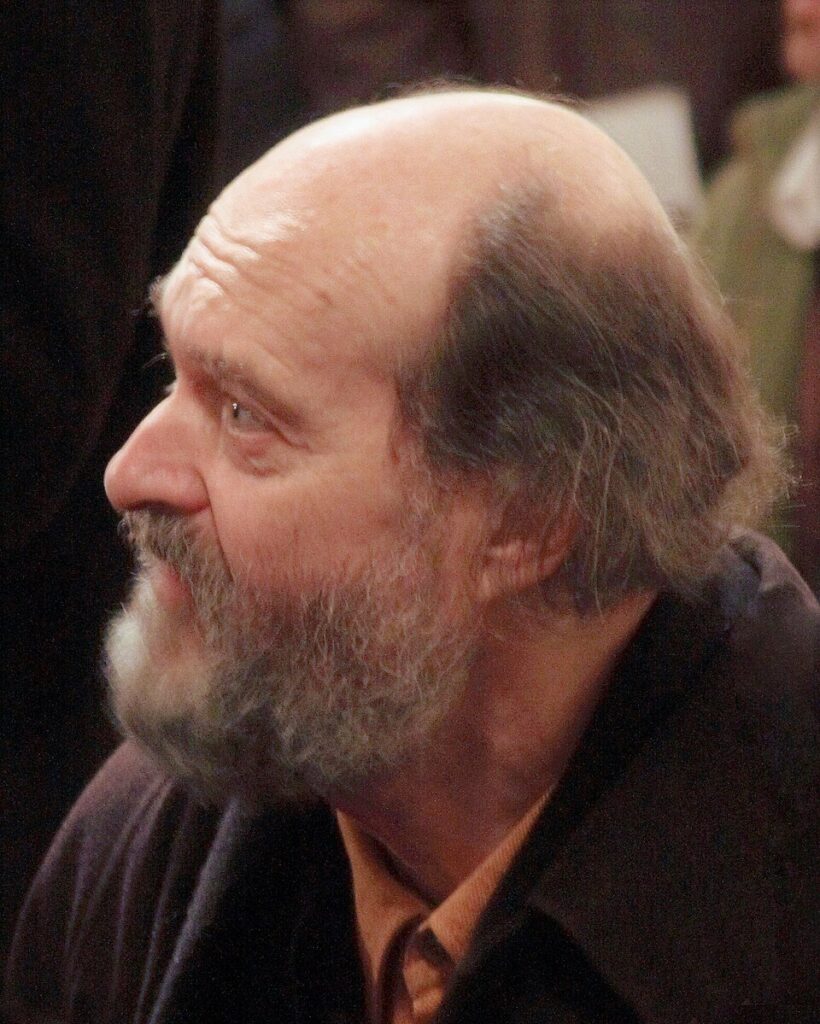
Arvo Part. Image: Woesinger, Wikimedia Commons

Finally, a return to Chandos Records and their new CD of Estonian musical magus, Arvo Pärt (born 1935) – the complete symphonies (1-4), performed by the Iceland Symphony Orchestra under Eva Ollikainen. “Worlds ahead for clarity” was a one-time sales slogan of Chandos, a choice of words which fully applies to this living-presence, revelation-of-detail recording made a year ago in Reykjavik; a presentation of a symphonic progression from the 1963 ‘Polyphonic’ – just over a quarter-of-an-hour in length, to the harp, timpani and percussion of the 2007-08 Fourth Symphony, subtitled Los Angeles – and dedicated to the Philharmonic Orchestra of that city. Essentially, Pärt’s music is concerned with the spiritual, with pure belief – orthodoxy, credo (‘Credo’ was a name of one piece from the late 1960s). In this collection, it is possible to find a rooted hope for music and for our world – every bit as reassuring as the mediaeval stonework and arches that we found earlier at Dartington Hall.

Recording details: Alan Rawsthorne, the complete works for violin and piano, and the Violin Sonata by Sir Arthur Bliss, available from EM Records, via em.marshall-luck@em-records.com; Shostakovich, Symphony No. 5 (with Second Symphony), CHSA 5378; Rimsky-Korsakov, Scheherazade, RPO, Beecham, SOMM-Beecham 34; Pärt, Complete Symphonies, CHSA 5372

Treasure island

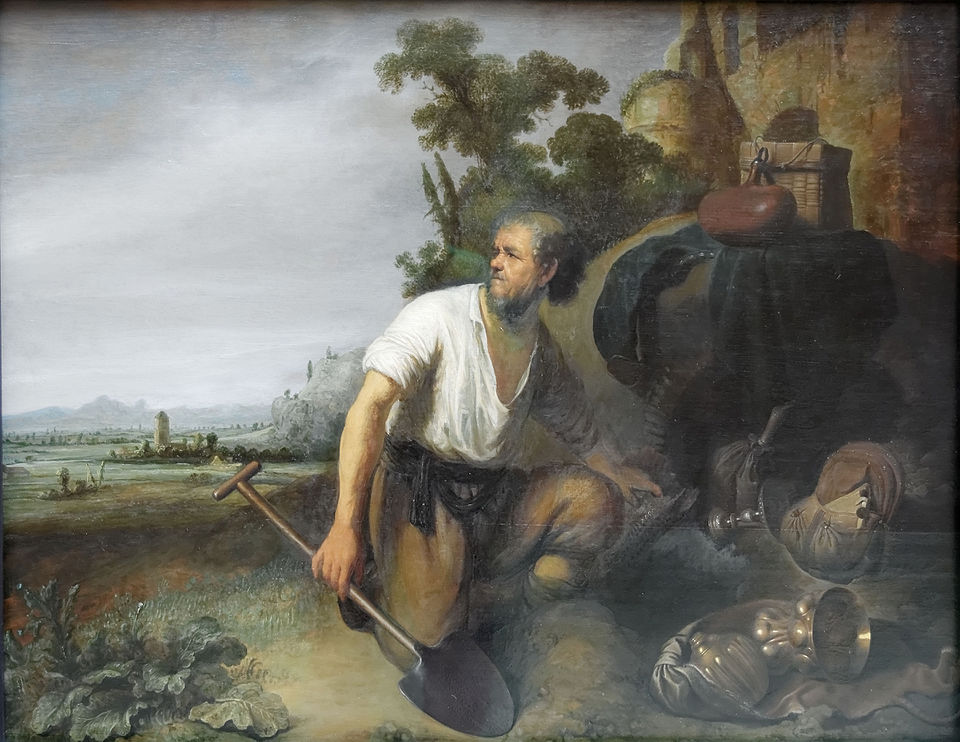
The Parable of the Hidden Treasure by Gerard Dou

Treasures on Earth – Buried Wealth in Landscape and Legend

Jeremy Harte, London: Reaktion, 2026, 292pps., £15

In his Anatomy of Melancholy, Robert Burton offers some sensible advice as one of his ‘Remedies against discontents’ – “Seek that which may be found.” Jeremy Harte’s subtle and finely written new book examines the countless Britons who have taken exactly the opposite approach.

Harte is a romantic and an indefatigable follower of tantalising trails, having written to excellent effect on the Devil in England, and the history of gypsies – and so feels empathy with the delvers and dreamers who from earliest history have hankered after treasures that are occasionally wonderfully real but much more usually imaginary. Rumours of hidden hoards speak to some of our deepest psychological requirements.

Treasure can be found, or visualised, in many places – burial mounds, castles, caves, churches, old houses, tunnels and under landmark stones. The Honours of Scotland were even concealed in a bed. Hoards have been envisioned as spectral specie guarded by demons, dragons (there are some 30 British placenames containing the root-word draca, dragon), fairies or monsters, only accessible to astrologers and ‘mystical sciencers’ – like the Elizabethan polymath John Dee, who tried to persuade the Lord High Treasurer to grant him a royal licence to hunt for caches guarded by such fearsome ‘kepars’. Traditionary treasure hunts almost always take place by night, tense events whose codified procedures are usually derailed by unnatural storms, strange lights or panic attacks, or when some searcher emits an excited oath just as the hoard hoves into view.

Hoards have also been seen as traces of vanished races, or mythologized individuals from King Arthur to the North Country bogeyman ‘Long Lankin’ – or more prosaically as the left-behind legacies of real-life despoliations and downfalls. The Dissolution of the monasteries and the Civil Wars left in their respective aftermaths countless rumours of secreted wealth, suggesting long-persisting sociocultural trauma. Buried treasures have also often been imagined in border areas, relatively plausible because of such regions’ turbulent pasts – suitably liminal locales for things themselves evanescent and uncertain.

Treasure’s potential presence in a landscape attests not just to a desire for actual wealth, but also our habit of investing hard earth with pleasant fictions. A fabulous hidden hoard can constitute a source of local pride, like the golden stag concealed somewhere near Llantwit Major which when found would allow the modest Glamorgan town to regain its early medieval eminence as Celtic Christian cultural powerhouse.

Hoards can also be symbols of non-temporal power. Treasure tales cluster in historically poorer or more remote districts, and in many of these stories ghostly guardians wishing to unburden themselves of guiltily got gains that are tying them to the earth select the virtuous poor as recipients of their eerie instructions, phantasms offering a chance of advancement in return for absolution. Treasure-tales have frequently been cautionary parables, affording moralisers agreeable opportunities to expound on the greed, gullibility or unscrupulousness of their fellow humans. Wealth has always been regarded as sniffily suspect, especially when its origins are opaque. It is hardly surprising that some troves were supposed to have been cursed. Treasure, Harte observes, “can never quite be cleansed from the blood and sweat that laid it in the ground.”

Treasures are sensationally unearthed – Mildenhall, Snettisham, Sutton Hoo – but much more often they are not, even when searched for systematically (or obsessively). This is hardly surprising, as most traditions are extremely vague, such as the Selkirkshire saying that the fabled “gowd” of Tamleuchar would be found “atween the wat grund and the dry”. Such discoveries as there have been have almost always happened accidentally.

Harte opens with one such incident in 1840, when the Cuerdale Hoard of silver was uncovered by workmen working on flood defences along the Ribble near Preston – 7,500 coins, 350 ingots and 1,000 fragments of buckles and jewellery – buried by retreating Vikings around 911, the largest early medieval hoard ever discovered in England. That part of Lancashire already had legends of buried treasure; there had been previous unsuccessful searches in and around Cuerdale (where Roman remains had been found), and there would be several more after 1840. Nearby Ribchester had famously disgorged an ornate Roman helmet in 1796 (now in the British Museum), which had seemed to bear out a local saying William Camden had recorded as long before as 1586 – “It is written upon a wall in Rome Ribchester was as rich as any town in Christendom”.

Many antiquarians saw such discoveries as suggesting that traditions about local hoards must have at least some basis in fact, although in many cases these ‘traditions’ were post-hoc confabulations. One example comes from Wales. The prehistoric gold peytral that was discovered in Mold in 1833 came from a hill whose Welsh name, Bryn-yr-Ellyllon, can be translated as ‘Hill of Goblins’, where it was said there had long been tales of golden ghosts glimpsed at night. But these traditions were not recorded until after 1833.

For obvious reasons, hoarding is usually carried out in secret, so it is difficult to see how it could lead to any tradition in the first place – whereas the excitement of finding treasure encourages people to see prefiguring patterns. If people really knew where treasure was stashed, they would almost certainly obtain it for themselves rather than talking about it to others. Almost all attempts at ostension – when traditions are subjected to tests – end in failure. Yet the allure never dims.

Treasure-hunting goes back a long way, and everywhere is fraught with contradictions. There was supposedly once a wayside stone near Damascus which bore the legend, “If you dig here, you will be sorry; if you do not dig you will be sorry also.” In Britain, there are eighth century runic inscriptions about hidden treasure in the Orkneys, and the contemporaneous Vita of Lincolnshire’s St. Guthlac records the traces of hopeful fossicks in the Fens. Gold glitters with the greatest lustre because of its scarcity. It was not used to make everyday currency – the Edward III noble, introduced in 1344, was the first relatively widely circulated gold coin – so was always associated with display, nobility, royalty and sacrality. Lost gold crowns are an especial leitmotif of lore, from King John’s crown allegedly lost in the Wash by way of the Crown of King Edward which vanished in 1649 to M R. James’s celebrated 1925 story A Warning to the Curious, about a legendary lost diadem of the Angles and its deadly custodian. Local saints were often imagined as sleeping in golden coffins, and the Holy Grail as a golden chalice. Buried gold is rarely seen as realisable riches, but more as a talisman and means of transmutation, all the brighter for being ultimately unobtainable.

For many treasure-hunters, the riches they seek often seem less important than their itch to search. Actually finding something could even prove anticlimactic. Anatomy of Melancholy to the contrary, seeking things which cannot be found may be a better ‘remedy against discontent’. As Charles R. Beard notes in his 1933 survey The Romance of Treasure Trove, “Treasure-hunting is like virtue; it is generally its own reward.” There are things hidden in the human psyche, we conclude, that surpass the wildest dreams of avarice.

This review first appeared in Country Squire, and is reproduced with permission

Three poems by Len Krisak

LEN KRISAK’s two most recent books are Magpie (original verse from Measure Press) and a complete verse translation of Dante’s Inferno, from Routledge. With work in the Hudson, Sewanee, and Southwest Reviews, he is the recipient of the Robert Penn Warren, Richard Wilbur, and Robert Frost Prizes, and a four-time champion on Jeopardy! A 3.6 pickleball player, he hopes to die a 4.0.

QUASI-EKPHRASTIC

Impastoed on the ceiling of the day,

Van Ruisdael’s clouds—and Constable’s—contend.

The war-torn firmament will not take sides;

Great cumuli must see it to the end,

Where their brute forces mean no other way:

They’re on their own, as cloud with cloud collides,

Smashing gun barrel blue against lead grey.

Two sky-scapes that have power to hurt, and may

Do some in combat, threaten us below

As well, where we live out our lives as though

This world meant either castles, long laid waste

And stabbing still at some scant scrap of blue,

Or hay-wain folk, who scorn unseemly haste

In reaping . . .  and in all that they must do.

CUCHULAIN MANQUÉ

—after a phrase stolen from Marie Ponsot

I run into the sea—no time to wade—

To snag a ball the combers carried out.

It is a warring water I invade.

You hug the safe shore; I can hear you shout

Your fear above the rollers’ roar. Invading

The invading breakers breaking in—

Their ravenous undertow, white edges braiding—

I plunge ahead. There is a game to win,

To take back what the water hasn’t earned:

The prize I play for. Rip tide wants me down.

Still, there where I have somehow never learned

The prudence needed if I’m not to drown,

The surge, though it’s an asymmetric fight,

Relents. I race back shore-ward, saved, but shaken

By mindless forces of unstinting might

That almost snared the prize they could have taken.

HIS MAGPIE SPEAKS

Across this white-scape in the morning light,

I scan the snow. There’s nothing here to eat

But shadows, blue and pink devouring white.

Where sun was, drifts have buried all the wheat.

No scuttling prey betrays a chance of meat,

And everything is far too blinding-bright.

Packed clumps of flakes weigh down the black-limbed trees,

Arthritic branches rhyming with my back.

Dead beauty: that is all this magpie sees,

Roosting atop my canted, crippled gate.

In frozen silence, I know only lack.

Sitting for Monet, how long must I wait?

Three poems by Isabel Chenot

ISABEL CHENOT has loved, memorised, and practised poetry all her remembered life. Some of her poems are collected in The Joseph Tree, available from Wiseblood Books

Great Lake 

As though we’d slipped through to a hidden room, 

we walked without our usual thoughts. 

Our fear was dying. 


A tree swept upward, an abandoned broom  

raking the quiet. Intermittently, it rained white 

birds – of whom, not one was crying.  


Dead fear can be exhumed,  

but what can rob us of that 

blue bar lying  


on its steel grey tomb – 

or of the slippered light 

on the sole sound of water flying? 

dawn, Manitowoc 

Lake birds are rowing out and turning 

  their long canoe of flight, 

perfecting air’s geometry of yearning 

  with curves of white. 


Hover and dip and swivel, gullwing, 

    ternwing; 

  pelican, drip light. 

Skim, heron. Oars of morning 

  on lakes of sight. 

The weeds were wrapped around my head 

  -Jonah 2:5 

The light exists along the edges 

of the roads we took. 

A few weeds grip the dirt 

and hold 


like weeds (we’re told) 

around a whale-shocked 

prophet’s head. Unlikely plot 

of an old book. 


On scraggle hedges 

where uncommon rains erode  

the desert 

light exists. 


And when I close 

my eyes 

gnarled, ragged roots of stars 

milk filaments of moon 


hard scimitars 

on seeds 

of sun 

and sparks 


of finespun 

nebula 

clutch havocked 

thought 


like weeds clutched Jonah. 

When I close my eyes 

a few weeds by a desert road 

clutch light. 


Some buried reason’s lode 

of sight 

in the foreswallowed 

dark. 

Correlations

IAN C SMITH’s work has been published in BBC Radio 4 Sounds, Cable Street, Griffith Review, North of Oxford, Rundelania, The Spadina Literary Review, Stand, & Westerly.  His seventh book is wonder sadness madness joy, Ginninderra (Port Adelaide).  He writes in the Gippsland Lakes area of Victoria, and on Flinders Island

Correlations

In March 1790 Bligh reaches England the same day as his letters describing the Bounty mutiny written five months earlier, Bligh aboard a Dutch vessel from the East Indies, his cannon shot news via France which seethes with its own uprising as does he with his need for vindication.

A new luminary deriving from his account of the miraculous feat of seamanship in the open launch, Bligh both seethes and basks at first. But questions soon arise suggesting all is not quite right with this talk of the town exploit, and Fletcher Christian is better connected than many in England, including Bligh. His clan numbers bishops, MPs, and university alumni, one brother a lawyer, another, a doctor.

Unable to defend himself, Fletcher of the tattooed arse constructs huts of vegetation and yard, cultivating his semi-tropical garden in a mutineers’ allotment on a little known and maddeningly more difficult to find island of the remote Pacific in residence with one of several native women and various scoundrels. Even from that distance he has allies with clout.

Rumour, gossip, abounds. We all love a mystery, each with an opinion. Nobody knows where Fletcher and his makeshift mob are, nor has heard from Bligh’s launch crew. Some scoff at the idea of so many ordered into an open boat, armed and provisioned, allowed to make their way home, however hazardous, without putting up a fight, the shame of this.

Several survivors of the incident-riddled launch odyssey are silenced, dead in the East Indies where tropical diseases scythe Europeans. Others stranded there by Bligh who couldn’t wait to be disencumbered of them are now debauched, drunken, threatening, even mutinous. Bligh writes to families of some of the original crew, expressing his feelings towards these shocked innocent people’s loved ones, whether calumnious or praiseworthy.

Fletcher’s fame, or infamy, puts Cockermouth on the map. Bounty’s voyage was financed to cultivate breadfruit as a profit-skimming basic slave diet. Political radicals sympathise with the French revolutionaries, among these the young Wordsworths in this time of a burgeoning anti-slavery movement. William attended the same school as Fletcher whose brother, Edward, shall later help the Wordsworths receive their rightful inheritance.

By 1808 when news of the discovery of the isolated Pitcairners – a tribe now with their own language – spreads, the South Pacific is well-charted. Illegally deposed as Governor of New South Wales during the Rum Rebellion after rubbing rogues the wrong way again, Bligh has nine years of life left.

In the heat of the mutiny he reminded Fletcher that he had dandled the Bligh children on his knee. His wife remaining in Lambeth where their twin sons are buried, Bligh’s married daughter deputised as his first lady in Australia. Did she captivate Sydney’s fledgling society with her childhood memory of Fletcher Christian?

Theatrical extravaganzas, prequels to future film flimflam, made much of Bligh’s dramatic days during his extraordinary life. Today, some still believe Fletcher found his way home to England, or vanished into America’s melting pot. In Hobart, anxious to clear his name again, did Bligh learn of the mutineers’ island descendants? Were these days of regret, of trembling sorrow?

Gardens of earthly delights

My Auntie Audrey used to cut the edges of her lawn with scissors. The grass was bowling green standard and a source of great pride, labour and constant concern. Her garden reflected her personality – meticulous attention to detail and a capacity to work endlessly to maintain her own high standards. I cannot remember her actually sitting in her garden, taking in the scents and views.  The esteemed editor of this magazine takes a different view. Let nature do its magnificent work whilst I lounge with a glass of something refreshing. Both approaches to gardening were to some extent on display at this year’s Chelsea Flower Show. The event has become a high societal event akin to strawberries at Wimbledon and flags at the Proms.

The best show garden this year was judged to be Sarah Eberle’s ‘On the Edge’ garden for the Council for the Protection of Rural England (see picture above). “Some of the best landscapes are where people and nature coexist in harmony…It’s about how it makes you feel. It’s almost a homecoming, an embrace, a hug.”  A central feature of this extraordinary garden is a fallen tree sculpted into the guardian figure of Gaia or Mother Nature. Her willow hair forms the top of a dry- stonewall that weaves through the copious, verdant planting. Weeds are reimagined celebrating our native flowing plants. There is a rusty corrugated tin fence suggesting a barn or tumbling warehouse where the countryside and development meet. Sarah Eberle’s guiding philosophy is for all gardeners to work with what they have. A boulder or tree stump can become a feature rather than a problem. She advises that we browse second-hand shops for weathered metal or wooden furniture. Beauty, she reminds us, can exist in the ordinary. The design encourages us to sit and ponder and do nothing.

The Tokonoma Garden

Contrast all this with the Tokonoma Garden designed by Kazuyuki Ishihara where Auntie Audrey’s scissors would definitely come in handy.  Everything is finely honed, brushed, choreographed. Everything has its defined and delicate space. It is the garden almost as a film set guided by well-defined Japanese traditions of harmony and beauty.  Weeds and corrugated iron are not welcome here. Nature has been squeezed and shaped into exquisite arrangements. The effect is stunning for very different reasons. In the CPRE garden you take off your shoes and socks and stretch out languorously. In the Tokonoma Garden you straighten your tie or adjust your fascinator. Two styles, two approaches, two designs that are different in almost every aspect in that one embraces nature and the other shapes it. 

The Garden for Every Parkinson’s Journey

There are also show gardens with an explicit narrative, a message to convey. Such as the Garden for Every Parkinson’s Journey. We will ignore the overuse of the word ‘journey’ in current human experience. This garden is wonderful. A smoothly carved handrail weaves through the planting, offering stability and sensory experience for those afflicted by Parkinson’s. Its designer, Arit Anderson, has a sister who lives with the disease.  The garden offers a safe space to relax for a moment or two away from the constant challenges of living with Parkinson’s. It is also a soothing night garden as many people with the disease have difficulty sleeping.  One can see so clearly that Arit Anderson has designed the space for her sister. It is personal, empathetic, emotional. It underlines the immense beneficial impact that our gardens can have on both our mental and physical health. This has become a common topic for discussion: our garden ‘journey’ for mental wellbeing. And whilst being sometimes overblown, it is not new. For centuries we have known that being in nature is good for us even if it is well trimmed and intensely weeded.

My own garden journey was interrupted by an overheard remark: “Well, I must say that is the neatest lady garden I have ever seen.” Gardens never fail to surprise. I was now in front of the Lady Garden Foundation show garden. The information leaflet informed me that 21 women die every day from gynaecological cancers most people cannot even name. This ‘Silent No More’ garden was designed, somewhat disappointedly, by a man, Darren Hughes. It contains five sculptures to signify the different cancers – ovarian, uterine, cervical, vaginal and vulval. It is an unashamedly propaganda garden with a clear, vital message. At first, I was a little uneasy with the idea but slowly as I took in the planting and the message, I understood. Two ladies were chatting about a hysterectomy one had and the discovery of an undiagnosed cancer. It had got people to talk although its underlying message was skipped over by the BBC in their filming of their evening show. The idea for the garden came from Lady Garden Foundation ambassador Emily Plane who was diagnosed with ovarian cancer at the age of 23 and died five years later. A highlight for me was the contrasting ideas of planting to encourage both private and group conversations. The garden will be dismantled and rebuilt across multiple sites in Jersey and Cornwall.

With an equally therapeutic ambition is the Breathing Space Garden from Asthma + Lung UK. The design of the garden by Angus Thompson draws on the Japanese aesthetic of yohaku no bi – the beauty of empty space and ma – the beauty of empty time. He was giving an impromptu talk as I arrived. The aim was to create a tranquil woodland-edge retreat to help visitors to slow down, breathe more deeply and reconnect with the restorative qualities of nature. Despite visiting on a day when 30,000 others crowded across the site, I stared at the space and felt transported to a quieter place.

That is the power of gardens. Ultimately it is not about skilled design, strong messaging, striking architecture but discovering a space where you can breathe deeply and relax profoundly. And if you are lucky enough to have Gaia carved out of a fallen tree then all the better. One hopes that given these circumstances even my industrious Auntie Audrey (who now gardens in a higher place) would put down her scissors.

All photos by Richard Dove

“The North for greatness”

Barnoldswick and nearby Yorkshire from Weets Hill by Dominic Nelson. Image: Wikimedia Commons

Lancashire: Exploring the Historic County that made the Modern World

Chris Moss, London: Old Street, 2026, hb., 364pps., £25

In his classic 1902-1904 Collecteana, folklorist Vincent Stuckey Lean cites a proverb which has since passed into cliché – “Lancashire thinks today what all England will think tomorrow”. Travel writer Chris Moss’s task in this highly personal book is to show how his home county helped make modern England – and so the wider world.

Until late medieval times, much of the future Red Rose County was remote and sparsely inhabited, its moors and uplands unsuited to agriculture, and too near Scotland for safety. In the Domesday Book, the county was referred to as merely the land “inter Ripam et Mersam” (between Ribble and Mersey), and accounted under Cheshire; it was not named until 1182. But the Dukedom of Lancaster, first created in 1351, became increasingly powerful and was ultimately merged in the Crown in 1413. There was even a folk-tradition that King Arthur had been Lancastrian, Lancashire supposedly a corruption of ‘Lancelotshire’. The combative nature of the inhabitants is suggested by an anonymous fifteenth century poem ‘The Shires’, listing the supposed characteristics of each county, which describes Lancashire as “a fair archer”.

By Tudor times, the county was increasingly integrated into the national mainstream, despite a reputation for Roman Catholic recusancy. The mother of William Camden, author of the nation-shaping 1586 chorography Britannia, came from Poulton. Alexander Nowell of Read was Dean of St Paul’s during Elizabeth’s reign – and the inventor of bottled beer! As Archbishop of Canterbury, Farnworth’s Richard Bancroft oversaw production of the King James Bible.

Michael Drayton hymned Lancashire in his 1612 loco-descriptive poem Poly-Olbion for its cattle, the “deepest mouth’d” of hunting hounds, silvery rivers, and women “who beare away the Bell” for beauty. There were seventeenth-century sayings alluding to regional power – “The North for greatness” – and cleverness – “He’s too far North for me”. The county was nevertheless rent by the Civil Wars, its north and west for the King, the rest for Parliament. The 1648 battles of Preston and Winwick were the last of the Second Civil War, and Preston would also be the locale of the last battle on English soil, during the 1715 Jacobite rebellion.

But Lancashire’s most important days began with the Industrial Revolution. Indeed, the Industrial Revolution was largely a Lancastrian creation. County inventors, speculators and visionaries yoked steam power to an array of new technologies and new thinking that would galvanise the globe, and give rise to vast questions which even now remain unanswered.

The world knows of Liverpool, Manchester, the Pendle witches, Stephenson’s Rocket, Lancashire cotton, St Helens glass, the Peterloo Massacre, Frederick Engels, the footballers of Everton, Liverpool, Manchester City and United, the Beatles and the Smiths. There was, or sometimes still is, also steel at Nelson, paint-making at Burnley, brickmaking at Accrington, wire at Warrington, beer at Blackburn, aerospace at Samlesbury (where Donald Campbell’s Bluebird K7 was constructed), submarine-building at Barrow-in-Furness, and fishing at Fleetwood. Peter Paul Roget compiled his Thesaurus at Manchester’s Portico Library.

Within the UK, Lancashire also conjures images of L. S. Lowry, Blackpool Tower, George Formby, Liverpool’s “Three Graces”, black pudding and pies, Eccles cakes, treacherous but magnificent Morecambe Bay, Coronation Street, Boys from the Blackstuff, Anthony Gormley’s Another Place, Bernard Manning, Les Dawson, Peter Kay, and a host of other bands, from Gerry and the Pacemakers to Joy Division.

It also connotes decline, division, ugliness, motorways (England’s first motorway was the Preston Bypass), harsh weather and a proverbial dourness of temperament. The author acknowledges that the county is often not conventionally beautiful, with exceptions like the Forest of Bowland, but even its least prepossessing locales “engage the mind”.

He is acutely aware of the hardness of life for many Lancastrians both during the Industrial Revolution – famously fictionalised in Hard Times – and in its wake – as documented in Orwell’s The Road to Wigan Pier. As he observes, “Lancashire was the first to turn the engines on, and the lights out.” Dickensian-style Gradgrinds, grasping though they were, at least sometimes gave back to their communities, leaving many magnificent public buildings, museums, schools, charitable bequests and a bittersweet memory of gritty civic pride. Later neoliberals merely shuttered still viable industries, hollowed out communities, and filled characterful quarters with soulless glass and steel.

Social suffering accounts for local traditions of radicalism – from seventeenth century Dissenters and Enlightenment intellectuals like Joseph Priestley via the Luddites and Chartists to the beginnings of Mass Observation (in 1930s Bolton), the first meeting of the Campaign for Homosexual Equality (in 1971, in Burnley) and contemporary anti-racism. Moss sees radicalism as a key county characteristic, although perhaps not every reader will share his admiration of the decor of Roughlees Clarion House, a country hostelry furnished with photographs of Labour MPs, copies of the Morning Star, and a banner exhorting “Workers of the World Unite”. But unlike some enthusiasts he realises the impossibility of erasing inconvenient facts (like slave-trading legacies) from cultural memory. He is open to all, but never uncritical.

The book is filled with little-known facts – such as that the American Civil War really ended on 6 November 1865, when the sole remaining Confederate Navy vessel, CSS Shenandoah, surrendered at Liverpool Pier Head. He also honours now unjustly forgotten local dialect poets. The Lancashire dialect was the first English dialect to be treated with cultural seriousness, thanks to writers like John Collier (‘Tim Bobbin’) whose 1746 comic tale View of the Lancashire Dialect, by way of Dialogue between Tummus o’ William’s o’ Margit’s o’ Roaf’s and Meary o’ Dick’s o’ Tummus o’ Peggy’s was one of the first books of its kind. Another was “the Lancashire Burns” Edwin Waugh, who sold shoes on Rochdale market and resided in a cellar, but whose 1855 Sketches of Lancashire Life and Localities impelled Thomas Carlyle to pronounce him “a man of decided mark”.

Moss greatly regrets the brutal truncation of 1974, when two-fifths of the historic county was reallocated arbitrarily to Cheshire, ‘Cumbria’, ‘Greater Manchester’ and ‘Merseyside’. The rump became a backwater, notwithstanding a richly suggestive – even sacral – heritage. Gawain sought the Green Knight in nearby Wirral Forest. An early seventeenth century sect called the Grindletonians was sure the Ark of the Covenant was hidden in Grindleton Chapel. George Fox, founder of the Quakers, climbed Pendle Hill in 1652 and was enraptured, writing in his journal: “When I was come to the Top of this Hill, I saw the Sea bordering upon Lancashire: and from the Top of this Hill the Lord let me see, in what places he had a Great People to be gathered”. The 1961 film Whistle Down the Wind, in which children mistake an escaped convict for Jesus, was shot in the Ribble valley. The ghosts of Scottish Royalists killed in 1651 have been ‘seen’ on the M6.

So long a stranger to his shire, the author ‘finally’ wanders closer to home and his heart – finding his own past amid landscape irreducibility and a septentrional poetry of placenames – Fair Snape, Goosnargh, Hail Storm Hill, Oswaldtwistle, Prickshaw Slack. He closes with conflicting feelings – “Lancashire lets me down, but I can’t compare it with anywhere else”. This is not just an overdue survey, but an unusually enquiring one – an admirable examination of an incomparably important county.

This review first appeared in Country Squire, and is reproduced with permission