Francis Bacon, by Reginald Gray. Wikimedia Commons
After/Après Francis Bacon
Alexander Adams, Bristol: Golconda Fine Art Books, 2022, 60 pages, £10. English and French (French translation by Peggy Pancini)
LIAM GUILAR follows an influential artist’s flamboyant trajectory through verse
Some years ago, the Canadian critic, Hugh Kenner, in conversation with Charles Tomlinson, lamented the disappearance of the ‘documentary tradition’ in poetry. He was referring to poetry where the verse functions primarily as a carrier of information. He was not making the false distinction between form and content, but describing a type of poetry that could be read for information the way one would read a newspaper, text book or biography. In Kenner’s view, such poetry had all but disappeared by the mid-nineteenth century, to be replaced by the egocentric poetry of the Romantics, and the poetry emptied of significant content written by those who followed. Alexander Adams’ new book, his seventh, After/Après Francis Bacon, proves the book length documentary poem is still being produced, despite its unfashionable nature.
Adams, an artist as well as a poet, takes as his subject the life of Francis Bacon (1909-1992). The poems follow the trajectory of Bacon’s life, from his early years in Ireland, via his time in Paris and London, to his death in Madrid. There is a facing page French translation by Peggy Pancini.
The book’s twenty-one numbered but untitled sections read like stills from a documentary film. The sequence begins in Ireland, appropriately with colours:
Surrounded by duns, olives, sages,
grey browns of trampled paddocks
the alcohol blue flame of asphyxia
burns with all the vignetting of unconscious
darkening and diffusing the periphery. (p.4)
Moving to London in the blitz:
Down from the ruin [Sic] ramparts
men grey with dust pass bundles
and expressionlessly scrape up
former people with their shovels. (p.14)
To Tangiers:
Sweet mint tea on the terrace,
hashish smoke wafts over.
Sea is flat as a strip of paper.
Endless warmth, dry air.
Paint dries fast but ideas come slow. (p. 34)
The writing evokes place and time, and like any biography contains snippets of social history: Paris after the Occupation; London rebuilding after the war, later a lost world of dilly boys, when homosexuality was still illegal, and where, in the saloon bar of The Grapes, ‘where men commune’:
The only woman is Marie,
behind the counter, beehive hairdo,
artificial nails, counting shillings,
menthol cigarette at the
corner of painted lips. (pp. 47/48)
The artist’s development is sketched into this trajectory. From his first excitement at seeing Picasso in Paris, which ‘broke you out of Edwardian airs/-dainty portraits, potted ferns-/and shaped you modern’ to an early exhibition where the punters, faced with ‘ostrich bodied, Buchenwald cadavers’, walked out in disgust ‘glad to be out of/their unwholesome presence’. To fame, drink, drugs, and finally death in Madrid.
The danger inherent in a poetry where information is the focus is that the writing can read like notes for a story that hasn’t been written. Details accumulate, but without context or effect and the possibilities of rhythm and sound are sacrificed. Section ten begins:
Men bending, lifting a heavy weight
Paralytic child crawling
Mastiff walking slow
Woman throwing a stick, three quarter view (p.28)
and continues like for this for the rest of the section’s mostly unpunctuated seventeen lines. It could be an exhibition catalogue, a summary of works produced, or it could be a young artist noticing the world around him, or all three. As information it is confusing; as poetry it’s flat.
Adams usually avoids this trap. His clipped declarative style keeps the story moving and creates deft images. The blank canvas is
-a mute mirror to perfect order
refuting the composite imagery
that grows so richly elsewhere.
At night, the canvas stands unchanging
like a locked door without a handle. (p.48)
The overall experience of reading After/Après Francis Bacon, is very similar to walking through a gallery hung with large pictures. Moving through them in their numbered sequence suggests they are related. However, the connections between the pictures are left unstated, and at times continuity and coherence are suggested solely by the fact that one picture follows the next.
It’s obvious that the Model Reader of this book knows as much about Francis Bacon as Adams does, and for that reader little will be obscure. Leaving aside the question whether the poems offer such a reader any new insight on Bacon’s life, what about the reader who knows nothing about Francis Bacon the artist?
It’s possible to enjoy the poems as poems. Adams provides enough information to suggest a biography. Relationships are hinted at. Names occur: Eric, Peter, George. However, there are sections where a lack of background knowledge makes the writing obscure.
Next day, the apartment was wrecked,
plaster gouged by chair leg at head height,
wine bottle dashed upon the tiles,
a canvas is rent open in a frayed V
lying on its side, cockeyed. (p.36)
Are we witnesses to a raucous drunken night or domestic abuse?
In passages like these, Adams makes no attempt to cater to the visitor to his exhibition who has strolled in out of curiosity. In section XV, if you don’t know who George was, then the seventeen lines listing some of George’s actions are just a list and the writing doesn’t make the list interesting.
George climbing a set of steps.
George cycling, double exposure
George seated on a stool
George seated on a chair, legs crossed (p.38)
However, even if, like me, a reader knew nothing about Francis Bacon before reading After/Après Francis Bacon, there is enough of his life in the poem and enough life in the poems to sustain and reward the reader’s attention. The writing, which is mostly vividly impressionistic, is guaranteed to make you want to know more about Bacon and his art.
LIAM GUILAR is Poetry Editor of The Brazen Head, and the author of several poetry collections, including the series A Man of Heart, Presentment of Englishry and The Fabled Third (Shearsman), set in post-Roman Britain. His most recent publication is a translation of the Mabinogion folk-tale How Culhwch Won Olwen (Shearsman, 2026)
ALEXANDER ADAMS is transported to a thrilling time of artistic experimentation
The Neue Galerie in New York holds one of the world’s greatest collections of German and Austrian Modernist fine and applied art. It was founded by Ronald S. Lauder and conceived of in consultation with his friend Serge Sabarsky, who owned a fine selection of the best of Austrian Expressionism, particularly by Egon Schiele. Sabarsky died in 1996, before the museum opened. When the museum opened in 2001, the intention of Lauder and team of directors and curators was to correct the bias towards French art in the historical surveys of the development of Modernism in the visual arts. Modern Worlds: Austrian and German Art, 1890-1940 is the grand catalogue of an exhibition held to celebrate the first two decades of the gallery. This review is from that catalogue.
Neue Galerie was warmly received when it opened and became highly regarded for its scholarship and the quality of its holdings. The great success of the Neue Galerie, which I have visited several times and consider an essential stop on any tour of New York museums, has made German-Austrian Modernist art now a much better understood part of art history. Among specialists, there was always an appreciation of Expressionism and Secession art, but the condensed selection of masterpieces by the very best artists, housed in a handsome beaux-arts townhouse at 1048 Fifth Avenue (built in 1914) has provided an integrated story of Modernism in Germany and the Austro-Hungarian Empire.
Modern Worlds has essays on various topics relating the fine art and applied art in the collection. One by Olaf Peters discusses Max Nordau’s book Degeneration (1892), which became (posthumously) his most influential book. We should not see those opposed to degeneracy solely as representatives of traditionalism. Many critics of decadence were liberals, who took a progressive view of society. As a social Darwinist, Nordau saw degeneracy as an aspect of evolution, which would lead to the atrophying and extinction of those urban populations which succumbed to its lure, driven by circumstance and genetics towards behaviour that would not sustain reproduction of healthy individuals. He cited art as a symptom of the degeneration of culture and genetic stock.
Nordau imagined a dramatic result as the consequence of this evolutionary process for art. In his view, art would cease to exist, since those who support it would have to make room for an increasingly rational humanity for whom art would no longer be a relevant form of expression. For Nordau, art would become an atavism, and only women and children – the more intensely emotional members of the population – would still pursue it. He favoured science over art, which he judged to be an irrational symptom of psychological illness. It had to yield to the advancing process of rationalisation.[i]
Another essay by Peters discusses the splintering of arts organisations in Germany and Austria in the Jugendstil/Secession period, as artists sought to gain more control over the selection, exhibition, publication and sale of their art works. A proliferation of artists groups ran alongside the desire to distance the avant-garde from state- and royalty-sanctioned bodies, academies and established professional organisations. Opposing approaches to ornamentation within Modernism are exemplified by architect Adolf Loos (anti-ornamentation) and Gustav Klimt (pro-ornamentation). This shows that there were very different aesthetic criteria supported by members of the avant-garde, just as we find contrary strands within reactionary and traditionalist camps. The influence of collector Karl Ernst Osthaus is appraised (his collection of Expressionist art is housed at a dedicated museum in Hagen, Westphalia).
The various displays and fairs including applied art, decorative art and diorama/installations accelerated the acceptance of Modernism into daily life, as well as high culture. The influence of the Arts & Crafts movement paved the way for patrons and creators. Wiener Werkstätte was founded in 1903 and flourished as a company that produced high-quality, expensive furnishings, clothing and housewares until 1914. The advent of war severely impaired WW’s output. Limited by material and manpower shortages, and the unwillingness of the affluent to invest in luxuries during a period of upheaval, business slowed dramatically. It was revived in the inter-war period but never regained its pre-eminence, closing in 1932. WW is remembered now often in terms of the contribution of female creators and for the influence of female customers, who generally made decisions regarding the decoration of family homes. Interestingly, no less than Adolf Loos gave a lecture called “Das Wiener Weh: Die Wiener Werkstätte” (“The Viennese Woe: Wiener Werkstätte”) in 1927, condemning the decline of WW. The turn to super-luxury goods was attributed to the women who dominated the management and product design of WW in the post-1914 era.
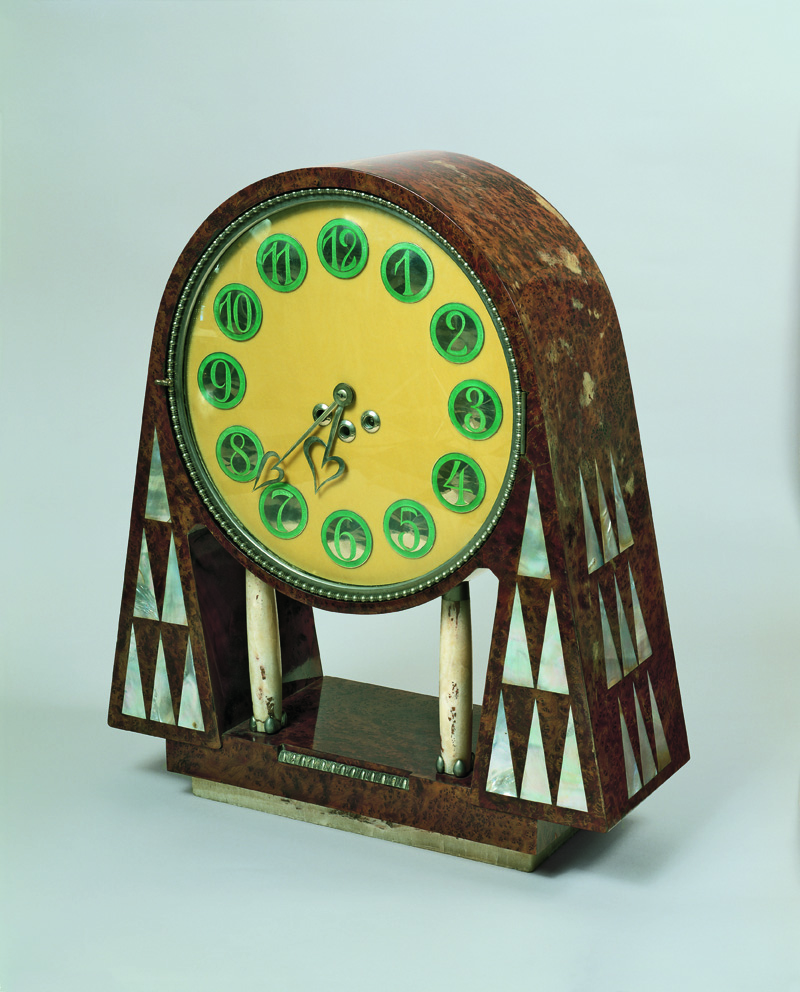
JOSEPH URBAN (1872-1933). Mantelpiece clock for Paul Hopfner Restaurant, 1906. Private collection
The excellent collection of WW in the museum’s collection – surely the best collection outside Vienna – includes works by leading lights of the company. The extensiveness of the Vienna design scene is amply represented by a series of striking designs of silverware, glassware, furniture, clocks, jewellery and ceramics by Dagobert Peche, Josef Hoffmann, Koloman Moser, (Belgian) Henry van de Velde and others. The designs range from the refreshingly simple and starkly unornamented to the ostentatiously impractical. Hoffmann’s cutlery services go beyond function into objets d’art. Geometrical patterns, plain checks, straight lines and elongated or square proportions are constants. Lines that echo Art Nouveau are found mainly in early, pre-war pieces. There is a silver coffer given by Klimt to the young Alma Schindler (later Mahler), when he was courting the young beauty in 1902. Another gift from Klimt is a necklace given to Emilie Flöge the following year. Both were made by Moser. Vintage photographs of other pieces in the collection show the furniture in trade shows or the homes of the original owners.
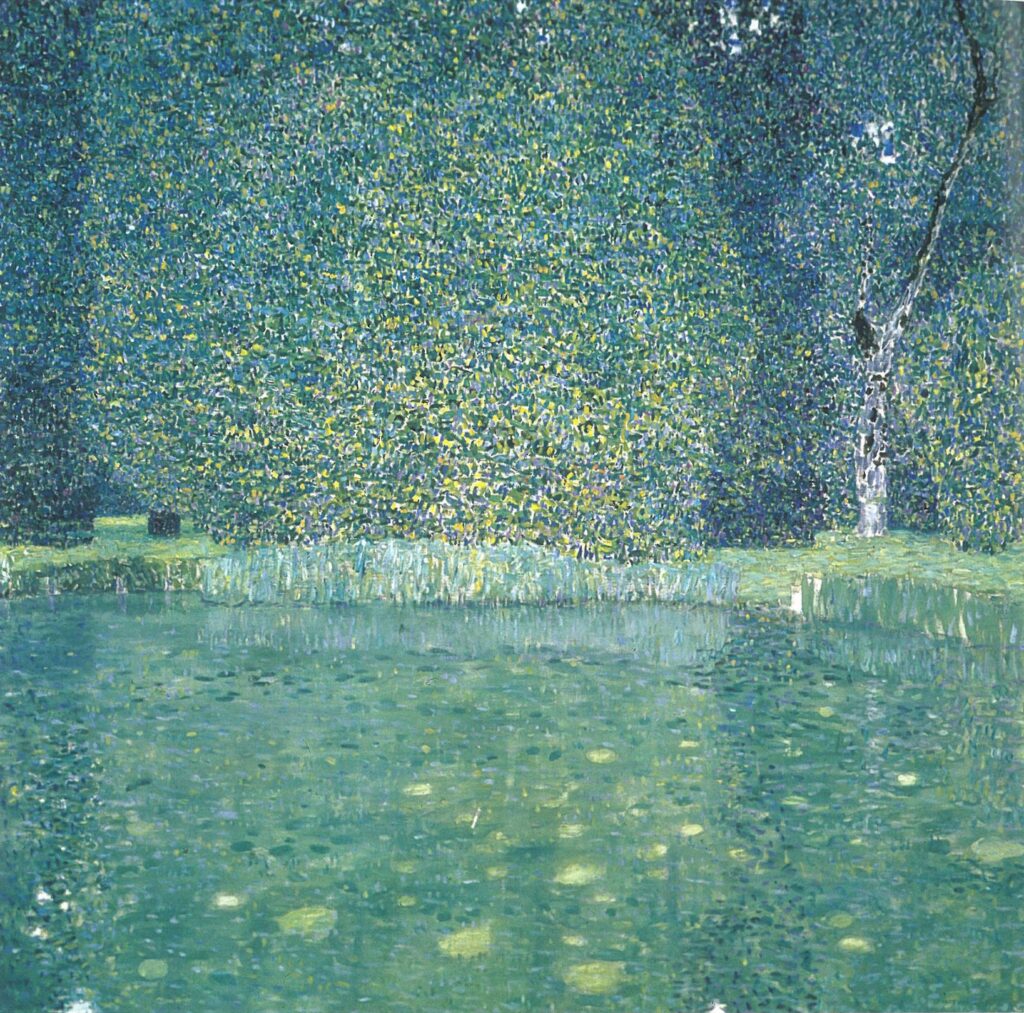
One photograph shows the star of the museum’s collection, Klimt’s gilded Portrait of Adele Bloch-Bauer I (1907). The painting was displayed at an exhibition of art and crafts in Mannheim in 1907, and appears to show the painting before the artist made minor modifications to it. The painting is once again displayed flanked by stone statues of kneeling youths made by George Minne, as it was in that Mannheim display. (There is a useful essay on Minne and the Germanic sculptors as precursors to the individualism of Schiele and Kokoschka’s art.) The Neue Galerie has a fine collection of Klimt drawings from all periods of the artist’s output. The square landscapes of Klimt are revolutionary. Not only is the square format (developed by Klimt in the 1890s) anti-traditional, Klimt’s flatness and decorative treatment of foliage was a radical departure from convention. Park at Kammer Castle (1909) is a typical late landscape, disorienting through the presentation of dappled surfaces that only minimally model trees, grass and water; sky is reduced to a few patches at the edges of the picture.
GUSTAV KLIMT (1862–1918), Park at Kammer Castle, 1909. Oil on canvas. Neue Galerie New York. This work is part of the collection of Estée Lauder and was made available through the generosity of Estée Lauder
The rise of Expressionism is understandable as a reaction against the emphasis on style over substance present in the Secession. The preoccupation with distinctive visual branding – something that reached a high pitch with the opening of WW – and the targeting of the super-affluent by artists (who supposedly disdained the status-conscious administrators and participants of established salons and academies) became anathema to ambitious young artists. The prevarication of the Secession between serving the wealthy and wanting to change the lives of everyday people left little space for the emergence of the exceptional individual – the much-discussed Übermensch of Nietzsche – and the man of heroic will. What was the role of the genius under Secession? Neither designing clothing for rich heiresses nor chairs for factory refectories seemed the calling of the true artist. The development of Art Nouveau in Germany and Austria was just one manifestation with a relentless drive towards Modernist ways of living.
This development was flanked by the Lebensreform (life reform) movement, which along with the housing colony and garden city movement, the land reform movement, vegetarianism, the naturopathy movement, and the Freikörperkultur (free body culture) or nudist movement, was aimed less at the sphere of aesthetics than at everyday lifestyle. Taken together, they formulated a fundamental critique of the scarcely controllable consequences of the rapid industrialization of the German Empire in the last three decades of the nineteenth century.[ii]
In the face of the deracinating effect of modern urban life – identified by nascent social science and criminology – and the increasing artificiality and superficiality of Secession, young artists who formed the Expressionists sought authenticity and rawness. They were inspired by Edvard Munch, whose 1892 exhibition in Berlin was closed as an affront to the professionalism of the artists’ organisation that staged the exhibition. The artists association Brücke (“bridge”) was founded on 7 June 1905 in Dresden, comprising Fritz Bleyl, Erich Heckel, Karl Schmidt-Rottluff and Ernst Ludwig Kirchner. It later included Emil Nolde, Max Pechstein and Otto Mueller. The artists (some of them architecture students) were committed to make an art free of pretension and artifice. Their idols included Munch, Gauguin, Dostoevsky, Freud, Ibsen, Strindberg, Wedekind and Nietzsche. Bearing this in mind, it is not surprising that exponents of Expressionism later found points of commonality with National Socialism. The admiration was reciprocated by some senior Nazis. However, it was the supporters of traditionalism among the Nazis who won out, consigning Expressionism to the category of entartete Kunst (“degenerate art”) when it came to the selection of official art styles after 1933.
Brücke was dissolved in Berlin in 1913. Blaue Reiter (“blue rider”) functioned as a Munich-based avant-garde group from 1911 to 1914. The Great War shattered the utopian aspirations of these artists; in some cases, the artists were killed in combat. We find in the Neue Galerie collection the proto-abstraction of Franz Marc and the cross-over art of Vasily Kandinsky of the 1910-3, which blends symbolism and abstraction. Blaue Reiter is discussed in the light of theosophy and spiritualism, which would become a lesser-considered strand of art teaching in the Bauhaus, particularly under Johannes Itten. An essay assesses the responses of artists to the Great War. These varied greatly, ranging from absolute pacifism to militaristic chauvinism. The post-war art of George Grosz and Otto Dix blends fierce satire with a seeming appetite for degradation; the impact of their work comes from that combination, which betrays a crucial ambiguity. As more perceptive critics of the time noted, an artist could not lavish so much care and time on art that was wholly condemnatory.
EGON SCHIELE (1890–1918), Stein on the Danube, Seen from the South (Large), 1913. Oil on canvas. Neue Galerie New York. This work is part of the collection of Estée Lauder and was made available through the generosity of Estée Lauder. Photo: Hulya Kolabas for Neue Galerie New York
Austrian Expressionism – in its best in Schiele, Oskar Kokoschka and Richard Gerstl, all of whom are represented by good examples – are marked by their engagement with the psychology of the subject rather than meditations on urban life or the condition of primitive man. There are few extant paintings by Gerstl, because Gerstl destroyed most of his paintings and drawings before committing suicide. The Neue Galerie owns four canvases by Gerstl, two of which (a self-portrait and a portrait of a seated man) are very fine pieces. We should mourn the loss of an artist, at the age of 25, capable of such work. The multiple nails in the coffin of German Expressionism were the advent of Dada, Neue Sachlichkeit and the scientific abstraction of the Bauhaus. Dada and photo-montage is represented in less depth than other movements in the collection.
It is instructive to compare WW designs with those of the Bauhaus, founded in Germany in 1919. Bauhaus extended the line of stark Modernism but without the influence of Art Nouveau, substituting the influence of strong unmodulated colour forms found in De Stijl abstract art. Bauhaus sacrificed functionality for style sometimes. The seats are often cruelly uncompromising for the human anatomy. Although the director Walter Gropius sought to fuse architecture, fine art and applied art – including clothing – in a manner that would be harmonious and pleasing, the Bauhaus never managed to balance its stated aims. The subsequent director, Hannes Meyer, deliberately steered the Bauhaus towards a more overtly socialist end, citing “the needs of the people rather than the requirements of luxury”. Meyer later moved to the USSR to teach, putting his socialist views into practice.
There are chapters covering Expressionist cinema, photo-montage, Klee teaching at the Bauhaus, the decline of artistic freedom in Germany and persecution of artists under the Nazis. This last includes the story of Felix Nussbaum, which is becoming better known over recent decades. Nussbaum was an artist of the Neue Sachlichkeit movement, who was imprisoned in France as an enemy alien in 1939. He later left the camp and went into hiding in Brussels, but he was ultimately captured by the occupying Germans and sent to a death camp. His wartime art portrays the artist in the French camp and gives an idea of what Jewish artists might have painted in the concentration camps, had they had access to materials.
The collection is wonderful but incomplete. Without the work of some traditionalist, National Socialist and Communist artists, we get an uneven view of art of Germany and Austria from 1890 to 1940, even of Modernism. Art of National Socialism and (pre-war) Communism were reactions against Jugendstil and Weimar-era Modernism. The Neue Galerie is a private collection and therefore subject only to the taste of the owner, who determines what is part of his conception of this history, but the story of Germanic Modernism cannot be properly understood without the inclusion of art that has hitherto been dismissed, seemingly without due aesthetic and historical consideration.
Preconceptions surface in the catalogue essays, mainly to do with the politics of today being applied to a period now a century past. The translation of völkisch as “racist-populist” is not accurate; it means “of the people or kinfolk”. Affinity for the company or culture of one’s own race does not necessarily imply sentiments of racial superiority, contrary to the translator’s assertion. Berating of individuals for sexism (as found in the essays by Janis Staggs) is unhelpful. The history of the operation and circumstances of WW and Bauhaus do have a sex dimension, but Staggs is not the author to apply a dispassionate eye.
Modern Worlds is an excellent, serious and lavishly illustrated survey of Modernism in Germany and Austria, forming an ideal counterbalance to art histories that prioritise the French lineage of the Impressionism-Pointillism-Fauvism-Cubism line. This book is a fitting tribute to the vision and commitment of Ronald S. Lauder (and Serge Sabarsky) and provides a fascinating slice of cultural history.
ALEXANDER ADAMS is an artist, art critic, novelist and poet. His most recent book is Artivism: The Battle for Museums in the Era of Postmodernism (Societas/Imprint Academic, 2022)
John Wyndham, three vols. (Day of the Triffids, The Midwich Cuckoos, The Chrysalids), Folio Society, 2022, 704 pps, £125
ALEXANDER ADAMS finds 1950s classics have troublingly modern messages
The publication of a clothbound boxset containing the classic novels Day of the Triffids, The Midwich Cuckoos and The Chrysalids by John Wyndham (1903-1969) by the Folio Society, prompts the question, ‘How much is Wyndham a man of his time?’ In this review, we will look at the novels, these illustrated editions and how much 1950s England influenced these stories.
Wyndham had a difficult childhood. His parents were involved in a high-profile divorce case, at a time when divorces were rare, and must have been aware of the consequent press coverage. The family moved around the country, and the young Wyndham attended a number of schools, including the famously progressive Bedales School. He had a number of different professions before deciding to pursue fiction writing. While he had some success as a writer of science fiction and pastiching American detective stories during the inter-war era, he did not seem to have found his metier. Although he did not know it at the time, his background and writing had set him up for spectacular success in the post-war period.
It was the catalyst of the war which seemed to bring Wyndham new introspection and a wider view of human nature. He was attached to a corps which saw heavy fighting in the advances through western Germany. Seeing the effects of wartime barbarity first hand – and the related crimes, atrocities, despair and vengeance – gave his vivid thoughts immediacy. Seeing exceptional events occurring in ordinary towns and houses, and the tide of history demolishing the certainties that complacent lives generate, meant the clichés of science fiction and crime noire (however clever) no longer seemed adequate.
The result of this transformed – or perhaps condensed – outlook led to Day of the Triffids (1951), the first book in this set. It is set in an alternative 1951, where a bio-engineered plant has become cultivated across the world for its rich oil. This ‘triffid’ plant can eat meat, stings animals, and can walk. Possessing a rudimentary form of intelligence, this plant is kept under control by docking the stings in ornamental individual plants or by penning undocked crop plants. In this alternative timeline, weaponised satellites orbit the Earth. A shower of meteors arrives, or an accident triggers weapons satellites; whichever it is, the result is that lights in the night sky blind almost the entire human population. Survivors have to struggle against gang warfare, disease, starvation and the threat of the triffids, which come to dominate the land.
In Triffids, Wyndham’s interests and skills form a glorious combination in his most successful and popular book. His progressive schooling and multiple careers gave him insight into the problems of farming and food supply; his wartime experiences sharpened his imagery of social breakdown and casual brutality. Wyndham’s sci-fi-writing origins allowed him to think through the plot; his experience of writing detective thrillers gave his prose a clipped asperity and punchy impact. He wrote strong characters and a compelling plot, yet Triffids is actually more of a novel-of-ideas than it seems. The excitement of the plot, believability of the characters and emotional appeal of the situations combined to make Triffids an ideas book that gets readers to think about issues organically, as we see characters deliberating options or forced to live out the consequences of their circumstances. Added to which, the astonishing imagery and haunting atmosphere make Triffids one of the best novels of the century. It far transcends science fiction, thrillers, dystopias and sociologically oriented examinations of the human condition and – I would say – functions as literature of the highest level. For the issues-driven, it includes discussion of environmentalism, disarmament, geo-politics, ethics and self-sufficiency. It has elements of thriller, romance, dystopia and social commentary, blended in a manner that is seamless.
Well, almost. There is a single chapter that is devoted to the backstory of the development of the triffids, which, while necessary, is rather dry on first reading. It is an obligatory exposition dump. On subsequent readings, it answers some of thoughts of readers now familiar with the titular antagonists of humanity. This chapter is the creakiest in terms of prose. Palanguez, the South American intermediary who smuggles triffid seeds from their point of origin in USSR laboratories, has a ‘sleek, dark head’ and addresses his interlocutor as ‘señor’. Wyndham’s pulp-fiction apprenticeship shows through a little. We have to sit through a bit of global politics, which is something that mars Wyndham’s follow-up novel The Kraken Wakes (1953 – not included in this set). However, if you can make it through chapter 2, the rest of Triffids is a terrific read – gripping, memorable, moving, thought-provoking. The contemporary film version was a wretched traducement, as was an embarrassingly updated 2009 television mini-series. A television version, co-produced by BBC Television in 1981, is excellent and well worth seeking out.
Wisely, for its new edition, Folio Society commissioned illustrations by Patrick Leger that are firmly in the 1950s style. The limited colours, bold blocking and strong line work all point back to the classic illustrations of comics and pulp fiction from the 1920s-1950s era. The speckling and deliberately loose registration imitate the printing of the time. Leger brings a cinematic eye to scenes, viewing protagonist Bill and young Susan from an aerial viewpoint. My favourite is the view of Bill in his hospital bed, with a swatch of sunlight illuminating his sheets. Folio Society, because it markets directly, rather than through bookshops, does not have to put text on its cover to inform browsers. This gives Folio Society designers a freer hand than otherwise. (Producing volumes for a boxset also allows book covers to remain text free.) Leger has illustrated all three books, including the covers.
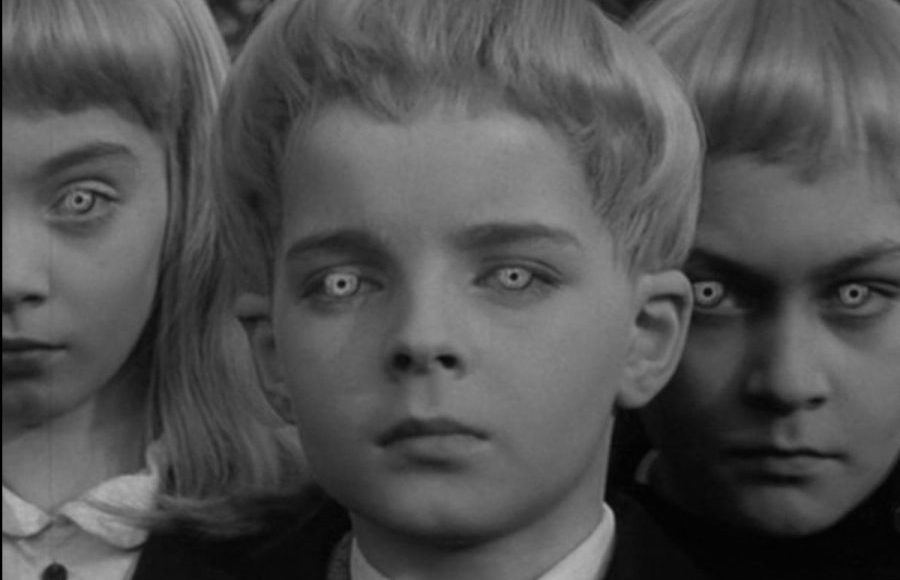
Like Triffids, The Midwich Cuckoos (1957) is infused with Cold War anxiety. Midwich, a village in southern England (based on Midhurst, Sussex), is suddenly isolated by an inexplicable forcefield and the residents rendered unconscious. When the barrier is lifted and people revive, they soon discover that all the women are pregnant. The human-seeming babies turn out to be uncanny cuckoos, planted into the wombs of women by aliens. Once born, the cuckoo children develop fast, act in a disciplined collaborative way and have powers of telepathy and limited mind control. This makes them an inscrutable and dangerous enemy. The hosts find themselves being held hostage by the parasite children, who threaten to grow strong enough to destroy the community that (warily and fearfully) cares for them.
Wisely, Wyndham does not dilute his story by introducing the aliens as other than prime movers. He has no interest in aliens. The science-fiction premise is merely a device to allow Wyndham to explore how communities (and civilisations) respond to the knowledge that they have in their midst forces that wish to supplant them and that are ruthless. From inter-species rivalry, Wyndham has moved to in-species rivalry. Of course, what must have been obvious to more observant readers of the time, was how this was an allegory for Communist infiltration of the West. The Midwich cuckoo-children, like Communists, form a tightly knit group working in concert to overturn the current order and advance to the next level of development, using any means necessary to overcome opposition. What seems so troublingly prescient, is how this scenario could act as a parable of multiculturalism. When a foreign group cannot be integrated, conflict for resources and status arises. If the organised minority overcomes the disorganised majority – as Mosca’s Law tells us – the numerical inferiority of the foreigners is no bar to them consolidating themselves and even coming to rule the hosts. So, while Midwich may seem dated sci-fi tosh set in a rural England of the past – Brian Aldiss will be forever remembered as the writer who damned Wyndham’s novels as ‘cosy catastrophes’ – it is actually a novel of ideas that is vitally relevant in a multicultural society facing a crossroads.
Likewise, The Chrysalids (1957) gives us another brilliant novel with exciting action, suspense and vividly drawn characters in a unique world, and one with a deeply troubling ethical conundrum. Chrysalids is a coming-of-age story set in a post-nuclear-war rural community in Canada, where millenarian Christianity holds sway. The society is obsessed by genetic stability, considering it a moral issue, which they police by destroying produce and animals if they genetically deviate from the norm, and exiling abnormal children. David, the protagonist, becomes aware that he has the power of telepathy. Living in fear that his psychic deviancy will come to light and lead to his expulsion, David forms a bond with the few other children of his age who also have this rare power. Eventually discovered, David and his friends have to flee into the wilderness to escape torture and (potentially) sacrifice.
Perhaps inadvertently on the author’s part, Chrysalids presents us with a question that is even more pointed than the one in Midwich: How far would you go to preserve your values and culture? What would you do if your children joined an extremist political group, or converted to a radical religion? Would you exile (even kill) relatives or your own children, knowing that if you did not, their values would supplant your own? I cannot think of any novels of ideas that are more pertinent today. Engaging with the novel’s issues honestly will result in readers doing some painful self-assessment about his/her limitations and the robustness of his/her values.
Wyndham, like every author, wrote in and of his time. In Triffids, a character drains the petrol from a car’s reserve tank. I don’t think I have ever travelled in a car with a reserve tank, although the concept is decipherable enough from the name. Perhaps the youngest of readers might need a reminder of what a corkscrew is; the idea of vacuum-packed cigarettes is rather neat, although today’s cellophane wrappers perform an inferior but cheaper alternative.
The language and social mores are of their time – which is a strong recommendation to readers of today – and this is particularly so in Triffids. When Wyndham presents the debates between pragmatists and Christians about whether or not sighted men should have multiple blind wives (who could give birth to seeing children), we encounter a slice of 1950s Britain, the last time Christian traditionalism had social hegemony. Today, I suppose many people would consider the matter merely one of avoiding partner jealousy rather than the breaching of a moral commandment.
The illustrations have a strong period flavour, with clothes, interiors and vehicles in Triffids and Midwich being contemporary with the period within which they were written. The retro quality of the illustration style suits the texts. If I had to venture one minor reservation about the illustrations in the Folio Society Wyndham boxset, it is that Leger tends to place us close to the actions, with main figures reaching the page edges. That means we are immersed in an event depicted, rather than viewing a scene at a distance. We are inside a motif, rather than outside a picture. This has some advantages – immediacy, engagement, impact, energy – but also reduces detached artistry, complex composition and contemplative reserve. On balance, it is well that Leger remains stylistically consistent within each volume and across the set.
Designers have taken care to co-ordinate the cover colours with the front and end-papers. The production quality is high and the margins and bindings make reading easy. This boxset with pictorial slipcase and hardback books with cloth spines (a reissue of the editions originally published in 2010) is a handsome set, and an ideal way to enjoy key novels of one of the greatest post-war British novelists.
ALEXANDER ADAMS is an artist, art critic, novelist and poet. His most recent book is Artivism: The Battle for Museums in the Era of Postmodernism (Societas/Imprint Academic, 2022)
Henry Wrong, first administrator of the Barbican Centre, overlooking the build. Credit: Barbican Archive
Building Utopia: The Barbican Centre
Nicholas Kenyon et al, Batsford, 2022, 288pp, fully illus., £40
ALEXANDER ADAMS acknowledges a modernist monument’s coming of age
My first exposure to the Barbican Centre came obliquely. In the children’s science-fiction drama The Tripods, when the producers for the (somewhat cash-strapped) BBC programme had to come up with a futuristic city-cum-biosphere in 1985, they selected the Barbican as one filming location. The palm-filled Barbican conservatory was suitably modern and exotic – at least for a child in the provinces. Years later, I worked in an office adjacent to the Barbican and walked its disorientating aerial walkways daily by rote, knowing that any clever shortcut would lead me inevitably and inconveniently astray. Barbican library became my local library.
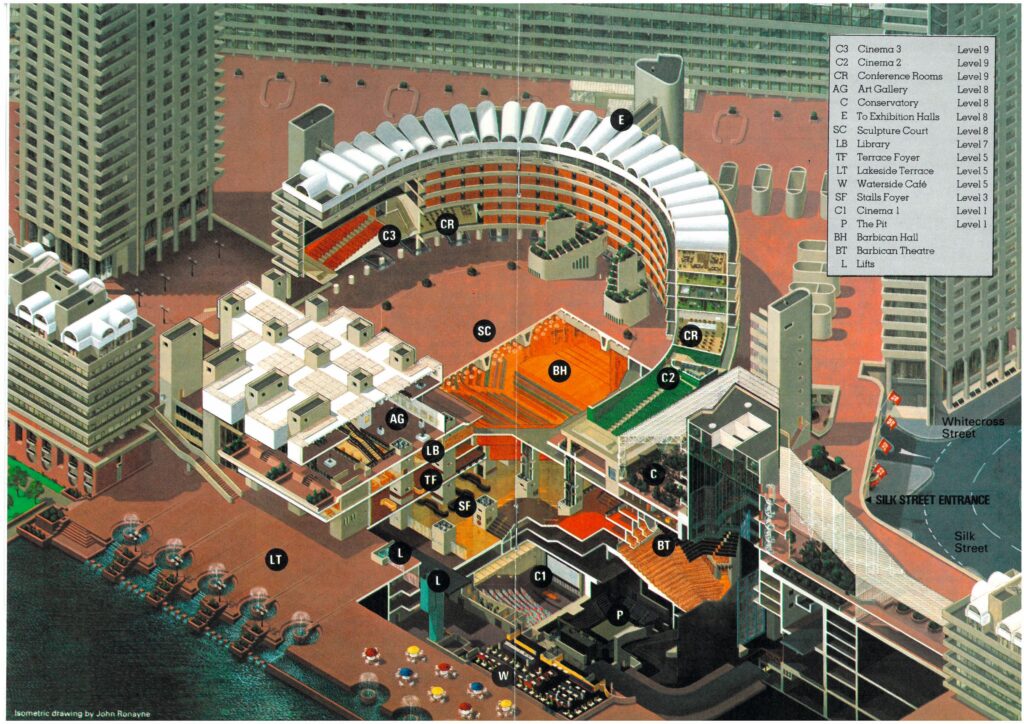
Isometric drawing of the Barbican Arts Centre as built, by John Ronayne, August 1982. Credit: Barbican Archive
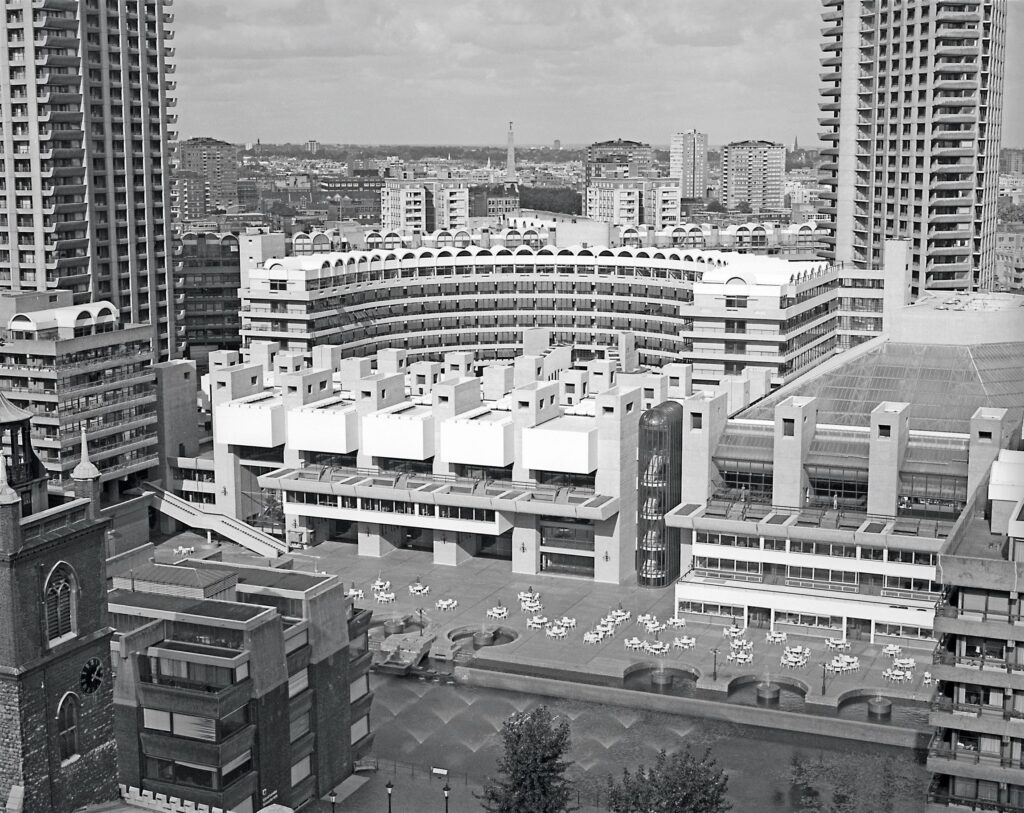
When it was built, between 1972 and 1982, the Barbican Centre was the UK’s most ambitious urban-planning project to reach construction stage. It houses cinemas, concert halls, exhibition galleries, conference rooms, a theatre, restaurants, shops, cafés, a library and car park in an estate that consists of 2,000 residences, mostly in high-rise towers, all built in a Brutalist style. The new hardback Building Utopia: The Barbican Centre marks the 40th anniversary of the Barbican Centre’s completion, the 50th anniversary of its commencement and (approximately) the 65th anniversary of its conception. Multiple specialist writers cover the origins of the project, the politics and development of the building process and outline the highlights and remit of the cultural activities of the centre. A plethora of photographs capture the centre throughout its operation, from construction up to today, with some shots of classic performances and memorable events.
The site of the Barbican Centre is Aldersgate, next to Silk Street, Beech Street and Whitecross Street, close to St Paul’s Cathedral in the City of London. The site had been bombed almost completely flat during the Blitz and thus the location presented itself for wholesale redevelopment – on a grand scale, integrating accommodation and facilities. It was already served by Moorgate Station (Northern line underground and mainline) and was within walking distance of the offices and banks of the City. There was little residential consultation – following wartime devastation, Cripplegate district had a residential population of 58. The photographs of the flattened district, with St Paul’s in the background, is a stark reminder of the state of British cities in the post-war aftermath.
It seems the impetus behind having so many residences was partly political. Sir Nicholas Kenyon, former Managing Director of the Barbican Centre, writes:
The vanishing residential population of the Square Mile posed an existential threat to the survival of the Corporation [of the City of London], with its independent governance and long traditions, for there was a serious possibility in the post-war years that, without residents and voters, there might be a move to incorporate the City into London County Council.
Hostility from LCC and the Arts Council caused friction with the Barbican Centre and led to tussles over funding and control. LCC wanted greater commercial development; the Corporation wanted residences and arts. The Corporation won out and architects Chamberlin, Powell and Bon were appointed to design the centre and estate buildings. An initial costing of £10m was eventually to balloon to £150m by the time of completion.
The Lakeside Terrace of the newly completed Barbican building in 1982, with Frobisher Crescent behind. Credit: Peter Bloomfield
The scale of the project is still – in our age of mega-structures – impressive (‘the largest single building for the arts in the Western world.’) The over thirty lifts include one that can transport a twenty-tonne lorry. The distinctive unpainted pitted concrete surfaces of walls were originally smooth before they were pick-hammered by men with pneumatic drills. This was time-consuming and thus expensive. Some aspects were flawed in design. The sculpture courtyard was rarely used because the weight of pieces was considered a potential structural danger to the building below. The gallery space has always been disappointing – a reflection of its late inclusion in the design – and has never lived up to the other facilities of the venue.
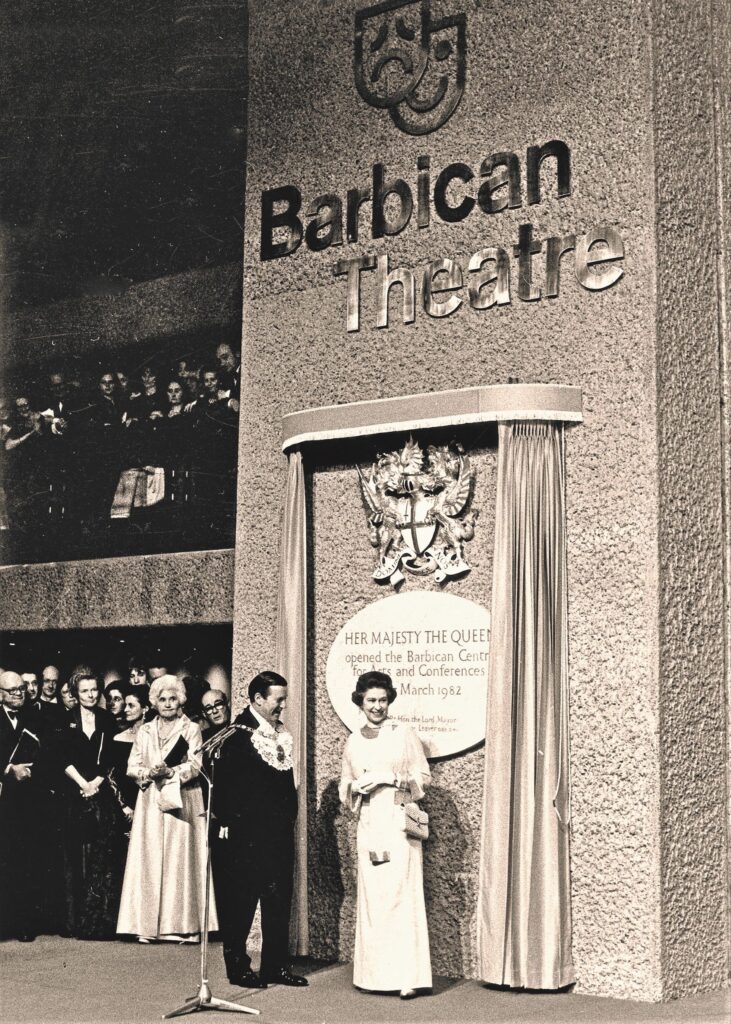
The opening of the Barbican Centre on 3 March 1982: the Queen unveiling the plaque in the foyer, accompanied by The Rt Hon the Lord Mayor Sir Christopher Leaver. Credit: Barbican Archive
When the centre was opened by the Queen on 3 March 1982, the building seemed anachronistic – both behind the times and ahead of them. The building seemed ponderous and unsympathetic, alien in its stylistic unity; cultural tourism was not as developed and streamlined as it would become so there were many doubts about the viability of a costly arts hub. The architecture seemed heavy and uncompromising in a time when Post-Modernism was jettisoning concepts of “truth to materials”, Brutalism and stylistic conformity. Its broad walkways and windswept courtyards seemed too ambitious and forbidding; its thick brass railings seemed passé. More than anything, Brutalism’s intimidating size and lack decorative concession seemed anti-human and indicative of failed visions of Communistic Eastern Europe and corner-cutting city councils. Today, attitudes to Brutalism are changing. Brutalism is an Instagram favourite topic and subject of photo essays and coffee-table books. The high aspirations and unapologetic futurity of Brutalist concrete structures exhilarates the young urban crowd.
The London Symphony Orchestra has been resident at the Barbican since it opened. The Royal Shakespeare Company acted as consultants as the theatre was designed. However, organisational politics and wrangles over income and subsidies caused Barbican to lose the RSC in an acrimonious parting in 2002 (‘The RSC were reluctant tenants. We were grumpy landlords.’) A transcription of a discussion between senior insiders notes that ‘the Corporation saw the conferences as money generators, and orchestras as money spenders.’ Balancing artistic considerations against commercial one is a constant negotiation, as is that of high culture versus experimental programming. (Although apparently the BBC-funded 1985 Stockhausen festival turned into a sell-out success.) Views on the acoustics of the concert hall were mixed; the acoustics noticeably improved once the Perspex hemispheres were removed from the ceiling. The opinions of performers, conductors and critics are summarised.
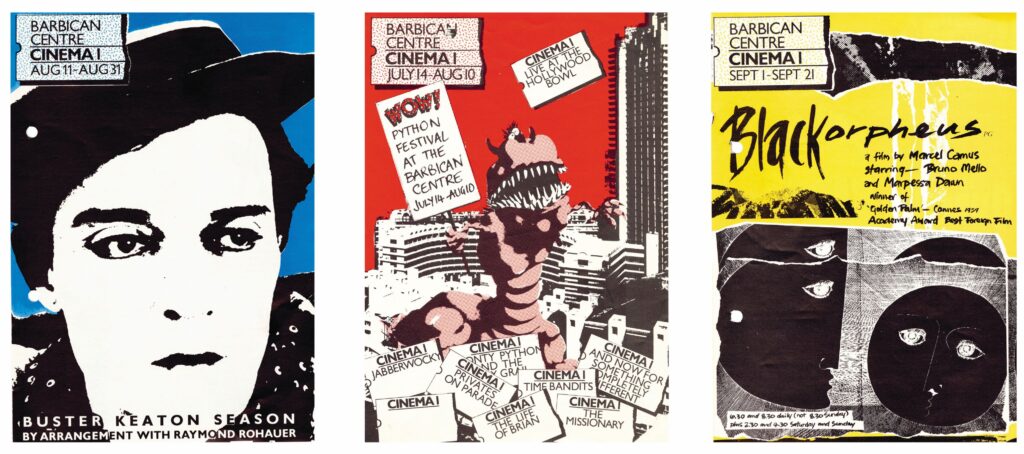
Barbican Cinema brochures from the early 1980s. Credit: Barbican Archive
Most of the fittings are bespoke, which added to the cost but were congruent and effective within the overall design. (There is a great shot of Robin Day’s strongly coloured concert-hall seats.) The signage was considered inadequate from the beginning, leading to notorious navigation difficulties. A Barbican poster announced, ‘If Helen Mirren can find the new Barbican Centre before it opens in March, she will be appearing in Midsummer Night’s Dream.’ The book has many photographs of these details, as well as plans, maps, images of construction, aerial views and vintage shots. A selection of posters shows the breadth of programming over the last 40 years, reminding readers of memorable experiences. The authors are either specialists in their fields or they are individuals who have worked at a high level in Barbican Centre management. Short testimonies by knowledgeable figures (including performers, managers and users) intersperse longer narratives, which show palpable affection but address faults. Subjects include the Barbican’s architecture, theatre, music, art, cinema, typefaces and branding and plentiful insights into the management.
Building Utopia: The Barbican Centre presents a comprehensive and sympathetic presentation of one of modern Britain’s most iconic buildings. Not universally loved as a building – indeed, still disliked by many – the Barbican Centre continues to act as an important centre for high culture. Most importantly, the Barbican is largely an independent enterprise, with relatively low and indirect tax-payer subsidies. Today, the Barbican’s distance from the interfering hand of government is more vital than ever.
ALEXANDER ADAMS is an artist, art critic, novelist and poet. His most recent book is Artivism: The Battle for Museums in the Era of Postmodernism (Societas/Imprint Academic, 2022)
ALEXANDER ADAMS applauds a comprehensive study of a complicated writer
If, after I die, they should want to write my biography,
There’s nothing simpler.
I’ve just two dates – of my birth, and of my death.
In between the one thing and the other all the days are mine. […]
– ‘lf, After I Die’, Fernando Pessoa writing as Alberto Caiero
He led a respectable life. He wore smart clothes to the office. He wrote and translated material, sometimes with a flourish that belied his extramural activities. He was courteous and a touch playful, a bachelor in his thirties. He was given to using spare time to write at his desk. At the end of the work day, he would put on his hat and raincoat and walk through the capital’s streets, thinking of his latest project. Perhaps he would go to his usual café, where he would see friends. They admired him as a writer, appreciating his abilities, chiding him for his perfectionism. He published a little but they knew he wrestled with larger work which was not made public, even to them. When he died he was mourned by his friends and his readers but they did not realise what a giant he had been. In time, he would come to define their whole nation.
This could be a description of Franz Kafka but it is not. American Richard Zenith is a leading authority on Fernando Pessoa. He has edited and translated Pessoa’s writing. Living in Lisbon, Zenith inhabits Pessoa’s home city, relic of a glorious age and scene of an inexorable decline. It is a testament to Zenith’s devotion and ingenuity that he has managed to produce a 1,000-page biography of a figure whom he describes as ‘fanatically private.’ There is no autobiography; there are few revealing letters; the most informative ones are the drafts and unsent (mostly unfinished) letters he kept. There were no direct descendants. There are three diaries with short factual entries that together cover a total of over half a year. Zenith describes the interviews and memoirs of those who knew Pessoa as uninformative – or at least informative on how reserved the subject was. Pessoa was well aware of this and seemed to have actively participated in this occlusion. He was much given to self-reflection and intimations of both immortality and obscurity.
Pessoa claimed to be descended of ‘a mixture of aristocrats and Jews’ although neither predominated nor were proximate to him. His family was largely agnostic (or non-practising) Catholics, more devoted to music than God, who earned a living serving the state. His maternal grandfather was a civil servant and his paternal grandfather was a senior general. Joaquim de Seabra Pessoa (1850-1893), the poet’s father, was a civil servant. He was an opera fanatic and (anonymously) wrote music criticism for a newspaper. In 1887, he wed Maria Madalena Nogueira (1861-1925), the Azorean-born daughter of a civil servant. She was intelligent, well-educated and a keen reader.
Fernando António Noguiera Pessoa (1888-1935) was born on 13 June 1888, in Lisbon. He was delicate, introverted and passionate about literature. He was a voracious reader and writer at a young age. He was encouraged by his cultured family. In 1893, his father died of tuberculosis. The following year, Pessoa’s infant brother died of a fever. In 1895, the widow Pessoa married João Miguel Rosa, another civil servant, this one a diplomat.
Rosa was appointed Portuguese Consul in Durban, South Africa; his new wife and stepson followed in 1896. They would stay (increasing the family with three surviving children) until 1905. They lived through the Boer War and saw rural refugees camped in Durban’s public spaces and outskirts. Pessoa’s schooling and first year of university were in English. The young Pessoa won prizes for English. Winning the Queen Victoria Memorial Prize in 1903 for an original essay (beating 898 other entrants) was one of his proudest achievements, something he cherished until his death. Although Pessoa’s English was fluent, it was unidiomatic and airy, influenced by his reading of Romantic and Victorian poetry, and the bookish Pessoa spent more time reading Carlyle and Keats than bantering on the school playing fields. Pessoa would use his English to good effect in later life and wrote verse and prose in both English and Portuguese.
II
‘I am astounded whenever I finish anything. Astounded and distressed.’
– Pessoa writing as Bernardo Soares
When he was an adolescent, Pessoa began his own newspaper for his family, filling it with fictional news, jokes and poems. The authors were numerous and all pseudonyms. Over his lifetime, Pessoa published under multiple names and wrote under others, over 100 in all. The degree to which he actually inhabited these ‘heteronyms’ is debatable. It seems to have freed him creatively and allowed him licence to intellectually position himself outside of his life experience. There is the question of whether or not these Borgesian alter egos were part of a meta-fiction, additional to the text. Pessoa stated that these were the real authors of his writings. Each had a distinct style and character. Pessoa published verse under pen names Alberto Caeiro, Ricardo Reis and Álvaro de Campos, as well as under his own name, plus others. Like Kafka, who is a useful point of comparison, Pessoa published a fair amount of creative writing and non-fiction prose during his lifetime, but left a sizeable unpublished legacy. In his lifetime, he was best known as a political and cultural commentator. Only in the last year of his life was his stature as a poet generally realised. His unpublished manuscripts were found in a wooden trunk after his death.
‘The trunk indeed existed, and some ten years after Pessoa’s death more than three hundred of the poems it contained found their way into a handsome edition of his poetry, with separate volumes for Alberto Caeiro, Ricardo Reis, Álvaro de Campos, and Fernando Pessoa himself. Since each of the three heteronyms boasted a large and exquisite body of work stylistically unlike the poetry of his fellow heteronyms or of Pessoa himself, one could say that Portugal’s four greatest poets from the twentieth century were Fernando Pessoa.’
Pessoa – and his alter egos – submitted poems, stories and criticism to publications in Portugal and Great Britain. Hungry for success and recognition – hence the decision to often write in English – Pessoa was afflicted with chronic doubt, lapses of confidence and changes of heart. In this biography and editions of Pessoa’s writing, the adjectives ‘unfinished’, ‘incomplete’ and ‘fragmentary’ are commonplace. One could conclude that Pessoa’s use of heteronymic personae is a double-edged sword. It permitted him freedom to develop diverse and distinct bodies of writing but it left him without a core body of writings. The decision to write short texts also allowed him the opportunity to drop projects unfinished without too much investment. Without the impetus to write a novel and publish it, Pessoa could afford to bounce between ideas. His only substantial book published in his lifetime was one year before his death and consisted of poems. Pessoa may have been temperamentally unsuited to write a novel but his propensity to write short, often and under different identities exacerbated his weaknesses of prevarication and detachment. His trunk was filled with unfinished plays, poems, stories, translations and letters.
‘The human author of these books has no personality of his own. Whenever he feels a personality well up inside, he quickly realizes that this new being, though similar, is distinct from him – an intellectual son, perhaps, with inherited characteristics, but also with differences that make him someone else.’
It is possible that – with regard to the legion of heteronyms – readers will experience alternating intrigue and boredom. When Zenith devotes paragraphs to investigating the recurring signature of ‘Gaveston’ – remarking that this is the sole case of an alter ego appearing persistently over time in Pessoa’s jotting without being credited with a single text – how is one supposed to react? It is curious but is it a matter for curiosity for anyone other than a scholar who has spent countless hours poring over Pessoa’s manuscripts? It is a true fact and (presumably) a new fact, but does it mean anything and do we care? The principal heteronyms have bodies of work attached, some of it now published in English, but discussion of peripheral heteronyms (associated with mere jumbled fragments, inaccessible to all except researchers) is more distracting than illuminating.
Zenith diligently hunts down seeds of heteronyms in the writings of past authors, great and forgotten alike. Pessoa’s favourite authors included Thomas Carlyle, Poe, Keats, Milton, Ruskin, Wilde and Baudelaire. A less obvious influence was Max Nordau’s Entartung (Degeneration) (1892), a book identifying and condemning degeneracy. According to this account, it was Nordau’s passages on mania and mental degeneration that fascinated Pessoa most. His grandmother had suffered from severe and atypical dementia, diagnosed as intermittent. He was worried that he too might come to be afflicted. (One also thinks here of Lovecraft’s narrators fearing for their sanity. Lovecraft lost his father to madness, albeit tertiary syphilis, with which Lovecraft himself was not infected.) ‘Pessoa’s fascination, it turns out, was restricted to the relationship that the writer posited between exceptional intellectual or creative activity and psychological deviation from the norm.’
‘It surprises us that Pessoa could have been so enthralled by Nordau – a fluent, effectual writer who was well read but intellectually rigid, priggishly moralistic, and aesthetically reactionary.’
Not at all. Just as Zenith points out that Pessoa had to wait until the end of the twentieth century for a receptive audience for his meta-textually ludic fiction; so Zenith should not be surprised that Pessoa then and others now search for the link between (on one hand) decadence, social atomisation and destruction of tradition and (on the other) liberalism, progressivism and materialism. Pessoa himself was not a traditionalist, but he was eager to understand the causes of social and personal decline. Nordau, Otto Weininger, Herbert Spencer, (later) Oswald Spengler and others advanced ideas that vary in insight and plausibility, but any intelligent open mind would have found such material to be thought-provoking, even if ultimately it disfavoured those authors’ conclusions. Decadence is appealing to vanguardists and the elite but it has characteristics of both pathology and poison.
Images from NCultura.pt, with acknowledgements – https://ncultura.pt/15-fantasticas-curiosidades-sobre-fernando-pessoa/
III
Pessoa used his inheritance to establish Ibis Press in 1909, which would be a commercial printer but also published advanced literature (including Pessoa’s books). It folded almost immediately, due to debt and tough competition. He burned through his inheritance accrued debt in under a year. This put him at odds with his family, then still in South Africa, especially when he requested they pay off his debts whilst at the same time refusing to get a job. The most he would do was provide translations of poems for a giant library of world classics in Portuguese.
In 1914 Pessoa wrote as Álvaro de Campos, Portugal’s first Futurist poet. With author-friend Mário de Sá-Carneiro, Pessoa would act as shadow editor for the avant-garde literary journal Opheu. The journal was published in 1915 and lasted only two issues. Influenced by the Futurist Manifestoes and the British Vorticist Blast, Orpheu caused a sensation. Its radical sensibilities, taboo subject matter (sex) and Cubist collages, ignited debate in Portuguese cultural circles. Who were these madmen? At least three of them were Pessoa. Sá-Carneiro fled to Paris, where he committed suicide after a period of debauchery.
Pessoa described himself as elitist, nationalist, imperialist (Portugal at this time still had a substantial empire) and (nominally) a republican, although one disillusioned with the corruption of the republican government established in 1910. He antagonised republicans in a newspaper letter and he had to evade a gang that came to assault him. It was one of the few physical escapades of this normally timid man. He was unenthusiastic about the Great War and critical of Portugal’s entrance into direct hostilities against the Central Powers on the continent, reasoning that war in France against the Germans did not contribute to protecting and ruling colonies in Africa. Pessoa’s unformed aspiration was the foundation of an aristocratic republic of Portugal, led by great men. He himself had no political aspirations. Zenith never mentions Pessoa delivering a public speech or broadcast.
At this time, Pessoa became involved with esoterica, mysticism, magic and spirit reading, all complementing an established commitment to astrological predictions. He was in the habit of gauging planetary alignments when submitting manuscripts to London publishers. The publishers were uniformly unreceptive to his submissions and proposals, though his chapbooks of poems won praise for the author’s accomplishment. He dabbled in secret societies, but (as a lover of mystery stories) Pessoa seemed more stimulated by the intrigue than the reality.
In 1930, Pessoa was Aleister Crowley’s companion on a visit to Lisbon. Pessoa, a native of Lisbon, steeped in occult knowledge and fluent in Portuguese and English, was the ideal choice. Crowley’s reputation as an indefatigable fornicator, Satanist and drug fiend put Pessoa on edge before Crowley’s arrival by ship. Crowley wanted Pessoa to head the Portuguese chapter of his spiritualist society; Pessoa wanted Crowley to publish his writings in England. They both assumed the other was richer than he actually was, which entailed mutual disappointment. Crowley departed after staging a hoax suicide, which Pessoa partially corroborated. This is one of the most amusing passages in a biography that makes an intelligent and lively read.
IV
‘I’m suffering from a headache and the universe.’
– Pessoa
In 1919, Pessoa started work at an import-export firm, using his knowledge of English and French. This was where (in 1920) he met the only woman he courted, Ophelia Queiroz.
Pessoa was averse to sexual intimacy. There is plenty of evidence in Pessoa’s writings of sexual attraction but also physical repulsion, perhaps linked to venereal disease. Love arises in the poems in an abstracted sense, derived from his reading. Zenith has good reason for assuming Pessoa died a virgin. Zenith also finds ample examples of misogyny in Pessoa’s writing and marginalia, provoked by fear (and disgust) regarding female libido. There are a number of sensitive and passionate homoerotic love poems ascribed to heteronyms, though Zenith (and others) do not believe this ever translated into carnal fulfilment.
Ophelia was nineteen years old and employed to act as a secretary. Pessoa was thirty-two but youthfully unattached, respected by colleagues as a great poet yet one unaccountably unrewarded. She was strongly attracted to Pessoa. Pessoa kindled to the affection and they carried on a romance of trysts, walks and love letters. It was imbalanced, with Ophelia taking the lead and wanting commitment. Pessoa was too detached and cautious for the relationship to develop straightforwardly. Unusually for Pessoa, their letters survive and are quoted in this account. Ophelia is insistent and puzzled by Pessoa’s reticence. Pessoa is playful and affectionate but unwilling to translate that into an engagement. (Him writing as his heteronyms was an augury of a poor outcome.) The impasse led to estrangement, though they did resume writing over the period 1929-30. By temperament and choice, Pessoa was determined to remain unencumbered by the emotional or domestic burden of partnership. Ophelia married the year after the poet’s death.
Pessoa’s apparent support for homosexual men as men and as writers comes as no surprise considering the poems he wrote. Even if Pessoa was not himself homosexual, he displays empathy and must have gained some pleasure from imagining himself as a homosexual poet, modelled on Walt Whitman. He publicly defended two homosexual writers whose work was banned. This attitude aligns with the idea of an aristocratic elite heading a nation founded on excellence and spurning the distractions of materialistic progress. In Pessoa’s vague imaginings, it was priest-scholars rather than Spartan warriors. Women in politics was anathema to him.
In 1921, Pessoa planned to publish The Protocols of the Elders of Zion in Portuguese. He did not do so. Instead, he wrote an essay about what he saw as the malign influence of Jews. ‘Without any perceptible animus toward Jews, writing as a calm analyst who happened to be informed by reactionary ideas, he noted that the three hundred members of the oligarchy allegedly plotting to overthrow the world order were not all Jews but were imbued by the spirit of what he called “sub-Judaism,” characterized by crass materialism and support of democracy and humanitarian causes.’ Later, he wrote about Jews in less charged terms, assigning to races ‘characteristics, however, [that] were neither genetic not altogether static; they depended on a complex web of historical, geographical, and sociological circumstances.’ Interesting lines of thought for an author who claimed Christianised Jews in his lineage to take.
Zenith criticises Pessoa for not being an egalitarian (while admitting that such an attitude was not incompatible with the poet’s outlook) and condemns Pessoa for wearing blackface as a prank (‘the inherent offensiveness of blackface’). What, a reader may wonder, is gained by wagging the measuring stick of American morality of 2021 at a Portuguese who grew up in Victorian-era colonial Africa? For the most part, such presumptions are not too intrusive.
Pessoa was both an artistic Modernist and a political reactionary; he was empathetic towards certain minority groups, indifferent towards others. He approved of the suppression of Communists and Socialists but was hostile towards Italian Fascism. (Perhaps he discerned within Fascism a core of Socialism.) Zenith thinks, ‘The “real Fernando Pessoa” was always someone else.’ I disagree. I see Pessoa as perfectly consistently himself in his apparent contradictions; he was honest enough to fully inhabit contradictory ideas. We have the concept of cognitive dissonance. However, there is no dissonance when there is no urge to harmonise contradictory ideas. Pessoa never believed he had to hold a consistent position. It seems he realised that a human being without contradictions is an impossibility.
V
‘An original, typically Portuguese literature cannot be Portuguese, because the typical Portuguese are never Portuguese’
– Pessoa
In 1928, António de Oliveira Salazar (1889-1970) was appointed finance minister and he would remain the directing force in the technocratic Portuguese government until a brain aneurysm in 1968. He would see out the last two years of his life as only the nominal (rather than actual) head of government of Portugal. His dryness – a devout Catholic, private, personally reserved, not given to rhetorical excess – and his competence as a director of the state finances won him widespread support. Pessoa supported Salazar’s measures, which stabilised Portugal’s finances and curbed the hedonistic excesses of Lisbon’s nightlife.
Almost a decade after their split, Ophelia and Pessoa reconnected during 1929-30. They resumed their correspondence and meetings. Again, they fell into the old pattern of conflict. Ophelia wanted marriage and companionship; Pessoa wanted to write. She was worried about his heavy drinking. It would leave him severely ill in the summer of 1932. He evidently enjoyed the excitement and experience of being desired but perhaps he felt guilty for giving Ophelia (about whom he evidently strongly cared) false hope of matrimony. Maybe he suspected he was not a writer in love but a writer researching love.
His Mensagem (Message) (1934) collection of poems won a prize from the government for its contribution to patriotic renewal. Pessoa was ambivalent, appreciating the recognition and the cash, but wary of official honours. The following year, Pessoa opposed a bill to outlaw secret societies, specifically the Freemasons. Pessoa had an affinity for societies so he took the legislation personally and wrote in the press strongly opposing the law. It was a futile effort because the parliament would rubberstamp the legislation. In his last months, he turned definitively against the regime for restricting personal freedom, especially freedom of artistic expression. His anti-Salazar poems could not be printed, but they apparently were circulated in a limited form. Zenith discloses that in his last months, Pessoa was writing an essay against Italy’s invasion of Abyssinia. Also, he was weighing up the merits of equality and humanitarianism. Death – intestinal obstruction (or possibly pancreatitis) apparently caused by alcoholism – intervened. Pessoa died on 30 November 1935, in hospital.
VI
‘Everlasting remembrance, how briefly you endure!’
– Pessoa
Over the subsequent years, volumes of the erroneously titled Complete Works of Pessoa were published by colleagues, amounting to a fraction of the slew of 25,000 sheets. The verses can be a little abstract and diffuse but often deploy pleasing irony, cutting humour and mordant insights. The best poem by Pessoa I have read is one of the longer ones, 1928’s ‘Tobacconist’s’ (written under the heteronym Álvaro de Campos) – one of his most involved and most concrete poems, featuring the poet’s thoughts upon watching a tobacconist and his store from across the street. It combines melancholy, levity and grandiosity.
The only lengthy work of fiction that Pessoa brought close to completion was The Book of Disquiet, which is assigned to Bernardo Soares. It consists of over 500 entries written over 1913-35, and was only published in 1982. It comprised hundreds of pages in an envelope. (One is put in mind of B.S. Johnson’s The Unfortunates (1969). His famous ‘book in a box’ is composed of individual sheets and sheaves.) The ordering and transcription are debated and since the first publication there have been new editions, some dramatically different. One English edition has been edited and translated by Zenith. The entries range from single sentences to passages of many pages. They are meditative, alternately detached and intensely personal, forming what Pessoa called a ‘factless autobiography’. It has a detached quality, splenetic humour and despairing melancholy that presages existentialist literature and the internal monologues of Beckett.
In an age of Borgesian meta-narratives and Post-Modern playfulness – as well as a (sadly) reduced capacity to concentrate on more involved lengthy prose – The Book of Disquiet and Pessoa’s heteronymic transformations have found warm appreciation. There is no doubt he was a serious, world-class writer and richly deserves this handsome biography.
Zenith is adept at sketching the situation of Portugal during the Belle Époque, republican and Salazar periods. He knows his subject matter inside out and speaks the languages of his subject. On balance, Zenith’s assertion that Pessoa’s heteronymic alter egos (at least, the major ones) are genuinely felt expressions of different intellects with unique voices, and not gimmicks, carries weight and is eloquently argued, with evidence. Once one grants Zenith his ethical and political interjections, even the most negative of critics is left with mere cavils. The biography hits the rare sweet spot of being as comprehensive as one might wish for while not lingering too long on any point. The amount and depth of research is humbling. Pessoa: An Experimental Life is a grand achievement – thorough, thoughtful, insightful and generally sympathetic, it does what all the best literary biographies do: inspire us to seek out the writings of its subject.
ALEXANDER ADAMS is an artist, art critic, novelist and poet. His most recent book is Artivism: The Battle for Museums in the Era of Postmodernism (Societas/Imprint Academic, 2022)
Kristina Krasnyanskaya, Alexander Semenov (eds.), Soviet Design From Constructivism to Modernism. 1920-1980
Scheidegger & Spiess, 2020, 448pp, illus., £65
ALEXANDER ADAMS traces the neglected history of Soviet building design
The neologism is beloved of technocracies, cults and dictatorships; the regime of the USSR had traits of all three tendencies. The lexicon of the USSR sprouted neologisms like mushrooms: Cominform, Comintern, Glavlit, Gosplan, Komsomol, Proletkult, Sovnarkom. VKhUTEMAS was an abbreviation of Higher Art and Technical Studios, a Bolshevik-founded art training school founded in Moscow in 1920. It was set up alongside the even more shortlived INKhUK Institute of Artistic Culture(Institut Khudozhestvennoy Kultury/Институт Художественной Культуры), which only existed from 1920 until 1924, by IZO-Narkompros, the Department of Fine Arts of the People’s Commissariat for Education. Despite being backed by the state, it failed to survive as long as the Bauhaus.
The new school combined eight departments (fakul’tey): painting, sculpture, architecture, woodworking, metalworking, ceramics, graphics (poligrafiya), and textiles1
There was a core curriculum which covered the basics of design and art, with additional topics: “Mathematics, Chemistry, Descriptive Geometry, Political Economy, History of Art, and Military Arts.”2. The school offered free education and encouraged applications from poor students, many of whom had part-time jobs to support themselves.
While similar to the Staatliche Bauhaus in its “communistic” spirit, Vkhutemas was over ten times larger than its German counterpart in terms of the student body. With an enrolment of more than 2,000 students, it was an unprecedented modern undertaking, rivalled only by the École des Beaux-Arts in Paris, which counted well over 1,000 students in the 1920s3
VKhuTEMAS students with models
VKhUTEMAS and the Pedagogy of Space is a record of the school through its teaching material, archival sources and explanatory essays. It provides us with a fascinating insight into the thinking of the Soviet avant-garde in the brief window before Modernism was occluded by Socialist Realism. VKhUTEMAS was a cockpit of Constructivism and Functionalism. Constructivism was a Modernist movement which divided into two strands: a) a Cubist-inspired abstract school of art that deployed geometric forms and b) a utilitarian form of architecture favouring Euclidean forms and eschewing decoration. Functionalism is a principle that design must be ergonomic and pragmatic, subordinating aesthetics to function. There was a stress on modern materials, geometric forms and human psychology would aid design of structures, making them fully rational and determined by science. Architecture, unlike painting and sculpture, was not imitative and could thus be liberated from convention. Constructivism is avowedly Modernist in form; Functionalism is Modernist in form only by default. VKhUTEMAS taught both – inasmuch as they were distinguishable.
VKhUTEMAS and the Pedagogy of Space records school publications and course materials. These consist of montages, collages, photographs, diagrams and texts. These are reproduced photographically. The Russian text is partially translated into English for the first time. This large book reproduces pages from the archives at large size, most with translation facing. The syllabi are transcribed and translated. Some commentaries provide other information. Models in cardboard, wire, glass, plaster and string were made by students and were photographed as examples. The curriculum gives us information about the teaching methods, the ideas that were to be imparted and what students were expected to demonstrate. Examples are given of documents, fabric samples, clothing, furniture designs, posters, architectural plans and art work.
Although the foundations of the school’s teaching were doctrinal, the actual practice did allow for experimentation and personal expression. All tutors and students had to be members of the Party but it does not seem that the teachers were anything other than thoughtful, patient and responsive to their students. Teachers included serious artists already known in the West: Alexandra Ekster, Lyubov Popova and Alexander Rodchenko.
Konstantin Melnikov Kurochkin, Gosplan Garage, 1930s
VKhUTEMAS was closed in 1930, victim of the political struggles and the Party’s declining approval for Modernism, which would soon be denounced as ‘bourgeois formalism’. The solution to the unsatisfactory performance was to split up the school into different, specialised institutions. The fates of the tutors mirror the fate of the avant-garde under the Stalinist regime. Rodchenko moved from avant-garde design to documentary photography. Ladovsky was purged under Stalin, a fate that also befell Malevich, Tatlin, El Lissitzky and other Modernist artists. Aleksandr Drevin and Gustav Klutsis were executed in 1938 as part of a purge of Latvians (partly overseen by Lavrentii Beria). Vladimir Baranov-Rossine (a Jew) died in a Nazi death camp.
VKhUTEMAS and the Pedagogy of Space is a fascinating insight into Soviet Modernism and design pedagogy. It is a somewhat specialised volume but a valuable addition to any extensive library on art education, design history and Soviet fine and applied arts.
The rivalry between the USSR and the USA dated back to the inception of the USSR. From the earliest days, ambitious Soviet officials and architects eyed the skyscrapers of New York with envy. For them, the logical development of the USSR would be to harness the capabilities of Soviet New Man, unleashed through the liberation of labour and freed from the shackles of bourgeois tradition, in order to build a new society that would surpass the USA’s lead. Socialism was a development of – and ultimately, replacement for – capitalism and this would be demonstrated through the creation of buildings grander than those of capitalism.
One of the great projects was Palace of the Soviets (designed 1931-3, head architect Boris Iofan). It would be a vast auditorium for conferences, with a giant library, served by 148 elevators, topped by the tallest building in the world, at 415 m (1,362 ft), with a 100 m tall statue of Lenin on the top of the tower. This would use techniques and materials innovated by the British, Germans and Americans to construct a palace dedicated to the people rather than to commerce. (Iofan led a delegation of engineers to New York to gain technical information.) It was seen as a direct riposte to the West, refuting the idea that Russia was technologically undeveloped and that Socialism could not match capitalist democracies. It had been barely started by the time the Great Patriotic War diverted the labour and materials into the war effort.
As Katherine Zubovich explains in Moscow Monumental: Soviet Skyscrapers and Urban Life in Stalin’s Capital, in the immediate aftermath of the victory over Germany, Stalin planned a group of eight tower blocks and completion of the Palace to show that the USSR was ready to enter the modern age and rival the world capitals. These would accompany completion of the Palace of the Soviets. Although the ill-starred Palace would never progress – the alarming amount of ground water flooding the foundations indicated the unsuitability of the location for the world’s tallest building – the tower blocks would be constructed. It turned out there would only be seven, built over the period 1947-53.
In the late 1930s, Stalin had effectively halted Soviet Modernism in all areas. The social, educational and – in some respects – the economic sovietisation of the USSR proved highly disruptive, slow and counterproductive. The Revolution would have to be stopped and (purely in an unannounced manner) reversed in select areas. A good example is the rise of Socialist Realism, which replaced the experimental Modernism of Suprematism and Constructivism with academic painting and sculpture depicting workers and party officials. In architecture, Stalinism entailed curtailing the excesses of Modernism and Rationalism, in favour of Historicism made at inhumanly large size. As always in totalitarian states (past and present) words were redefined. “небоскреб/neboskreby” (“skyscrapers”) was redefined to mean Western capitalist tall buildings; “Высокоездание/vysotnye zdaniia” (“tall buildings”) was the preferred term for tower blocks in the USSR.
The heroic experimentalism of the early revolutionary period of the Modernist period had never materialised. Construction on the Palace of the Soviets had stalled. Although the city had suffered aerial bombardment, it had not suffered as much as Leningrad, not to mention Stalingrad. The project of boulevardisation and the new metro system from the inter-war period was intact. In January 1947, with the USSR still gradually recovering from the ravages of war, the decree was issued to construct eight new skyscrapers. The plans were initially fluid.
In the early months of 1947, Soviet officials, construction managers, and architects themselves had little notion of the shape the project would take over the following months and years. The skyscraper decree of January 13, 1947 was impressionistic at best. The document gave little indication of the outsized role the buildings would come to play in Soviet life4
The buildings were Hotel Ukrainia (the tallest building in the USSR), Kotelnicheskaya Embankment Apartments, Kudrinskaya Square Building, Hotel Leningradskaya, the Ministry of Foreign Affairs, Moscow State University headquarters and the Ministry of Construction of Heavy Industry. Construction was staggered due to the potential strain on labour, logistic and management. Zubovich outlines the internal politics of the bureaucracy and the shifting responsibility for the project as it came to life. The internal manoeuvring was not just a question of personal advancement but of survival by denouncing rivals as insufficiently Communist, as officials lived under the shadow of the KGB removing individuals due to counter-revolutionary subversion.
The ‘Seven Sisters’ displaced tens of thousands of Muscovites, who were evicted without compensation, although the Moscow government was obliged to find or build accommodation. The author tells the stories of some of the residents who were resettled to the outskirts of Moscow. The process was administered by Lavrentii Beria, former head of the NKVD. Rehousing the displaced population became a project in itself. The influx of construction workers required temporary housing, which would expand the city boundaries of Moscow.
Construction became an opportunity for propaganda. The presence of women doing some of the lighter labour was heralded by the press as a triumph of communal co-operation in the world no longer encumbered by custom. Press coverage concealed problems:
Postwar shortages resulted in intense competition over materials, equipment, and labor between managers working across Moscow’s different construction sites. Building materials often arrived late or not at all, and construction equipment and gear were in short supply. Managers at all skyscrapers sites complained about a shortage of skilled workers5
Limitations in the conditions were obvious. Overcrowding in dormitories was commonplace. Internal Party reports noted
…workers’ housing was not only lacking mass-political activities and red [political] corners; living conditions in the material sense were abysmal6
Completion of the Seven Sisters coincided with the death of Stalin, soon followed by the era of the Great Thaw and de-Stalinisation of the USSR and Eastern Bloc. The untrammelled power and stylistic appropriation of the past were deemed indicative of the flaws of Stalin’s reign.
When Khrushchev spoke on the final day of the Builders’ Conference [in 1954], he called for greater efficiency in construction, increased use of industrialized and prefabricated materials, and an end to unnecessary decorations and embellishments in design that, as he stated, caused “unnecessary expenditures7
According to the new guard, Stalinism’s stylistic anachronism betokened a system-wide culture of deception. In terms of financial and human costs, monumentalism was indicative of inhumane excess that could no longer be supported.
Administrators and architects fell from favour but the undeniably impressive aspects of the project appealed to Communist regimes elsewhere. Soon structures typical of Stalinist Historicist architecture would spring up in the form of the buildings of Karl-Marx-Allee in Berlin, the Presidential Palace in Bucharest and buildings across the Eastern Bloc.
A third book joins the space between the VKhUTEMAS and the Stalinist years, then brings the story up the dissolution of the Soviet Union in 1991. Soviet Design From Constructivism to Modernism. 1920-1980 seeks to place Soviet furniture, clothing, interior design and architecture in a continuum that integrates them within the ideals and reality of the USSR over almost its entire existence. Soviet design is relatively little known compared to other Modernist movements such as Secession, De Stijl, Bauhaus, Art Deco, Minimalism and Italian and Scandinavian Modernism. The reasons are that the USSR exported relatively little and (aside from political sympathetic states) it had little cultural and technological exchange with other states.
Due to its relative isolation, the USSR had to produce everything. This was a precursor to the creation of a new rational world suitable for Soviet Man, then, later, independence demonstrated the viability of self-sufficiency of the Communism-in-one-country doctrine. Soviet Design includes everything from teacups to underground stations. As with all areas of life in the USSR, the 1920s were full of bold experimentation and radical ideas.
Space was at a premium, so efficiency was prioritised. The drive to make furniture compact and multifunctional chimed with reappraisals of ways of living. Leading designer and theorist El Lissitzky declared,
Salons, halls, boudoirs, living-rooms […] everything has been swept away – only the bare living space is left8
New Soviet furniture could be folded away, rotated or reversed for different functions. Telyakovsky’s combination unit had a bookcase, desk and bed. Built-in storage was designed for new-build apartments. Soviet engineer-designers made a virtue of the limitations imposed by circumstances and, in doing so, their labours turned New Soviet Man’s domestic environment into something between factory cell, submarine berth and space-flight module.
Soviet designs could be painfully uncompromising, with straight lines and flat planes more suited to showroom than living room – certainly not suited to human anatomy. Due to the severe restrictions (technical, material, financial, bureaucratic and political) many designs never went beyond drawing or prototype stage. Mismanagement, delays and lack of competition led to chronic shortages and compromises in all areas of Soviet life. Production targets were arbitrary and goods were often defective. Designers rarely saw their designs reach production in the quality they stipulated.
The earliest phase produced some attractive designs. A teacup and saucer from 1923 have spare geometric Suprematist forms on a white ceramic ground, crisp, dainty and assertively ant-traditional. The designer was Nikolai Suetin (1897-1954), a student of Malevich and one of the outstanding figures in Soviet ceramics. (Suetin designed Malevich’s coffin.) Some outstanding examples of suites or interiors were produced for public expositions.
The design of furniture models (in many cases never realized) taking their inspiration from Constructivist forms effectively ceased after 19349
By 1932, Stalinist policies decreed a return to order and convention – to a degree. Expressions of physical culture would become heavier, grander, more voluminous; traditional materials and forms would be adopted, although decoration would never become too elaborate. To give an impression of stability and continuity, the fine and applied arts would turn their backs upon “bourgeois formalism” of Modernism that distanced the proletariat from the products of their society.
This Historicism is evident in the submitted designs – reproduced in the book – of the Palace of the Soviets. Cinemas, theatres, department stores, hotels and other important spaces evoked the grandeur of the Romanov Empire period, complete with chandeliers, marble facing and dark lacquered-wood panelling. Rather than being challenged by Functionalist surroundings that asserted the dawn of a new age, Soviet citizens in the 1940s would be embraced by the stifling pomp of the belle époque, made available to all, not just the (now liquidated) capitalist class.
Reverse engineering and copying formed part of Soviet design. The most notable example was the adoption of Art Deco for architecture, furniture and Metro stations. The use of crisp lines, simple forms, tubular metal supports and absence of ornamentation provided a counterpoint to the rival Stalinist Historicism. This Art Deco can be found in a showpiece ship that was used to ferry passengers to holiday resorts on the Black Sea.
All Union Competition entries, 1972 – from Soviet Design
Post-war reconstruction, advances in technology and the death of Stalin allowed moderate Modernist designs to reach production stage and dominate interiors from the late 1950s onwards. There was popular demand for domestic furniture that was informal and comfortable. We see curvilinear metal tubing, foam padding, slimline design and lightweight construction become commonplace – many of the products copied from Western examples. Electrical appliances became affordable. The communal canteens demanded by the communitarian ideals of the Revolutionary era – which had never been popular in domestic habitations – were abandoned in favour of fitted kitchens.
Significantly, the advent of the Eastern Bloc brought international trade on a large scale for the first time in Soviet history. Apparently, the USSR imported many interior fittings from Czechoslovakia. Despite advances, however, Soviet manufacturers were unresponsive to public demand, often unwilling to modify inferior designs. Lacking competition and the profit motive, manufacturing was deeply inefficient.
Soviet Design does much to familiarise readers with the origins, principles, limitations and unique circumstances that led to the designs produced in the USSR. The many large illustrations, explanatory narrative and concise biographies of major figures will make this book a primary introduction to one of the most neglected fields of design.
ALEXANDER ADAMS is an artist, art critic, novelist and poet. His most recent book is Artivism: The Battle for Museums in the Era of Postmodernism (Societas/Imprint Academic, 2022)
Anna Bokov, VKhUTEMAS and the Pedagogy of Space, 1920-1930, p40 [↩]
Unrealistically high targets (motivated by arbitrary statistical ambition) pushed workers to breaking point. As with the pre-war metro construction, accidents were frequent. Pay was so low that there was even labour unrest. What was not made clear in the press was the amount of forced labour used. By 1950, 8,000 prisoners (including foreign nationals) were working on the Seven Sisters in zones segregated from the population and the (nominally) free workers.
The buildings were well-appointed and the décor restrained. The public spaces at the lower levels were Historicist, pastiching Romanov-era state buildings, replete with marble cladding and columns. The Party elite scrambled to petition high officials to secure apartments. As it was, the number of apartments did not materially affect the housing crisis in the city. Although more generous than average Moscow apartments, the tower-block apartments were not large, especially when occupied by multi-person households.
At the very moment Moscow’s skyscrapers were completed in the mid-1950s, they became symbols of Stalinist “excess” ((Zubovich, ibid., p5 [↩]
Ralph Geis (ed.), Hirmer, 2020, hardback, 336pp, fully illus., €45/£42/$50
ALEXANDER ADAMS immerses himself in disquiet and dreamscapes
Berlin’s Alte Nationalgalerie exhibition of Belgian Symbolists, Decadence and Dark Dreams: Belgian Symbolism, closed last month. As few were able to attend, for obvious reasons, this article will review the exhibition from the catalogue1.
Symbolism – like its precursor, Romanticism – is a school that thrived, and had its premier exponents reside, in Northern Europe. Belgium produced some of the best Symbolist art in the era 1860-1914. Artists of the new nation of Belgium in search of an identity reached back to the Flemish Primitives as a strong regional model and nation achievement.
Symbolism was a rejection of the deracinating impact of greater homogeneity in industrial production, education, and news dissemination, and the dwindling of traditional religion, farming and attachment to the land and homeland
Symbolism was a rejection of the deracinating impact of greater homogeneity in industrial production, education, and news dissemination, and the dwindling of traditional religion, farming and attachment to the land and homeland. In the same way the Arts & Crafts movement was a reaction against industrialisation, Symbolism was a reaction against rationalism.
Symbolism had two leading mediums: art and literature. The best Symbolism includes Maeterlinck, Mallarmé, Rodenbach and Verlaine, all of which followed the example of the pre-eminent spirit of Symbolist literature: Baudelaire. For artists, there was a resistance to the domination of portraiture and the preoccupations of the picture-buying middle class, as evidenced in the Salon.
What are the themes of Symbolism? Eros and Thanatos: sex/love and death. These are frequently mingled in art which plays on the fear of venereal disease (the prostitute as Death) and death and the maiden. One also finds an attraction-repulsion complex regarding death, wherein artists fear death but seek the endless slumber of oblivion. Others? Vanitas and memento mori, the supernatural, primal fear of night, dreams, the grotesque, the outcast, criminal, flanêur. Deviant social, political and sexual behaviour – often in a context heroizing or celebrating it – becomes a key feature of the Decadent Movement, a sub-group of Symbolism. States of narcolepsy, hypnosis, hysteria and ecstasy, all beyond conscious control and revealing the darker urges and hitherto hidden truths. Unorthodox approaches to religion meant that Symbolists were involved (on levels superficial and profound) with occultism, Theosophy, Satanism and Paganism and fringe sects of Catholicism. Non-Western and non-Abrahamic religions are subjects of interest.
In other words, it was a hugely diffuse movement. One can spot it easily enough, even if one has trouble pinning down all its qualities, and finds it impossible to identify a unifying principle.
Featured artists include Félicien Rops, Jean Delville, James Ensor, George Minne, Fernand Khnopff, Xavier Mellery, Léon Spilliaert and Léon Frédéric. Prints were important (especially those of Ensor and Khnopff). Sculpture – especially polychrome stone carving and stone-metal busts – by Minne, Khnopff and Charles van der Stappen confirmed the breadth of Symbolism’s versatility. Symbolism found channels to intellectuals and public through exhibiting associations Les XX (1884-93) and La Libre Esthétique (1894-1914). Symbolist art frequently appeared in art journals and had wide currency through book illustrations, not least for Baudelaire’s books. Many public commissions required symbolism, even though the art that derived from such public schemes is a touch generic and has little to distinguish itself from standard academic and civic art.
Nocturnal interior by Xavier Mellery
William Degouve de Nuncques’s moonlit views of Venice and Bruges are atmospheric and less familiar than Spilliaert’s nocturnal street views of Ostend. Mellery’s dim nocturnal interiors of churches and house stairwells are masterful scenes of crepuscular tension. They have a dreamlike quality and beautiful finish – detailed enough to be immersive, but not so polished as to lose their liveliness of facture. The low-key disquiet of these scenes is very effective. Mellery’s public commissions include images featuring rather lumpen angels against gilded grounds, which are illustrated but excluded from the exhibition, happily.
Ensor is represented by works from his youthful and mature periods. His painterly approach marks him out from his compatriots. Ensor’s skeleton and mask pictures are very appropriate for this exhibition, even though Ensor as an artist is very mixed and individualistic.
Khnopff is the dominant presence in this selection. His paintings and drawings are well known. Caresses (1896) is the classic oddity of Belgian Symbolism. A cheetah with a woman’s head nuzzles a male warrior, who has a female face. It is absolutely ridiculous, yet iconic. Two scenes of satanic manifestations by Rops, featuring female nudes, are complemented by prints from the suite Les Sataniques (1882). Rops’s imagination attains the perversity of a true libertine in the latter. Von Stuck’s women are generally types – with the exception of a portrait of actress Tilla Durieux in character – and perform the role of dangerous seducers. In Berlin, his work is usefully paired with that of Böcklin. Here we see him near Khnopff’s eternal woman, based on his sister. Art by peripheral artists such as the Pre-Raphaelites shows how Belgium (a geographical and intellectual hub) was connected to other countries’ art scenes. Spilliaert’s nocturnes, marines and figure pictures (as seen recently in London) are excellent and ambitious, as a whole.
Supplemented by classic Symbolist paintings by non-Belgian artists, including Böcklin’s Isle of the Dead (1883), Edvard Munch’s Jealousy (1913), Gustave Moreau’s Oedipus the Traveller (c. 1888), von Stuck’s Tilla Durieux as Circe (c. 1900), as well as paintings by Klimt and others. There are mistakes. Vilhelm Hammershøi’s Interior Strandgade 30 (1901) is a nice painting but it does not carry the charge of Mellery’s interiors, which was clearly the comparison the curators were making. A mysterious atmosphere is not enough to make a piece of art Symbolist. Belgian Antoine Wiertz’s La Belle Rosine (1847) is a foundational work and perhaps the best proto-Symbolist paintings, as haunting as anything made later.
The art selected is excellent and a tour de force of Symbolism’s highlights, as well as including lesser known artists. The sculptures – principally busts of young women as enigmatic allegorical personages – remind us of the importance of that medium in 1900. The catalogue includes short essays and many comparative illustrations, as well as full-page illustrations. The biographies of more obscure artists are welcome; there is no bibliography.
ALEXANDER ADAMS is an artist, art critic, novelist and poet. His most recent book is Artivism: The Battle for Museums in the Era of Postmodernism (Societas/Imprint Academic, 2022)
This article first appeared in The Jackdaw, and is reproduced with permission. [↩]
ALEXANDER ADAMS revisits the rich oeuvre of one of 20th century France’s finest thinkers
Albert Camus (1913-1960) confessed that he had one wellspring of inspiration: his Algerian childhood. His silent unlettered mother, his absent father (killed in the Great War) and the ever-present warmth of the sun and the presence of the sea: all these were the foundations for his insights into the world:
A man’s work is nothing but this slow trek to rediscover, through the detours of art, those two or three great and simple images in whose presence his heart first opened. This is why, perhaps, after working and producing for twenty years, I still live with the idea that my work has not even begun.
Ironically, Camus would be dead less than two years later, not even 50, killed in a car accident.
This idea of a return to an immutable emotional locus is something Camus reprises in the 1958 introduction to The Wrong Side and the Right Side, some of his earliest writings. This is the first part of Personal Writings, which also includes the 1939 collection Nuptials (Noces) and Summer (L’Été) of 1954. The essays of The Wrong Side and the Right Side (L’Envers et l’Endroit, previously translated as Betwixt and Between) were written 1935-6 and published in 1937 in Algeria. The book was initially little known – partly due to the low edition size – but Camus’s receipt of the Nobel Prize in 1957 turned French acclaim into international demand. The increase in attention led to Camus agreeing to a reissue of the book in 1958. Writing the introduction and re-reading the texts of The Wrong Side and the Right Side also inspired Camus’ last novel The First Man, published posthumously in 1994.
Camus held to his youthful arguments but found their forms “clumsy”. “I can confess that for me this little book has considerable value as testimony.” He also thought that in that roughness, he revealed too much of himself:
Clumsiness and disorder reveal too much of the secrets closest to our hearts; we also betray them through too careful a disguise.
The pieces are partly essay, partly story, partly memoir, each with the air of a parable.
Suddenly he realizes that tomorrow will be the same, and, after tomorrow, all the other days. And he is crushed by this irreparable discovery. It’s ideas like this that kill one, men kill themselves because they them – or, if they are young, they turn them into epigrams.
Thus, the youthful Camus is able to ironise his insight. The author dips into his familiarity with the legends of the Greeks, mentioning stories well known and obscure.
There are prose sketches of his native Algiers. The biographical element is ever present. He describes his mother’s silence and simplicity, which held talismanic significance for him of the good person who resists the buffets of fortune. He mentions the fate of his father:
Probably he was very ordinary. Besides, he had been very keen to go to war. His head was split open in the battle of the Marne. Blinded, it took him a week to die; his name is listed on the local war memorial.
‘Death in the Soul’ describes a formative experience. Camus toured Prague, speaking only a little German – which many inhabitants did not speak – and felt ill, wandering around the landmark churches and museums. In the room next to his was a dead body. A male guest had died (Camus supposed due to suicide) and Camus saw the body when it was discovered. Banality, suffering and mortality co-exist, lacking inherent meaning. Only in retrospect did their proximity did the experiences mean anything consequential.
Nuptials contains four lyrical essays set in North Africa and Italy. It contains some beautiful description of the landscape and buildings of the coast.
The violent bath of sun and wind drained me of all strength. I scarcely felt the quivering of wings inside me, life’s complaint, the weak rebellion of the mind. Soon, scattered to the four corners of the earth, self-forgetful and self-forgotten, I am the wind and within it, the columns and the archway, the flagstones warm to the touch, the pale mountains around the deserted city. And never have I felt so deeply and at one and the same time so detached from myself and so present in the world.
Camus dwells on what he understands of life, ideas that will inform his Existentialist ideas of the 1940s and 1950s:
I tell myself: I am going to die, but this means nothing, since I cannot manage to believe it and can only experience other people’s death. I have seen people die. Above all, I have seen dogs die.
Not a profound thought, but a true one. He takes the insight as a call to live well every day. Sometimes he finds more unexpected truths –
Everyone wants the man who is still searching to have already reached his conclusions.
Camus took his morals from the working-class district of Belcourt, Algiers.
They have their code of morality, which is very well defined. You “don’t let you mother down”. You see to it that your wife is respected in the street. You show consideration to pregnant women. You don’t attack an enemy two to one, because “that’s dirty”. If anyone fails to observe these elementary rules “He’s not a man”, and that’s all there is to it. This seems to me just and strong.
A 1939 travelogue lauds Oran as ready to become a hub of international culture – “Oran, a happy and realistic city, no longer needs writers. It is waiting for tourists.” It is a sad hope that failed. The nightmare of civil war, exodus of the colonists, mismanagement under independence and further civil strife has obliterated Algeria from the world’s consciousness. Oran still awaits its tourists. Camus had odd criteria for a holiday destination. “All the bad taste of Europe and the Orient meets in Oran.” The cafés are dirty but cheap; amenities are crude; the youth follow fashions picked up from American movies.
Camus is not being only satirical – although he is; he is suggesting one gains as much understanding of the world by observing the streets of this ordinary town as the glories of Italy or Greece. As Camus later admits,
Sometimes, in Paris, when people I respect ask me about Algeria, I feel like crying out: “Don’t go there.” Such joking has some truth in it. For I can see what they are expecting and know they will not find it. And, at the same time, I know the attractions and subtle power of this country, its insinuating hold on those who linger, how it immobilizes them first by ridding them of questions and finally by lulling them to sleep with everyday life.
The companion volume, Committed Writings, is very different in tone and content. It is a collection of more polemical pieces: Letters to a German Friend, ‘Reflections on the Guillotine’ and ‘The Nobel Speeches’. The former is four articles published clandestinely in occupied France in the journal Combat. They critique Nazi ideology and the treatment by German occupying forces of the French. Although they address the recipient as “you”, Camus explains,
When the author of these letters says “you”, he means not “you Germans” but “you Nazis”. When he says “we”, this signifies not always “we Frenchmen” but sometimes “we free Europeans”
He analyses how the Nazis might see the French:
I know, you think that heroism is alien to us. You are wrong. It’s just that we profess heroism and we distrust it at the same time. We profess it because ten centuries of history have given us knowledge of all that is noble. We distrust it because ten centuries of intelligence have taught us the art and blessings of being natural.
Camus seems to set up a false dichotomy between the value of heroism and the value of peace. Peace comes from a willingness to defend one’s land and people with adequate controlled savagery and endure suffering.
As these texts are intended as moral arguments, they function quite differently from the lyrical discourses of The Wrong Side and the Right Side. They are argumentative, yet no response from the supposed recipients, the German occupiers, would have been expected. Camus is arguing his points without expectation of counterpoint. His generalisations are rather grand; instances given could be actual, inaccurate or invented. While one sympathises with the position of the author and the occupied French, these arguments are not especially strong as arguments, whatever their merits as utterances of moral superiority and personal resolution. These are the weakest pieces in the two books.
The experience of national doubt and being detached from the certainties of tradition inculcated a suspicion of the given standards of French society after the Great War. The rapid defeat of the Second World War and the sight of many compatriots collaborating with the occupying army was the immediate spur for Existentialism and Absurdism. For Camus, the absurdity came from man without God, country, king or tradition, forced to find meaning in a universe both inhospitable and without objective morals. Camus’s humanism came – paradoxically – from the barbarity and cowardice of war and occupation. When God and the generals turned their backs upon France, it was the ordinary man (at great risk to himself) who found meaning in sacrificing his life so that his compatriots might go free. Camus’s experience of the war, during which he put his life at risk in the resistance movement, and his reading of Kafka’s The Trial, that shaped his Absurdism. The Trial is a parable of an everyman caught in a system that judges and sentences without transparency. It is, of course, a reflection upon life.
‘Reflections on the Guillotine’ (1957) is an essay on capital punishment, which accompanied a text by Arthur Koestler. Camus’s father apparently witnessed a public guillotining, which he found distressing. The account of his father’s reaction fascinated Camus his whole life. Camus’s argument against capital punishment in France and her colonies is interesting and well-argued. One argument against state killing, which was no longer public in France after a 1939 execution (quite a late date for a public execution), is that the very concealment of the horror of killing sustained support for the act because supporters did not have the opportunity to confront the reality. He adds the remarkable fact that a vast majority of the executed had, before committing their crimes, attended a public execution. (James Boswell had confessed his fascination with attending executions, whilst finding the compulsion degrading.) This tends to undermine the argument that the death penalty – and its spectacle – provides a deterrent against crime.
‘The Nobel Speeches’ covers Camus thoughts on the role of art during the Cold War and the responsibilities of writers –
All artists must find the solution to this problem according to their sensitivities and abilities. The greater an artist’s revolt against the reality against the reality of the world, the greater the weight of that reality needed to counterbalance it. But that weight can never overpower the unique requirements of the artist.
He was positive about the importance of art.
Tyrants know that great works embody a force for emancipation that is only mysterious to those who do not worship art. Every great work of art makes humanity richer and more admirable, and that is its only secret.
The speeches feature his political outlook –
What characterizes our times, in fact, is the tension between contemporary sensitivities and the rise of the impoverished masses. We know they exist, whereas before, we tended to ignore them. And if we are aware of them, it is not because the elites, artistic elites or others, have become better.
This awareness also leaves artists prey to the desire to display false class solidarity and to mouth expected political pieties, in contradiction from their experience and insight. The explicit social function of art can conflict with honesty and integrity, both of the artwork and the creator.
All considered, on the evidence here, it is baffling that a writer of Camus’s intellect and unvarnished insight could have believed that anarchism and non-centralised socialism to be anything other than unrealistic responses to the truth of human head and human heart. It could be that Camus’s optimism regarding the human spirit outstripped his judicious consideration and one might fault him for not his Absurdism but his overestimation of the power of rationalism, in the face of all the evidence Camus himself marshalled in these essays. Readers of these excellent new editions will be able to assess that point themselves.
ALEXANDER ADAMS is an artist, art critic, novelist and poet. His most recent book is Artivism: The Battle for Museums in the Era of Postmodernism (Societas/Imprint Academic, 2022)
ALEXANDER ADAMS surveys the story of deliberate destruction
We are familiar with the folly and – from the Baroque period onward – the purposefully constructed ruin used to enhance the pathos of a place, most especially a view of a country estate. This would be a view that could be controlled, protected and secluded, reserved for the delectation of initiates, guests, devotees and – crudely – the owners of the land. For if wildness can be fabricated as easily as order, then ersatz history can also be generated to meet the expectations of the cultivated observer. The frisson of melancholy, the stimulation of imagination and the contentment of viewing destruction from a position of comfort are experiences the ruin can provide. Whether or not that ruin is ‘real’ is a matter of degree. After all, a building as a habitable residence and as a blasted ruin are separated by less than a human lifespan and can be produced through merely absence of funds or care. It can be cultivated by purposeful neglect as well as it can be forged by purposeful intent.
Ruins as an aesthetic
The Romantic relic is generated through defacement plus time, one encountered in a time of tranquillity by a traveller, for it is the curious traveller or pilgrim who fully sees the artefacts in a way that inhabitants of the region cannot. Consider Piranesi’s views of Rome. Among the ruins – greatly enlarged by the artist – the Romans of the day continue their quotidian lives heedless of the grandeur their squalid lives animate. They cannibalise palaces and bath houses to build their meagre abodes. These Romans are portrayed in a way to contrast them with the nobility, purpose and polity of their Roman ancestors. Where the elder Romans were capable of epic achievements unmatched, the latter-day Romans can only rob and scavenge their ancestors’ ruins. Thus, the Romans of Piranesi’s day were little better than parasites or termites eroding their habitat to eek out their paltry existences. In Piranesi’s Rome, Man (brought low from his high estate) is no more or less than a mean function of Nature, like wind, rain or the roots of plants, destined to topple even the sturdiest of towers. Piranesi’s Romans are little different from animals which graze under the pinnacles of an abandoned cathedral spire. It is surely their very indifference which makes them animals; it is the traveller, pilgrim and connoisseur (one who can afford and appreciate the prints of an artist such as Piranesi) who is the moral being because he responds to art and comprehends history, thus elevating himself above the animals of the field and wood.
Note that tranquillity is prerequisite for the appreciation of nature and the ruin. Not only is measured contemplation in a time turbulence or movement impossible, but for a ruin to have stately gravity, erosion must be halted (or slowed) to a state where it is not perceptible to the mortal. For a ruin to have a timeless quality, time cannot be seen to be changing its subject visibly in “human time”. A sand castle being washed away by the waves is not noble. However, if the castle were large enough (or, conversely, the spectator small enough) and the waves slowed to a nearly imperceptible speed, then nobility would be achieved. Bears fighting is awe-inspiring; sparrows fighting is comic. Again, if those sparrows were large enough and fought more slowly, then they would inspire awe. The essential material conditions of sand castles and sparrows do not preclude grandeur; it is the framing of these beings that determines their emotional impact upon the viewer. It is our perception – not our comprehension or the material attributes of that which we contemplate – which imbues a subject with emotional weight and determines the amount of significance we attribute to it.
What separates the Romantic ruin from evidence of atrocity? How does shock and anger shade into estimable melancholy and detached contemplation? Time is surely one factor. When I painted the ruins of Berlin photographed in 1945, I was fascinated by their visual correlation to ruined abbeys and castles and yet the historical immediacy impinged upon my understanding of them. Captured photographically in 1945, they were too raw, too fresh, too soused in newly spilled blood to be Romantic. Did, I wondered, my translations of these images into paint take away their sting? When I painted from photographs of battlefields, I was unsure as to whether I was just playing in the mud of Flanders, turning soil, fetid water and shattered tree trunks into brush strokes that were dainty and earnest, slashed with élan or arbitrarily revised. Who was to say that I was not more selfish, cavalier and flippant than any Georgian poet or Victorian historian, considering my (comparably) much greater appreciation of the atrocities connected to these battle fields compared to any comprehension they might have had about the subjects of their contemplation?
Ignorance numbs. To the uninitiated, the crofters’ cottages of the Scottish Highlands have a tragic timelessness. Yet once one understands that crofters were sometimes forcibly evicted from their inherited homesteads, these buildings seem more a marker of political and socio-economic forces than simple tides of time. Lady Butler could take as her subject the Irish crofter departing her home for the final time as a contemporary subject, pointed in its political commentary. Over one century later, her painting and the ruined cottage carry emotional charges, if one has the basic information that allows the subject to become legible. The information needs to be recorded and imparted through conscious will.
Sometimes the landscape remembers for us. In dry summers, when water demand is high, the levels of a reservoir in mountainous North Wales sink low and, for a few days, the ruins of the village of Capel Celyn are revealed. The stone walls of houses and chapels are upright and dry under the hot sun, standing over pools of drying mud. Former residents can see the lost streets of their home village, lost when the valley was flooded in 1965 to provide the expanding thirsty conurbations of north-east England with potable water. Disgruntled Welsh nationalists paint anti-English slogans on the walls in white paint. No one paints on the slag heaps of the Rhondda Valley despoiled by miners; instead, their artificial outlines are abraded by foliage and erosion.
Sometimes we ourselves become ghosts – walking ruins. When a Cockney visits the back streets of Stepney to be surrounded by Bangladeshis and Somalis, is he any different from a Canarse Indian viewing the first palisades of Fort Amsterdam erected on the tip of Manhattan island? It is the visitor returning to his homeland who is the relic, the last fragment of the past washed up on a shore made newly unfamiliar. It is he who is out of time, like the Flying Dutchman drifting the oceans. He is the ruin, looked at by native eyes as a curiosity of history, a temporal aberration. In time, his mortal remains will mimic the ruin. His bones will imitate the exposed beams and the vacant eye sockets of his skull will be the glassless windows of the abandoned house.
Decay is demonstrative of the passage of time. Time is difficult to measure visually, especially in a momentary encounter or a static record (a work of art or photograph), so visual evidence of decay – staining, erosion, cracking, weathering, lichen – forms the tangible mark of the passage of time. As for statues, we incorporate insults into their meaning. The hammer marks of statue defilers become the patina of our antiquities, absorbed into the meaning of the statue read backwards. A form of teleology, if you like. The statue was made to be defiled, lost, unearthed, traded and placed in an art museum for our momentary diversion. Art + time = pathos.
Buildings as their own memorials
This idea of decay spawning pathos is connected to the idea of a building as its own memorial. The building’s full potential is only realised in its ravaged, ruined form, when it can symbolise of the loss of a civilisation, religion or people. Only once it has served its first stage of utility can it enter its second stage of utility – as a former building.
When Albert Speer and Adolf Hitler discussed the grand architectural projects of the Third Reich, they referred to their projected buildings’ afterlife as ruins. Strange as it may seem for a regime which expressed a desire to last a thousand years (matching that of Rome), the planners of the regime had half an eye on the debris of their country as a failed civilisation, which was to manifest itself as ruins at which travellers would marvel. Thus, one component of the functionality of Nazi-created boulevards, memorials, triumphal arches, concert halls and ministries was to awe not only the inhabitants of Germania (as Berlin was to be called) but the inhabitants of the former Germania. For Speer and Hitler, the glories of Rome and Greece were a template for imperial greatness and architectural perfection. It therefore follows that for Nazi Germania to be the salutary example of cultural achievement it was intended to be, it had to be encountered in a defeated, fragmentary and partially erased by the people who would replace the German titans of old. The wonder and melancholy produced in contemplation of the ruin was a suitable spur to dreaming heroic figures of later ages who would strive to emulate their lost ancestors. A sensation of loss, temporal distance and incomplete comprehension were integral to the Romantic response to the ruin and for the architects of Nazi Germany.
It was this aspect that Anselm Kiefer admitted in his richly patinated giant paintings of Nazi buildings brought to ruin. The irony was that by the time Kiefer began his paintings in the late 1970s, the Nazi buildings had to be ruined in his imagination because the more significant Nazi buildings – especially the Neue Reichskanzlei – had been utterly erased. Kiefer had to consult publicity photographs of the buildings in pristine condition before he could summon the apocalyptic aftermath in his imagination. Generally, nothing so ambiguous or evocative as a state of ruin is permitted to Nazi buildings. They are either in use or completely erased. Exceptions are: coastal defences (abandoned, unusable and on liminal land), the Berlin and Vienna Flakturm (hugely expensive to dismantle) and the concentration and death camps (in a state of suspended animation, semi-preserved as historical reminders).
Not one trace
Modern iconoclasts have no intention of allowing anything as material as ruins to survive. They call for the destruction of material they deem offensive, to be marked by open space or replaced with new icons of the religion of social justice. The warriors of social justice take an old-fashioned absolutist view of cultural material. Produced by the exploitation of ‘black bodies’, facilitated by ‘white colonialism’, set in service of Christianisation of foreign lands, the relics of the past are infused with the toxins of social injustice at an atomic level. The utterly unparalleled evil of white, European, colonialist, Christian, patriarchal systems of barbarism which sustained society and produced its monuments transferred its evil to the very matter of its manifestation.
The statue must be toppled, the plinth must be dismantled, the plaque must be removed, the street name must be erased, the books recording the subject’s deeds must be deaccessioned from every public library. Once the subject is eradicated, his ghost can take any form his detractors wish, unimpeded by material evidence. Just as the graves of holy men were opened during the Chinese Cultural Revolution, to allow the smashing of bones, so today’s iconoclasts pursue their own forms of ritual shaming. Not only was the Bristol statue of Edward Colston toppled and submerged in June 2020, stained glass windows dedicated to him were dismantled, his name was removed from the concert hall and from the school founded in his name. The society commemorating his beneficence was dissolved. He was unpersoned during an orgy of revisionist righteousness, designed to allow Bristolians to forget, to rest easy now their historical debt had been paid.
Perhaps these new zealots intuit from their atavistic instincts that when material remains exist they can accrue mystery, significance and power in the minds of men. Colston’s statue may be permitted to live on in a museum, but only in its damaged state, to be surrounded by demeaning contextualisation intended to perpetuate the public humiliation. It is a trophy. Perhaps in future, no evidence of the supposed miscreants of history will remain except as trophies in displays intended to subvert lasting glory into endless infamy in stocks of the public space. Damnatio memoriae, as the Romans would have recognised. There will be no ruins to linger among and no fallen colossi to contemplate. Will the masked rioters of Europe mimic the masked iconoclasts of ISIS in Nineveh by reducing statues to stones, stones to pebbles, stopping only when the no trace of the subject remains identifiable?
The fury of today’s destroyers comes from the fact that the sins they condemn (colonialism, racism, capitalism, ecological exploitation) are diffused into every particle of their life. Pennies that flow through their bank accounts are residues of slavery. Houses they live in contain bricks made by the exploited. In their pockets, they have iPhones with components of cobalt and cadmium, mined by slaves in Africa. Their clothes are made in conditions they themselves have called ‘sweatshop’. Their pension providers invest in tobacco, munitions, genetically modified crops, oil drilling, polluting airlines, ‘big pharma’ and all manner of enterprises which have yet to be condemned by the pure. The very substance of the rioters’ lives cries out with injustice. So, they target scapegoats. They deflect and they project. Snagged in a trap of irresolvable contradictions, they lash out and their fury is strategically directed by politicians, educators, lobbyists and agitators. The Christian destroys the pagan idol; the Muslim destroys the infidel’s false image; the warrior for social justice destroys the statue of his ancestor. Each seeks to expiate guilt and protect the next generation from encountering the false authority. Some leave ruins, others leave none.
ALEXANDER ADAMS is an artist, art critic, novelist and poet. His most recent book is Artivism: The Battle for Museums in the Era of Postmodernism (Societas/Imprint Academic, 2022)