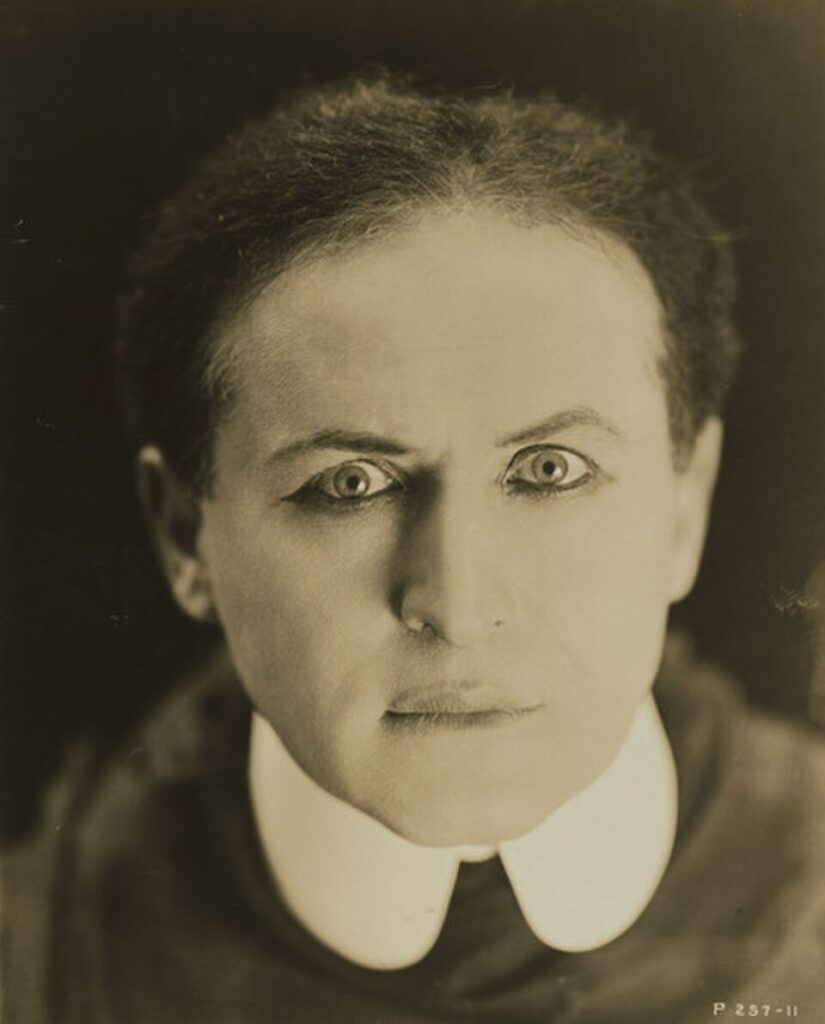
CHRISTOPHER SANDFORD asks what we should make of Harry Houdini, who died a hundred years ago
Considerable ink has been spilled – much of it fruitlessly – in an attempt to portray Houdini’s signature escape act as somehow symbolising the peculiar desire of the common man at around the turn of the 20th century to slip the yoke of his servitude to society’s ruling caste. According to this reading, the magician’s feats of self-liberation from the restraints of handcuffs, chains and prison cells resonated powerfully with working-class immigrants to the United States, like himself, who felt trapped by economic and social barriers in their daily lives. His escapes thus stand as potent symbols of self-determination, hope and above all of resistance to authority figures, from policemen to wealthy elites. Like his near-contemporary Charlie Chaplin in his Tramp persona, Houdini was a universal ‘little man’ with whom ordinary people around the world could identify. Implicit in both individuals’ performance is the proposition that life may be hard, but that one must never surrender or despair, thus anticipating the spirit of Nike’s ‘Just Do It’ exhortation of some eighty years later, if not the sort of self-obsessed individual riddled with internet-induced narcissism sadly prevalent in all walks of life today; the reader may have examples of his or her own acquaintance.
I have to say I remain unconvinced by what could be called the sociological explanation of Houdini’s continuing appeal. It’s almost always a mistake to try and retrofit a particular historical figure, or for that matter to assemble random historical facts, into a neatly unified pattern that few people would have recognised at the time. Whether in their claim that Britain overnight became a socialist utopia with the advent of the welfare state in 1945, or that the country abruptly succumbed to a sort of priapic frenzy characterised by the sight of bare-thighed young women swaggering around Carnaby Street in their Mary Quant miniskirts to a backdrop of herbally-tinged joss sticks and the wafted strains of the Grateful Dead in the so-called Summer of Love 22 years later, social historians are always keen to identify what seem to them to be the transformative shifts in our collective life. Such judgements are generally only feasible with the aid of hindsight. Few people confronted with the individual pieces of the jigsaw can picture the completed puzzle, and by the same token we can surely treat with scepticism the idea that many potential audience members of around the years 1900-26 elected to leave their homes and board the trolleycar for their local opera house or civic auditorium in order to watch Houdini in action because of his supposed allegorical insights into their culture.
What he did offer, of course, was pure entertainment: a beleaguered but indomitable spirit at work, along with a peerless sense of showmanship. Like every truly successful public performer, Houdini was well versed in the props of his profession, which in his case included a thudding, Jaws-like accompanying musical repertoire, in which he often personally participated, to signal the unfolding drama of the occasion. But the instrument he really played best was his audience. Scantily-clad female or garishly-uniformed male assistants abounded on stage as the actual escape acts progressed, darting hither and thither like shoals of tropical fish. Anyone familiar with the numbing combination of blinding lights and amplified music redolent of today’s rock concert need only think of that same experience, but with the added spectacle of actual life-threatening peril, to get some of the flavour.
Nor was Houdini ever exactly a martyr to false modesty, or backward when it came to separating the public from its money. When the prolonged shock of the Great War turned popular taste away from escapology and toward the occult promise of reuniting the bereaved with their lost loved ones, he again shrewdly read the runes and incorporated a spiritualist component into his programme, first in the form of a straightforward demonstration of the supernatural, and then of debunking those he saw as its obvious charlatans. He had known too many of the latter in their former guises as fellow vaudeville performers to take their purported newfound psychic powers seriously. In time, there were also excursions into the worlds of books and of cinema. When in 1919 Houdini mass-produced his autograph for sale on a publicity still that apparently showed him clinging for dear life to the wing of a biplane as part of a barnstorming film called The Grim Game, he added the inscription: ‘About 4000 feet in the air!’ This was a slight exaggeration, as the photo in question had been taken on the ground.
Just for the record, Houdini was not in fact born in the small American midwestern town of Appleton, Wisconsin, on 6 April 1874. The date and place were almost universally accepted during his lifetime, and perhaps lay a suitably false early trail for a career dedicated to the art of illusion. Houdini wasn’t even his real name, of course. He was born Erik Weisz on 24 March 1874 in the family home in the Rákosárok district of Budapest, to the fitfully employed Mayer Weisz and his wife Cecilia. The family emigrated to the United States at intervals in the later 1870s, for some reason settling in the obscure mill town of Appleton before moving to the comparative bright lights of Milwaukee. Mayer Weisz seems to have been only marginally more materially successful in his new life than in his old one. The records show that the family was soon forced to appeal to the Milwaukee Hebrew Relief Society for coal to see them through the winter.
The future Houdini (he took his name from the pioneering French magician Eugène Robert-Houdin) was one of those constantly hyperactive children, with a taut, muscular physique, a fidgety energy, and the burning conviction, he later recalled, ‘that, in America, with hard work and determination, a man can get anything.’ Legend insists that he opened his first lock at the age of six while in pursuit of a piece of pie secured in his mother’s kitchen cupboard. It’s known that one afternoon in October 1883, when he was nine, he earned 35 cents by making his debut as a trapeze artist called ‘The Prince of the Air’ in a Milwaukee circus, and that he later gave a series of impromptu performances around town in which he demonstrated his ability to bend over backward and pick up a pin from the floor with his teeth, among other feats of agility. We also know that, as a young man, he both engaged in a course of rigorous physical training, and made a study of the-then limited variety of standard-issue padlocks and other restraints on the market. All this led up to the moment in March 1897 when he presented himself at a police station in suburban Boston and challenged the amused desk-sergeant to slap his best pair of handcuffs on him. The reports of what happened next vary, but all parties agree on the essential fact that Houdini retired to a corner and returned between one and five minutes later, a free man. Having had the foresight to invite the press, he could not have asked for better coverage than that which appeared in the following morning’s Boston Advertiser. ‘The King of Handcuffs’, it called him.
How did he do it? Alongside practice, dexterity, brute physical force – and the artful concealment of a tiny steel lock pick on his person – there are still elements of the performance that defy any rational explanation. No less a judge than Arthur Conan Doyle never quite knew what to make of Houdini’s act when he first witnessed it on the London stage in April 1920. Three months later, the creator of the world’s most famously rational detective publicly announced that this ‘God-given performer’ possessed a ‘dematerialising and reconstructing force [that] could separate the molecules’ of any solid object toward which it was directed. Houdini himself at first tolerated such whimsy, but knew that his most famous escapes owed their success to more material agencies. Over time, the two men’s differing views on the occult would strain their friendship to its breaking point. In June 1922, Houdini and Conan Doyle attended a séance at the beachfront Ambassador Hotel in Atlantic City, at which Doyle’s wife Jean – a medium who claimed to be adept at the art of automatic writing – scribbled out a fifteen-page message supposedly from Houdini’s beloved mother Cecilia, who had died nine years earlier. As a bulletin from the afterlife it was only partly convincing. Although Houdini again held his tongue at the time, he privately concluded that Jean was not a true psychic. His Jewish mother would never have drawn the sign of the cross atop each page of a letter to her son; nor did it strike him as likely that she would have chosen to communicate in somewhat florid, Edwardian English, a language she had never spoken.
It’s been said that, in time, this growing spirit of mutual hostility ultimately led to Houdini’s death, which was supposedly brought about when a series of muscular young men in the pay of the spiritualist camp followed him about while he undertook a theatrical engagement in Montreal, and that one of their number, a local postgraduate student by the name of Jocelyn Whitehead, quoting the magician’s own boast that he could withstand any blow without pain, suddenly struck him with sufficient force to rupture his already inflamed appendix, and in turn to induce a fatal case of peritonitis.
Whatever the precise cause, it seems fair to say that nothing in Houdini’s life became him like the leaving it. Eventually confined at Grace Hospital in Detroit, he suffered grievously during his final week. Despite this, he roused himself sufficiently to fire off a series of encouraging cables to friends and admirers around the world, including one that remarked evenly ‘I am not feeling at my best just now’, but insisting, ‘I will get over this waviness in no time.’ As his condition worsened, however, he gave his wife Bess elaborate instructions as to how to attempt to contact him in the afterlife, and finally looked up to quietly tell his younger brother Theo, ‘I guess I’m all through fighting.’ They were his last words. Houdini died later that day of what the doctors called ‘Diffuse peritonitis [with] complications’, much the same condition that had carried off another immigrant entertainer who had spectacularly made his name in America, Rudolph Valentino, just ten weeks earlier. Seeming to fulfill at least one part of a recent curse brought down upon him from the stage of a well-attended spiritualist rally at New York’s Madison Square Garden, Houdini’s own time of death was recorded as 1.26pm on Sunday 31 October, 1926 – Halloween.
Bess Houdini duly followed instructions and made repeated efforts to reach her late husband from beyond the grave, but finally abandoned the struggle exactly a decade later. ‘Ten years is long enough to wait for any man,’ she remarked. Her conclusion on the matter will likely not stop the ranks of the curious or obsessed in their own attempted outreach to Houdini’s spirit on the centenary of his death that falls this October. Voices may be heard, and chains somehow appropriately rattle, in various candlelit rooms around the world. On one level, one can see the appeal of the whole enterprise, even it’s really to do more than endlessly repeat what Bess Houdini and others have done before, a sort of occult version of Groundhog Day. Such people may believe the true essence of Houdini’s spirit to lie in some posthumous message delivered in a darkened séance room, but I say it actually resides in the always peerless and often enjoyably mysterious entertainment he selflessly provided during his 52 years of life.

CHRISTOPHER SANDFORD is the author of Masters of Mystery: The Strange Friendship of Arthur Conan Doyle and Harry Houdini