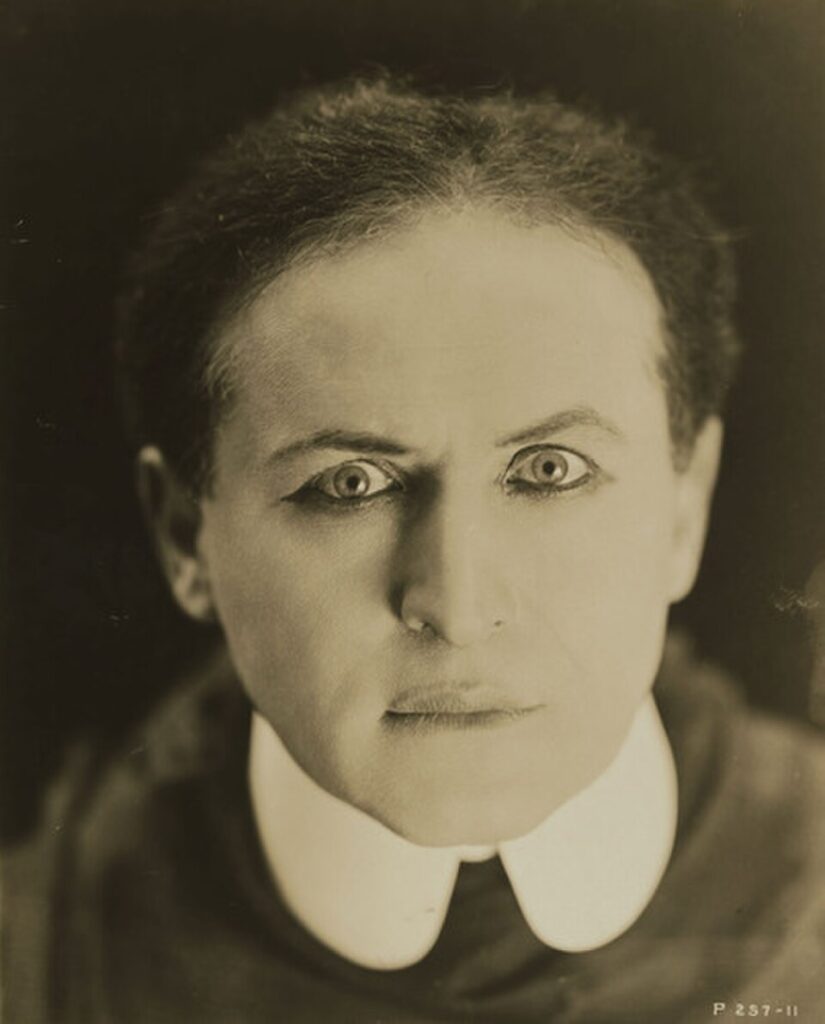
Harry Houdini’s final escape

Harry Houdini, c. 1920

I have to say I remain unconvinced by what could be called the sociological explanation of Houdini’s continuing appeal. It’s almost always a mistake to try and retrofit a particular historical figure, or for that matter to assemble random historical facts, into a neatly unified pattern that few people would have recognised at the time. Whether in their claim that Britain overnight became a socialist utopia with the advent of the welfare state in 1945, or that the country abruptly succumbed to a sort of priapic frenzy characterised by the sight of bare-thighed young women swaggering around Carnaby Street in their Mary Quant miniskirts to a backdrop of herbally-tinged joss sticks and the wafted strains of the Grateful Dead in the so-called Summer of Love 22 years later, social historians are always keen to identify what seem to them to be the transformative shifts in our collective life. Such judgements are generally only feasible with the aid of hindsight. Few people confronted with the individual pieces of the jigsaw can picture the completed puzzle, and by the same token we can surely treat with scepticism the idea that many potential audience members of around the years 1900-26 elected to leave their homes and board the trolleycar for their local opera house or civic auditorium in order to watch Houdini in action because of his supposed allegorical insights into their culture.

What he did offer, of course, was pure entertainment: a beleaguered but indomitable spirit at work, along with a peerless sense of showmanship. Like every truly successful public performer, Houdini was well versed in the props of his profession, which in his case included a thudding, Jaws-like accompanying musical repertoire, in which he often personally participated, to signal the unfolding drama of the occasion. But the instrument he really played best was his audience. Scantily-clad female or garishly-uniformed male assistants abounded on stage as the actual escape acts progressed, darting hither and thither like shoals of tropical fish. Anyone familiar with the numbing combination of blinding lights and amplified music redolent of today’s rock concert need only think of that same experience, but with the added spectacle of actual life-threatening peril, to get some of the flavour.

Nor was Houdini ever exactly a martyr to false modesty, or backward when it came to separating the public from its money. When the prolonged shock of the Great War turned popular taste away from escapology and toward the occult promise of reuniting the bereaved with their lost loved ones, he again shrewdly read the runes and incorporated a spiritualist component into his programme, first in the form of a straightforward demonstration of the supernatural, and then of debunking those he saw as its obvious charlatans. He had known too many of the latter in their former guises as fellow vaudeville performers to take their purported newfound psychic powers seriously. In time, there were also excursions into the worlds of books and of cinema. When in 1919 Houdini mass-produced his autograph for sale on a publicity still that apparently showed him clinging for dear life to the wing of a biplane as part of a barnstorming film called The Grim Game, he added the inscription: ‘About 4000 feet in the air!’ This was a slight exaggeration, as the photo in question had been taken on the ground.

Just for the record, Houdini was not in fact born in the small American midwestern town of Appleton, Wisconsin, on 6 April 1874. The date and place were almost universally accepted during his lifetime, and perhaps lay a suitably false early trail for a career dedicated to the art of illusion. Houdini wasn’t even his real name, of course. He was born Erik Weisz on 24 March 1874 in the family home in the Rákosárok district of Budapest, to the fitfully employed Mayer Weisz and his wife Cecilia. The family emigrated to the United States at intervals in the later 1870s, for some reason settling in the obscure mill town of Appleton before moving to the comparative bright lights of Milwaukee. Mayer Weisz seems to have been only marginally more materially successful in his new life than in his old one. The records show that the family was soon forced to appeal to the Milwaukee Hebrew Relief Society for coal to see them through the winter.

The future Houdini (he took his name from the pioneering French magician Eugène Robert-Houdin) was one of those constantly hyperactive children, with a taut, muscular physique, a fidgety energy, and the burning conviction, he later recalled, ‘that, in America, with hard work and determination, a man can get anything.’ Legend insists that he opened his first lock at the age of six while in pursuit of a piece of pie secured in his mother’s kitchen cupboard. It’s known that one afternoon in October 1883, when he was nine, he earned 35 cents by making his debut as a trapeze artist called ‘The Prince of the Air’ in a Milwaukee circus, and that he later gave a series of impromptu performances around town in which he demonstrated his ability to bend over backward and pick up a pin from the floor with his teeth, among other feats of agility. We also know that, as a young man, he both engaged in a course of rigorous physical training, and made a study of the-then limited variety of standard-issue padlocks and other restraints on the market. All this led up to the moment in March 1897 when he presented himself at a police station in suburban Boston and challenged the amused desk-sergeant to slap his best pair of handcuffs on him. The reports of what happened next vary, but all parties agree on the essential fact that Houdini retired to a corner and returned between one and five minutes later, a free man. Having had the foresight to invite the press, he could not have asked for better coverage than that which appeared in the following morning’s Boston Advertiser. ‘The King of Handcuffs’, it called him.

How did he do it? Alongside practice, dexterity, brute physical force – and the artful concealment of a tiny steel lock pick on his person – there are still elements of the performance that defy any rational explanation. No less a judge than Arthur Conan Doyle never quite knew what to make of Houdini’s act when he first witnessed it on the London stage in April 1920. Three months later, the creator of the world’s most famously rational detective publicly announced that this ‘God-given performer’ possessed a ‘dematerialising and reconstructing force [that] could separate the molecules’ of any solid object toward which it was directed. Houdini himself at first tolerated such whimsy, but knew that his most famous escapes owed their success to more material agencies. Over time, the two men’s differing views on the occult would strain their friendship to its breaking point. In June 1922, Houdini and Conan Doyle attended a séance at the beachfront Ambassador Hotel in Atlantic City, at which Doyle’s wife Jean – a medium who claimed to be adept at the art of automatic writing – scribbled out a fifteen-page message supposedly from Houdini’s beloved mother Cecilia, who had died nine years earlier. As a bulletin from the afterlife it was only partly convincing. Although Houdini again held his tongue at the time, he privately concluded that Jean was not a true psychic. His Jewish mother would never have drawn the sign of the cross atop each page of a letter to her son; nor did it strike him as likely that she would have chosen to communicate in somewhat florid, Edwardian English, a language she had never spoken.

It’s been said that, in time, this growing spirit of mutual hostility ultimately led to Houdini’s death, which was supposedly brought about when a series of muscular young men in the pay of the spiritualist camp followed him about while he undertook a theatrical engagement in Montreal, and that one of their number, a local postgraduate student by the name of Jocelyn Whitehead, quoting the magician’s own boast that he could withstand any blow without pain, suddenly struck him with sufficient force to rupture his already inflamed appendix, and in turn to induce a fatal case of peritonitis.

Whatever the precise cause, it seems fair to say that nothing in Houdini’s life became him like the leaving it. Eventually confined at Grace Hospital in Detroit, he suffered grievously during his final week. Despite this, he roused himself sufficiently to fire off a series of encouraging cables to friends and admirers around the world, including one that remarked evenly ‘I am not feeling at my best just now’, but insisting, ‘I will get over this waviness in no time.’ As his condition worsened, however, he gave his wife Bess elaborate instructions as to how to attempt to contact him in the afterlife, and finally looked up to quietly tell his younger brother Theo, ‘I guess I’m all through fighting.’ They were his last words. Houdini died later that day of what the doctors called ‘Diffuse peritonitis [with] complications’, much the same condition that had carried off another immigrant entertainer who had spectacularly made his name in America, Rudolph Valentino, just ten weeks earlier. Seeming to fulfill at least one part of a recent curse brought down upon him from the stage of a well-attended spiritualist rally at New York’s Madison Square Garden, Houdini’s own time of death was recorded as 1.26pm on Sunday 31 October, 1926 – Halloween.

Bess Houdini duly followed instructions and made repeated efforts to reach her late husband from beyond the grave, but finally abandoned the struggle exactly a decade later. ‘Ten years is long enough to wait for any man,’ she remarked. Her conclusion on the matter will likely not stop the ranks of the curious or obsessed in their own attempted outreach to Houdini’s spirit on the centenary of his death that falls this October. Voices may be heard, and chains somehow appropriately rattle, in various candlelit rooms around the world. On one level, one can see the appeal of the whole enterprise, even it’s really to do more than endlessly repeat what Bess Houdini and others have done before, a sort of occult version of Groundhog Day. Such people may believe the true essence of Houdini’s spirit to lie in some posthumous message delivered in a darkened séance room, but I say it actually resides in the always peerless and often enjoyably mysterious entertainment he selflessly provided during his 52 years of life.

Spirits of the Jazz Age – the Spiritualist craze of the Twenties

CHRISTOPHER SANDFORD evokes an age of desperate belief

On 7 September 1919, the 60-year-old Sir Arthur Conan Doyle, GP, lecturer, seafarer, sportsman, indefatigable social campaigner – and globally-renowned author of the Sherlock Holmes tales – shared the platform of a Spiritualist rally at the seafront Grand Hotel in Portsmouth with a 38-year-old medium named Evan Powell. The Great War had ended just ten months earlier, and it had taken a fearful toll on Conan Doyle’s family. He lost no fewer than 11 relatives either to combat or disease, among them his 25-year-old son Kingsley, who had been invalided out of the front line in France but then succumbed to the Spanish Flu epidemic. It was a blow from which many felt his father never quite recovered.

After several departed souls had apparently materialised on the stage of the hotel ballroom, Conan Doyle, his wife Jean, and five colleagues repaired to a private upstairs room where they searched Powell, tied him semi-naked to a chair, and turned off the lights.

“We had strong phenomena from the start”, Doyle later wrote to his friend the physicist Oliver Lodge.

The medium was always groaning, muttering, or talking, so that there was never a doubt where he was. Suddenly I heard a voice.

‘Jean, it is I.’

 My wife cried, It is Kingsley’.

I said, ‘Is that you boy?’

He said in a very intense whisper and a tone all his own, ‘Father!’ and then, after a pause, ‘Forgive me!’

Conan Doyle, who assumed Kingsley was referring to his earthly doubts about the paranormal, concluded his account by saying that he had then felt a strong hand pressing down on him, followed by a kiss on his forehead. “I am so happy”, his late son assured him.

This encounter would have a profound effect on Conan Doyle, hitherto best known as the creator of English literature’s most formidably rational human calculating machine. Soon the author turned away from detective stories and towards a steady stream of papers and speeches on the subject of what he called collectively the “new revelation”. It was now clear to him, he wrote, that this insight into the ultimate meaning of life was not for his benefit alone, “but that God has placed me in a very special position for conveying it to that world which needs it so badly.”

Of course, Conan Doyle wasn’t the first celebrity, or even the first literary giant, to apparently commune with the dead. In 1849, Charles Dickens had begun to attempt ‘mesmeric cures’ of his young sister-in-law, who was said to be suffering from ‘intestinal evil.’ The great novelist reported that his performances of ‘animal magnetism’, as hypnotism was then called, afforded him clairvoyant power. Personalities as diverse as Queen Victoria, W.B. Yeats, and Edvard Munch all later engaged in Spiritualistic efforts to reach a departed loved one. There was a dramatic surge of interest in the paranormal both during and in the immediate aftermath of the American Civil War, with its 620,000 military casualties and undetermined number of civilian deaths. In the White House, Abraham Lincoln and his wife Mary held a series of candlelit séances following the loss of their 11-year-old son William to typhoid fever, by no means the last time a US president would dabble in the occult.

But it wasn’t until the early 1920s that the Spiritualist message really gripped the imagination of the Western public. It did so as a consequence both of the Great War, and of the period of unrivalled national prosperity that followed. It sometimes seemed that the concept lying deepest at the heart of American life, in particular, as that country embarked on its extended period of 20th-century world dominance was that of illusion. The nation had bread, but it wanted circuses – and now it got them, in an explosion of music halls and other places of entertainment offering a rich variety of fare whose most common artistic theme was the idea of mystification, legerdemain, or some other form of deception. In 1909, there were 427 officially licensed “Mentalists, visual deluders, and [other such] artistes” active in the seven core eastern seaboard states; a decade later, the figure had jumped to 6,390, quite apart from the profusion of “street fakirs, jongleurs, bunco merchants, miracle workers, healers and seers” one New York newspaper found at work in the city.

“The times hungered for something”, remarked Harry Houdini, a sceptic who knew something about escapism, in every sense of the term. “A war memorial had appeared in every town, and many people naturally sought some divine solace for their grief.” Unfettered by an established Church, America was particularly rich in alternatives, among them such sects as the Holy Rollers, the Holy Jumpers, and the estimated three million followers of the evangelist Frank Buchman, whose core gospel of ‘inclusiveness’ eventually led him to try to convert Adolf Hitler.

But none of those groups, however well-patronised or devoted to their various causes, compared in size or intensity to the worldwide Spiritualist crusade with Conan Doyle as its de facto head. By early 1923, there were reported to be some 14,000,000 ‘occasionally or frequently’ practicing occultists, served by a network of 6,200 individual churches or lodges, in North America alone. Barely a week passed without some sensational paranormal claim appearing in the newspapers or over the radio. ‘“MY FRIENDLY CONTACT WITH DEPARTED SOULS: MESSAGE RECEIVED FROM MURDERED CZAR”, by Grand Duke Alexander of Russia’ ran one such headline in the New York Times. A few weeks later, Doyle explored this same historical turf when he and some friends sat down in a darkened room of a London home and apparently made contact with the recently deceased Bolshevik leader Vladimir Lenin. The revolutionary hero left the sitters with the cryptic advice: “Artists must rouse selfish nations”.

In Edwardian Britain, the fashion for Spiritualism often came with a feminist subtext. Women were thought to be uniquely qualified to communicate with spirits of the dead, and in the séance room, at least, a medium could enjoy a degree of independence and authority not readily available to her elsewhere. There are no reliable figures on actual attendance at séances or services, although it was widely believed at the time that an increasing number of the nominally respectable were dabbling in psychic affairs. When reviewing the history of Spiritualism in the UK, Houdini would remark that

…by the turn of the new [20th] century an invitation to tea amongst London’s gentility would often conclude with a candlelit course in which the spirits would be asked to reveal themselves by rotating or lifting the table, among other manifestations, to the delight of the audience.

As early as 1882, the British movement as a whole was sufficiently widespread to bring about the creation of the Society for Psychical Research (SPR), with a committee of largely Cambridge-based academics promising

…to approach [Spiritualist] issues without prejudice or prepossession of any kind, and in the same spirit of exact and unimpassioned enquiry which has enabled Science to solve so many problems, once not less obscure nor less hotly debated

One can almost hear a foreshadowing of the ‘Follow the data’ mantra that distinguishes the great Covid debate of our own day. The SPR initially set up five subcommittees, to variously investigate Mesmerism, Mediumship, Reichenbach Phenomena (electromagnetic forces), Apparitions and Haunted Houses, and Séances, as well as a Literary Panel to study psychic history and conduct surveys. In one early census, the SPR asked 17,000 British adults whether they had ever experienced a “spiritual hallucination” while fully awake and in good health. Of the 1,684 who said they had, there were those who insisted that they had been psychically ‘embraced’ or ‘kissed’ by an unseen force, among several other less conventional liaisons.

                                                                         ***

There were several reasons other than the shock of war and the extended economic boom that followed for the early-20th century loss of momentum in the traditional religious dynamic. For one thing, science again. Who needed the Church, the theory went, when the answers to day-to-day life could be found in the laboratory? Presented at every turn with new labour-saving devices that owed their existence to breakthroughs in automation (this was the era of the vacuum cleaner, the washing machine and the refrigerator), the Western man – and, increasingly, woman – in the street was ready to believe that technology could accomplish almost anything. On the loftier philosophical level, people were now reading daily about scientific developments that seemed to lend respectability to psychic beliefs.

Among the newly evolving doctrines that purported to question man’s role in the universe was Quantum Field Theory – on one hand, a structure designed to analyse the creation and annihilation of minute particles, and on another, a contemplation on the ‘non-observable’ material world. It was one of several such “seismic jolts”, as the lapsed Catholic Conan Doyle called them, of an era that also saw the belated confirmation of Einstein’s general theory of relativity, as well as the invention and rapid availability of the household radio, which Oliver Lodge, one of its pioneering figures, insisted was itself a medium that allowed the spirit world to communicate with the living one over the ether. Many people shed their traditional religious beliefs in the face of rational scrutiny, while, to others, science diluted religion to a watery sort of social work.

By the spring of 1921, the Spiritualism debate was sufficiently ingrained in all walks of life for it to be the theme of several prominent Easter Day church services on either side of the Atlantic. In fact, opposition to the occultist message seems to have united the ordained ministry of New York, in particular, to a degree not seen since their similarly stout defense of Prohibition in 1918-19. At the city’s Seventh Day Adventist Temple, for instance, an overflow audience of 672 heard Revd. Carlyle Haynes speak on the topic of “Can the Dead Come Back? An Answer to Sir Arthur Conan Doyle”. The minister of the Community Church of New York was compelled to hurriedly move proceedings to the nearby 800-seat Lyric Theater in order to accommodate a congregation reportedly “seething” for his own views on the subject. Rabbi Lewis Newman, preaching at the Temple Israel on Central Park West, roundly mocked the idea that “the departed ever bring tidings from the grave”, a notion that “could surely only be visualised by a writer of fiction”.

Meanwhile, what might be called the more enlightened, or charitable, Roman Catholic attitude was expressed by the British Jesuit priest Herbert Thurston, when he wrote:

If Spiritualism has the merit of upholding the belief that man is not purely material and that a future life awaits him, the conditions of which are in some measure dependent upon his conduct here on earth, it must be confessed that there is very little else to set to its credit. Catholic teaching recognises one divine revelation which it is the appointed office of the Church, in dependence upon the living voice of the Supreme Pontiff, to maintain inviolate. For this, Spiritualism substitutes as many revelations as there are mediums … all these communications being open to suspicion and, as the briefest examination shows, abounding in contradictions about matters most vital.

Many contemporaneous Roman Catholic views on the spirit world were not as benign as that. The Catholic author J. Godfrey Raupert, a psychic investigator who abandoned his initial sympathy on the subject, wrote in the 1921 edition of his book The Dangers of Spiritualism:

The root of Spiritism … is the diseased moral condition of the age … Too powerfully dominated by intellectual pride to submit to the law of Christ, men seek another world capable of demonstrative proofs … That they should build a system upon phenomena which elude rational examination, that they should stake their hopes for time and eternity upon manifestations which have so much in common with the juggleries of the magician, while at the same time they shut their eyes to the proofs of supernatural life and supernatural power which living Christianity offer them, is a melancholy example of that fatuous superstition which is so often the punishment of unbelief.

Even this was mild compared to the likes of Fr. Arnold Pinchard, who in July 1921 wrote to enlighten Arthur Conan Doyle about his views on the “deplorable tendency” of Spiritualists to put curiosity-seeking before the cardinal requirement of seeking God. “You probably do not realise that I speak as a Catholic,” he wrote, “and that Catholics have certain knowledge upon such matters which others like yourself, more in an atmosphere of doubtful empiricism, lack.” Some of Conan Doyle’s critics took a more robust tone even than that. The author was to remark of one telephone conversation with the perhaps well-named Lord Dunraven, a self-appointed ‘Catholic authority’ on a wide range of spiritual matters, that “he was so furious that I felt it best to hold the instrument away from my ear.”

Arthur Conan Doyle and “the little chap”, Harry Houdini

Perhaps the greatest, and certainly most theatrical, showdown between the two foremost public performers of their day, respectively representing the pro- and anti-Spiritualist camp, came when Conan Doyle and Houdini met in the author’s suite at the Ambassador Hotel in New Jersey’s Atlantic City one sunny afternoon in June 1922. Even the occult can have produced no stranger sight than that of the birthright Catholic, then a stout, mustachioed 63-year-old figure of military gait, seated alongside his equally substantial wife and the “little chap”, as Doyle affectionately called their guest, the latter dressed in an ill-fitting white tropical suit, with their heads bowed over a table in their candlelit room. They were there in an attempt to bring Houdini news from his sainted mother Cecilia, who had died nine years earlier. In time the three sitters joined hands, and said a prayer. For some moments after that, Lady Doyle, who had recently begun to show a gift for channelling the spirits, sat motionless, poised over the blank writing pad before her. Then, with a jolt, the pencil in her hand began to move.

“It was a singular scene” Conan Doyle later wrote,

…my wife with her hand flying wildly, beating the table while she scribbled at a furious rate, I sitting opposite and tearing sheet after sheet from the block as it was filled up, and tossing each across to Houdini, while he sat silent, looking grimmer and paler every moment.

Lady Doyle was eventually to produce 15 pages seemingly full of the late Mrs. Houdini’s expressions of love for her son, including the statements “I am so happy in this life”, and “It is so different over here, so much larger and bigger and more beautiful”, and concluding, “God bless you, Sir Arthur, for what you are doing”. It was “profoundly moving” for all parties, Doyle later wrote, and a “striking affirmation of the soul’s immortality”.

When they met in New York two days later, Houdini gave Conan Doyle the impression that he believed “my mother really ‘came through’ … I have been walking on air ever since”. Over the next few weeks, Doyle spoke effusively of the event in public meetings, and in a full-length book he called Our American Adventure, while the ‘little chap’ apparently did nothing to contradict him. But perhaps it was all another case of artifice by a master of the craft, because Houdini later marked a newspaper report of the event with a satirical “Ha! Ha! Ha!”, while coming to wonder why it was that his dear mother should have chosen to communicate with him in fluent English, a language she had never spoken.