Season of satire

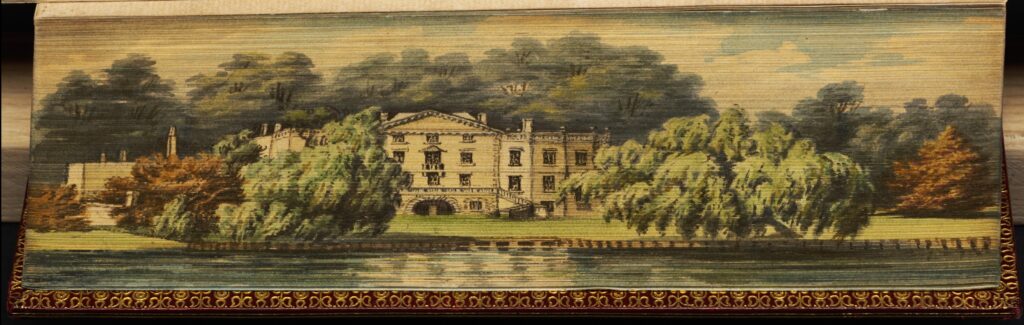
1863 book fore-edge painting of Pope’s Villa at Twickenham

The Twitnam Summer: Friendship, Satire and the Writing of Gulliver’s Travels

Hester Grant, London: William Collins, 2026, hb., 336pps., £25

Early in the eighteenth century, the Middlesex village of Twickenham began to be noticed by Londoners wearying of the metropolis, drawn by the attractiveness of its Thames-side setting. One admirer was Alexander Pope, a poet of waspish reputation and socially problematic Catholic background, who in 1720 built a riverside villa in the latest Palladian style on a five-acre plot set between a malthouse and a tanner’s yard.

Pope was widely considered England’s preeminent poet, thanks to works like Essay on Criticism (1711), from which we get the phrases “A little learning is a dang’rous thing” and “Fools rush in where angels fear to tread”. He had also written The Rape of the Lock (1712), a mock-epic about the cutting of a hank of hair belonging to a society beauty, and Windsor Forest (1712/3), a lyrical example of loco-descriptive poetry. He had translated the Iliad, and knew Joseph Addison, Richard Steele and William Wycherley.

He was friends, too, with Jonathan Swift and John Gay – and between May and August 1726 played host to both at his house in what was then commonly called ‘Twitnam’, at a pivotal time in all three men’s creative lives. The works associated with that season have ever since been regarded as among the brightest ornaments of English letters.

Pope had known Swift since Windsor Forest, which as well as evoking that history-haunted tract, was also a commentary on contemporary politics. Pope’s poem was adopted by the Tories as useful agitprop, and the poet annexed by Swift, twenty-one years older, the Dean of St Patrick’s Cathedral in Dublin, and a highly effective veteran of political pamphleteering at an especially turbulent time. Dichotomies and discontents left over from the Civil Wars had found new expressions in vitriolic battles between Whigs – mostly Dissenters, anti-Stuart, and allied to mercantilism and finance – and Tories – mostly Anglicans, pro-Stuart, and associated with the landed gentry – with all the writers of the age enthusiastically taking sides.

Swift was famous for Tale of a Tub (1704), a satire on denominational disagreements between Christians, and the clash of old and new learning, and the Bickerstaff Papers (1708-9), a still funny extended lampoon of the Whig astrologer-propagandist John Partridge. After the Whigs took power in 1715, and began purging Tories at all levels, Swift’s writings waxed increasingly incandescent, sometimes forcing changes in government policy, infuriating Prime Minister Robert Walpole.

Walpole’s period of political dominance, between 1721 and 1742 – nicknamed the ‘Robinocracy’ – was notorious for its corruption and partisanship, and the generally unwanted extension of state power through patronage and preferment. Swift took courageous stances against such practices, frequently risking his liberty, and became a folk hero in Ireland, his writings uniquely able to unite Catholics and Presbyterians against exploitative London policies. Swift was held in such awe in Ireland that on one occasion he was able to disperse a crowd which had assembled to watch an eclipse by telling them it had been put off on his orders. Ironically, Swift saw himself as English, and didn’t much approve of the Irish, but any reservations about his adopted country were outweighed by his desire for social stability, and moral outrage at abuses by the rich and powerful.

Swift brought to Twickenham the militantly ironic manuscript which would make him immortal – Travels into several remote Nations of the World. In four parts. By Lemuel Gulliver. Gulliver’s Travels is one of the great books of the eighteenth, or any, century – a masterpiece of surreal invention and sustained invective which gave the language ‘Lilliputian’ and ‘Yahoo’, and held up the perfect Houyhnhnms to shame humans into better behaviour. Its exposure of cant, folly, gullibility and human weakness is still resonant; Gulliver is, wrote Morris Golden in his 1972 study The Self Observed, “more painfully ourselves than any other creation of his century.” Swift made his last tweaks during his time at Twickenham, and on the 8th of August packed it off to the printer, and posterity.

Almost as sensational in their day, if perhaps less read now, were Pope’s Dunciad (1728) and Gay’s Beggar’s Opera (first staged in 1728), both influenced by Gulliver and prodded into being by Gulliver’s author. Swift reputedly snatched a first sketch of the Dunciad out of the fire into which Pope had cast it. Years before, he had given Gay an idea for a “Newgate pastoral, among the whores and thieves”, and now made Gay bring it forward.

Pope penned the Dunciad to poke fun at bad or sycophantic writers, some of whom had recklessly assailed him in print, ironically giving them a more lasting fame than they would ever have attained otherwise. The poem’s portentous closing lines are still cited – “Lo! thy dread Empire, Chaos! is restor’d; / Light dies before thy uncreating word: / Thy hand, great Anarch! lets the curtain fall; / And Universal Darkness buries All” – but no stylistic fineness can conceal the essential redundancy of his squibs against such ignes minores as his former publisher Barnaby Lintot, and the malignant Irish cleric-poetaster Jonathan Smedley. The only target who could be called well known is the dramatist Colley Cibber, who in 1730 became one of the least distinguished versifiers ever to occupy the post of Poet Laureate. The Dunciad nevertheless contributed greatly to contemporary Whig discomfiture, and Pope’s then and future fame.

Gay had written unusually empathetic poetic conjurations of rural life, and finally following up on Swift’s old idea, completed his musical play The Beggar’s Opera, which introduced the characters of Polly Peachum and her highwayman beau Captain Macheath to enthralled London playgoers. Gay supposedly made £800 from the play, leading to a joke that it had made Gay rich, and Rich (the surname of the producer) gay. The strength of the satire is evident from the outset, the first song sung by Polly’s father, a receiver of stolen goods and underworld informer, which runs in part “The Priest calls the Lawyer a Cheat, / The Lawyer be-knaves the Divine: / And the Statesman, because he’s so great, / Thinks his Trade as honest as mine.” Delighted-scandalised audiences saw shades of Walpole in Mr Peachum, Macheath and a gang-member, “Bob Booty”.

Gay’s spin-off, Polly, was accordingly banned by the Lord Chamberlain, which naturally excited frenetic interest. The Duchess of Marlborough paid £100 for a copy, and the Duchess of Queensberry was banished from court for soliciting money for Gay within the precincts of the Palace. The Opera had become a powerful weapon in the Tories’ intellectual armoury. It is ironic to recall that Gay’s most famous modern emulator was the Marxist playwright, Berthold Brecht.

The conversations of that summer must have been as sparkling as the Thames, and they were occasionally joined by guests like William Congreve, the politician-philosopher Henry St. John (1st Viscount Bolingbroke), and the polymathic physician Dr John Arbuthnot, who invented the bluff English archetype, ‘John Bull’. As well as agreeing in morals and tastes, the three were also united in bachelorhood. Gay’s innate indolence appears to have extended to his relations with the opposite sex. Swift was platonically devoted to two women – Esther Vanhomrigh (“Vanessa”) and Esther Johnson (“Stella”) – whose correspondence with him reveals the literary lion’s private humanity and humour. The unluckily diminutive and deformed Pope – he was 1.3 metres tall, and suffered from Pott’s disease, which twisted his spine and gave bladder and bowel problems, joint pains, headaches and eye inflammation – seems to have been celibate much against his will.

Hester Grant conjures this dazzling company deftly, memorably conveying the flavour and likely routines of that sunlit season, as the trio conversed, read or wrote, wandered in the celebrated gardens, or sat in the shell- and mirror-encrusted grotto called the Nymphæum in search of shade and classical inspiration. She also offers excellently observed wider vistas of these extraordinary artists in full, the politics and literature of their period, and a capital city full of corruption and disquiet, but also abounding creativity and vitality, where wits traded brilliant insults and speculative builders raised elegant edifices above stinking streets.

That London is lost, and Pope’s villa has gone, with just the Nymphæum to mark where once a great poet walked with great friends, and all imagined a world less unclean. Three hundred years on from that remarkable meeting of minds, this is a poignant portrait of an England that once was, or maybe could have been – and a satisfying reminder of the power and possibilities of literature.

This review first appeared in Engelsberg Ideas, and is reproduced with permission

Voyages through vanities

Gulliver’s New Travels: Lemuel Gulliver Collides with the 21st Century

Guy Walker, self-published, 2022, 140pp, £4.99

DEREK TURNER is entertained by a clever updating of a classic

Satire, often thought of today as a liberal genre, can also be a conservative art. Any writing that relies for its comical or scourging effects upon the discrepancies between fantasy and truth, hypocrisy and sincerity, can lend itself easily to a conservative sense of realism, and distrust of fine rhetoric. Cant, dishonesty and foolishness are perennial, and no respecters of parties.

Satire was practised by Aeschylus and Euripides amongst others, who wrote plays as jocular tragedies, wherein the actions and words of serious characters were constantly being undercut by drunken, foul-mouthed, priapic satyrs. Such contrasts have a recurring appeal to a certain type of person, who may be of either ‘Left’ or ‘Right’, depending on who is in power, and how badly they are abusing that trust.

Chaucer belaboured corrupt clerics, not on anti-clerical but on pro-Church grounds. Satire was also deployed by reforming humanists like Sebastian Brant, whose still-read 1494 Das Narrenschiff (‘Ship of Fools’) was just one of many similar salutary works – not to mention Thomas More’s Utopia (1516). Rabelais’ Gargantua and Pantagruel was officially condemned, but 16th century Cardinals kept copies in their cassocks. Juvenal’s withering satires of the Rome of the first and second centuries were of intrinsic appeal to the 18th/19th century writer William Gifford, editor of the Quarterly Review (the journal which coined the term ‘Conservative’), who became one of the poet’s most successful interpreter-translators. The contemporary comedian Andrew Doyle uses his avatar ‘Titania McGrath’ to lampoon the inconsistencies of ‘intersectionalism’, and prick the priggishness and pomposity of over-sensitive orthodoxies. 

Jonathan Swift was first a Whig and then a Tory, whose loathing of the Deist and mercantilist currents of his time led him into morally outraged vituperation, most famously his 1829 Modest Proposal to deal with Irish poverty by advocating anthropophagy, at a time when the English authorities seemed content to let the Irish starve – a phrase which has become shorthand for any straight-faced outrageous suggestion. Most lastingly, of course, he dreamed up the disingenuous Lemuel Gulliver – a supposedly simple mariner cast up by shipwreck into a parallel universe, where the assumptions, institutions and practises are oddly reminiscent of those of early 18th century Europe, with just a wicked twist to emphasise the essential ridiculousness of the originals.

Gulliver epitomises Swift’s ideal of the Englishman – brave, enterprising, inquisitive, resourceful and sturdily commonsensical, with a tincture of Protestant prejudice. Gulliver’s Travels was deservedly successful, even if at times Swift’s touch is too heavy, and the conceit is carried on too long. Two centuries on, the English writer Guy Walker has been inspired to follow this great unflagging example, and apply Swiftian lucidity and smiling scorn to some of the deceits and rodomontade of today.

Walker is notably widely read and a retired teacher of language, attributes made evident by the orthographical exactitude of his text (‘atchieve’, ‘Emmets’, ‘extream’, ‘Fanfaronade’, ‘smoak’), and his familiarity with the atmosphere and state of knowledge of the England of Swift’s time. An unwary reader could easily assume that the ‘real’ Gulliver did indeed visit the fantastical realms of Khiliastika, Obversia and Ypsilosia, especially as these are interponed on this itinerary with Swift’s Houyhnhnms and non-fiction’s St. Helena. The ‘authenticity’ of Walker’s style and vocabulary inescapably entails offensiveness to certain refined members of modern audiences, for whose delicate benefit he includes a prior ‘WARNING’ that is all part of his vigorous joke. But inside all his rumbustious humour, as inside Swift’s, is a swingeing critique of some of our prevailing reductive philosophies, a wonderfully witty appraisal of some of the ways we delude ourselves.

Khiliastika is a land of ostentatious self-abasement, whose inhabitants vie with each other in demonstrations of humility, even publicly classing themselves below animals. Inevitably, this so-public humility is really private pride, a neat inversion of the former worldview, when pride in being part of the hierarchical ‘Great Chain of Being’ had really been a kind of modesty, which acted as restraint. The present Khiliastikan elite is idly rich, existing parasitically on the fruits of former industry and responsibility, with rather too much time to adorn themselves and consider their own reflections in strategically placed mirrors. Domestic servants and other workers on Khiliastika (as elsewhere!) are largely disregarded as irrelevant, even as their masters and mistresses vie with each other in expressing egalitarian and internationalist sentiments, and loudly apologising for their very existence. Parallels with modern middle-class checking of privilege and virtue-signalling (a phrase Swift could almost have coined) hardly need to be adumbrated.

Wealthy Khiliastikans are also subscribers to an apocalyptic philosophy, which holds that the old industries had critically damaged the world through over-heating of the air, exacerbated by the ‘Flatus and Ructations’ of ‘Cattell’, horses, and the islanders themselves. People are ergo expected to abstain from meat-eating and leather- or wool-wearing, and await the coming of a braided young ‘Prophetess’ bearing a not wholly adventitious resemblance to Greta Thunberg.

Prestigious ‘Virtuosi’ and ‘Universal Artists’ are employed to find ways of storing the animals’ involuntary emissions, and even to plug an active volcano. Others are building vehicles powered by magnets, springs or wind, others metal domes to afford protection for when the sky falls in, yet others an Ark for the end of days. Those who diverge from any detail of the orthodoxy are pilloried, ridiculed and excluded even from employment. Even for readers less sceptical of anthropogenic climate-change than this author, the satirical strokes fall fast, and hard.

Onwards to Obversia, a black kingdom whose inhabitants treat the mariners with extraordinary condescension – because amazed ‘at the Miracle of Humans of a white Complexion shewing that they too could make Shift to build and navigate a Merchantman.’ Rich Obversians compete to offer accommodation to the pale barbarians, because they see this as an opportunity to demonstrate their non-racist charitableness. They are haunted by Obversia’s one-time prominence in the slave trade, which had long ago entailed the kidnapping of countless ‘white-Complexioned’ people to boost the economies of Africa.

Obversia’s impressive-looking Grand Academy is staffed by grave intellectuals, determined to upturn all assumptions (such as that men differ from women), and ultimately erase Nature. According to the Academy’s overarching theory, everyone is equal and interchangeable, and everything inherited from the past, including maths and science, is illegitimate. Politicians, including the rather ponderously-named ‘Sir Kirkley Streamer’, when not in power themselves, as a matter of both principle and policy always advocate the opposite of whatever the government is doing, irrespective of its merits. Poor and starving people are kept on a barren offshore island, so they can be inspected and publicly petted by wealthy mainlanders, who have themselves painted in such edifying poses. A whole ‘Œconomy’ has grown up around this practice, and when Gulliver asks why the poor are not allowed off this island, to settle in available fertile land on the mainland, he is laughed at for his simplicity – because they are more valuable to the exchequer (and public morality) where they are.

They leave this island gladly, and are then captured by the airborne ships of the powerful Ypsilosian Navy. All the Ypsilosians’ military might is dedicated ironically to the service of a state which advocates a universal language and ultimately universal peace. The savants and wealthy residents of the capital, Schro Dinga on the River Phrenos, float serenely above the ground, uplifted by the rarefaction of their reasoning, while earth-bound drudges toil below. Beautiful women in elegant salons condemn their Objectifycation and oppression by men, and bewail the squalid necessity of child-bearing. Prominent businessmen call for higher taxes, and condemn the common people for worrying about the price of food and value of their hovels. Senior military men espouse saccharine pacifism, and the country’s leading intellectual urges the severance of all connections to culture and nation – and biology and geography. At the Temple of Transcendence, a gorgeously attired celebrant preaches disbelief in deities, but foresees lifespans of a thousand years and in the meantime, the survival of intelligence by means of electricity.

Gulliver and his companion dislike all this vastly; ‘we had begun to find the Attempt to be and not be the same Thing at the same Time inimical to the Composure of our Brain and the Quietude of our Minds.’ They escape, and make sail to St Helena, a British colony and assumed safe haven – only to find that ideas like those prevailing in his recently-visited dystopias have made their way here too.

Under the rule of a party calling itself the Know-Alls, the common islanders have been discouraged from making up their own minds about anything until ‘This might extend to their not even being able to distinguish confidently between their Posteriors and their Elbows.’ Now called contemptuously Know-Nothings, ordinary people have been fenced out of old land-holdings by Projectors, enclosed out of ‘Common Sense’. Philosophers strive to reduce life on even this tiny outpost to rigid formulae, even trying to mathematize the arts, banning dangerous displays of spontaneity and enjoyment. This abhorrent state of affairs calls for outraged action, and Gulliver is just the kind of Englishman to act. Condign punishments ensue, and ancient arrangements are resumed, to general contentment.

Gulliver sails on eventually, the ever-restless Englishman, an Anglo-Saxon Everyman – but he leaves behind a better island, and real-life readers wishing real-life restorations could be quite so easy, or swift.