STUART MILLSON enjoys the sounds of the classical continuum
In Director, Ken Russell’s famous 1962 Monitor film about the life of Edward Elgar and narrated so memorably by Huw Wheldon (a patrician voice clinging on in what was a changing era), the point was made that the English composer’s life encompassed three facets: “the romantic, the drum-beating patriot, and religious visionary”.
Certainly, the religious element – Elgar was a Roman Catholic – is hugely significant in his work, as his most famous oratorio, the Cardinal Newman setting, The Dream of Gerontius (1900), testifies. Six years later, now knighted and perhaps the nation’s most famous and recognised composer, Sir Edward turned again to religious themes, but this time a piece about the earliest days of the Christian church, with a libretto selected and woven together by his own hand from both the Old and New Testaments. Whereas The Dream of Gerontius began with a hushed orchestral introduction – as if the mist of incense is beginning to clear in the shadows of a Worcestershire rural Catholic Church – The Kingdom opens with a “rushing wind”, a tremendous, revelatory symphonic call-to-arms, before subsiding into one of Elgar’s most moving passages, almost out-Nimrodding Nimrod: surveying the lands of the Bible, the morning of Pentecost, Solomon’s Porch – all seen through the hazy summer skies of the Malvern Hills.
Revelatory, too, is the May 1957 recording of the piece, set down for posterity by the SOMM label – and, thanks to Elgar expert and sound-technician, Lani Spahr, presented in astonishingly-detailed, audio-restoration glory. I do not use the latter term lightly: for here we have the pre-eminent Elgar conductor of his age, perhaps of all time, Sir Adrian Boult at the Royal Festival Hall, at the helm of the BBC Symphony Orchestra, with the voices of (in those halcyon days of regional and London choruses) the much-acclaimed Croydon Philharmonic Society. The soloists, too, are names that dominated the concert stages and recording studios of the 1950s to early 1970s: Heather Harper, Helen Watts, William Herbert and Gordon Clinton. But aside from the Elgar and Boult interest, another important element exists with this recording, and that is the capturing of a sound-of-voice, tone-of-voice and diction which, over the last 60-odd years, has almost been lost. The best way in which I can describe the sensation is by comparing the voice, of say, Kenneth More or indeed, Huw Wheldon, to an actor or announcer of today. SOMM’s new CD is a vital piece of social history, too.
The fill-up work on this two-CD set, the Enigma Variations, is another remarkable archive performance: Sir Adrian Boult again, but this time abroad – in Holland, in that year of peril, 1940. Conducting Amsterdam’s Concertgebouw Orchestra (now, Royal Concertgebouw) we are reminded of a time when Elgar was played more frequently in continental Europe than he is now. Needless to say, the Dutch orchestra is on fine form as one of the greatest ensembles of its time – an excellence continued, post-war by Van Beinum and Haitink, and which, of course, lives on in our own time under new generations of musicians. But when Boult stood before those players, just months before Holland was overrun by Nazi Germany, the combination of music, emotion, world events all seemed to make a potent brew. We are so fortunate to be able to dip into the Europe of 86 years ago and to hear – and imagine – what must have been in people’s hearts. Another truly superb addition to SOMM’s (and the world’s) music library.
The anguish of totalitarianism, this time of the Soviet era, is brought into focus by another of SOMM’s productions, the Symphonic Diptych, Anna, Op. 171 by David Matthews (b. 1943). Anna – an opera, with libretto by the philosopher and writer, the late Sir Roger Scruton, tells an anguished story of Peter and Anna, whose father (during the years of the Iron Curtain) was imprisoned for assisting anti-Communist dissidents. Anna meets a young man, Miro, with whom she falls in love, but it is later revealed that his own past, spent cooperating with the authorities, was responsible for their father’s death. The tragedy unfolds, but the composer brings us not operatic extracts or the full drama, but instead, a symphonic compression of this modern saga – an intensive, half-an-hour ‘symphony’ in its own right, Mahlerian in its emotions, but more pared down, more intimate, more of a philosophical conversation between the music and the listener.
Performed by the Ulster Orchestra under Jac Van Steen and recorded two years ago in Belfast, this is the brightest of modern recordings, showing the rich tone of the Northern Ireland players, especially the pinpoint, sharp yet subtle brass and woodwind instruments, captured with both balance, forthrightness and radiance by SOMM’s director, Siva Oke, and Recording Engineer Richard Campbell – with mixing and mastering by Alastair McMillan. The team at the recording console also bring us a change of mood and tempo, in the form of the David Matthews Flute Concerto, given a mesmerising, air-borne, joyful and fabulously detailed rendition by soloist, Emma Halnan – acclaimed several years ago at the English Music Festival for her performance of Malcolm Arnold’s Flute Sonata.
Another contemporary composer, Nimrod Borenstein (b. 1969), is currently bringing his exacting, intense, but fluid and compelling conducting style to the English Chamber Orchestra, in a new Mandolin Concerto performed by Alon Sariel. Borenstein rejects the leaden, de-Natured, tortured landscape of much old-hat, self-consciously anti-tonal ‘music’. In conversation, the conductor-composer talks in a torrent of intellectual passion about Mendelssohn and Mozart, so it is easy to see the inspiration behind his own exciting, classically based, thoroughly tuneful compositions. SOMM’s discography embraces not just the old masters, but a genre of contemporary music that has something to say and which belongs to the continuum.
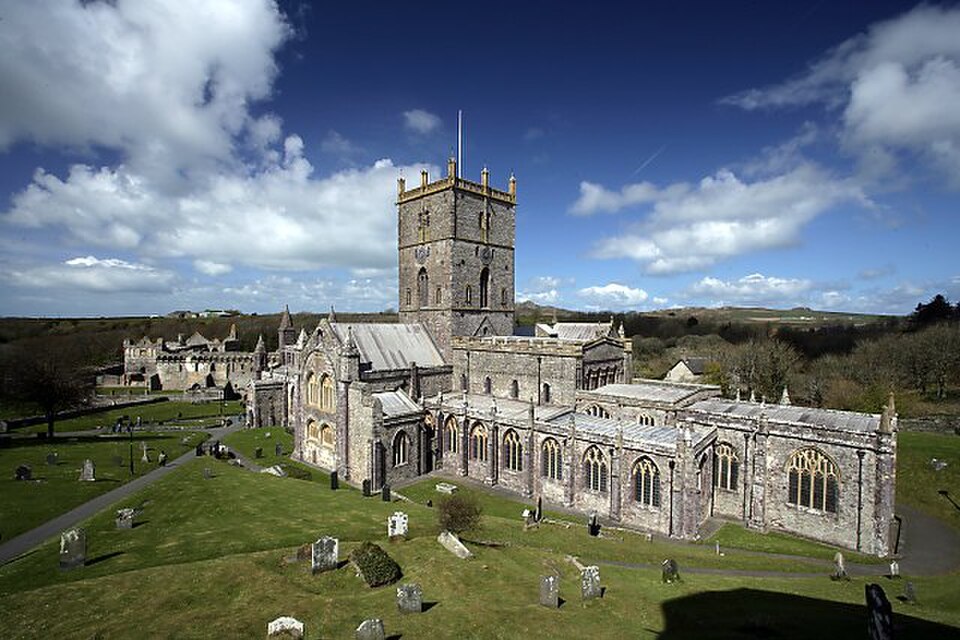
Finally, live music, courtesy of the enterprising, classical-opera and folk-filled Fishguard Festival of Music in West Wales, in their grand opening concert at St. David’s Cathedral on the south-western tip of Cambria. In a countryside alive not just with Festival fever, but wrapped up in preparations and bunting for August’s Eisteddfod, it seemed completely right that the opening works celebrated folk tradition – in this case, the movements, Sarka, and From Bohemia’s Woods and Fields by Bedrich Smetana. Czech conductor, Tomas Hanus, drew both intense and delicate playing from the Orchestra of Welsh National Opera – the players clearly enjoying the experience of performing as a symphony orchestra ‘on stage’, rather than an ensemble half-hidden beneath flooring occupied by singers and scenery. Sarka is an alarming tale of a deadly female warrior army of legend, in which the orchestral pace is sometimes strident and alarming, yet in the contrasting woods and fields of Bohemia, Smetana invites us to wander dreamily in meadows (which some two decades later, Mahler would consecrate to Pan).
A more spectral rural atmosphere, this time in England, was evoked in George Butterworth’s Six Songs from A Shropshire Lad, sung by the prize-winning young baritone, Steffan Lloyd Owen – whose voice took me back to concerts and recitals by the famous Cornish baritone, Benjamin Luxon, an artist prominent in the 1970s and 1980s who recorded the cycle, but with piano accompaniment. In the St. David’s performance, perhaps a slightly slower tempo might have been in order, as occasionally (such as in the song, Look Not in My Eyes) I found the clarity of the words a little indistinct. But nevertheless, the interpretation unearthed all the treasures of Butterworth’s and A.E. Housman’s native soil – romance, lost love, the passing of youth, the sacrifice of a generation (the composer was killed on the Western Front in 1916), the memory of the town fair, good chaps and friends, the cherry tree, and the ploughed field.
A delightful interval was spent in the grounds of the cathedral, watching jackdaws find their nests and nooks in the great building’s tower, and listening to the mid-evening swifts, scything and “scree-screeing” through the drowsy, warm air. The interval bell summoned the capacity audience back to the final work, the Symphony No. 4 by Brahms, written in the Austrian countryside of Styria in 1884-85 (1885 being the year Butterworth was born). Brahms’s Fourth is often considered, especially in its opening and final movements, a tragic, autumnal, even wintry work, casting a spell of solitude and introspection. Yet all such thoughts are banished in the headlong, joyful rush of the Allegro giocoso third movement – the WNO musicians filling the cathedral with a head-spinning, summer energy. After the applause had died down, the orchestra paid its own tribute to Tomas Hanus, now leaving the company for pastures new. A moving encore from Songs my Mother Taught Me by Dvorak seemed the perfect end to this well-thought-out programme of heavy high summer.

STUART MILLSON is a member of the Chartered Institute of Journalists, and a Contributing Editor to The Brazen Head