Verse modesty

Liberality and Modesty, by Guido Reni

Talking to Skeletons

David Dumouriez, Liverpool: erbacce-press, 90pps., £10

The third poem in David Dumouriez’s collection is titled ‘POETRY IS WANK.’ It’s printed in capitals, runs two pages, and closes on the line “POETRY WILL NEVER NOT BE WANK.” Provocation or confession, it sets the terms for the book: eighty-odd pages from a poet who refuses, on the surface, to take poetry seriously, and who is, all the same, very good at it.

Talking to Skeletons ranges from English childhood to Istanbul, and the mixture is as eclectic as that suggests. There are elegies and satires, love poems, a walking tour of a childhood town, political rants, an ode to Cary Grant’s suit in North by Northwest, and a two-line poem about a curry. The voice is colloquial (sometimes too much so), sardonic, and almost religiously allergic to pretension. Rather than the elevated register, Dumouriez reaches for the pub, the bus stop, the snooker club. He is suspicious of anyone who takes themselves too seriously — himself included.

For me the collection’s finest moment is ‘51° 30′ N, 0° 25′ E,’ a long walking tour of a small English town that slowly turns into an elegy for a vanished self. Dumouriez takes us past polling stations, dog walks, rusted goalposts, a toyshop run by a Polish man, a church where he and a friend once tried to summon a thunderbolt by swearing at the threshold. The imagery is specific and unhurried: “Another postbox. Focal point back then. / Not sure now.” The accumulation of observed detail makes the place feel at once ordinary and irreplaceable. Memory, class and mortality converge without any of them being announced. And somehow the combination works.

‘Reading Kipling by Candlelight’ is one of the more personal poems in the book, and the one I found easiest to climb inside. Set during the 1999 Istanbul earthquake, it follows the speaker through a night of confusion. He mistakes the tremor for a burglar, goes back to sleep while the parks fill with frightened residents, and only in the morning grasps the scale of what he slept through. It’s funny and quietly unsettling at once. Dumouriez has an instinct for the exact detail that lifts an anecdote into something more: “Myself and one old woman, two floors up, / remained at home. My flaws you’ll find described. / As for her, perhaps she’d given up on life.” That last line does something the earlier stanzas don’t prepare you for. Death has entered what had been, up to that point, largely a comic story. And then life shrugs and moves on.

Talking to Skeletons is at its strongest when the humor and the grief run in parallel. ‘An Anglican Event’ opens with “My mother lies before us in a box, / to put it blunt,” and proceeds to take a funeral apart with deadpan precision: the vicar who “styles himself as ‘Father Tim,’” the embarrassed congregants working through hymns they haven’t sung since school, the curtain that makes it real. ‘Ex of England’ pulls off something similar with a grandfather’s hoarded possessions and an unidentified Victorian portrait heading for a bonfire. The joke in these poems does not push the grief aside; it comes out of the same material.

Dumouriez is most interesting when he runs into something that resists him: a death, a memory, a place, the stubborn survival of affection. When the sardonic voice has something to push against, the friction produces complexity. He is less interesting when he already knows what he thinks before the poem starts.

The smaller provocations don’t all land. The opening of ‘Sonnets from the Portuguese, 43 (revised)’ – “How can I fuck thee? Let me count the ways” – is genuinely funny and technically competent parody. But some of the shorter satirical pieces (‘Addendum,’ ‘Laid Back, Laid Under,’ ‘The Poetry is in the Potty’) read more like social-media wit than poems. Set beside ‘51° 30′ N, 0° 25′ E’ and ‘Reading Kipling,’ they sound a dissonant note. Dumouriez knows the difference between a poem and a punchline. He just prints the punchline anyway from time to time.

The unevenness points to a larger issue. Across the eighty-odd pages, subjects and attitudes recur – death, aging, literary pretension, cultural irritation – and a handful of the lighter pieces work against the stronger ones nearby rather than for them. A shorter book might have been a stronger one. That said, the excess is clearly a part of how Dumouriez writes, forever spotting something else that seems to want a joke or an elegy.

I come to the book as a poet who works mainly in formal verse and in two languages – about as far from Dumouriez’s aesthetic as one can reasonably get. What I hadn’t expected was how little the distance ended up mattering. Talking to Skeletons isn’t really asking to be identified with; it’s asking for a reader willing to be amused, provoked, and every so often caught off guard – the anecdote that opens onto mortality, the joke that turns without warning into grief.

Which is also, I think, why the opening declaration eventually defeats itself. For all the mockery of poetry and poets and gatekeepers (and his own reasons for writing), Dumouriez’s best poems rely on the one thing “POETRY IS WANK” pretends to distrust: the idea that arranging words carefully might preserve something that would otherwise vanish. That a poet who opens with “POETRY IS WANK” also writes “51° 30′ N, 0° 25′ E” is, in the end, the strongest argument against his own thesis.

A well-examined life

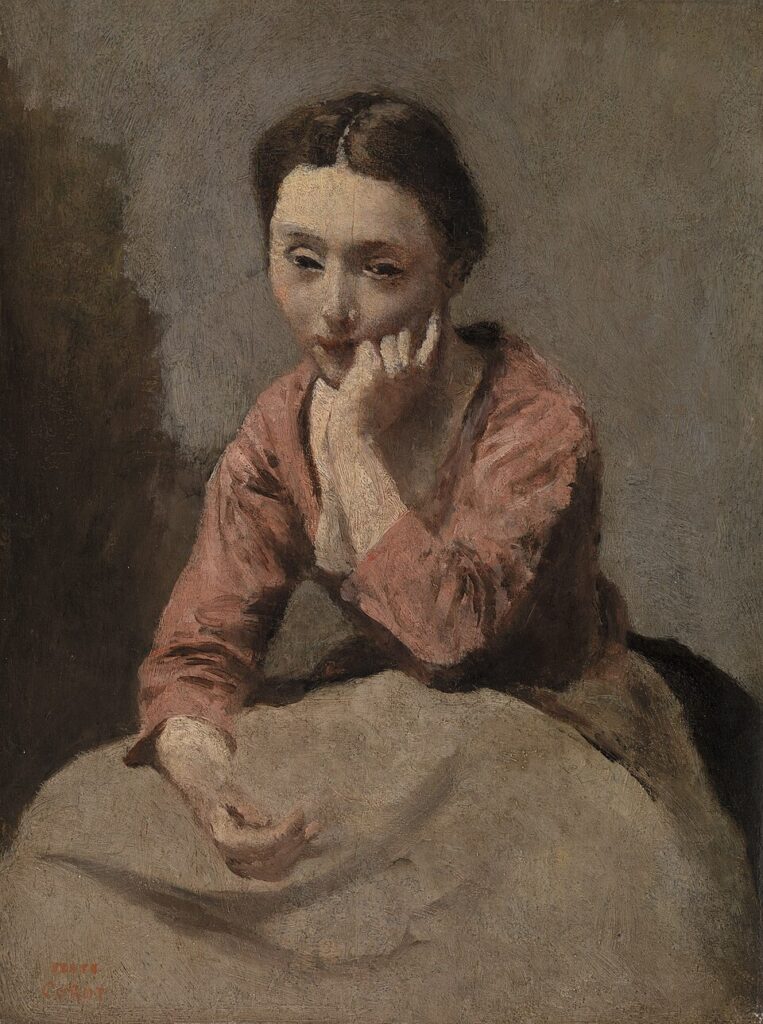
Pensive Woman by Jean-Baptiste-Camille Corot

Time and Other Solvents: A Story of Healing, Told in Poems

Claudia Gary, Sligo Creek, 2026, pb., 96pps., £12.99

Full disclosure: Claudia Gary is my teacher. I mention this upfront, because it shapes my approach to Time and Other Solvents – a poet reading a poet, with the personal connection inevitably influencing the process. Poetry can obscure as easily as it reveals, which is why it takes courage to turn it on your own life. Gary does exactly that, across eighty-plus poems and a whole life, in forms ranging from the villanelle to the sonnet to free verse. It is one of the most honest books I have read in years, and one of the most charged.

The collection is organized as a triptych. Part I traces a childhood in New York and elsewhere, filtered through art, music, a brilliant and damaged mother, and the first intimations of loss; Part II follows the speaker through the joys and pains of adolescence and young adulthood – asserting her space, a marriage and life abroad, another marriage, pregnancy, and an off-and-on background of eating disorder; Part III moves into a hard-won adulthood – grief, recovery, the death of parents, and the return to (and through) art. The title says “A story of healing”, and it is not a marketing phrase. It is a precise description of what the book does and how it works.

I admire Gary’s command of form. The sonnet ‘Perfect Time’ splits cleanly into two numbered sections: the first a subway ride with her mother, the second the mother’s psychiatric hospitalization and ECT, which Gary names in a footnote with clinical plainness: electroconvulsive therapy. The second section opens: “Perfect time’s up. A brittle stick of chalk, / you’re quivering, sobbing, packing for somewhere.” The same rhyme scheme, the same fourteen lines – but the mother who was singing is now shaking and being packed off to a clinic. Gary doesn’t explain the gap. The form does it. It is notable that the first part is an uninterrupted block of text, while the second one is broken into stanzas – somehow adding to the difference between the childishly joyous stream of thought and brittle, uncertain reality of a clinic. The villanelle ‘Getting Lost’ ends: “Patterns of bricks, words, music, inexhaust- / ible in variation, began oozing / out of that childhood dream once double-crossed. / I found myself through fear of getting lost.” That fear becomes the reason to write.

The mother is the centre of the book, and Gary gives us time to understand that relationship. The mother was an artist herself – a maker of mosaics, a repairer of picture frames, a woman who guided her daughter’s hand across the paper. She was also someone whose own mind had been damaged by the very treatments meant to mend it. In ‘Her Memory,’ Gary says: “Mom was a blessing once, / a vibrant tapestry, / until they took away / her woven synergy. / Although her inner strength / turned into cruelty, / her earliest bright stitches / dance through my memory.”

That the mother who could receive half an embrace before pulling back, who could call her clinging child “sticky chewing gum,” who retreated from half an affection, also taught that same child to see the world – this is the contradiction the book is built on.

Part II turns personal. The eating disorder is present from ‘Empathy’ through ‘Bulimia’ and into ‘The Spill’ – shown, named, and examined. A poem addresses Princess Diana directly, noting they shared a hushed disease before it had its public name. ‘Desserted’ is about chocolate the way addiction is about the substance – not really. ‘Wrong-Way Driver’ uses a near-collision on a dark road – a wrong-way car narrowly missed, the baby in the back seat sleeping through it – to ask whether a brush with death is enough, or whether the will to live has to come from somewhere else. ‘The Cure’ takes that question head-on: the speaker has been told real illness demands a real cure, not an imagined one. The final couplet doesn’t argue – it just states what is true: “You have been cured by friendship, words, and song.”

Part III is about losing the people who made you. The father who walked through the Brandenburg Gate just after the Wall fell, who had once been a billboard face for bourbon in cities the daughter never knew; the mother who, near the end, ran her fingers through her daughter’s curls and apologized for straightening them chemically decades before. ‘Barrier Reef’ returns to that childhood subway ride and what the mother tried to teach there – and finds that something the speaker once refused has finally come through. The poem ‘Marathon’ holds the mother’s dying with quiet control – its returning lines carrying the long duration of dementia, until her last words turn out to be about airline ticket prices, and then she is gone. The quietly intense poem called ‘In the Cellar’ gives the collection its name – stories kept in airtight vessels, agitated from time to time, until one day they appear “translucent.” The poet asks: Will I someday grow old / enough to speak of them?” The book itself is the answer, and it took decades to get there.

I come to Gary’s work as a poet myself – someone who has spent years wrestling with formal verse in two languages and knows what it takes to make a form work rather than merely contain. What I find here is something else I aspire to: an image that carries more weight than an argument. ‘Skating Lesson’ ends with one: “Under the frozen surface of a pond / was a baby. I ran to break the crust, / and found the child alive. / From this dream I gathered, / Yes, have children. / The message had a hibernating twin: / Ice will revive you.” It’s the most quietly hopeful image in the book.

I also understand many of the losses Gary writes about – not the same losses, but similar in shape and scope. The distance between a parent’s aspiration and their capacity for presence. The experience of arriving in a foreign country and learning to live inside another language. The way poetry and music are not escape routes so much as load-bearing walls, the things that hold you together while you figure out how to hold yourself together. Reading Time and Other Solvents felt, at many points, like being recognized by a stranger – which is perhaps the best thing a collection of poems can do.

The book ends with ‘Comfort Food,’ a short poem that manages to be funny and devastating in equal measure: lentils, barley, split peas, water, salt – the recipe is simple, almost nothing, and then in the third stanza, with no warning: “Towers have toppled / into the soup.” A poem can do that – fold the catastrophic into the domestic without irony and without sentimentality – only if the poet has earned it by paying attention, poem after poem, to things that hurt. Claudia Gary has earned it.