Chapter Five – An age of wood

This is Part Five of LIAM GUILAR’S almost completed epic of Britain. Part One was published in Long Poem Magazine #25 Spring 2021, and Chapters TwoThree and Four in The Brazen Head. For more information about Hengist, Vortigern and the Legendary History, visit www.liamguilar.com

The story so far. Mid Fifth Century; Hengist and his brother Horsa have sailed to Britain where they have been taken on as mercenaries by Vortigern, the newly appointed leader of the Province. Their immediate, shared problem is an army of Picts. In the long term, Hengist’s desire to establish a kingdom must bring him into conflict with the Britons. He is scheming to ensure the conflict will be fought on his terms. Vortigern’s desire to save the Province will bring him into conflict with Hengist, but also with Vortimer, his eldest son and those Britons who resent his even-handed rule, while happily benefitting from it. The story of Thongcaester in this chapter marks the continual shift in the Legendary History between possible history and the world of folk tales.

Snap shot of Hengist

‘Fuck me’, said Horsa,

‘that’s a lot of paint.’

The Pictish horde, a festering

howl of painted bodies, surging

towards the silent lines,

stopping, stepping back,

closer each time,

building the rhythm

of their final charge.


‘We should pray now to Woden, god of all battles?’

‘If you wish’, replies Hengist. ‘I’m betting on our Roman.’


No speeching, no boasting,

no threats of discipline.

Vortigern had explained what needed to be done,

trusting his soldiers would do it.

And wonder of wonder, they trust him.

Hengist admires the choice of ground.

The limited front negates the Pict’s numerical superiority.

The lack of slope, conventionally a disadvantage,

leaves the cavalry who loiter on the flanks

an open field to move across.

The pitch perfect voice steeling the ranks.


In an avalanche of noise, the Picts attack.

‘Hold your lines!’ says the voice.

The Picts shatter like glass hurled against a wall. 

Brothers in Arms

After they destroyed the Picts

and massacred the survivors,

after they hunted raiders in the west,

after the spoils had been divided.


‘You’re staring at your spear,’ said Hengist, ‘is something wrong?’

‘It would look better’, says his brother, ‘with his head on it.‘


Hengist smiles. ‘The Picts and Scotti, they are worthy enemies?’

Horsa thinks about it, nods, ‘Bold fighters, yes, strong warriors.’


‘In every battle that we’ve fought’, says Hengist, tiptoeing,

‘we’ve been outnumbered but we’ve held the field,

yet lost so few in doing so?’ Horsa, still imagining his spear

adorned with Vortigern’s head, nods, admitting this is true.


‘We gave him our word that we will serve.’


‘Was it still our word in their birdy babble?

We told our people we would find a home.

How is this home if we don’t give the orders?’


‘Everyone but god takes orders.

Fifty of the best fighters these islands have seen

are sparrow fart in a thunderstorm

if we inherit his enemies and turn

his former friends into our foes.


Either we finish off his enemies

and slaughter all his friends

so you can decorate your spear.

Or we serve him well,

bait our trap and when he’s caught

the hired hand becomes the master’s equal

and our grandsons give the orders.’

‘So we’re sending for my niece?’

‘Soon’, says Hengist, ‘soon,

I’ll be sending for my daughter.’

Vortigern lectures his eldest son on recent history

‘Four hundred years the legion kept us soft.

They broke the tribes, removed

their expertise with point and edge.

Head hunters once, we worried about status,

cultivated roses, practised Latin,

patronised the makers of Mosaic floors.


The legions kept the peace and fought the Empire’s wars.

They were the turtle’s shell and we the soft

delicious flesh barbarians dreamt

of feasting on. Now the legions have gone over

and left us on our own. The forts are empty,

the watchtowers home to nesting birds.

The weapons we kept hidden, heirlooms,

are a language we’ve forgotten how to speak.

Time washed us up, defenceless and alone,

like a turtle stranded on its back.

Now the predators are moving in.

Until we train an army, we hire muscle.’


‘These men are pagans, father.

What kind of world will you build with their help?

We should exterminate them all

and build God’s kingdom on their bones.’


‘Oh child, your Jesus loves us all?

He cares and is compassionate?

He is a just and loving God?

Did your mother deserve her fate? 

What terrible crime could she commit

to earn such terror and such pain?

Do you believe the Gods are even handed?

Prayer will not drive the raiders back.’


‘You favour them.

I have no land. I have no income.

I have no household of my own.

They point at me and say,

There goes Vortimer nithing.

His father does not trust him.’


‘What is there in what I’ve done

suggests I do not trust you?’


‘You will not let me fight beside you.

You are keeping me from glory.’


‘There is no glory fighting pirates.

I want you to gather Britons

who are willing to fight.

I want you to help Gloucester train them.’


‘Help him? I am your son.’


‘And you have no experience,

no skill, no proven aptitude.

What do you know of training fighting men?

Survival depends on our success.

This is not a time for-self-appointed experts.


Do this and I shall give you land:

and income for your household.’


‘And should I refuse to second Gloucester?’


Vortigern, saying nothing, leaves.

Snap shot of Hengist #2

Gods roll their dice, or fortune cranks her wheel.

You choose your metaphor to regulate the chaos.

Despite the fragile palisade and ditch,

it’s just another village; the usual beehive huts,

wattle fences, pigs, angry dogs. Hardworking adults.

Dirty children looking up to see the sky collapse.


It’s in Vortigern’s path, where and when it needs to be.

Held by some sad fool who calls himself a King,

who thought he could defy the call to Lincoln.

A stash of weapons and some looted goods

are all excuse he needs to make this place a name

to go before the army to infect his enemies with fear

and curdle resolution. The name will mean,

terrifying cruelty; it will translate annihilation.


Warriors slipped off the leash are happy to oblige.

Vortimer sits on the hillside, with two bound captives.

They will carry the news. They will spread the virus.

Horrified, he had protested to his father:

‘You’re letting pagans murder Christians.’


‘Treason is a crime that must be punished,

regardless of the gods they claim to serve.’

Hengist, bloodless, arriving with Keredic.

‘He has a wife and daughter.’ The irrelevance

confusing father and son into baffled silence.


‘He wants to know if the King is married?’

‘My mother is with God and all his saints.

She worshipped Christ.’ ‘Where was He then

when I buried what was left of her?’


‘Raiders? Saxons?’ ‘Britons,

scratching at old tribal sores.

She wasn’t British.’ Hengist bows.

‘He says he’s sorry for your loss.’


Sincere, but qualified,

even in translation.

Thongcaester

Success following success, the age of stone

gives way to wood. See Vortigern the King,

now seated on his wooden throne,

in a wooden hall, smoke filled and dim.

The shadows threaten. The council has dissolved,

he is the one the people look to for solutions

But they remember their grandfathers despised the younger man.

Those who were punished forget how they had sinned.

The sons of those rewarded forget their loyal fathers bled

to earn the lands and titles they inherited.


Vortigern can hear death sharpening her scythe,

scraping in his dreams, the endless ‘help me’.

The whining of the privileged, the weeping of the poor,

silenced as Hengist went down on one knee.


‘Lord’, he said, ‘we have served you well.

We have wives, children, but no home.

We have kept the promises we made.

I ask for land to settle as our own.’


Vortigern, touching the coin he wears,

‘You will dig a ditch and build a palisade.

You will invite your family and your allies

you will forget the promises you made.’


‘We gave our oath that we would serve.

We served, we all bled, many died.

I do not ask for much.’ ’Good dog’,

I’ll give you land,’ Vortimer replied.


The understudy claiming the performance.

He is stepping out to claim the light.

The assembly shoals. Some out of curiosity,

some keen to see the son and father fight.


The King, enthroned, watching,

inscrutable. His silence a surprise.

Gloucester tugging the boy’s sleeve,

whispering, ‘My lord this is unwise.’


‘If it is my land’, this to his father,

‘then I can give it to your dog without your leave.

He only needs enough space for a kennel.

I will give you’, and he pauses,


like a comedian anticipating his applause,

‘as much as you can cover with a flayed bull’s hide.’

Hengist, ignoring insult and insulting laughter,

listening to Keredic, asks: ‘Covered by?


Repeat his promise, but contained in.’

No one notices the switch of verbs.

‘Now make him swear, on all that he holds holy,

that he will give to me as much land


as can be contained within a flayed bull’s hide.’

This nit picking, detracting from his moment,

infuriating Vortimer: ‘I swear by God

and all his saints, by Holy Mother Church,


upon my mother’s grave and on

God’s wounded hands and feet and side

I will give this heathen as much land

as can be contained within a flayed bull’s hide


and freely give him leave, to host as many

as can stand or sit and shit in it.’

Smirking applause from the sycophants,

who may live long enough to learn that Hengist


should not be underestimated.

Or insulted. Nor should Vortigern.

Adolf picking at his cloak

won’t look at anyone.


Hengist, his brother, and their retinue

trailing a growing entourage of British Lords

who thought the joke too good to miss,

wander through Vortimer’s possessions

with a calculated insolence

that worried only Gloucester.


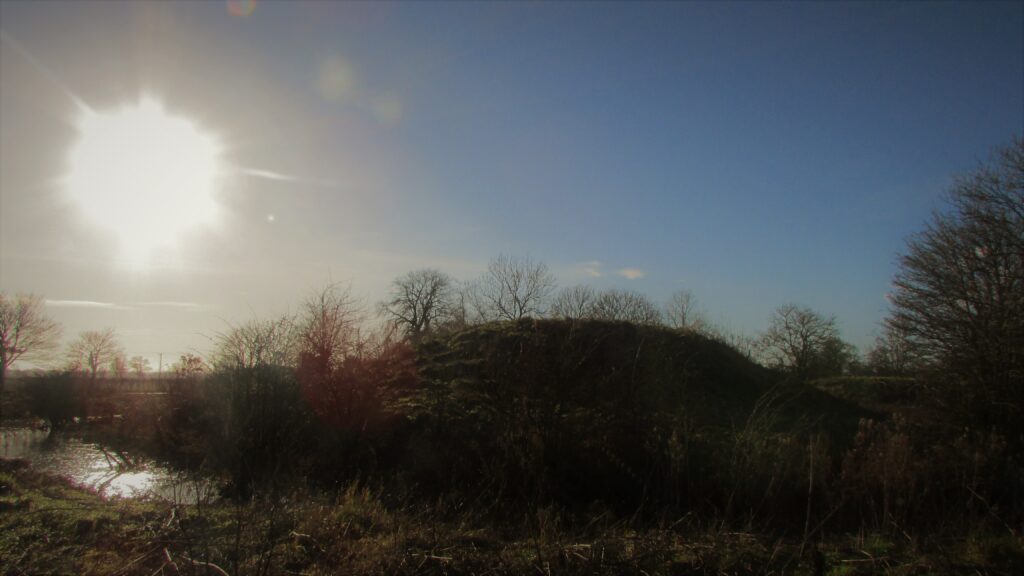
Until they found a hill, wrapped in a river bend,

with steep slopes falling to the water

a fresh spring, clear views, a wood nearby.

While the others camped and drank,

and waited for the punch line to the joke,

the brothers sauntered down the river to the sea.


When they returned they flayed a bull,

to Vortimer’s confusion gave the hide

to the most skilled of all their leather workers,

who sharpened his knives,

and cutting the thinnest of lines,

made a single, long, unbroken thong.


As the onlookers grew silent,

Hengist marked out his new property.

Saxons were soon digging a ditch

building a palisade, hauling timber,


hammering together a fine high hall

for fire and feast and fellowship

and huts, for families, for the ale maker,

a smithy with a forge, wattle fences for the kine.


With a speed the Britons would ascribe to magic,

the Saxons to their own hard work and skill,

the hill was cleared and Hengist’s new home built.

He called it Thongcaester, lest Vortimer forget.


It was not as big as Pevensey or Porchester.

but big enough. Then he sent for his wife

and his sons and his daughter.

Before the wedding

There’s thunder in the east.

Gloucester walks with Vortigern

through the ruins of a villa

and the flicking of the first drops

of a welcome summer shower.

Given jobs that he does well,

Adolf has been generously rewarded,

the benefits of obedience

outweighing the temptation to rebel.


The journey here, past ruined temples,

ruined homes, strung together 

by ruined roads reminding Vortigern of Ovid.


So much changes; so little stays the same.

But he is wary of bad metaphors.

Landscapes are not people. 

Gloucester is a stouter version

of the up and coming man

most likely to succeed.


Translating his personal ambitions

to devotion to the public cause;

the restoration of the Council,

the unification of the Province.

But hard to tell if he has changed

or if his new clothes are just old clothes

dyed and cut a different way.


‘The Boys?’[i]

‘Are not a problem, yet.’

‘They blame you for their brother’s death.’

‘His retinue got drunk and slaughtered everyone.’

‘A retinue of Picts that you had trained.

‘He sent me away.

When he realised

I‘d stand beside the Council.

When he couldn’t pay,

they killed him.’

‘They claim it was a ruse

to make the Picts afraid,

to force them to rebel.

Because you wanted to be King.’

‘And then I killed them all?

I cleaned up the mess, remember?’

‘To cover up your crime.’

‘That’s not what happened.

What other news?’

‘Hengist’s wife and daughter have arrived.’

A silent Vortigern admires the broken wall

where a rose bush has grown wild.

‘He’s going to pitch her at you.

At this great feast in his new hall.’

What would the owner of this rose

think of the incomers

who built their cooking fires

upon his mosaic floor?

‘We pay him for his service: he’s our servant.

I marry his daughter: he becomes our ally.

My father in law. Our equal.’

‘If you turn her down, he’ll revolt.

The word is fifty keels have landed.’

‘Seventeen. I had them counted.’

‘Seventeen or fifty. Fifty Picts did Constantine.’

The tide rolls in.

There is no dam, dyke, ditch

will keep it back.

What’s seventeen keels,

each day twice as many land

scattering incomers along the coasts

families moving inland

some intent on mayhem

others looking to settle.

If we do not find a way

to make them part of us

they will make us irrelevant.


Take the title, become the title.

The obligations of the office

before personal desire?

‘He will expect a Morning Gift.’

‘Then give him Thanet. It’s already his.

It’s not like she’s deformed,

or old. They say she’s stunning.

You get to break her in.

Teach her a trick or two.’

Golden hair incongruous

against the bishop’s bony knees.

‘I’m marrying a woman or a horse?’

His awkward attempts at blokiness rebuffed

Gloucester withdraws, hurt and baffled,

like a puppy that’s been kicked.


Vortigern watched as summer rain

streamed off the roof. Someone

loved this garden. I had a wife.

The daughter of a Roman General

who had no time for flowers.

She liked things, pretty things.

She married me to guarantee

the hard bright pretty things

and we could have grown old

in comfortable indifference.


Take the title, be the title.

Do what needs be done.

‘And the Church, and the British Lords?

When they hear their King is fornicating

with a heathen, when they see the pagan,

Hengist treated as their equal?’

‘What they think won’t matter when we’re safe.’

‘Outrage is a pastime for the lazy.

A wedding will be one more faggot

for the funeral pyre.

She converts before we marry.’

‘The Bishops won’t baptise a Saxon.’

‘How long would it take

to dunk her in a river

and mutter the usual spells?’

‘Marry the girl. Hengist won’t revolt.

When The Boys return, we’ll have an army.’

How beautiful a garden after rain.

The intensity of colour, the clarity of scent.

Gloucester’s red cloak shrinks into the dusk.

An army I can trust? Unlike the one you’re training?

The word is Gloucester, you’re talking to The Boys.

If you make me choose,

I’d rather stand by Hengist than against him.


Vortigern returns to the rose bush.

Sweet smell of sadness and regret

after the rain, with the light fading.


[i] The sons of Constantine the King, who fled to Britany after their father and eldest brother were assassinated.

Fernando Pessoa – shadow of a ghost

Pessoa: An Experimental Life

Richard Zenith, Allen Lane, 2021, 1,088pp, £40

ALEXANDER ADAMS applauds a comprehensive study of a complicated writer

If, after I die, they should want to write my biography,

There’s nothing simpler.

I’ve just two dates – of my birth, and of my death.

In between the one thing and the other all the days are mine. […]

– ‘lf, After I Die’, Fernando Pessoa writing as Alberto Caiero

He led a respectable life. He wore smart clothes to the office. He wrote and translated material, sometimes with a flourish that belied his extramural activities. He was courteous and a touch playful, a bachelor in his thirties. He was given to using spare time to write at his desk. At the end of the work day, he would put on his hat and raincoat and walk through the capital’s streets, thinking of his latest project. Perhaps he would go to his usual café, where he would see friends. They admired him as a writer, appreciating his abilities, chiding him for his perfectionism. He published a little but they knew he wrestled with larger work which was not made public, even to them. When he died he was mourned by his friends and his readers but they did not realise what a giant he had been. In time, he would come to define their whole nation.

This could be a description of Franz Kafka but it is not. American Richard Zenith is a leading authority on Fernando Pessoa. He has edited and translated Pessoa’s writing. Living in Lisbon, Zenith inhabits Pessoa’s home city, relic of a glorious age and scene of an inexorable decline. It is a testament to Zenith’s devotion and ingenuity that he has managed to produce a 1,000-page biography of a figure whom he describes as ‘fanatically private.’ There is no autobiography; there are few revealing letters; the most informative ones are the drafts and unsent (mostly unfinished) letters he kept. There were no direct descendants. There are three diaries with short factual entries that together cover a total of over half a year. Zenith describes the interviews and memoirs of those who knew Pessoa as uninformative – or at least informative on how reserved the subject was. Pessoa was well aware of this and seemed to have actively participated in this occlusion. He was much given to self-reflection and intimations of both immortality and obscurity.

Pessoa claimed to be descended of ‘a mixture of aristocrats and Jews’ although neither predominated nor were proximate to him. His family was largely agnostic (or non-practising) Catholics, more devoted to music than God, who earned a living serving the state. His maternal grandfather was a civil servant and his paternal grandfather was a senior general. Joaquim de Seabra Pessoa (1850-1893), the poet’s father, was a civil servant. He was an opera fanatic and (anonymously) wrote music criticism for a newspaper. In 1887, he wed Maria Madalena Nogueira (1861-1925), the Azorean-born daughter of a civil servant. She was intelligent, well-educated and a keen reader.

Fernando António Noguiera Pessoa (1888-1935) was born on 13 June 1888, in Lisbon. He was delicate, introverted and passionate about literature. He was a voracious reader and writer at a young age. He was encouraged by his cultured family. In 1893, his father died of tuberculosis. The following year, Pessoa’s infant brother died of a fever. In 1895, the widow Pessoa married João Miguel Rosa, another civil servant, this one a diplomat.

Rosa was appointed Portuguese Consul in Durban, South Africa; his new wife and stepson followed in 1896. They would stay (increasing the family with three surviving children) until 1905. They lived through the Boer War and saw rural refugees camped in Durban’s public spaces and outskirts. Pessoa’s schooling and first year of university were in English. The young Pessoa won prizes for English. Winning the Queen Victoria Memorial Prize in 1903 for an original essay (beating 898 other entrants) was one of his proudest achievements, something he cherished until his death. Although Pessoa’s English was fluent, it was unidiomatic and airy, influenced by his reading of Romantic and Victorian poetry, and the bookish Pessoa spent more time reading Carlyle and Keats than bantering on the school playing fields. Pessoa would use his English to good effect in later life and wrote verse and prose in both English and Portuguese.   

II

‘I am astounded whenever I finish anything. Astounded and distressed.’

– Pessoa writing as Bernardo Soares

When he was an adolescent, Pessoa began his own newspaper for his family, filling it with fictional news, jokes and poems. The authors were numerous and all pseudonyms. Over his lifetime, Pessoa published under multiple names and wrote under others, over 100 in all. The degree to which he actually inhabited these ‘heteronyms’ is debatable. It seems to have freed him creatively and allowed him licence to intellectually position himself outside of his life experience. There is the question of whether or not these Borgesian alter egos were part of a meta-fiction, additional to the text. Pessoa stated that these were the real authors of his writings. Each had a distinct style and character. Pessoa published verse under pen names Alberto Caeiro, Ricardo Reis and Álvaro de Campos, as well as under his own name, plus others. Like Kafka, who is a useful point of comparison, Pessoa published a fair amount of creative writing and non-fiction prose during his lifetime, but left a sizeable unpublished legacy. In his lifetime, he was best known as a political and cultural commentator. Only in the last year of his life was his stature as a poet generally realised. His unpublished manuscripts were found in a wooden trunk after his death.

‘The trunk indeed existed, and some ten years after Pessoa’s death more than three hundred of the poems it contained found their way into a handsome edition of his poetry, with separate volumes for Alberto Caeiro, Ricardo Reis, Álvaro de Campos, and Fernando Pessoa himself. Since each of the three heteronyms boasted a large and exquisite body of work stylistically unlike the poetry of his fellow heteronyms or of Pessoa himself, one could say that Portugal’s four greatest poets from the twentieth century were Fernando Pessoa.’

Pessoa – and his alter egos – submitted poems, stories and criticism to publications in Portugal and Great Britain. Hungry for success and recognition – hence the decision to often write in English – Pessoa was afflicted with chronic doubt, lapses of confidence and changes of heart. In this biography and editions of Pessoa’s writing, the adjectives ‘unfinished’, ‘incomplete’ and ‘fragmentary’ are commonplace. One could conclude that Pessoa’s use of heteronymic personae is a double-edged sword. It permitted him freedom to develop diverse and distinct bodies of writing but it left him without a core body of writings. The decision to write short texts also allowed him the opportunity to drop projects unfinished without too much investment. Without the impetus to write a novel and publish it, Pessoa could afford to bounce between ideas. His only substantial book published in his lifetime was one year before his death and consisted of poems. Pessoa may have been temperamentally unsuited to write a novel but his propensity to write short, often and under different identities exacerbated his weaknesses of prevarication and detachment. His trunk was filled with unfinished plays, poems, stories, translations and letters.  

‘The human author of these books has no personality of his own. Whenever he feels a personality well up inside, he quickly realizes that this new being, though similar, is distinct from him – an intellectual son, perhaps, with inherited characteristics, but also with differences that make him someone else.’

It is possible that – with regard to the legion of heteronyms – readers will experience alternating intrigue and boredom. When Zenith devotes paragraphs to investigating the recurring signature of ‘Gaveston’ – remarking that this is the sole case of an alter ego appearing persistently over time in Pessoa’s jotting without being credited with a single text – how is one supposed to react? It is curious but is it a matter for curiosity for anyone other than a scholar who has spent countless hours poring over Pessoa’s manuscripts? It is a true fact and (presumably) a new fact, but does it mean anything and do we care? The principal heteronyms have bodies of work attached, some of it now published in English, but discussion of peripheral heteronyms (associated with mere jumbled fragments, inaccessible to all except researchers) is more distracting than illuminating.

Zenith diligently hunts down seeds of heteronyms in the writings of past authors, great and forgotten alike. Pessoa’s favourite authors included Thomas Carlyle, Poe, Keats, Milton, Ruskin, Wilde and Baudelaire. A less obvious influence was Max Nordau’s Entartung (Degeneration) (1892), a book identifying and condemning degeneracy. According to this account, it was Nordau’s passages on mania and mental degeneration that fascinated Pessoa most. His grandmother had suffered from severe and atypical dementia, diagnosed as intermittent. He was worried that he too might come to be afflicted. (One also thinks here of Lovecraft’s narrators fearing for their sanity. Lovecraft lost his father to madness, albeit tertiary syphilis, with which Lovecraft himself was not infected.) ‘Pessoa’s fascination, it turns out, was restricted to the relationship that the writer posited between exceptional intellectual or creative activity and psychological deviation from the norm.’

‘It surprises us that Pessoa could have been so enthralled by Nordau – a fluent, effectual writer who was well read but intellectually rigid, priggishly moralistic, and aesthetically reactionary.’

Not at all. Just as Zenith points out that Pessoa had to wait until the end of the twentieth century for a receptive audience for his meta-textually ludic fiction; so Zenith should not be surprised that Pessoa then and others now search for the link between (on one hand) decadence, social atomisation and destruction of tradition and (on the other) liberalism, progressivism and materialism. Pessoa himself was not a traditionalist, but he was eager to understand the causes of social and personal decline. Nordau, Otto Weininger, Herbert Spencer, (later) Oswald Spengler and others advanced ideas that vary in insight and plausibility, but any intelligent open mind would have found such material to be thought-provoking, even if ultimately it disfavoured those authors’ conclusions. Decadence is appealing to vanguardists and the elite but it has characteristics of both pathology and poison.  

Images from NCultura.pt, with acknowledgements – https://ncultura.pt/15-fantasticas-curiosidades-sobre-fernando-pessoa/

III

Pessoa used his inheritance to establish Ibis Press in 1909, which would be a commercial printer but also published advanced literature (including Pessoa’s books). It folded almost immediately, due to debt and tough competition. He burned through his inheritance accrued debt in under a year. This put him at odds with his family, then still in South Africa, especially when he requested they pay off his debts whilst at the same time refusing to get a job. The most he would do was provide translations of poems for a giant library of world classics in Portuguese.

In 1914 Pessoa wrote as Álvaro de Campos, Portugal’s first Futurist poet. With author-friend Mário de Sá-Carneiro, Pessoa would act as shadow editor for the avant-garde literary journal Opheu. The journal was published in 1915 and lasted only two issues. Influenced by the Futurist Manifestoes and the British Vorticist Blast, Orpheu caused a sensation. Its radical sensibilities, taboo subject matter (sex) and Cubist collages, ignited debate in Portuguese cultural circles. Who were these madmen? At least three of them were Pessoa. Sá-Carneiro fled to Paris, where he committed suicide after a period of debauchery.  

Pessoa described himself as elitist, nationalist, imperialist (Portugal at this time still had a substantial empire) and (nominally) a republican, although one disillusioned with the corruption of the republican government established in 1910. He antagonised republicans in a newspaper letter and he had to evade a gang that came to assault him. It was one of the few physical escapades of this normally timid man. He was unenthusiastic about the Great War and critical of Portugal’s entrance into direct hostilities against the Central Powers on the continent, reasoning that war in France against the Germans did not contribute to protecting and ruling colonies in Africa. Pessoa’s unformed aspiration was the foundation of an aristocratic republic of Portugal, led by great men. He himself had no political aspirations. Zenith never mentions Pessoa delivering a public speech or broadcast.

At this time, Pessoa became involved with esoterica, mysticism, magic and spirit reading, all complementing an established commitment to astrological predictions. He was in the habit of gauging planetary alignments when submitting manuscripts to London publishers. The publishers were uniformly unreceptive to his submissions and proposals, though his chapbooks of poems won praise for the author’s accomplishment. He dabbled in secret societies, but (as a lover of mystery stories) Pessoa seemed more stimulated by the intrigue than the reality.

In 1930, Pessoa was Aleister Crowley’s companion on a visit to Lisbon. Pessoa, a native of Lisbon, steeped in occult knowledge and fluent in Portuguese and English, was the ideal choice. Crowley’s reputation as an indefatigable fornicator, Satanist and drug fiend put Pessoa on edge before Crowley’s arrival by ship. Crowley wanted Pessoa to head the Portuguese chapter of his spiritualist society; Pessoa wanted Crowley to publish his writings in England. They both assumed the other was richer than he actually was, which entailed mutual disappointment. Crowley departed after staging a hoax suicide, which Pessoa partially corroborated. This is one of the most amusing passages in a biography that makes an intelligent and lively read.

IV

‘I’m suffering from a headache and the universe.’

– Pessoa

In 1919, Pessoa started work at an import-export firm, using his knowledge of English and French. This was where (in 1920) he met the only woman he courted, Ophelia Queiroz.

Pessoa was averse to sexual intimacy. There is plenty of evidence in Pessoa’s writings of sexual attraction but also physical repulsion, perhaps linked to venereal disease. Love arises in the poems in an abstracted sense, derived from his reading. Zenith has good reason for assuming Pessoa died a virgin. Zenith also finds ample examples of misogyny in Pessoa’s writing and marginalia, provoked by fear (and disgust) regarding female libido. There are a number of sensitive and passionate homoerotic love poems ascribed to heteronyms, though Zenith (and others) do not believe this ever translated into carnal fulfilment.   

Ophelia was nineteen years old and employed to act as a secretary. Pessoa was thirty-two but youthfully unattached, respected by colleagues as a great poet yet one unaccountably unrewarded. She was strongly attracted to Pessoa. Pessoa kindled to the affection and they carried on a romance of trysts, walks and love letters. It was imbalanced, with Ophelia taking the lead and wanting commitment. Pessoa was too detached and cautious for the relationship to develop straightforwardly. Unusually for Pessoa, their letters survive and are quoted in this account. Ophelia is insistent and puzzled by Pessoa’s reticence. Pessoa is playful and affectionate but unwilling to translate that into an engagement. (Him writing as his heteronyms was an augury of a poor outcome.) The impasse led to estrangement, though they did resume writing over the period 1929-30. By temperament and choice, Pessoa was determined to remain unencumbered by the emotional or domestic burden of partnership. Ophelia married the year after the poet’s death.

Pessoa’s apparent support for homosexual men as men and as writers comes as no surprise considering the poems he wrote. Even if Pessoa was not himself homosexual, he displays empathy and must have gained some pleasure from imagining himself as a homosexual poet, modelled on Walt Whitman. He publicly defended two homosexual writers whose work was banned. This attitude aligns with the idea of an aristocratic elite heading a nation founded on excellence and spurning the distractions of materialistic progress. In Pessoa’s vague imaginings, it was priest-scholars rather than Spartan warriors. Women in politics was anathema to him.

In 1921, Pessoa planned to publish The Protocols of the Elders of Zion in Portuguese. He did not do so. Instead, he wrote an essay about what he saw as the malign influence of Jews. ‘Without any perceptible animus toward Jews, writing as a calm analyst who happened to be informed by reactionary ideas, he noted that the three hundred members of the oligarchy allegedly plotting to overthrow the world order were not all Jews but were imbued by the spirit of what he called “sub-Judaism,” characterized by crass materialism and support of democracy and humanitarian causes.’ Later, he wrote about Jews in less charged terms, assigning to races ‘characteristics, however, [that] were neither genetic not altogether static; they depended on a complex web of historical, geographical, and sociological circumstances.’ Interesting lines of thought for an author who claimed Christianised Jews in his lineage to take.

Zenith criticises Pessoa for not being an egalitarian (while admitting that such an attitude was not incompatible with the poet’s outlook) and condemns Pessoa for wearing blackface as a prank (‘the inherent offensiveness of blackface’). What, a reader may wonder, is gained by wagging the measuring stick of American morality of 2021 at a Portuguese who grew up in Victorian-era colonial Africa? For the most part, such presumptions are not too intrusive.

Pessoa was both an artistic Modernist and a political reactionary; he was empathetic towards certain minority groups, indifferent towards others. He approved of the suppression of Communists and Socialists but was hostile towards Italian Fascism. (Perhaps he discerned within Fascism a core of Socialism.) Zenith thinks, ‘The “real Fernando Pessoa” was always someone else.’ I disagree. I see Pessoa as perfectly consistently himself in his apparent contradictions; he was honest enough to fully inhabit contradictory ideas. We have the concept of cognitive dissonance. However, there is no dissonance when there is no urge to harmonise contradictory ideas. Pessoa never believed he had to hold a consistent position. It seems he realised that a human being without contradictions is an impossibility.

V

‘An original, typically Portuguese literature cannot be Portuguese, because the typical Portuguese are never Portuguese’

– Pessoa 

In 1928, António de Oliveira Salazar (1889-1970) was appointed finance minister and he would remain the directing force in the technocratic Portuguese government until a brain aneurysm in 1968. He would see out the last two years of his life as only the nominal (rather than actual) head of government of Portugal. His dryness – a devout Catholic, private, personally reserved, not given to rhetorical excess – and his competence as a director of the state finances won him widespread support. Pessoa supported Salazar’s measures, which stabilised Portugal’s finances and curbed the hedonistic excesses of Lisbon’s nightlife.

Almost a decade after their split, Ophelia and Pessoa reconnected during 1929-30. They resumed their correspondence and meetings. Again, they fell into the old pattern of conflict. Ophelia wanted marriage and companionship; Pessoa wanted to write. She was worried about his heavy drinking. It would leave him severely ill in the summer of 1932. He evidently enjoyed the excitement and experience of being desired but perhaps he felt guilty for giving Ophelia (about whom he evidently strongly cared) false hope of matrimony. Maybe he suspected he was not a writer in love but a writer researching love.

His Mensagem (Message) (1934) collection of poems won a prize from the government for its contribution to patriotic renewal. Pessoa was ambivalent, appreciating the recognition and the cash, but wary of official honours. The following year, Pessoa opposed a bill to outlaw secret societies, specifically the Freemasons. Pessoa had an affinity for societies so he took the legislation personally and wrote in the press strongly opposing the law. It was a futile effort because the parliament would rubberstamp the legislation. In his last months, he turned definitively against the regime for restricting personal freedom, especially freedom of artistic expression. His anti-Salazar poems could not be printed, but they apparently were circulated in a limited form. Zenith discloses that in his last months, Pessoa was writing an essay against Italy’s invasion of Abyssinia. Also, he was weighing up the merits of equality and humanitarianism. Death – intestinal obstruction (or possibly pancreatitis) apparently caused by alcoholism – intervened. Pessoa died on 30 November 1935, in hospital.  

VI

‘Everlasting remembrance, how briefly you endure!’

– Pessoa

Over the subsequent years, volumes of the erroneously titled Complete Works of Pessoa were published by colleagues, amounting to a fraction of the slew of 25,000 sheets. The verses can be a little abstract and diffuse but often deploy pleasing irony, cutting humour and mordant insights. The best poem by Pessoa I have read is one of the longer ones, 1928’s ‘Tobacconist’s’ (written under the heteronym Álvaro de Campos) – one of his most involved and most concrete poems, featuring the poet’s thoughts upon watching a tobacconist and his store from across the street. It combines melancholy, levity and grandiosity.

The only lengthy work of fiction that Pessoa brought close to completion was The Book of Disquiet, which is assigned to Bernardo Soares. It consists of over 500 entries written over 1913-35, and was only published in 1982. It comprised hundreds of pages in an envelope. (One is put in mind of B.S. Johnson’s The Unfortunates (1969). His famous ‘book in a box’ is composed of individual sheets and sheaves.) The ordering and transcription are debated and since the first publication there have been new editions, some dramatically different. One English edition has been edited and translated by Zenith. The entries range from single sentences to passages of many pages. They are meditative, alternately detached and intensely personal, forming what Pessoa called a ‘factless autobiography’. It has a detached quality, splenetic humour and despairing melancholy that presages existentialist literature and the internal monologues of Beckett.

In an age of Borgesian meta-narratives and Post-Modern playfulness – as well as a (sadly) reduced capacity to concentrate on more involved lengthy prose – The Book of Disquiet and Pessoa’s heteronymic transformations have found warm appreciation. There is no doubt he was a serious, world-class writer and richly deserves this handsome biography.

Zenith is adept at sketching the situation of Portugal during the Belle Époque, republican and Salazar periods. He knows his subject matter inside out and speaks the languages of his subject. On balance, Zenith’s assertion that Pessoa’s heteronymic alter egos (at least, the major ones) are genuinely felt expressions of different intellects with unique voices, and not gimmicks, carries weight and is eloquently argued, with evidence. Once one grants Zenith his ethical and political interjections, even the most negative of critics is left with mere cavils. The biography hits the rare sweet spot of being as comprehensive as one might wish for while not lingering too long on any point. The amount and depth of research is humbling. Pessoa: An Experimental Life is a grand achievement – thorough, thoughtful, insightful and generally sympathetic, it does what all the best literary biographies do: inspire us to seek out the writings of its subject.

Unfinished symphony in Oz

R. J. STOVE says reports of the death of Australian classical music education have been greatly exaggerated

The most satisfying paid regular employment that I have ever experienced concluded on 11 November 2021. For a twelve-week course, I worked as a sessional tutor under the University of Sydney’s auspices. The tutorials – overarching title: ‘Music in Western Culture’ – catered not purely for first-year music majors, but for first-year majors in other fields too. (As I write this paragraph, there remains some essay-marking for me to complete.)

Initially, I felt overwhelming panic, thanks to the requirement for near-Lisztian virtuosity in the Zoom-PowerPoint combination. ‘Have I turned the sound on?’ ‘Have I turned it off?’ ‘Have I accidentally shared the answers to tutorial questions?’ Of the course’s first two weeks, almost no memories remain except my visceral technophobia.

Besides, what (I wondered) if my students turned out to be a monstrous regiment of snowflakes, merrily toppling the nearest Queen Victoria monument, when not ululating into their smartphones about being ‘triggered’ by my own ‘Eurocentric’, ‘cisgendered,’ ‘heteronormative’ ‘microaggressions’ and ‘cultural appropriations’ upholding ‘the patriarchy’? Could my restricted didactic aptitude ensure those ‘safe spaces’ that Homo Snowflakiens considers indispensable?

My fears proved excessive. Zoom’s malfunctions and eastern Australia’s draconian lockdowns notwithstanding, I received from students consistent politeness. Whether this resulted from good luck – or from, instead, some antecedent administrative colander by which the palpably woke had been strained out, before they could contaminate the main dish – others must determine. Possibly a third cause prevailed.

All in all, my first salaried academic occupation gave me intense pleasure. The moment when everything clicked occurred as I replayed one of the tutorials’ set pieces: a Haydn piano sonata scintillatingly performed by L’viv-born, Manhattan-based Emanuel Ax. Suddenly I realised: ‘I’m receiving federal subsidies for listening to this marvellous stuff.’

Last summer’s dirge from a prominent British musicologist, who has huffily left the discipline (short version: ‘Goodbye, cruel world’), inspires not the faintest empathetic echo in my bosom. The musicologist achieved a full professorship before he had turned thirty-eight; maybe therein lies his whole trouble. 

Yes, my job had its nuisances, principally an exasperating holdup in my wages’ arrival, plus a nasty bout of mid-term illness which required my hospitalisation (and which complicated my already overworked colleagues’ timetables). About these nuisances I shall say little, partly because I crave further university employment, but chiefly because such irritants come with fallen human nature. Erstwhile Esquire boss Arnold Gingrich cherished a magnificently orotund sentence redeeming, circa 1947, one otherwise humdrum epistle to the editor: ‘I find no fault in Esquire that I do not find with the age that produced it.’ Mutatis mutandis, this encapsulates my response to Australian academe.

+++

What straightaway impressed me, regarding the ‘Music in Western Culture’ course, was its predominating old-fashioned decorum. The main textbook, A History of Western Music, is but a revision – by Indiana University’s J. Peter Burkholder – of an identically named volume known earlier as ‘Palisca’ and even earlier as ‘Grout’ (after the previous versions’ respective authors: C.V. Palisca and Donald J. Grout, who died in, respectively, 2001 and 1987).

We who grew up with ‘Palisca’ and ‘Grout’ found much of Burkholder’s tome familiar. True, Burkholder cites hip-hop and sexual identity politics, as Grout would never have done; true, feminist considerations now compel coverage of female composers – Hildegard of Bingen among them – whom Palisca and Grout either underrated or omitted. These are incidentals. Aesthetic detachment marks all three musicologists: their audiences, happily, will find no clues as to which genres are the authors’ own favourites.

It scarcely requires accentuating how objectionable this dignified scholastic model is within Critical Race Theory’s snake-pit, which one Philip Ewell now inhabits. Ewell (of City University New York) bears the same relation to a conventional apparatchik like Norman Lebrecht that Wilhelm Reich bore to Freud, Foucault to Sartre, and Pol Pot to Brezhnev.

The Wuhan market, as it were, which first disseminated Ewell’s ‘thinking’ was a 2019 lecture to the blandly named Society for Music Theory, where Ewell demanded that Western music’s ‘white racial frame’ be ‘decolonised.’ (He nowhere condescended to explain who would do the decolonising. R. Kelly?) Ewell cast special opprobrium upon theorist Heinrich Schenker, a Jewish thinker never previously charged with white supremacism. Ordinary teaching of Western staff notation, teaching liable to necessitate such elitist hierarchical signifiers as ‘dominant’ and ‘subdominant,’ goaded Ewell to rage.

Timothy Jackson, a white liberal at the University of North Texas, organised a firm but courteous refutation of Ewell. This refutation – involving fifteen writers – occupied an issue of the magazine that Jackson co-edits, the Journal of Schenkerian Studies. The issue’s appearance activated frenzied calls for Jackson’s dismissal. At his references to racial slurs among Ewell’s beloved rappers, the anti-Jackson brigade took particular offence. One touch of (inadvertent) farce emerged from Ewell’s champions, when a female Canadian pundit treated the world to its least felicitous  recent neologism: she derided Schenker’s white female adherents as ‘SchenKarens.’

Throughout my own work contract, I heard not a syllable of Ewell-advocacy. This argues for some inherent common sense within the Australian university system.

+++

The system had other merits. On average, each of my online tutorials contained twelve students. This was (apologies for sounding Panglossian) the best of all possible class sizes. Too small a group, and a single garrulous individual can monopolise the whole hour. Too large a group encourages dumbed-down populism. The latter hazard could well plague all vast programmes aiming to save the world through one colossal music lesson.

Of the Orff and Kodály instructional methods’ details, I lack the competence to speak. Alas, no such mitigating circumstances characterise the Suzuki method, which its founder’s fake doctorate and bogus claims to Weimar Republic tuition make hard to stomach now. Nor do they characterise the Venezuela-derived El Sistema. Once viewed as the ultimate in pedagogical chic, El Sistema prompted in 2014 a devastating book-length exposé by Geoff Baker, left-wing musicologist and Guardian correspondent. Baker’s harrowing disclosures incorporate accounts of El Sistema’s explicitly erotic corruption.

So much for the New York Times feature on El Sistema (16 February 2012) with a banner typifying the method’s longstanding media hype about proletarian empowerment: ‘Fighting Poverty, Armed With Violins.’ The perfect modern validation, surely, of William Dean Howells’s acerbic epigram ‘Americans want tragedies with happy endings.’

+++

Naturally ‘Music in Western Culture’ was spared all carnal predators and all holders of counterfeit PhDs. My largely congenial experiences engendered my quiet, healthy scepticism towards anti-intellectual harangues from Fox News’s talking heads. Had I believed apocalyptic rhetoricians so obsessive that they could probably detect woke outrages on the planet Saturn, I would have been too scared to do my job.

Unlike those talking heads, I acutely recollect Australia’s higher education during the Cold War. This had its joys, above all Sydney’s Dr Andrew Riemer – specialist in Elizabethan-Jacobean drama – who gave the clearest, most fair-minded lectures which I have heard on any topic. (He subsequently produced memoirs as readable as, and striking deeper than, Clive James’s.)

Yet no milieu is less apt than my undergraduate youth to provoke my predispositions, themselves infinitesimally sparse, towards Golden Age nostalgia. Is woke craziness in 2021 truly more malevolent in its effects on academe than was Martin Bernal’s craziness (the briefly modish ‘Black Athena’ phantasm) in 1991? Or Sandinista craziness in 1981? Or anti-Vietnam-War craziness in 1971? Or D.H. Lawrence’s craziness in 1961? Or – lest we forget – Freudian craziness in 1951? Frankly, I doubt it. (I speak as one who, when a small and always fearful child, repeatedly wondered whether my father would get home alive after his daily encounters with draft-dodging, vandalising mobs who shrieked ‘Ho, Ho, Ho Chi Minh! / The NLF is gonna win!’.)

Against several benchmarks, Australian humanities departments have improved. A trivial but significant amelioration: I marvel at how attractive their latter-day recordings of medieval music are.

Students no longer gain their formative exposures to the Middle Ages’ sounds, as I gained lots of mine forty-one years ago, through the Historical Anthology of Music  series (surface-noise-infested American LPs supplementing a primer that dated from 1946). There, every second track seemed to comprise bleating from three Teutonic nonagenarians with vibratos almost wide enough to march a platoon through. It was, furthermore, mandatory to capture the nonagenarians in an acoustic resembling someone’s broom-cupboard. Today, anyone trawling through music schools’ libraries (to say nothing of Spotify or YouTube) can find more abundant and beauteous early-music renditions inside an hour than we in 1980 could have located inside six months.

+++

More momentous are universities’ newish regulations for conduct. I think of those Australian academics in the 1980s – wielding influence disproportionate to their limited numbers – who at best channelled Lucky Jim Dixon, and at worst channelled Walter Mitty. Thanks in part to online packages like Turnitin, sanctions against plagiarism (whoever commits it) have teeth now, whereas in the 1980s no such sanctions existed. Admirers of that classic 1948 film The Red Shoes will appreciate the impunity with which unscrupulous teachers once thieved pupils’ material, in music as elsewhere.

Heaven knows, present-day Australian students are susceptible enough to the pernicious worldviews expounded by Peter Singer. That said, I – unlike those students – am conversant with the equally pernicious worldviews expounded by the University of Sydney’s 1927–1958 philosophy professor John Anderson: militantly anti-Christian demagogue and long-time Communist Party fellow-traveller, with compulsive unwillingness to differentiate the ontological concept of ‘female undergraduate’ from that of ‘sex toy.’ Nor was Anderson’s unwillingness unique. While the worst predation flourished amid the Age of Aquarius, as late as 1984 our juvenile gossip included a pervasive wisecrack concerning the relevant transaction: ‘a lay for an A.’ And this taxpayer-funded bonking  was, be it emphasised, entirely legal.

Some outstandingly toxic teacher-student relationships encompassed no physical acts. Wherever degrees are both rare and esteemed, opportunities for students to levy emotional blackmail against teachers (or vice versa) proliferate. Joyce Carol Oates’s short story ‘In the Region of Ice’ frighteningly depicts the inexorable persecution of a teaching nun by her male protégé.

‘Well, for good or evil’ – I here quote Chesterton’s Autobiography – ‘that is all dead.’ Manipulative teacher-student interactions will seldom eventuate when each participant is a mere flickering Zoom image to the other. Moreover, with the nation’s 1989–1992 university reforms, the droit du seigneur over female students (not to mention over female secretaries) disappeared from Australian tenured life’s fringe-benefits.

This tenured life itself – like its British counterpart – has dwindled to a rarity which in the USA is unimaginable. In 2006, one Australian lecturer told Inez Baranay, a Sydney-based novelist-essayist: ‘the area I teach in has not appointed any tenured academics in ten years.’ Undoubtedly, entrenching casual labour carries risks; in Sydney’s and Melbourne’s higher education systems, wage theft has reached alarming levels. But likewise undoubtedly, the pre-1989 antipodean routine of near-automatic tenure mollycoddled so many layabouts that it just had to be scrapped.

Australia’s sustained Cold War prosperity facilitated tenure’s abuse. The abolition of student fees in 1974, by Gough Whitlam’s government, merely reinforced the long-extant system whereby eighty per cent  of local undergraduates avoided paying fees anyhow (the University of Western Australia, in Perth, charged no fees at all). Nor, in that profligate epoch, did stringent selection criteria for staffers invariably operate. Thank goodness, arbiters of Australian students’ destinies no longer include that frequent pest from my young manhood: the rancorous idler who had not published a solitary article or, indeed, drawn a solitary sober breath since around 1960.

+++

Another, and unexpected, modern improvement concerns religion. Current Australian academe has got ninety-nine problems, but Freemasonry ain’t one. (Read the 1997 biography of Australia’s classics scholar F.J.H. Letters, by his widow Kathleen, if you dispute local lodges’ former influence over universities.) Whatever my attire’s shortcomings, no-one has commanded me to rectify these by procuring a leather apron.

Neither have any university personnel weaponised against me my Catholicism, shared with Letters himself, and discoverable through five minutes on Google. To Australians my age or older, such newfound tolerance of ‘papists’ is mind-boggling. We recall the longevity of a tabloid, The Rock, which for half a century after 1944 spewed Klan-style vilification against Catholicism (it greeted sponsored Italian immigrants with headlines like ‘450 Human Wogs Arrive’).

Hardly anyone admitted to reading The Rock, but that fact indicates how many liars Australia had. Because at the tabloid’s pre-Vatican-II apex, it sold 30,000 copies per issue: a remarkable total in a country with under eleven million inhabitants, and quite adequate for coercing numerous politicians into servility. Witnessing The Rock’s diatribes and their parliamentary counterparts, Scottish newspaperman John Douglas Pringle – an unbeliever – lamented: ‘Anti-Catholic feeling is extremely strong in Australia. From time to time it bursts out like lava from a sleeping volcano, burning and destroying everything it touches.’

Of course, as the mendacious campaigns against Cardinal Pell showed, this emotion has not vanished from Australia’s midst. It still governs our state police forces and schoolteachers’ unions; all of our gutter media (what are our surviving non-gutter media, pray tell?); much of our medical establishment; and much of our judiciary. Nonetheless, for whatever reason, anti-Catholic wrath now leaves New South Wales’s universities undisturbed. Without this welcome change, I could never have attained academic emolument.

Decades back, my late Sydney chaplain friend Father Paul Stenhouse once parked his car on campus, having left visible his dashboard’s Virgin Mary statuette; he returned to find the windshield smashed. These days, comparable sectarian malevolence incurs serious penalties, Twitter castigation included. Back then, had Father Stenhouse formally submitted a complaint, campus officials would have all but laughed in his face.

Cardinal Sir Norman Gilroy, Sydney’s Catholic archbishop from 1940 to 1971, had discouraged his flock from university attendance in general. What with Marian figurines being punishable by smashed windshields – and what with Anderson the bellicose Christophobe on the prowl, sizing up the female talent – the Cardinal was conceivably on to something.

+++

Altogether, therefore, I remain as conscious of Australian universities’ past defects as of their present ones. Whilst the latter are undeniable, I question the novelty and the immediate nature of their threat.

Incontrovertibly, it is dreadful that various full-fee-paying foreign students now graduate despite their limited spoken and written English. But even that vexation, albeit new in degree, has a prototype in kind: the Colombo Plan’s late-1950s zenith. This zenith placed academics like my father in loco parentis to numerous young Southeast Asians, who too often secured Australian degrees while insufficiently Anglophone to request a train-ticket unassisted, let alone to grasp my father’s lectures on David Hume’s metaphysics. In Dad’s own weary but eloquent aphorism: ‘the challenge is to fail.’

As for the reckless dream of higher education for all, surely the pandemic dispelled that dream faster than any libertarian think-tank could do. COVID has intensified our established dependence on couriers, cleaners, nurses, postal clerks, supermarket clerks, warehouse workers, slaughterhouse workers, aged-care workers, truck-drivers, and garbage-collectors, all of whom can acquire their specific proficiencies with not the slightest collegiate force-feeding. No First World polis can cope without these persons for twenty-four hours. Any First World polis can cope evermore without my musicological and organ-playing functions, though my school crossing function has retained since 2016 (in coronavirus-afflicted Melbourne at that) its utilitarian efficacy.

I wish to declare only this: however Augean academe’s stables might be elsewhere, my colleagues and I kept our own minuscule domain really rather neat. Hereabouts, to update Mark Twain, the death of music teaching has been greatly exaggerated. For outsiders, combating this exaggeration will rarely matter much. But if televisual pundits grew rich from proclaiming that you yourself were dead, publicising the truth would urgently matter to you and your loved ones.

Sadly, perhaps my age (I am 59) will preclude further academic employment. Yet if offered it, would I accept it? Verily I say unto you, ‘Bring it on.’

The year of Dr. No – and rural poverty

On the Cusp: Days of ’62

David Kynaston, Bloomsbury, 239 P, £18.99

KEN BELL admires a study of 1962, but wonders why that year was singled out for attention

David Kynaston must be the premier social historian of post-war Britain writing today, and his latest book is a fine, standalone work which really captures the air of a country that was about to change beyond all recognition.

The first three volumes of his putative series that will take the British national story from 1945 to 1979, Austerity Britain, Family Britain and Modernity Britain are house-brick sized volumes that really capture the themes embodied in their titles, and take the reader from 1945 to the early months of 1962. The next volume, which we have been waiting for since 2013, is to be called Opportunity Britain and will take the story from late 1962 to a point in 1967. However, that has not been written so what we have to keep us going is this short volume which argues that the starting point for the 1960s was October 1962 when the first James Bond film (Dr. No) and the first single by the Beatles (‘Love Me Do’) were released on the same day.

The Beatles clearly embody much of the 1960s, as do the Rolling Stones who also played one of their first gigs before a paying audience of two in a North Cheam pub “while four people stood outside listening for free”. However, it was far from certain in 1962 that either of those two groups would amount to anything at all, but the same cannot be said of what must surely be the real start to the 1960s which came about the year earlier in 1961.The contraceptive pill was only prescribed by the NHS to married women until 1967, but it was available on a private prescription from its 1961 introduction. That, along with the five-point geometric haircut invented by Vidal Sassoon in 1965, and the miniskirt of 1966, must embody the hedonistic spirit of the decade that only ended with the oil crisis in 1974. The music was background noise to the glorious New Britain that actually began with the Pill.None of those factors are mentioned by Kynaston, who instead chose to concentrate on three themes not discussed in his earlier works – rural life, industrial Wales, and immigration.

Life in the agricultural regions began to change in 1947 with the Agriculture Act:

On the one hand, cheap food for urban consumers without a heavy reliance upon imports; on the other hand, price-support manipulation, capital grants, subsidies and so on for the farmers. 

It was a system that worked very well, especially for the large-scale farmers, in what we think of today as agri-business. But the lot of the rural poor remained drab and miserable. Kynaston illustrates this with the tale of two spinster sisters, both in their 50s, who had pooled their limited resources to buy the farmhouse where they had both been born. They kept a few cows and other livestock. Water was brought in from a well, the cows were milked by hand and the resulting milk was churned by them into butter which was sold to their neighbours. The sisters’ way of life died with them as the young left the countryside to seek better wages in the towns and the urban middle class began to move into the vacated villages.

The old squirearchy became irrelevant, with only a few from the old order hanging on in greatly reduced circumstances. At the same time, as farm-sizes increased, the number of actual farmers and farm workers fell. Although farmers were involved in local politics and many of them served on district councils where they sat as the replacements for the old manor house caste, many stopped doubling up as local politicians because running their farms as businesses took up far too much time. Thus the professional, middle-class incomers began to run life in the rural areas, for better and for worse.

Over in Wales, coal was still king, but the throne looked decidedly wobbly. Oil was taking over as a means of heating and steam engines were giving way to diesel ones. Luckily for the Welsh, steel making boomed, as did the ancillary industries that relied on steel, so a redundant miner had few problems finding work that was a lot cleaner, a lot safer and often a lot better paid than mining. Few in Wales objected to pit closures; that would come decades later when mining had become the only game in many Welsh towns. Politics was dominated by Labour who had run Wales as a fiefdom for most of the century. By the 1960s that had led to the usual story of civic corruption and local cronyism, but demands for change were muted at best. The desire for Home Rule was a minority interest, mainly amongst the declining numbers who spoke Welsh. It is true that the Welsh Language Society was formed in 1962 to fight for the language, but Wales in that year still looked like the country that had been formed by the valleys, the mines, the chapels, the temperance societies, the unions and above all the Labour Party. Given that Wales is still dominated by Labour, one might ask what was really so special about 1962 in the country’s long history?

Opposition to non-white immigration was fairly widespread, with some managers at some factories letting the immigrant workers go first if there was a retrenchment. As one manager pointed out, “there would be a riot” if he hadn’t done that. The unionised workers were often opposed to the new influx as they saw the incomers as a tool that would be used by management to cut the wages. Peter Rachman was still alive and still letting out properties to West Indians most landlords would not rent to. Kynaston suggests that much of the opprobrium that settled on Rachman later came about not by his actions, but by those of his underlings who found him his tenants and collected the rents. Rachman set a rent, and the underlings increased it substantially, so that they could rip off both Rachman and the tenants. Opposition to New Commonwealth immigration was widespread but inchoate, as both main parties supported the government’s policy. Sometimes a hard line was attempted, as when a Jamaican shoplifter was deported back to her home country – something today’s government cannot seem to manage – but by and large a lid was kept on popular discontent via a quiet agreement between the two parties. It is hard to tell what has changed since then, to be honest.

One error that has crept into the text is a reference to my old tutor at Ruskin College, Oxford, Raph Samuel. Kynaston refers to him as “Ralph (later Raphael) Samuel,” but he was never called by that name and was known to everyone who knew him as Raph. That minor caveat aside, On the Cusp is a worthy addition to anyone’s shelf, and reminds us of just how close and yet so far away we are from the early 1960s.

From The Cruel Sea to St. Trinian’s…

Still from ‘The Cruel Sea’ (1953)
STUART MILLSON revels in British film music at the Proms

It seems unthinkable that a Proms season in peacetime would have to be abandoned, but this is almost what happened last year at the height of the Covid pandemic. With much-reduced orchestras – their players spread widely across an extended Royal Albert Hall platform in order to preserve social distancing – the BBC resolutely produced a Proms 2020, but with the stalls, arena, gallery and boxes of the great Hall empty. The Prommers had to content themselves with listening to the skeleton season on Radio 3, or watching the proceedings on BBC Four television. But it was better than nothing.

This year, audiences returned, but on the basis that concertgoers showed evidence of a double Covid vaccination, or a negative test for the virus. And even then, the famous Proms queues, the pre-concert drinks, atmosphere and general buzz of the season – little of what we understand by this remarkable and long-established music festival existed.

Doreen Carwithen (Mary Alwyn)

On the 2nd September your reviewer ventured into London to enjoy a Prom given by the 60-strong BBC Concert Orchestra, possibly the most versatile orchestra to be employed by the BBC – covering the classical repertoire (often lighter or more recondite works); show music and the songs of theatreland; and even touching upon jazz and pop. For my evening, the BBC CO conveyed its audience through the Odeon doors and into the world of British film music, beginning with Doreen Carwithen (real name, Mary Alwyn) and her overture to the 1954 film, The Men of Sherwood. What a good choice: asplendid curtain-raiser which immediately lifted the spirits of the 2,000 people present; the music immediately taking everyone away from their Covid concerns and back into a world of Lincoln green and derring-do. Carwithen’s overture was reminiscent of her better-known Suffolk Suite, an effective piece of scene painting – with rhapsodic evocations of the English landscape mixed with trumpets and brass, as men of valour meet in combat on battlements.

The programme notes for the evening tended to be a little sniffy about the quality of the film – underlining the point by reproducing the original theatrical poster from the time, and referring to “scrappily-drawn faux mediaeval title cards” and “an illuminated manuscript of the lowest wattage”. A trifle harsh, perhaps – given the general good intentions of the film-makers, who in those days at least tried to celebrate our English past. In fact, there is much reassurance in the mythical country evoked by the props and artwork on the 1950s. In our age of political correctness, it is encouraging that such images should have been dusted down and brought out before an audience.

Similar notions of the countryside and olde England were also found in one of the major items on the bill: Vaughan Williams’s Three Portraits from the England of Elizabeth, the result of the composer’s collaboration with nationalised British Railways. Just as the travel poster was used in the 1930s to inspire holidaymakers to head for the ‘Cornish Riviera’ or the breathtaking Lakeland, the 1950s embraced the technology of the in-house film unit – the perfect opportunity for composers to earn money quickly (instead of waiting for an orchestra to include their new work in a Festival Hall programme). And so, Vaughan Williams’s style – a gracious blend of Tudor-infused tone-painting, with the echo of the village green never far away – proved to be the ideal accompaniment to British Transport’s public information films. Yet played on their own in the concert hall (with the listener, perhaps not even aware of how they were commissioned or written), the ‘Three Portraits’ could very easily have been a short, long-lost folk symphony by Vaughan Williams.

Alan Rawsthorne, William Alwyn and Malcolm Arnold were also dominant figures in the film industry and it was fascinating to hear – live – Rawsthorne’s dark score to The Cruel Sea (1953) which starred Jack Hawkins and told the story of the Battle of the Atlantic. Rawsthorne is hardly ever played these days in his own native Britain, the Second Piano Concerto surfacing, perhaps, every 30 years at the Proms. It is high time for a re-evaluation of this masterful composer, capable of bringing a psychological sense of sea warfare and the limitless ocean into a conventional British war film.

Is there a tendency for film music to be bitty? Not so, in the case of William Alwyn’s truly large-scale symphonic contribution to the 1947 Carol Reed production, Odd Man Out – the tense, anguished story of an Irish nationalist (named Johnny McQueen) injured, and on the run through the mean streets of Belfast. Again, here is an example of music that could easily have been the first movement of a symphony: Alwyn conceiving large, heavily-woven expanses of ideas – with much complicated development, instead of simply relying on a simple, repetitive theme for the film-goer. A satisfying span of gripping, tragic proportions.

Peter Cushing in ‘The Skull’

The most avant garde work of the evening was the Elisabeth Lutyens score for the 1965 Peter Cushing film, The Skull, made in 1965. Not afraid to produce haunting sounds, by using modernist techniques, Lutyens could almost be described as an English (female) Bela Bartok. A strange, disjointed, disharmony at the edge of tonality brings to life the occult world of Peter Cushing’s obsessive character, Dr. Christopher Maitland – the Proms programme editor finding a marvellous still from the film: Cushing staring into the eye sockets of the Marquis de Sade’s skull.

Finally, a complete change in mood – the BBC Concert Orchestra bringing the house down with the skittish score by Malcolm Arnold for The Belles of St. Trinian’s: a dazzling, tongue-in-cheek, belly-laugh of an extravanganza, complete with shifty ‘Flash Harry’s’ furtive schemes (played to perfection by the great George Cole); and all the unleashed anarchy of the worst girls’ school in cinematic Britain (headed by the ever-so-slightly alarming Alistair Sim as ‘Miss Fritton’). Arnold had the rare ability to match the mood of so many productions, from war stories to comedies, but succeeding in everything he did because of his limitless, lyrical self-confidence, mastery of the orchestra, and refusal to see anything in conventional terms. It is possible to say that without Arnold’s dizzying, barrier-breaking sound-world – music that is the equivalent of a downing a treble gin and tonic in the company of the best British comedy actors of the ’50s – The Belles of St. Trinian’s might not have been the classic that it became.

The BBC Concert Orchestra marched us out of the Royal Albert Hall with a rousing film encore – again by Malcolm Arnold, the unforgettable Bridge on the River Kwai, with conductor, Bramwell Tovey, making sure that everyone clapped and whistled along to that famous evocation of parade-ground swagger and cheerful British heroism, ‘Colonel Bogey’.

The God that failed – Fanny Trollope’s America

Credit: Wikimedia Commons
R. J. STOVE remembers a classic work of anti-travel literature

So far as Anglo-American relations are concerned I have always felt that they would probably have been better had the two nations spoken different languages. In the latter years of the eighteenth century there was a school of thought which held that German, rather than English, should be the official tongue of the new state, and on many grounds it is to be regretted that their views did not prevail. Because the Englishman and the American speak the same language they are inclined to take it for granted that they mean the same thing, with the result that misunderstandings arise. (Sir Charles Petrie, 1895–1977, Anglo-Irish historian)

Now that COVID has made us all empathise with Macbeth’s complaint ‘I am cabined, cribbed, confined, bound in / To saucy doubts and fears’ – unless of course we have the privilege of political office enabling us to swan around G7 meetings – maybe we can take special pleasure in that healthy, much underrated sub-genre of travel literature: anti-travel literature. Any halfway competent Public Relations Officer for a tourist bureau can make foreign lands seem attractive; it requires much more exalted authorial aptitude to make foreign lands seem repulsive. The foundational masterwork of English-language anti-travel literature must be Frances ‘Fanny’ Trollope’s 1832 Domestic Manners of the Americans. One hundred and eighty-nine years after it exploded upon the consciousness of British and American readers alike, it can still be hailed with the aphorism once coined about a truly great library: it ‘contains something to offend everyone.’

Imagine a quaint little period piece, endurable only by vigilant exercise of the historical imagination, and you will acquire a near-perfect idea of what Mrs Trollope’s chronicle is not. It remains one of those books which makes the centuries roll back. Goodness knows what a present-day reader of it who had never visited the USA would make of it. But for those of us who have repeatedly spent time in the States, usually in unglamorous capacities – who have performed work for American enterprises, had American clients, seen America itself at its awe-inspiring best and at something like its hellish worst; whose own experiences range from Detroit at its slummiest to Los Angeles at its sleekest and Washington DC at its most patrician – the overwhelming sensation derived from the book is that of plus ça change. To reach Mrs Trollope’s final pages is to ask: can there be any country in the world, except perhaps for Russia, where the national character’s fundamentals have changed less than America?

Mrs Trollope really knew how, as youngsters now say, ‘to push people’s buttons.’ The chief reaction among Americans themselves to her exposé consisted of disgust mingled with fear. As she herself archly mused:

 Other nations have been called thin-skinned, but the citizens of the Union have, apparently, no skins at all; they wince if a breeze blows over them, unless it be tempered with adulation.

A new verb, to trollopize (meaning ‘to revile others’ etiquette’) briefly entered American English. American cartoonists ransacked their armoury of visual invective to portray her as a goblin and a harridan. One ambitious versifier, coyly hiding under the pseudonym ‘Nil Admirari, Esq.’, made her the target of an epic poem entitled The Trollopiad. Within seven years Domestic Manners of the Americans had already achieved a fifth edition, guaranteeing protracted affluence for its hitherto impoverished author, who had embarked on the project mainly because of financial need. American readers railed against the book but, for whatever obscure psychological reason, could not bring themselves to ignore it. (Which would have been the sensible response for those existentially affronted by it.)

Not all American readers joined the choruses of vituperation. Washington Irving found much merit in the travelogue. So did Mark Twain, who clearly recognised in Mrs Trollope a fellow scourge, and who knew better than anyone how much scourging depends for its lasting effectiveness on a strict (albeit usually implied rather than stated) moral code. The author of The Innocents Abroad paid fitting tribute to the English non-innocent abroad:

She lived three years in this civilization of ours; in the body of it – not on the surface of it, as was the case with most of the foreign tourists of her day. She knew her subject well, and she set it forth fairly and squarely, without any weak ifs ands and buts. She deserved gratitude … Nearly all the tourists were honest and fair; nearly all felt a sincere kindness for us; nearly all of them glossed us over a little too anxiously … but Mrs Trollope, alone of them all, dealt what the gamblers call a strictly ‘square game’. She did not gild us; and neither did she whitewash us.   

Without naming any obvious names, let this be said in 2021: the political phenomena which have dominated America over recent years, the last five years especially, were unimaginable to our Eisenhower-revering, Reagan-liking, and Nixon-tolerating parents. Were these parents still alive to witness post-2016 America, they would have concluded that the ‘land of the free and the home of the brave’ – in which they themselves had invested so much allegiance, and so much deserved allegiance, during the Cold War – increasingly resembled one vast insane asylum.

Mrs Trollope’s chief literary assets include her unconscious ability to make us perceive how much a departure the (mostly) fortunate happenstance of Cold War decorum represented from the national default mode. She had the historiographical benefit of seeing America at something like its pre-Civil-War societal nadir: during the 1829–1837 presidency of Andrew Jackson, whose iconoclastic wrath against what are now called ‘elites’ (pronounced, Stateside, ‘eeleets’) has in 2021 a familiar ring. Through another far-sighted strategy, Jackson revealed exceptional enthusiasm for making local non-Caucasians wish that they had never been born. The ethnic cleansing of Native Americans which Jackson did so much to carry out, and to which history has accorded the name ‘the Trail of Tears,’ inspired some of Mrs Trollope’s most caustic paragraphs.

Young America, by Thomas Le Clear

Nothing in Mrs Trollope’s pre-American life led her to expect an overwhelming allergy to the USA. In her world-view, there lurked the acrimony of a cultural love-affair gone hopelessly wrong. The truest parallels to her experience can be found in those subsequent authors – George Orwell, W.H. Auden, Arthur Koestler, André Gide – who at first welcomed communism in theory at home, recoiling from it with justified terror when they saw it in practice abroad: Gide through his direct experience of Stalin’s USSR, the others through their direct experience of notionally independent but actually communist-ruled Spain.

Neither Moscow nor Barcelona seemed more exotic to 1930s foreign travellers than America did to foreign travellers a hundred years earlier. To cross the Atlantic at all in 1827, let alone to live for three years on the other side of the ocean, presupposed steady nerves coupled with an almost deranged optimism about one’s prospects. These advantages the forty-eight-year-old Mrs Trollope abundantly possessed. She had planned to join the Neshoba Commune in rural Tennessee, which a friend of hers, Frances Wright, had established with the aim of educating former slaves. Her own husband, Thomas Trollope, had already shown much greater talent at running up debts than at contributing usefully to his household. When, seeking relief from his disabling headaches, he became habituated to a mercury-based drug, his already few credentials for the paterfamilias’s role became still fewer. Much asperity can be forgiven a woman with children to feed, when she has been yoked to such an unreliable spouse.

After a fashion, the marriage (which produced not just the great Anthony Trollope but another novelist, Thomas Trollope Junior) survived. The friendship with Frances Wright – one hitherto much deeper than Mrs Trollope’s cryptic published allusions to it would imply – did not. No prizes are offered for guessing what Miss Wright thought when she read Mrs Trollope’s printed observations at her expense:

 … it was my purpose to have passed some months with her [Miss Wright] and her sister at the estate she had purchased in Tennessee. This lady, since become so celebrated as the advocate of opinions that make millions shudder, and some half-score admire, was, at the time of my leaving England with her, dedicated to a pursuit widely different from her subsequent occupations. Instead of becoming a public orator in every town throughout America, she was about, as she said, to seclude herself for life in the deepest forests of the western world, that her fortune, her time, and her talents might be exclusively devoted to aid the cause of the suffering Africans. Her first object was to show that nature had made no difference between blacks and whites, excepting in complexion; and this she expected to prove by giving an education perfectly equal to a class of black and white children. Could this fact be once fully established, she conceived that the Negro cause would stand on firmer ground than it had yet done, and the degraded rank which they have ever held amongst civilized nations would be proved to be a gross injustice.

Already we can discern how Miss Wright has become a trial run for Mrs Jellyby. It should be stressed that Dickens himself grew to cherish Mrs Trollope’s account (having initially deplored it), and underwent a similar metamorphosis in his attitude to America.

At home when young, Dickens had raved about the country for the same reasons which many of his most voluble compatriots ever since George III’s time – from Charles James Fox and William Cobbett, to Kenneth Tynan and Christopher Hitchens well within living memory – have raved about it. They have rhapsodised over its democratic institutions, its freedom from chip-on-shoulder class warfare, its fundamental egalitarianism, its self-confessed global obligation as ‘the city upon a hill.’ (This phrase originated, not with Woodrow Wilson in 1917 or with George W. Bush in 2001, but with Massachusetts Puritan John Winthrop as long ago as 1630.) All these American characteristics are most readily detected from that distance which proverbially lends enchantment; all, when sought in America itself, are less immediately conspicuous, and, when conspicuous, less charming. Such starry-eyed pro-Americanism among Englishmen – it almost never afflicts Englishwomen – moved Mrs Trollope to the following acidulous verdict:

 … the theory of equality may be very daintily discussed by English gentlemen in a London dining-room, when the servant, having placed a fresh bottle of cool wine on the table, respectfully shuts the door, and leaves them to their walnuts and their wisdom; but it will be found less palatable when it presents itself in the shape of a hard, greasy paw, and is claimed in accents that breathe less of freedom than of onions and whiskey. Strong, indeed, must be the love of equality in an English breast if it can survive a tour through the Union.

Dickens’s own love of equality failed to last the distance. Once on American soil, he wailed to his actor friend William Macready: “I am disappointed. This is not the Republic I came to see. This is not the Republic of my imagination”. When he wrote Martin Chuzzlewit, he took his revenge. Yet somehow the American reading public found Dickens’s wild anger forgivable, in a way that it never found forgivable Mrs Trollope, with her profound belief in revenge as a dish best eaten cold. To this day, mentioning Mrs Trollope to all Americans outside the ranks of one’s closest friends can be a risky gesture; sometimes one almost feels as if one is recommending them to enthuse over pornography or Mein Kampf.

Frances Trollope, by Auguste Hervieu

Perhaps she amounted to collateral damage in the sex war. Rightly or wrongly, her portraits make her look both aristocratic and somewhat cunning, in a very English fashion that even now many Americans could well dislike. Certainly her rather small eyes and mouth accord with no American criterion, past or present, of physical pulchritude. She can easily be envisaged administering rat-poison amid an episode of Midsomer Murders, while murmuring banalities about the weather in a refined BBC voice.

Routinely Mrs Trollope laments what she views as the inferior social position of American women, ‘guarded by a sevenfold shield of habitual insignificance.’ This finding will seem odd to most non-American readers nowadays, who all too reasonably dread the surrender of our media, administrative, and academic institutions to America’s forever unhinged viragos, among whom the moaning maenads of #MeToo are simply the latest example. Still, Mrs Trollope knew better than to ignore the emotional depths below the American female surface. Not for nothing was she a novelist, and in her own day a much appreciated one. She devotes to American womanhood one of the book’s most penetrating and clairvoyant sentences:

 There is a great quietness about the women of America (I speak of the exterior manner of persons casually met), but somehow or other, I should never call it gentleness.

Any suggestion that Mrs Trollope’s anti-American sentiment precluded pro-American sentiment needs to be halted forthwith. Repeatedly in her book, she praises individual Americans. She marvels at the natural beauty that so often surrounds her (however much she insists that she lacks a descriptive pen, she manages to describe this beauty with great effectiveness). New York City and, to a lesser extent, the national capital prompt her to open delight. In her age’s American literature she takes a serious, and periodically an admiring, interest. She congratulates American painters and sculptors for their diligence and craftsmanship in economic circumstances more burdensome than anything which their European counterparts usually faced.

What she always refused to do was to pretend that black was white – an apt metaphor in the American racial context – concerning America’s amour-propre. She would have been much readier to grant America’s contributions to liberty and human progress if the locals themselves had not thrust these contributions down her throat, in season and out of season. We can witness from her account the cheap demagogic trick which any number of Third World Marxists have exemplified since, and to which any number of Americans resorted in Mrs Trollope’s day: the trick of adopting the first principle ‘I must be judged by my intentions, which are glorious; my enemies must be judged by their results, which are atrocious.’

Naturally this comprises the perfect method of making oneself look good and one’s foes look bad. It turned Mrs Trollope’s stomach. Her entire volume may be legitimately viewed as a full-length sequel to the unanswerable question with which the great Dr Johnson, in 1775, taunted American revolutionists: “How is it that we hear the loudest yelps for liberty among the drivers of Negroes?”

Or, for that matter, among the drivers of Amerindians. Here is Mrs Trollope on the latter theme:

Had I, during my residence in the United States, observed any single feature in their national character that could justify their eternal boast of liberality and the love of freedom, I might have respected them, however much my taste might have been offended by what was peculiar in their manners and customs. But it is impossible for any mind of common honesty not to be revolted by the contradictions in their principles and practice. They inveigh against the governments of Europe, because, as they say, they favour the powerful and oppress the weak. You may hear this declaimed upon in Congress, roared out in taverns, discussed in every drawing-room, satirized upon the stage, nay, even anathematized from the pulpit: listen to it, and then look at them at home; you will see them with one hand hoisting the cap of liberty, and with the other flogging their slaves. You will see them one hour lecturing their mob on the indefeasible rights of man, and the next driving from their homes the children of the soil, whom they have bound themselves to protect by the most solemn treaties.

Sometimes she changed her mind. When she could be shown to have committed an honest mistake, she conceded the mistake and, in later editions, regretted it. On no issue did she more clearly avow an alteration of her assessments than on the issue of chattel slavery.

Never did she openly defend that ‘peculiar institution.’ But at first, not least when exploring Louisiana and Virginia, she extenuated it as the lesser of two evils. Initially she shared the belief – articulated by Cobbett, although she nowhere mentions him – that chattel slavery in domestic environs had its merits compared with the conscienceless sweatshops and dark satanic mills of Industrial Revolution England, inimical as those were to any save the most utilitarian and transactional family ties. (Brazil retained chattel slavery long after Jefferson Davis’s downfall, without thereby inspiring hysterical rage generations thence, least of all among Brazilians.) Over the passing years, her limited forbearance towards slavery deserted her. By 1839 we find her writing:

I have had the pleasure of receiving acknowledgements from many who at first raised their voices to contradict me, that my statements were essentially correct, and that in many cases they have been useful; nor have American voices been wanting to confirm this judgement … I should have no fear of meeting anything but a friendly reception from the educated classes were I to revisit America. But this must not be till slavery be abolished, OR, till that part of the Union which has a right to call itself free, shall separate for that whose fame and whose history rests, and will forever rest, more on its reputation for slavery, than on its claim to freedom. Till then, indeed, the Union must be a negative one; it is life and death bound up together.

There was Mrs Trollope, a Cassandra predicting the Civil War two decades before it broke out. Few Americans shared her prescience; fewer still imagined that by the time an exhausted peace could reign (peace which Mrs Trollope, dying in 1863, never saw), 600,000 of their fellow Americans would have forfeited their lives, and that a further century and a half would not avail to eliminate the bitterness of the vanquished or the evangelistic hubris of the victors. In one of her deadliest passages, she holds up to the most thorough derision Thomas Jefferson’s mixture of tireless libertarian ranting with the most shameless sexual predation upon his slave-girls.

Illustration from the first edition of Domestic Manners of the Americans

This is but one area where Mrs Trollope’s analysis seems to have been ripped from today’s newspaper headlines. Another is her treatment of American religion. Do you find yourself, gentle reader of 2021, contemplating with mingled disbelief and nausea the shrieking, bellowing, gibbering brainlessness which distinguishes several hundred thousand of the USA’s church services each Sunday? Does these services’ unexamined equation of Christianity with American world conquest instil in you a passionate desire to vomit? Fear not: Mrs Trollope was there before you, marvelling and blanching. And whilst she would later attain considerable popularity by writing not one but two explicitly anti-Catholic novels (to write one is a misfortune, to write two seems like carelessness), she found American Catholicism something of a relief after the local brands of Protestantism:

It is impossible, in witnessing all these unseemly vagaries, not to recognise the advantages of an established church as a sort of headquarters for quiet unpresuming Christians, who are contented to serve faithfully, without insisting upon having each a little separate banner, embroidered with a device of their own imagining. The Catholics alone appear exempt from the fury of division and subdivision that has seized every other persuasion. Having the Pope for their common head, regulates, I presume, their movements, and prevents the outrageous display of individual whim which every other sect is permitted.

She supplied a glowing commendation of Edward Dominic Fenwick, Cincinnati’s Catholic archbishop from 1822 to 1833. ‘I … have never known in any country,’ she insisted, ‘a priest of a character and bearing more truly apostolic.’

Yet an entire episcopal conference’s worth of Fenwicks could not have made her amenable to her American hosts’ curious ideas of what constituted adequate schooling. Now that almost every month newspapers and current-affairs websites notify us of yet another American school massacre – invariably perpetrated by males on government-run premises, and usually perpetrated by white males – we can consult Mrs Trollope for proof that already, in her epoch, such evils lay in the womb of time. They required for their eventual parturition nothing more than changed external circumstances, four in particular: mindless affluence; the likewise mindless ascription to Freud, John Dewey, and suchlike grotesques of a moral wisdom which threescore Father Damiens would be hard-pressed to reach; a mass-media and social-media culture without the slightest residue of a conscience; and the quaint belief in the salvific operation of antidepressant-dependence upon the adolescent brain.

Mrs Trollope’s painter friend, the Frenchman Auguste Hervieu, voiced with fascinated dismay a finding which has echoed down the ages: ‘American parents never reprimand their children.’ For her own part, Mrs Trollope comments on whatever occurrences of sensibly conceived tuition she can find in the USA, if only because of their rarity value. She is likelier to issue such grim warnings as this:

I have conversed with many American ladies on the total want of discipline and subjection which I observed universally among children of all ages, and I never found any who did not both acknowledge and deplore the truth of the remark. In the state of Ohio they have a law (I know not if it exists elsewhere), that if a father strike his son, he shall pay a fine of ten dollars for every such offence. I was told by a gentleman of Cincinnati, that he had seen this fine inflicted there, at the requisition of a boy of twelve years of age, whose father, he proved, had struck him for lying. Such a law, they say, generates a spirit of freedom. What else may it generate?

What indeed? Try the following varieties of pseudo-intellectual garbage, Mrs Trollope. An American campus gulag archipelago purporting to offer something called ‘higher education,’ where grown men hourly tremble in dread of the latest outrage by hormonal yahoos against insufficiently sycophantic visiting speakers and even against insufficiently woke statuary. Police forces so terrified of having another George Floyd on their watch that they must stoically indulge every form of Oregonian rioting, and every type of obscene abuse from every ululating pubescent with a Twitter account. A milieu where each American adult with two functioning brain-cells will admit in private that only the most comprehensive program of enforced military service can possibly stave off – at least in the interim – endless, still bloodier repeats of last January’s insurrection; but where no such adult will dare hint at the need for this program in public, because the usual suspects will Get Offended. The elementary political will needed to impose such military service on American youth (modern America being an unmistakable embodiment of Chairman Mao’s notorious epigram ‘Political power comes from the barrel of a gun’) is as non-existent after four years of presidential rule by an alleged conservative, as it was in the heyday of Herbert Marcuse and Ho Chi Minh.

One could continue citing Mrs Trollope’s gifts as a seer. She exhibited remarkable insight into the hideous isolation that had already come to differentiate America’s backwoodsmen – about whose supernal virtue Jefferson loved to fantasise – from even the most ‘solitary, poor, nasty, brutish, and short’ lives of communitarian rural England:

These people were indeed independent, Robinson Crusoe was hardly more so, and they eat and drink abundantly; but yet it seemed to me that there was something awful and almost unnatural in their loneliness. No village bell ever summoned them to prayer, where they might meet the friendly greeting of their fellow men. When they die, no spot sacred by ancient reverence will receive their bones – Religion will not breathe her sweet and solemn farewell upon their grave; the husband or the father will dig the pit that is to hold them, beneath the nearest tree; he will himself deposit them within it, and the wind that whispers through the boughs will be their only requiem. But then they pay neither taxes nor tithes, are never expected to pull off a hat or to make a curtsy, and will live and die without hearing or uttering the dreadful words, God Save the King.

J.D. Vance, for taking several hundred pages to say less than Mrs Trollope here says inside four sentences, is regularly hailed as a genius. Might not Mrs Trollope’s own ‘hillbilly elegy’ receive its due meed of praise?

But enough. One day the pandemic will abate; America will regain some kind of tourism industry; and we might discover for ourselves the relevance or otherwise of Mrs Trollope’s reportage to a post-COVID polis. The chances are that this reportage will require little revision, and that what little revision is needful will concern outward and visible signs alone (just as improved public health has already rendered socially unacceptable a particular aversion of Mrs Trollope’s: the constant spitting and tobacco-chewing to which most American males of 1827 were addicted). Meanwhile – for however many years the only two political movements maintaining traction in the USA can be summed up as, respectively, the 1619 Project and the 1776 Project – the cool sardonic voice of Mrs Trollope the European Tory realist can continue to work its magic.

The Venatio – an extract

LUKE GILFEDDER tells a dark tale of Cheshire

Crime writer Stephen Niskus suspects that his long-lost school friend, Alexei Orphonov, is a serial killer. When he catches sight of Alexei in Alderley Edge, he embarks upon an urgent quest to prevent another murder. But Stephen’s investigations soon lead him into a far more tangled and deadly web than he could ever have imagined, one whose origins lie in the heathen history of The Edge, yet whose far-reaching strands threaten to re-engineer the future of humanity itself

CHAPTER ONE

A black-suited six-footer descended the steps of Manchester Victoria station. He twitched his Celto-Lancastrian nose like a rabbit. There was a storm coming, one of those Pentecostal storms which occur only in this region of hills and neogothic spires, tall as obelisks, when dams burst, roofs are swept away, squares are flooded, and every lead pipe becomes a fountain. After a few meaningless but magnanimous hours that had resembled good weather, so Manchester was, on cue, creaking back into its rainy groove like a tram proudly regaining its rails. The man signalled a taxi and gave an Alderley Edge address. Streets of angry red brick assumed a tone of purple as they drove out of town, until, beneath the uncertain and swinging illumination of a Northern gale, the skyline of his youth became but a badly smudged Lowry, an opaque deepening of twilight itself.

Fifteen miles later, the taxi’s headlights swept down the cobbled and very superior half-mile of Woodbrook Road, where bronchial trees soared high in the darkness, and medievalish lampposts bore aloft wavering haloes of golden drizzle. “People think Cheshire as flat as a pancake,” said the driver, “and it is for the most part, but not ‘ere.” Six hundred feet high and three miles long, the detached mass of the Edge rose from the Cheshire Plain, a long-backed hill that was tall and sombre and dark. Estates crept down its slopes, stepping on their own shadows.

At the base of the wooded sandstone hill was Alderley itself, the “best” postcode in all of Cheshire. It was Cheshire’s Kensington, its Linlithgow, its Sandycove, its Charlottenlund, and (to the Welsh at least) its Cowbridge. Alderley was rich in the early aura of old halls, fallen fortunes, and county families common to so many of too many English autobiographers. Much rarer in the North than the South, Stephen Niskus thought, but only mildly less intolerable. During the day, the Edge would hum with the sounds of Alderley villagers, be they cashmere-draped ramblers trampling down the dead leaves or the self-exiled grandchildren of the self-made racing their smoke-blue Mercedes’. But at dusk, such life withered in a moment, and the sounds became those of the wood, the crystal tongues of water and nightingale, and the heathen murmurings of Roman mines and druid bones lay beneath the marl.

The deluge was so great now that visibility was cut to a few yards; rain lashed against the windows, tearing the streetlight into golden shrapnel. The taxi turned off the bottom of Woodbrook onto Mottram Lane, which, having shaken off the shadow of the Edge, ran more straight and free. Cricket fields lay on the right, nude and white as blanched nut kernels, while a swim of oxblood manors and Mississippian mansions drifted by on the left, each with cactus and bamboo trees leaden in their greenness, sad feathery shafts dripping water, intense against the dark sky. The driver said:

“Strange weather, isn’t it?”

Stephen was slavonically mute. He had never been the type to answer a curt “yes” to such observations, nor to reply with a similarly hackneyed phrase. The driver continued:

“An’ they were sayin’ this might turn to snow overnight. Don’t think we’ve had a white Christmas since 2010.”

Stephen managed to say, “really?” and stroked a disinterested hand through neat terraces of auburn hair.

“Aye. I’d steer well clear of the Edge though tonight, it being the solstice an’ all. The crackpots’ll all be out in force.”

Alderley looked strange and melancholy in its moon-polished state, with only a few Brueghel-like characters, necks swathed in mufflers, stalking about the lanes like plump wraiths. It reminded Stephen of Prague last winter, of mist in the gingerbread gothic square, the bells of Týn Church echoing in their black Catholicly way, and of a tyrolean-hatted shadow receding into the darkness down Alchemist Alley. A nostalgia at least half revulsion affected him, only to be dissipated by the driver’s voice:

“What do you do, son, if you don’t mind my asking? Couldn’t help but notice all of them tags on your luggage.”

“I’m a crime writer,” said Stephen, “I’ve just finished a promotional tour.”

“Oh, really?” the driver replied with raised (or over-raised) eyebrows. A twenty-something living on his wits — what! — a label which, harmless as it may sound to foreign ears, somehow in England confers upon a person a moral ambiguousness. “I knew I’d seen your face around. You were in Cheshire Life, weren’t you? The missus reads it.”

He continued to talk as the taxi turned onto the high street, but Stephen no longer listened. His eyes closed. Being back in Alderley provoked other memories, the rain encouraging them to unfold like those Japanese flowers that open in water. He recalled being dressed in his confirmation suit, drenched to the skin, that first day he alighted at an autumn-leaved Alderley station which was quite unlike the godforsaken one (broken mirrors, tattered plush, arsoned vending machines) from which he had set out. Stephen had just passed the entrance exam for Manchester Grammar School, the “Eton of the North”, and it had divided his life as cleanly as Roald Dahl’s Boy and Going Solo. He had not gone to a poor primary: indeed, the best Catholic schools were all in the North, for the Reformation, like blood from the feet when the arteries harden, could not push up so far so easily. But his eschewal of the local Catholic secondaries (St. Ambrose and Cardinal Newman) meant that his life swiftly became one of two towns, two skies and two-tone shoes: streets of fatal poverty gave way onto a world of fatalistic wealth, Michaelmas blues, bonfire moons, and gothic quads, not to mention those metallic-green lawns whose edges you could slice your finger on, the eternal wait for fifth-period break after Double Latin, that most wintery of phases ‘Lent Term’, and, last but not least, Little Arthur’s History of England with its sketch of the Princes in the Tower, those two royal princes, so innocently embracing, so soon to be smothered. What only child could look upon them without a disturbance?

“Typical,” the driver tut-tutted as they hit the Christmas traffic on London Road, “would you look at the way they park…”

Stephen lowered the window to let out the smell of the driver’s cigarette, admitting a gust of rain and the sounds of swishing tyres on the wet asphalt. His taxi halted at the lights. He peered across the road. A Daimler Sovereign had drawn up outside De Trafford hotel as two silhouettes emerged from the lobby’s golden oblong. One was a boy, head held like an emperor stag, and the other a vulturine old man. The boy eased the aged fellow into the waiting Daimler, and as he did so, shot a glance up at Stephen’s taxi, sharp and swift as the click of a camera. Then he tilted the head away with that same arrogance made up of having stared at you, measured your value, and decided you were not there. That same! Stephen felt the stab of recognition as keenly as a knife on a wintery mountaintop. He was about to leap out of the taxi and shout hello when the boy vanished into the Daimler. The vehicle cleared its throat and, tyres slewing, sped toward the private road labyrinth of Nether Alderley.

The traffic lights remained mulishly red. Stephen was tempted to tell his driver to give chase, but he rapped on the partition screen and said:

“Would you please stop outside that hotel?”

“But we’re almost at Davey Lane!”

“Yes, but I’ve remembered I have to see someone. It’s urgent.”

The taxi turned into De Trafford’s horseshoe driveway, joining a flotilla of taxis who sought with the unwieldy wariness of reluctant machinery a place to park. Stephen leapt out by the flood-lit fountain and shouted:

“Wait for me here. I shan’t be two minutes.”

The trees flanking the hotel were shivering and erect. Above the half-hearted portico, smoky clouds were gathering, twirling in triskelions. Stephen took the shallow steps two at a time, the keen air of the dying year resisting each stride. He had the door open before the commissionaire could oblige. The very wood of the reception felt full of the imminent snowstorm. A teenage girl stood behind the hostess stand with her pentathletic head thrust forth. Stephen approached her.

“Excuse me, there was a young lad who left here a second ago. Do you have a name? Is he staying here?” He added: “I believe he’s an old school friend.”

“Gosh, I couldn’t say. We’ve had such a busy night tonight; it’s our Christmas buffet. All traditional Cheshire food, sir. There’s still some left if you’d like: Potted Pigeon, Fidget Pie, Rabbit Brawn, Chester Pudding…”

“I’m sure,” said Stephen. “But could I please see a guest list?”

Her eyebrows were ruched as she turned to find a manager. Stephen cursed the impulsivity which went along with his red hair— how often it led him into scrapes like this! He’d only seen the boy thirty feet away through a rain-spattered window. He could have been anyone… couldn’t he? A moment later, the girl returned with the list. Stephen scanned it twice, then shook his head and handed it back. She apologised and said:

“We did have a cancellation earlier, now I come to think of it. It was taken by an older gentleman, I would have thought he was with his grandson, but the boy didn’t seem local. His name was Alex, I think?”

“Alex?” Stephen pressed. “Could it have been Alexei? Alexei Orphonov?”

“It might have been… I’m so sorry, but I couldn’t say for sure.”

Stephen gave a rare double smile of eye and mouth. “Never mind, you’ve already been most helpful.”

“A pleasure, Mr Niskus.”

“You know my name?”

“Of course! I read your novel. How do you pronounce it, The Venatio? I love a good whodunit, but I have to say, I never saw that twist coming.”

Stephen thanked the girl again and then turned to leave. Thoughts of Alexei obscured the anonymous farewells of women pursuing him from the gaping mouth of the lobby. Before him, taxis began to purr, and keen patches of light sped over the slushy wastes of the drive. The word “venatio” echoed in his mind as he zippered his coat, offering the minuscule pleasure that one word from Double Latin had returned amid this electrifying turn of events. Vēnātiō: the hunt, a hunting spectacle. They taught Latin well at Manchester Grammar School. He climbed back into his taxi.

“Fun and games over for tonight, sir?” The driver inquired.

“No,” Stephen said, “they have only just begun.”

The battle for the soul of a Kentish village

Credit: Shutterstock
STUART MILLSON reports from semi-rural England

The earliest settlement to have occupied the ground that we now know as East Malling, Kent, is thought to have been Roman, although who knows what band of ancient Britons wandered and settled the area before the Legions and arrow-straight roads came to our shores. Fragments of stone from Roman buildings may be found in the fabric of the village church – the Church of St. James the Great; a Norman and mediaeval structure which itself occupies the site of an Anglo-Saxon place of worship. Criss-crossed by streams (which powered the village’s mills of the 19th-century) the present-day village is a place which still preserves a country identity, notwithstanding the traffic jams which often bring the narrow High Street to a standstill, rendering the 20mph speed signs redundant.

Climb the church tower of St. James the Great Church and you will see East Malling surrounded by its very own greenbelt: a playing field, known as the South Ward Playing field, complete with a rim of ancient trees and a brick-built cricket pavilion, dating from AD 1985; the Bradbourne estate, dominated by the Queen Anne-era Bradbourne House; and most importantly, the large expanse of experimental orchards and fields, created in the First World War as the East Malling Research Station – still a body of national importance and world-leader in the field of horticulture. And finally, close to the railway line (built in the middle of the 19th-century), the Cottenham Orchard – once a place of abundant fruit trees, but now – due to the trees being unattended for some 30 years – an unexpected Nature reserve. Today, the former orchard is trying to become a woodland. Rewilding itself, the orchard is now home to a new generation of walnut trees and oak saplings – all threaded together by dense blackberry bushes. A few fruit trees do manage to survive and the pattern of the orchard can still be discerned, but it is likely, in time, that any semblance of the well-ordered apple and pear trees of the past will completely disappear.

Despite this Kent village-redoubt possessing such a green hinterland, the area in which East Malling is situated is now facing major challenges to its identity as a part of the semi-rural England of the South East. I use the expression, semirural, because a significant part of the countryside of Kent exists almost as fragments, compressed by growing towns such as Ashford and Tonbridge, and falling to the gradual, oil-slick-like creep of housing in-filling – the effect of which can be seen along Maidstone’s so-called M20 corridor. Here sits East Malling and its beleaguered neighbours, Ditton, Aylesford and Larkfield – the latter long since sacrificed to the will of the planners.

Most recently, conservationists and residents have been forced to abandon their usually quiet lives in order to join the fight for two areas adjoining their village: the Forty Acre field, separating East and West Malling, and the former hamlet of Leybourne, a pleasant community but made up largely of the modern brand of typical 1980s’ out-of-town housing. And southwards from East Malling and Leybourne is the area of Broadwater Farm, a commercial fruit-growing area, but with many ancient landscape features, such as deep holloways – lanes which seem to take you into a tunnel through the earth. The high sides of the holloway (at Broadwater Lane) provide an instant geology lesson for passers-by: strata of ancient rock and ragstone, all held together by ancient roots.

Despite a valiant effort by the letter-writers and organisers of protest meetings, Forty Acres will fall to housing: a blob of 250 properties (no doubt, the cul-de-sacs and closes named after the trees and butterflies they have crushed). Broadwater, meanwhile, is intended to provide no fewer than 900 houses – a vastly disproportionate housing allocation even for a community in the South East. Described as “land north of Kings Hill” (Kings Hill being the local equivalent of Milton Keynes – a new town built on West Malling’s old RAF aerodrome) the development is, in fact, a major encroachment into the countryside and existing village and community life.

Often described by its proponents as bringing much-needed housing, the reality is that the four or five-bedroom houses that will fill up the fields of the South East offer little or no provision for local families, workers or younger people who depend upon non-London wages. The over-development of the South East will, instead, absorb the large numbers of metropolitan dwellers, understandably eager to leave behind the congested suburbs and sprawl of Greater London, but who – in heading for the relative security of the Home Counties – bring with them the very conditions they wished to escape. And there is a rootlessness about the ‘new-build’ areas: a sense of a suburbia, suddenly planted in country fields – quite different from the slow growth of a small hamlet to the size of a large village, an organic process that barely registers on the consciousness of the local people from one lifetime to another.

The disappearance of the traditional contours of the landscape beneath the new suburbia also empties a place of an element less easy for the developers and council planners to understand: the spirit of a place. In East Malling’s case, this is the legacy of the ancient (and now extinct) Twisden family, whose names are carved into the memorials of the church in which they worshipped since before the Civil War. Then there is the First World War officer, married at St. James the Great on an early summer’s day in 1917, but whose tragic death in the last year of the conflict is commemorated on the church’s north wall; and then, just outside, over by the last-surviving pub in the village, the traces of the 18th-century estate which continues to remind us, emphatically, how the village belongs to Kent, to England – and not to the faceless world of a housing deluge threatening to obliterate the character of our countryside, forever.

Is London street art dying?

Image: Frank K. Molloy
DAVID UPTON tries his hand at making his mark

Everyone knows about Banksy, who came to fame around 2000 for his cheeky anarchic spray paintings and stencils on walls in Bristol, and later all over the world.

His real name is still officially secret, though by now his works sell in the major art auction houses, and walls are removed so his paintings can be sold (see https://www.bbc.co.uk/news/uk-england-bristol-56098124). But it’s over twenty years since Banksy started, and the street art scene has changed completely. You don’t discover Banksy paintings any more: or if you do, somebody else has found them first and they soon disappear.

What we see these days, despite the continuing mists of spray paint propelled by greenhouse aerosol gases on to London’s walls, is mostly mediocrity, angling to sell itself through traditional art markets for the highest prices. Even the anti-establishment rebellion and lawbreaking has gone: artists today use spaces where graffiti are tolerated, sign their names, and sell clothing brands.

Banksy himself sets high standards of professionalism:

All artists are prepared to suffer for their work, but why are so few prepared to learn to draw?

Banksy, p.10

Banksy also has really original artistic ideas, that make you laugh and understand even when you had a different viewpoint to start with. Someone who can do that is rare. He broke with the traditional art market, sold prints his own way, and refused to go after the highest possible prices. For example, during a residency in New York he set up a stall selling real Banksy prints at $60, a fraction of their ‘retail value’ – only seven were bought.

It’s not like that any more.

Of course in any art movement there will only ever be one or two stars, followed by a lot of lesser figures, some drawn in by the hope of quick profit. Anyone these days can go out and paint a wall, and the rest of us have to walk by it until someone else paints it over.

Part of the problem is the confusion between graffiti and street art. In a serious legal study of the copyright issues involved, E. Bonadio says:

…what distinguishes graffiti writing from the broader concept of street art [is that] … by placing tags (as well as other letters-based pieces difficult to read to the everyday public) on walls and other surfaces, graffiti writers aim at speaking just to other taggers or crews, while street artists want to address a larger audience

E. Bonadio, p.8, footnote 60

Simple ‘tagging’ makes up most of the graffiti we see. It’s easy, a sort of logo meaningless except to insiders, rather like dogs peeing on lamp posts. Police operations, such as ‘Misfit’ in London and ‘Anderson’ in Bristol, and increased security measures in target areas such as London Underground, have cut down the amount of visible graffiti. Prison sentences were real: for example ‘Tox’ was sentenced in 2011 to 26 months imprisonment after allegedly causing over £200,000 worth of damage. 

Street artist Ben Flynn, aka Eino, says that these convictions have driven out serious art in favour of quick-and-dirty graffiti:

We would spend days drawing what we were going to paint that weekend. When I wrote graffiti, I knew I would have maybe an hour or an hour and a half to paint. Now, there is less time to do something nice. They have only five or ten minutes, so they are not going to spend their time in their bedrooms developing intricate graffiti. So graffiti has evolved into something that is less easy on the eye

Evening Standard

Even the more elaborate, larger, geometrical tag patterns, colourful though they sometimes are, tend to be stylised and repetitive. They may brighten up a dull corner but they don’t say anything to most of us, though this sort of design can be traced back to Jean Dubuffet in the 1960s.

A few might be described as ‘art’, though only a few I’ve seen recently seem to me to be witty and cheeky:

I saw some quite well drawn heads recently, for example:

This is a painterly achievement, and the drapes are amazing, considering they were done with an aerosol can, but it still reminds me of Tretchikov’s ‘Chinese girl’, which the Independent once described as the Mona Lisa of kitsch (Independent, 17 March 2013).

Sites such as the Stockwell Pen, or Leake Street near Waterloo, are provided by official or corporate bodies in the hope that they will confine or ‘pen’ graffiti to a small area (this has not worked in Stockwell!) or that they will provide nurseries for future Banksys, as John Nation’s site in Bristol is said to have nurtured Banksy. Street art is officially permitted there. London has incorporated them into its tourist trade.

The images above  are in the Stockwell Pen ‘approved’ area,  and in effect signed: you can quickly find the web sites of the two artists (Cat in bath:  http://www.malditomono.com. Large face https://www.woskerski.com). Mono is Spanish and living in London; his site shows a lot of advertising and commissioned/ advertising work, and advertises his own clothing line. Woskerski’s site advertises prints of his works, selling at £70, and a full scale canvas selling at £1,400. These wall paintings give the artists, literally, ‘street cred’. It’s not that prospective clients come down to Stockwell to see them: it’s enough that these paintings are shown photographed ‘in situ’ on their web sites, and on social media such as Instagram. If they were painted over tomorrow, it would not matter once they are on social media.

The tourist industry boasts

London has one of the biggest and best collections of uncommissioned street art in the world. Local and international artists have decorated the streets of London with a staggering array of creative works, from miniature bronze statues to painted murals several storeys high

Visit London website

Websites advertise street art areas, guide books mention them. You can go on escorted tours, just as you can do tours of the Jack the Ripper murder sites. There are agencies that claim to help you find a street artist and commission work (https://bookanartist.co) or to “offer a consulting service to both individuals and corporations to acquire and expand their art collections” (https://www.stolenspace.com/gallery-info/). There are galleries specialising in ‘street art’, conveniently transferred to prints you can take home. (See for example https://wellhung.co.uk/art/ in Hoxton, or https://www.graffikgallery.co.uk in the Portobello Road.)

But much of this now is street art with its heart ripped out. It’s people building a career as an artist/ designer, aping the style of the streets and painting in ‘permitted’ graffiti areas as a way of building credibility. It’s a thousand miles away from the furtive, athletic life of the original taggers, as shown in Crack and Shine videos (eg, https://www.youtube.com/watch?v=s7oDvqBqNSA ) It merges imperceptibly into advertising, it doesn’t say anything about the world, except ‘buy my clothing brand’. It just has a (dishonestly) more ‘raw’ or ‘edgy’ feel than if you said ‘here is an artist who mostly does prints in a studio’.

Graffiti artists have also specialised in painting out of the way places, which are often dangerous. As Banksy says:

People look at an oil painting and admire the use of brushstrokes to convey meaning. People look at a graffiti painting and admire the use of a drainpipe to gain access

Banksy, p. 237

At least one artist has died as the result of a fall, though apparently not whilst painting (see https://www.bbc.co.uk/news/uk-england-london-30339046). No-one wants artists to be at risk, but it’s annoying when they dishonestly imply that they are. Any street art is at its best when it relates to its context, and places like the Stockwell Pen are too bland, too half-heartedly municipal, to be a context for anything.

Some new ideas have come up, but often you can see from the internet how they have died out. Guerilla knitting, for example – covering street furniture with knitted cosies – had a vogue around 2005-2010. The web sites are still there, but haven’t had anything new added for ten years (see https://www.flickr.com/groups/londonguerillaknitting/)

However, if you look around Brick Lane, which as far as I know is not officially a permitted graffiti area, there are some signs of new ideas.

Small sculptures are now appearing, glued high up walls where they can’t easily be reached. (Broken vegetables in the next image are where people have tried to help themselves to a free art work.)

The orange balloon in the next image is a 3D object, made and signed by Tripsandpieces (https://www.instagram.com/tripsandpieces/?hl=en )

Other new ideas involve what used to be called ‘stickers’. Stickers were an easy equivalent of tagging with simple graffiti. You made a few copies of a design on pre-glued pages and stuck them on lamp-posts or doors. Often, like ‘tagging’, this was just an in-group communication. However, the sticker scene has grown up and there are currently some very interesting works in the Brick Lane area. Typical walls and doorways are crowded with overlapping stickers or mini-posters, some of them political, some satirical, some just weird. The process is known as ‘paste up’, or ‘wheat-pasting’ from the flour based glue used to do it. (See https://vimeo.com/14623568 )

Of course, fly-posting goes back a long way. But fly-posting art for art’s sake does not. The result, similar to the leap graffiti ‘tagging’ took to become street art, is richer and more interesting walls.

Images can be larger and in different styles. Artists can take their time. Brick Lane currently houses  several paste-ups done in bold spray paint on old newspapers, for example, by ‘LT66’ – https://www.instagram.com/lt66stencil/?hl=en  . (LT66’s images can also be bought framed from https://lt66.bigcartel.com/category/spray-art . I liked them so much I’ve just bought one myself.) The use of newspaper reminds me of ‘arte povera’, and the style is bold but lyrical. And LT66 isn’t just in it for the money – his site says “Looking to exchange Paste ups DM me I can paste yours up around Brick Lane in exchange for mine going up in new areas”.

Some images use QR codes, which open up a whole area for interaction, but sadly many of these are blurred or damaged and wouldn’t read properly on my phone. So as an example, here is one I put up myself, in Centaur Street, Lambeth, near some mosaics about William Blake’s work.

Use the barcode reader on your phone; this will take you to an experimental animated page on my website. The animation uses .css, which gives a limited range of possibilities. However, it springs into life once you hit the web page, whereas if you use a video (for example) you need to authorise it separately to run, and this spoils any spontaneity.  But you don’t get the augmented reality (AR) effect, of placing the site page in the background you see through your camera.

Insa has made digital, moving works using an AR app, gif-iti, which you download to your phone. (Regolini 2020) When you point your phone camera at one of his works (or at an image of the work) it shows the work as a .gif, in motion. Typical screens involve laboriously painting layers by hand and then photographing each one, rather like drawing a cartoon. This is a great AR technology, but it only works for the few screens contained in the app; each time Insa makes a new work, he’ll have to issue a new app. However it does look good on mobile phones: if anyone ever markets a good AR viewer, this will revolutionise street art.

Another Insa project involves creating identical images at different places and producing a series of coordinated views in one .gif (see https://youtu.be/aFjv8cdWRZE). But this is not anti-capitalist rebellion: like the Duke and Duchess of Sussex, it was funded by Netflix. It takes in all the spectacular capitalist destinations – Paris, Manhattan, Taipei, like Michael Palin on E. Technically ingenious, but art monetising itself using the traditional market strategies.

Banksy too has taken the big money route. But one of the greatest triumphs of London street art, ironically, is the video of a Banksy art work shredding itself just after it had been sold for over £1 million at Sotheby’s in October 2018. (see https://www.bbc.co.uk/news/uk-england-bristol-45770028 ). The wealthy international connoisseur audience is visibly gob-smacked, mouths hang open, people jump to their feet: the anarchic spirit of the streets lives on.

There’s hope yet.

As a personal coda, I felt I could not write about street art until I had tried doing it. I prepared some modest stencils, of an eye and an apple, using three colours. Drawing and cutting out the stencils took an afternoon. Practising with paint on some Amazon cardboard boxes took another hour. As Banksy said, “Mindless vandalism can take a lot of thought” (Banksy p 237)

When I eventually left my studio and got out into the streets, the main lesson I learned is that even a simple stencil takes a lot of time and concentration to manipulate, and to spray properly.

As a result, you WILL NOT NOTICE the police officer coming up behind you.

Image: Frank K. Molloy

References and acknowledgements

Banksy – ‘Wall and Piece’, Century, London 2006.

Bonadio, E, Copyright Protection of Street Art and Graffiti under UK Law (4 April 2017). Intellectual Property Quarterly, Issue 2, 2017 , Available at SSRN: https://ssrn.com/abstract=2946360

Evening Standard, 18 July 2011, at  http://www.thisislondon.co.uk/standard/article-23970702-prolific-graffiti-vandal-jailed-for-27-months.do

Independent – see https://www.independent.co.uk/arts-entertainment/art/news/chinese-girl-mona-lisa-kitsch-8537467.html

Regolini, E, 2020: “ADAPTING STREET ART IN THE DIGITAL AGE WITH INSA”, in  http://globalstreetart.com/blog/adapting-street-art-in-the-digital-age-with-insa

Visit London – official visitor guide’ see https://www.visitlondon.com/things-to-do/openspace/street-art-london

The evolutions of revolutionary architecture

A 1934 competition project, Narkomtiazhprom – from Soviet Design From Constructivism to Modernism,1920-1980

Anna Bokov, VKhUTEMAS and the Pedagogy of Space, 1920-1930

Park Books, 2021, 624pp, illus., $65

Katherine Zubovich, Moscow Monumental: Soviet Skyscrapers and Urban Life in Stalin’s Capital

Princeton University, 2021, 274pp + xii, illus., £34

Kristina Krasnyanskaya, Alexander Semenov (eds.), Soviet Design From Constructivism to Modernism. 1920-1980

Scheidegger & Spiess, 2020, 448pp, illus., £65

ALEXANDER ADAMS traces the neglected history of Soviet building design

The neologism is beloved of technocracies, cults and dictatorships; the regime of the USSR had traits of all three tendencies. The lexicon of the USSR sprouted neologisms like mushrooms: Cominform, Comintern, Glavlit, Gosplan, Komsomol, Proletkult, Sovnarkom. VKhUTEMAS was an abbreviation of Higher Art and Technical Studios, a Bolshevik-founded art training school founded in Moscow in 1920. It was set up alongside the even more shortlived INKhUK Institute of Artistic Culture(Institut Khudozhestvennoy Kultury/Институт Художественной Культуры), which only existed from 1920 until 1924, by IZO-Narkompros, the Department of Fine Arts of the People’s Commissariat for Education. Despite being backed by the state, it failed to survive as long as the Bauhaus.  

The new school combined eight departments (fakul’tey): painting, sculpture, architecture, woodworking, metalworking, ceramics, graphics (poligrafiya), and textiles1

There was a core curriculum which covered the basics of design and art, with additional topics: “Mathematics, Chemistry, Descriptive Geometry, Political Economy, History of Art, and Military Arts.”2. The school offered free education and encouraged applications from poor students, many of whom had part-time jobs to support themselves.

While similar to the Staatliche Bauhaus in its “communistic” spirit, Vkhutemas was over ten times larger than its German counterpart in terms of the student body. With an enrolment of more than 2,000 students, it was an unprecedented modern undertaking, rivalled only by the École des Beaux-Arts in Paris, which counted well over 1,000 students in the 1920s3

VKhuTEMAS students with models

VKhUTEMAS and the Pedagogy of Space is a record of the school through its teaching material, archival sources and explanatory essays. It provides us with a fascinating insight into the thinking of the Soviet avant-garde in the brief window before Modernism was occluded by Socialist Realism. VKhUTEMAS was a cockpit of Constructivism and Functionalism. Constructivism was a Modernist movement which divided into two strands: a) a Cubist-inspired abstract school of art that deployed geometric forms and b) a utilitarian form of architecture favouring Euclidean forms and eschewing decoration. Functionalism is a principle that design must be ergonomic and pragmatic, subordinating aesthetics to function. There was a stress on modern materials, geometric forms and human psychology would aid design of structures, making them fully rational and determined by science. Architecture, unlike painting and sculpture, was not imitative and could thus be liberated from convention. Constructivism is avowedly Modernist in form; Functionalism is Modernist in form only by default. VKhUTEMAS taught both – inasmuch as they were distinguishable.

VKhUTEMAS and the Pedagogy of Space records school publications and course materials. These consist of montages, collages, photographs, diagrams and texts. These are reproduced photographically. The Russian text is partially translated into English for the first time. This large book reproduces pages from the archives at large size, most with translation facing. The syllabi are transcribed and translated. Some commentaries provide other information. Models in cardboard, wire, glass, plaster and string were made by students and were photographed as examples. The curriculum gives us information about the teaching methods, the ideas that were to be imparted and what students were expected to demonstrate. Examples are given of documents, fabric samples, clothing, furniture designs, posters, architectural plans and art work.

Although the foundations of the school’s teaching were doctrinal, the actual practice did allow for experimentation and personal expression. All tutors and students had to be members of the Party but it does not seem that the teachers were anything other than thoughtful, patient and responsive to their students. Teachers included serious artists already known in the West: Alexandra Ekster, Lyubov Popova and Alexander Rodchenko. 

Konstantin Melnikov Kurochkin, Gosplan Garage, 1930s

VKhUTEMAS was closed in 1930, victim of the political struggles and the Party’s declining approval for Modernism, which would soon be denounced as ‘bourgeois formalism’. The solution to the unsatisfactory performance was to split up the school into different, specialised institutions. The fates of the tutors mirror the fate of the avant-garde under the Stalinist regime. Rodchenko moved from avant-garde design to documentary photography. Ladovsky was purged under Stalin, a fate that also befell Malevich, Tatlin, El Lissitzky and other Modernist artists. Aleksandr Drevin and Gustav Klutsis were executed in 1938 as part of a purge of Latvians (partly overseen by Lavrentii Beria).  Vladimir Baranov-Rossine (a Jew) died in a Nazi death camp.  

VKhUTEMAS and the Pedagogy of Space is a fascinating insight into Soviet Modernism and design pedagogy. It is a somewhat specialised volume but a valuable addition to any extensive library on art education, design history and Soviet fine and applied arts.


The rivalry between the USSR and the USA dated back to the inception of the USSR. From the earliest days, ambitious Soviet officials and architects eyed the skyscrapers of New York with envy. For them, the logical development of the USSR would be to harness the capabilities of Soviet New Man, unleashed through the liberation of labour and freed from the shackles of bourgeois tradition, in order to build a new society that would surpass the USA’s lead. Socialism was a development of – and ultimately, replacement for – capitalism and this would be demonstrated through the creation of buildings grander than those of capitalism.

One of the great projects was Palace of the Soviets (designed 1931-3, head architect Boris Iofan). It would be a vast auditorium for conferences, with a giant library, served by 148 elevators, topped by the tallest building in the world, at 415 m (1,362 ft), with a 100 m tall statue of Lenin on the top of the tower. This would use techniques and materials innovated by the British, Germans and Americans to construct a palace dedicated to the people rather than to commerce. (Iofan led a delegation of engineers to New York to gain technical information.) It was seen as a direct riposte to the West, refuting the idea that Russia was technologically undeveloped and that Socialism could not match capitalist democracies. It had been barely started by the time the Great Patriotic War diverted the labour and materials into the war effort.

As Katherine Zubovich explains in Moscow Monumental: Soviet Skyscrapers and Urban Life in Stalin’s Capital, in the immediate aftermath of the victory over Germany, Stalin planned a group of eight tower blocks and completion of the Palace to show that the USSR was ready to enter the modern age and rival the world capitals. These would accompany completion of the Palace of the Soviets. Although the ill-starred Palace would never progress – the alarming amount of ground water flooding the foundations indicated the unsuitability of the location for the world’s tallest building – the tower blocks would be constructed. It turned out there would only be seven, built over the period 1947-53.

In the late 1930s, Stalin had effectively halted Soviet Modernism in all areas. The social, educational and – in some respects – the economic sovietisation of the USSR proved highly disruptive, slow and counterproductive. The Revolution would have to be stopped and (purely in an unannounced manner) reversed in select areas. A good example is the rise of Socialist Realism, which replaced the experimental Modernism of Suprematism and Constructivism with academic painting and sculpture depicting workers and party officials. In architecture, Stalinism entailed curtailing the excesses of Modernism and Rationalism, in favour of Historicism made at inhumanly large size. As always in totalitarian states (past and present) words were redefined. “небоскреб/neboskreby” (“skyscrapers”) was redefined to mean Western capitalist tall buildings; “Высокое здание/vysotnye zdaniia” (“tall buildings”) was the preferred term for tower blocks in the USSR.

The heroic experimentalism of the early revolutionary period of the Modernist period had never materialised. Construction on the Palace of the Soviets had stalled. Although the city had suffered aerial bombardment, it had not suffered as much as Leningrad, not to mention Stalingrad. The project of boulevardisation and the new metro system from the inter-war period was intact. In January 1947, with the USSR still gradually recovering from the ravages of war, the decree was issued to construct eight new skyscrapers. The plans were initially fluid.

In the early months of 1947, Soviet officials, construction managers, and architects themselves had little notion of the shape the project would take over the following months and years. The skyscraper decree of January 13, 1947 was impressionistic at best. The document gave little indication of the outsized role the buildings would come to play in Soviet life4

The buildings were Hotel Ukrainia (the tallest building in the USSR), Kotelnicheskaya Embankment Apartments, Kudrinskaya Square Building, Hotel Leningradskaya, the Ministry of Foreign Affairs, Moscow State University headquarters and the Ministry of Construction of Heavy Industry. Construction was staggered due to the potential strain on labour, logistic and management. Zubovich outlines the internal politics of the bureaucracy and the shifting responsibility for the project as it came to life. The internal manoeuvring was not just a question of personal advancement but of survival by denouncing rivals as insufficiently Communist, as officials lived under the shadow of the KGB removing individuals due to counter-revolutionary subversion.

The ‘Seven Sisters’ displaced tens of thousands of Muscovites, who were evicted without compensation, although the Moscow government was obliged to find or build accommodation. The author tells the stories of some of the residents who were resettled to the outskirts of Moscow. The process was administered by Lavrentii Beria, former head of the NKVD. Rehousing the displaced population became a project in itself. The influx of construction workers required temporary housing, which would expand the city boundaries of Moscow.  

Construction became an opportunity for propaganda. The presence of women doing some of the lighter labour was heralded by the press as a triumph of communal co-operation in the world no longer encumbered by custom. Press coverage concealed problems:

Postwar shortages resulted in intense competition over materials, equipment, and labor between managers working across Moscow’s different construction sites. Building materials often arrived late or not at all, and construction equipment and gear were in short supply. Managers at all skyscrapers sites complained about a shortage of skilled workers5

Limitations in the conditions were obvious. Overcrowding in dormitories was commonplace. Internal Party reports noted

…workers’ housing was not only lacking mass-political activities and red [political] corners; living conditions in the material sense were abysmal6

Completion of the Seven Sisters coincided with the death of Stalin, soon followed by the era of the Great Thaw and de-Stalinisation of the USSR and Eastern Bloc. The untrammelled power and stylistic appropriation of the past were deemed indicative of the flaws of Stalin’s reign.

When Khrushchev spoke on the final day of the Builders’ Conference [in 1954], he called for greater efficiency in construction, increased use of industrialized and prefabricated materials, and an end to unnecessary decorations and embellishments in design that, as he stated, caused “unnecessary expenditures7

According to the new guard, Stalinism’s stylistic anachronism betokened a system-wide culture of deception. In terms of financial and human costs, monumentalism was indicative of inhumane excess that could no longer be supported.

Administrators and architects fell from favour but the undeniably impressive aspects of the project appealed to Communist regimes elsewhere. Soon structures typical of Stalinist Historicist architecture would spring up in the form of the buildings of Karl-Marx-Allee in Berlin, the Presidential Palace in Bucharest and buildings across the Eastern Bloc. 


A third book joins the space between the VKhUTEMAS and the Stalinist years, then brings the story up the dissolution of the Soviet Union in 1991. Soviet Design From Constructivism to Modernism. 1920-1980 seeks to place Soviet furniture, clothing, interior design and architecture in a continuum that integrates them within the ideals and reality of the USSR over almost its entire existence. Soviet design is relatively little known compared to other Modernist movements such as Secession, De Stijl, Bauhaus, Art Deco, Minimalism and Italian and Scandinavian Modernism. The reasons are that the USSR exported relatively little and (aside from political sympathetic states) it had little cultural and technological exchange with other states.

Due to its relative isolation, the USSR had to produce everything. This was a precursor to the creation of a new rational world suitable for Soviet Man, then, later, independence demonstrated the viability of self-sufficiency of the Communism-in-one-country doctrine. Soviet Design includes everything from teacups to underground stations. As with all areas of life in the USSR, the 1920s were full of bold experimentation and radical ideas.

Space was at a premium, so efficiency was prioritised. The drive to make furniture compact and multifunctional chimed with reappraisals of ways of living. Leading designer and theorist El Lissitzky declared,

Salons, halls, boudoirs, living-rooms […] everything has been swept away – only the bare living space is left8

New Soviet furniture could be folded away, rotated or reversed for different functions. Telyakovsky’s combination unit had a bookcase, desk and bed. Built-in storage was designed for new-build apartments. Soviet engineer-designers made a virtue of the limitations imposed by circumstances and, in doing so, their labours turned New Soviet Man’s domestic environment into something between factory cell, submarine berth and space-flight module.  

Soviet designs could be painfully uncompromising, with straight lines and flat planes more suited to showroom than living room – certainly not suited to human anatomy. Due to the severe restrictions (technical, material, financial, bureaucratic and political) many designs never went beyond drawing or prototype stage. Mismanagement, delays and lack of competition led to chronic shortages and compromises in all areas of Soviet life. Production targets were arbitrary and goods were often defective. Designers rarely saw their designs reach production in the quality they stipulated.

The earliest phase produced some attractive designs. A teacup and saucer from 1923 have spare geometric Suprematist forms on a white ceramic ground, crisp, dainty and assertively ant-traditional. The designer was Nikolai Suetin (1897-1954), a student of Malevich and one of the outstanding figures in Soviet ceramics. (Suetin designed Malevich’s coffin.) Some outstanding examples of suites or interiors were produced for public expositions.

The design of furniture models (in many cases never realized) taking their inspiration from Constructivist forms effectively ceased after 19349

By 1932, Stalinist policies decreed a return to order and convention – to a degree. Expressions of physical culture would become heavier, grander, more voluminous; traditional materials and forms would be adopted, although decoration would never become too elaborate. To give an impression of stability and continuity, the fine and applied arts would turn their backs upon “bourgeois formalism” of Modernism that distanced the proletariat from the products of their society.

This Historicism is evident in the submitted designs – reproduced in the book – of the Palace of the Soviets. Cinemas, theatres, department stores, hotels and other important spaces evoked the grandeur of the Romanov Empire period, complete with chandeliers, marble facing and dark lacquered-wood panelling. Rather than being challenged by Functionalist surroundings that asserted the dawn of a new age, Soviet citizens in the 1940s would be embraced by the stifling pomp of the belle époque, made available to all, not just the (now liquidated) capitalist class.    

Reverse engineering and copying formed part of Soviet design. The most notable example was the adoption of Art Deco for architecture, furniture and Metro stations. The use of crisp lines, simple forms, tubular metal supports and absence of ornamentation provided a counterpoint to the rival Stalinist Historicism. This Art Deco can be found in a showpiece ship that was used to ferry passengers to holiday resorts on the Black Sea.

All Union Competition entries, 1972 – from Soviet Design

Post-war reconstruction, advances in technology and the death of Stalin allowed moderate Modernist designs to reach production stage and dominate interiors from the late 1950s onwards. There was popular demand for domestic furniture that was informal and comfortable. We see curvilinear metal tubing, foam padding, slimline design and lightweight construction become commonplace – many of the products copied from Western examples. Electrical appliances became affordable. The communal canteens demanded by the communitarian ideals of the Revolutionary era – which had never been popular in domestic habitations – were abandoned in favour of fitted kitchens.

Significantly, the advent of the Eastern Bloc brought international trade on a large scale for the first time in Soviet history. Apparently, the USSR imported many interior fittings from Czechoslovakia. Despite advances, however, Soviet manufacturers were unresponsive to public demand, often unwilling to modify inferior designs. Lacking competition and the profit motive, manufacturing was deeply inefficient.

Soviet Design does much to familiarise readers with the origins, principles, limitations and unique circumstances that led to the designs produced in the USSR. The many large illustrations, explanatory narrative and concise biographies of major figures will make this book a primary introduction to one of the most neglected fields of design.

  1. Anna Bokov, VKhUTEMAS and the Pedagogy of Space, 1920-1930, p40 []
  2. Bokov, ibid, p132 []
  3. Bokov, ibid., p40 []
  4. Katherine Zubovich, Moscow Monumental: Soviet Skyscrapers and Urban Life in Stalin’s Capital , p81 []
  5. Zubovich, ibid. , p150 []
  6. Zubovich, ibid., p154)

    Unrealistically high targets (motivated by arbitrary statistical ambition) pushed workers to breaking point. As with the pre-war metro construction, accidents were frequent. Pay was so low that there was even labour unrest. What was not made clear in the press was the amount of forced labour used. By 1950, 8,000 prisoners (including foreign nationals) were working on the Seven Sisters in zones segregated from the population and the (nominally) free workers.

    The buildings were well-appointed and the décor restrained. The public spaces at the lower levels were Historicist, pastiching Romanov-era state buildings, replete with marble cladding and columns. The Party elite scrambled to petition high officials to secure apartments. As it was, the number of apartments did not materially affect the housing crisis in the city. Although more generous than average Moscow apartments, the tower-block apartments were not large, especially when occupied by multi-person households.

    At the very moment Moscow’s skyscrapers were completed in the mid-1950s, they became symbols of Stalinist “excess” ((Zubovich, ibid., p5 []

  7. Zubovich, ibid., p201 []
  8. 1926. Quoted, p74, Kristina Krasnyanskaya, Alexander Semenov (eds.), Soviet Design From Constructivism to Modernism. 1920-1980 []
  9. Krasnyanskaya, Semenov, ibid., p174 []