Painting the pear orchard

NICHOLAS BOOTH captures a fleeting moment in Kent

I packed my battered little orchestra of colours in an old Fortnum’s bag along with some rolled up paper and a bottle of ginger beer and set off for the pear orchard which lies across a road at the back of the housing estate where my mother lives in Kent, in the fruit country not far from Faversham. Between us we had been keeping an eye on the progress of the blossom, waiting for it to become picture-worthy. After arriving from London the day before I took the dog on a recce and judged it ready.

After a weeks of cold weather today, Saturday, was set fair, the sky almost Mediterranean. More gloom was in the forecast for following days so it had to be now – rain and wind ruin blossom.

I had painted the orchard before, back in 2014 during dark days when my sister was dying. Then I portrayed it in a blue, moonlit night in early autumn, the trees looking rather monstrous and with dozens of pears lying discarded on the ground. My sister liked it and had it framed and hung in her house, which now belongs to my mother. In the intervening years, I had promised to paint a sort of sequel, or even a series: one for each season. Unfortunately, I am easily distracted, what with my work, other paintings and sundry writing projects. But of late the orchard had begun haunting my imagination again.

My father died earlier this year in the pandemic, not from Covid but after a chain of events that began with him getting Covid. In the four months that had passed since his death I’d had no urge to paint or draw, and scarcely any to write. This total artistic impotence was a new feeling for me. I was not distressed by it, grief making me indifferent.

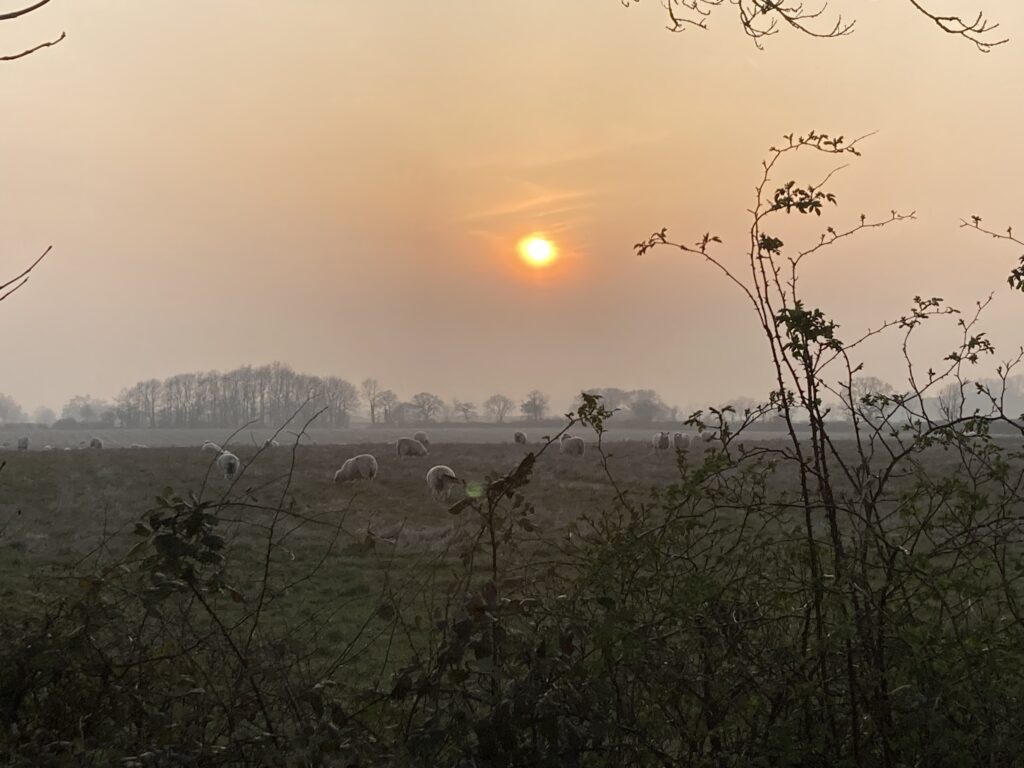
Then towards the end of March in one of those magical, fiery sunset hours at that time of year, which herald spring and somehow reconnect you with earlier versions of yourself, I felt life and art stirring again.

Now here I was, with a slight feeling of trepidation that I sometimes get when painting en plein air: a feeling that the challenge has been laid down: there is no scope for the kind of pottering and evasion that can be indulged in the studio (or in my case, spare bedroom), except perhaps that if things go badly you can tell yourself that a later studio version will be far better. After all, open-air painting has had its illustrious detractors. Degas, one of my heroes back in the days when one had heroes, would not hear of it. Studies flung down in notebooks yes, but to set up shop out of doors was very wrong in his view:

You know what I think of people who work out in the open. If I were the government I would have a special brigade of gendarmes to keep an eye on artists who paint landscapes from nature. Oh, I don’t mean to kill anyone; just a little dose of bird-shot now and then as a warning

As it happens I could hear guns being fired for sport in the old quarry nearby. Was this a bad omen? Not especially: few things would please me more than to be accosted by the armed ghost of Degas, though why he would be skulking in a Kentish field is anybody’s guess.

In terms of inspiration for this painting Degas had not really figured but another favourite, Pissarro, had though somewhat vaguely. In the back of my mind I recalled Orchard in Bloom, Louveciennes from his great period in the early 1870s. Another fleeting thought was of Forties neo-romantics such as Johns Craxton and Minton. The dog days of the pandemic and dead winter vaguely reminding me of that postwar period when dreams of the Mediterranean seeped into visual culture. But in the end when you set hand to paper, you get what comes out, and that is the adventure of it.

I sat down to work on a small camping stool, which promptly collapsed. I chuckled, and began again in the lovely sunshine and luxurious peace, hearing nothing but birdsong and the odd gunshot from the quarry. On a dog walk earlier I had scouted my spot a few feet down a lane of mature pear trees. The blossom against the cloudless blue sky was a tonic after the long grey months.

‘You must find painting relaxing,’ someone said to me recently. Not really. I’m basically an amateur painter but dislike that prefix in this world where artists such as X and Y are considered the professionals: so, not pro yet fairly serious when I get going. Painting for me is half battle and half making love, and the doing of it usually stirs old passions and variances in me that I sometimes resolve on paper: form versus light, realism versus romanticism, abstract versus representation, English line versus French colour . . .

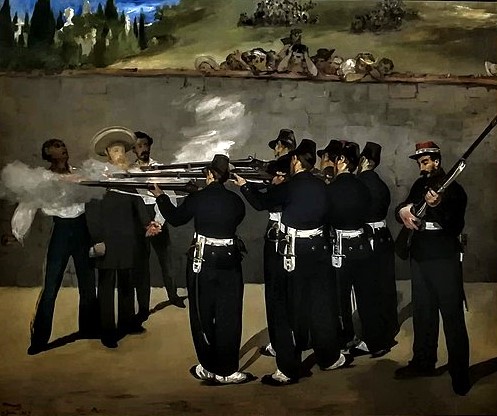
A charcoal drawing took shape. As I drew the blossom I thought, ‘You can’t draw them all, and then I heard Manet backing me up on the subject of detail: ‘One doesn’t want to be a bore . . .’

I thought of lucky old Monet, building his subject matter in his back garden at Giverny, getting as far into water lilies as anyone has got. Given the way the world is going, I thought, I could happily spend day after day in this kind of peace and beauty, making pictures – if I had the income . . .

With the sky blocked in – I was using French pastels of intense pigment – and warming me along with the hot sun, I started on the blossom in white. At this point in a painting the feeling of battle subsides and with colour the lovemaking part of the process begins. The blossoms in the orchard were lavish; I rolled the white pastel up and down the paper, trying to get that sparkling cascade, which now reminded me of champagne bubbles. I was getting thirsty and my ginger beer was gone.

I reached for the green. I don’t really like green, and I often toy with ways of dispensing with it. I was pleased to discover that Eric Ravilious, the lost hero of British art, felt the same way about the colour. I took a deep breath and plunged in, mitigating it where I could with orange and lemon yellow. As I moved down the paper I realised that the pastel would not last out and in a few moments the last crumb was gone. Still, I rather liked the effect of white paper to the right of the picture; it suggested the hot sunlight in reality. Perhaps I was making a virtue of necessity but it seemed a happy accident that I had run out of green.

At last, after a few dabs of yellow to indicate the intense colour of the dandelion, charming urchins that they are, I was finished. Walking back in something of an afterglow, I felt I’d done a good afternoon’s work.

The pear orchard occupies two fields separated by an overgrown public footpath. In a corner of the first field there is an incline which gives a good raised view of the rest of the field. Walking down the slope one evening as I had done many times with my father, I marked the spot down as a potential picture. Two days after my blossom painting I set up again on a windy afternoon with intermittent sun. Once again the orchard worked its magic on me and the struggle on paper resumed. This time it was more battle than loving, but even so the sheer beauty of the environs was a kind of medicine in itself. One of my mum’s neighbours out walking his dogs stopped and we passed the time of day.

As we talked I watched the late afternoon sun creep across the field, lengthening shadows and bringing an elusive and lovely blue into proceedings. We got on to the ugliness of architecture and lack of infrastructure to underpin hasty urban sprawl. ‘Still,’ I added, ‘isn’t it lovely to have this so close?’

‘The orchard?’ he said. ‘It’s earmarked for a new housing estate, wider road and a big roundabout.’

Britannia in peril – an extract from an epic

Brazen Head Poetry Editor LIAM GUILAR is writing a Legendary history of Britain. Chapter One will appear in Long Poem Magazine in June 2021. This is Chapter Two from the story of Vortigern; Chapter Three will appear in the Summer issue. Further details about the Legendary history can be found at www.liamguilar.com

The story so far

In the fifth century, the Roman province of Britannia is now isolated from Europe. A combination of external threats, internal squabbling and two botched coups has left the Province on the verge of ruin.

But it was not only fornication that characterised this time,

but all the vices to which human nature abandons itself:

The people were abandoned by the Romans,

then led astray by vanity and error into a trackless place.

After Gildas, De Excidio, etc. para 20-21

Chapter Two – A Man of Heart?

A Royal Funeral 

…and the rain began to fall

on the polished armour of the honour guard

ornate, ceremonial and useless.

The wind mangling the bishop’s words

threatened to drag the flame from the torches

before they were touched to the pyre.

Vortigern in the place of honour.


You’re looking at the wrong man.

That shining burnished dazzle

is Adolf, Earl of Gloucester.

Breastplate’s modelled on a statue of Augustus

though which campaigns he’s fought in is a mystery.

He’s Magister Militum material.

Just ask him when you’ve got an hour or two.

Thinks his red cloak should be purple

and doesn’t care who knows.

He’d climb a dung heap

to crow above the competition

and call his stinking pile a kingdom

so he could call himself a king.


Vortigern the thin, the grey fox,

stands beside him. Primes inter pares.

Official speak to smooth the ragged fact

that nobody’s in charge.

They say that once this party’s over

the Vicarius will appoint his successor.


Look at the corpse of the King on the piled wood.

The senators in their windblown finest,

the priests and bishops, the civilian crowd

waiting expectantly for the spectacle.


Brigantes, Atrebates, Cats,

still scratching at old tribal sores.

You’d think four centuries of Pax Romana

would have softened the edges.

So you know we’re in for it my friend

the depth and spread and stink of it

when they’re so scared

they put aside their cherished

self-defining hatreds

and try to work together.


Vortigern framed the elegy he’d deliver,

had anyone asked, and honesty were possible.


Let us now praise Constance the King

Ruler of Britain, Father to us all.

Before we light his funeral pyre

before the flames consume the corpse

let us rehearse his virtues:

Son of a murdered usurper,

dim-witted in council, lacking in wisdom

useless in battle, cowering behind a shield

he could barely lift.

When his father was assassinated

the council ripped him from the monastery

because he was a Descendant of Brutus,

last of the Trojans, ‘legitimate rulers of Britannia’.

Not caring that he was indifferent to the law,

despising the church, a drunkard at the feast,

a sly despoiler of other men’s women:

Incompetent, untrustworthy, dead.

His much younger brothers

bundled to Gaul

where their mother will school them

in the arts of resentment.

Now those old men facing the pyre,

will preside over the death throes of Britannia.

These are the Good Old Days

(Name your drug of choice,

power, land, office, sex,

before the evening’s out

someone will make an offer.)


After the incense and the ritual incantations,

after the prayers and the sermonising,

after the God of Love has been

importuned for military victory,

a party to celebrate these coming men:

friends to drink to their success

who’d known them all their lives

although they’d never met, 

hoping to be remembered, hinting at

a son or protégé who might serve

in a minor capacity on their staff.

Then daughters, decorous and decorative,

well-briefed and drilled for the engagement.

Gloucester, good looking, single,

with the gift of the gab,

a tall figure circled by adoring females

pressing him with their attractions

while Vortigern is steered towards a corner

where members of the council

discoursed upon Britannia’s future. 


These old men, hungering for clues,

competing for his gratitude,

or the revelation of a weakness.

(Name your poison, power, titles, office, sex,

if it’s too embarrassing, just hint at it,

someone, with a mainline to the source,

will make an offer before the evening’s out.)


They want to be his friend

despite their previous contempt. 

Confident enough for hints, innuendo.

He’s not looking well, our aging leader.

The times do need a younger man.

Has a successor been appointed? No?

Walk around inside the pauses

and see the possibilities.

Implications dangling bait

for conspiracy or betrayal.

That’s not what I meant at all…

The council, the council must expand.

Of course, become inclusive, reach out

beyond the city walls, reflect the tribal

distribution, equality of representation?

We’ll need a leader everyone can trust

That rules out the Brigantes. And the Cats.

And the army? An imbalance in the leadership

to be addressed…Taken aside by senators,

passed around in a game of confidential whispers.

I’ve been watching your career with interest

please don’t misunderstand of course we

The Brigantes, after all I was only joking.


Men who would have lost their lunch

at the thought of living in a hut

now sought security, identity, community,

in a rediscovered tribal heritage

they were busily creating for themselves

made attractive by ignorance and nostalgia.

As though ‘culture’ was a buried hoard

that could be excavated, reused untarnished

not made irrelevant by time.

Their bad jokes advance scouts of a civil war.

What do you call fifty drowned Brigantes?

A good start? One hundred Saxons? Not enough.

Soon they’d rediscover druid lore.

invoking hailstorms against their enemies.

There’d be rumours of strange rituals

in forest clearings, and murders for the right

to put on silly clothes and be ‘Archdruid’.

Men protective of their privileges

their rank, their wealth, their family histories,

so proud of their rhetorical skills,

how they were Romans first and Britons second.

Soon they’d be daubing themselves

and trading their sophistication for survival.


Lamps were lit, slaves ghosting between the diners.

Forced female laughter, twining around Gloucester’s voice,

erupted arrhythmically from the other corner of the room.

Vortigern was wondering how long he had to stay

until an older woman at his elbow said:

‘As if any of them cared.

Did they not see the empty streets?

The ruined houses?

We’ll all be dead within the year

and still they play the same old games,

betting long odds on a future

that ceased to exist before most of us were born.


I’ve heard you read?  Do you study Caesar’s wars?

take notes on Onasander? Who’s your favourite author?’


‘Ovid.’


The most accomplished actress

can be startled into honesty.

The Art of Love? She’s too surprised

to hide her disbelief.

Freed of obligations by the insult,

he laughs at her reaction.


‘’The Metamorphosis. A poem for our times.’


‘Everything changes, nothing stays the same’

‘So much changes; so little stays the same.


More accurate; less memorable.’


Next morning there would be a slave

outside his lodgings with a scroll:

or a rare copy of his favourite text

left discreetly on a table.

Name your poison?

He had nothing she could want.

They chatted about literature,

two educated diners waiting for Ovid 

to come posturing through the doors

and scandalise the rich and bored

four hundred years too late.

‘At least’, she said, before she left,

‘one can choose how and when to die.’


After the ladies and the elderly retired

someone produced ‘the girls’:

courtesans who had been paid

or lesser daughters and more desperate wives.

These two men were poised

before the ladder’s upper rung.

When Survival’s on the auction block

you’ll bid with what you’ve got

even if your daughter’s splendid tits

might be your only asset,

hoping they’d be remembered

if one of these two men succeed.


The evening blurring into heaving flesh

scenes for a fresco on a wall in hell:

two prelates spit-roasting a German slave

the girl’s blonde hair incongruous

against the bishop’s bony knees.


A pretty face, well-practised,

In the amatory arts,

her manoeuvres mindlessly

but expertly performed. 


The Matron’s words:

‘I will not watch my daughters

whore themselves to the barbarians.’


She’d call it family politics

and therefore no lost dignity

if she pimped them to a Latin speaker on the rise?


‘One can at least choose how and when to die.’ 

All evening she had sought for an analogy, 

as though precision would validate her suicide.


The lights had faded, the room

a roiling sludge of limbs.

In the foul smoke of oil lamps

a different thinner face,

dark curls plastered to her forehead.

Shut eyed, languid, sinuous,

movements stuttering to her own satisfaction.


Her final version: ‘We’re players

who turn up to find the theatre

has burnt down, and no one’s left

to watch our well-rehearsed performance.’


He gathered up his clothes

stepped his way towards the door.

The bodies on the floor moved fitfully,

scum on the edges of a stagnant pool

shrugging as the ripples died.

Stepped out into the clarity of early morning.

He would not remember them.

There were far too many dead

already begging his attention.

Vortigern in London

The past’s a broken mirror

making the present looked deformed;

the crook backed limping child

of disappointed parents.

The age of iron rusted out,

our age of stone is almost gone.

Now comes an age of wood

where everything can splinter, rot or burn.


The horizon’s clear of smoke,

nor dotted by wheeling carrion.

But the city is dying into itself.


Here there was noisy spectacle.

Stone humanised by speech

now stone without story

is simply broken stone.

Your ancestors’ most sacred site,

or random spillage of disjointed rock.

This coin he’d rescued from the mud,

portrait erased; inscription illegible.


Behind him reeking tidal mud.

The wall he stands on killed the port.

Where his grandmother played

burnt timbers, blackened roofs.

The cart tracks overgrown.

This is what time will achieve

when no one bends a back against it.


Late in this afternoon. A merchant ship

backlit by the golden river,

the slow drift of it at odds

with the frantic scurry of the crew.

The bridge has been maintained

but there are few ships on the Thames.

Few traders skirting down the coast,

fewer coming from the continent.


The evening is turning cold,

the city shrunken, huddled

against its inevitable night.

To his left on the hill,

the amphitheatre’s a piece of wall,

water glinting in the ponds

filling the robbed-out pits

between the piles of weed grown rubble.


There have been bad times before.

But the danger was no longer out there, beyond the walls.


It was in the civil men and women pretending

to be outraged by the new graffiti:

‘Romani non Germani!  Britanni non Barbari!’

As though the idiots who daubed those words

didn’t have at least one grandparent

born somewhere in the empire’s furthest reaches.

Aurelius and Uther, fled to Brittany

after their father then their eldest brother

botched their coup, now proclaiming

they could trace their bloodline back to Brutus.

A standard move to add legitimacy and lustre

to a power addicted family on the make.

Ironic given Brutus was a Trojan immigrant

who slaughtered the indigenous inhabitants.

But when did logic play a winning hand in an election?


When a man like Constantine, caught in his lies,

shrugged and claimed the words he’d used

meant only what he wanted them to mean,

then law became impossible, and titles empty.


The steady rumble that replaced the traffic noise was fear.

Not just fear of incomers and raiders

fear of people who had once been neighbours

and were now ‘others’ to be hated.

Any other, anyone who was not a friend

and trust in friend and family was rotting

because when incompetence and talent

are equally dangerous, look to yourself.


One day he wouldn’t hear the assassin

or see the bowmen hiding on a roof

but he has heard Adolf of Gloucester,

coming along the wall.


Count of the Saxon shore.

Man Most Likely to Succeed.

Gloucester coughs, speaks.


‘He’ll see us now.’

It’s meant to be affable,

drinking buddy confidante.

‘What do you think he wants?’


Vortigern shrugs.

Rude or reticent, it’s hard to tell.

He’s wondering why here?

The roads still spin out across the country

but it’s a long way from the danger zones.

An uncharacteristic nostalgia?

Or a final gesture of farewell?

No one alive remembered the Vicarius

in the days of his youth

His parties were notorious

for excessive decadence.

Perhaps that was nostalgia

for another fabricated past,

the court of Caligula and Nero

when any vice was possible

‘Why not’ sufficient reason

and ‘no’ was not an option.


He is dying without an heir.

He has outlasted Constantine and Constance

and sent the Boys to brood upon their rocky headland.

Word is, he’s going to choose.

Why else call the two contenders

for a private meeting?


Cain and Abel taking their offerings to God.

And we know how badly that turned out.


If you define your progress

by the titles you accumulate;

you measure your success

by your graded movement

along a string of words.

What makes them more

than complicated echolalias,

meaningless as infant babble?

Count of the Saxon Shore,

Magister Militium, Consul,

Heir-Apparent, King?


Vortigern, if pushed, defines success

as battles won, problems solved, lessons learnt,

might have asked ‘Heir to what?’

40 emperors in a hundred years

God for a month, then erased

like the portrait on the coin.


Council members shoaling from the building

form self-important, self-regarding groups

who nod to both the soldiers as they pass.

Overseers of the death of meaning,

Peddlers of cancerous euphemisms,

revelling in the endless crisis of definition

that passes for meaningful debate.

Still busy fighting over granddad’s privileges.


Pay attention now and watch how they react,

trying to pick the winner before the dice are rolled.

Some greet Gloucester. He’s done terrible things

to earn their gratitude. But he speaks when spoken to,

can be counted on to say the right things at the right time

and pay his dues when his debts are called.  


Some acknowledge Vortigern.

See how wary they become?

He’s in no-one’s pocket.

But they all know he’s the silent go to man

when the shit’s on the fan.


In this tired world, titles and positions

are still the gifts of slack old men:

ancient relics twinkling in the wreckage

like stagnant ponds in the ruined amphitheatre

catching a fading sun.


But not this man, not Ambrosius.

He is the ghost of whatever made the Empire great:

devious, unpredictable and dangerous.

Authority regardless of his titles or his clothes.

Neither clumsy copy nor conscious fake,

the steady pilot who would face whatever storm

to bring the Ark to safety, with Noah’s indifference

to the millions drowning who were not on board.


They bend over a map of Britain.

Gloucester finding this foreplay tedious

wanting to hear the job is his

or know the details of their final test.


Ambrosius, between coughing fits.

‘We asked the Western Emperor for troops.

His Master of Horse tells us to look to ourselves.’


Vortigern.

‘There’s rumours that the Huns are on the move.

A half a million men. Attila claims the empire

his by right of promised marriage to Honoria.

If even half that number enters Gaul

the Western Empire’s gone for good.’


Ambrosius.

‘In Britannia Secunda our writ no longer runs.

We summon them and they refuse.

North of the Humber the cities are abandoned,

two bad harvests and constant raiding have brought famine.

They have begun to squabble for the scraps.

A few armed men, a bit of wall, a tribal hill,

a man’s reach might stretch to the tribal boundary.

There’s no tax collection, so no distribution.

So many starve.’ (More coughing)


Gloucester:

‘Picts from the north, overland 

through the ruined gates of the wall.’


Vortigern Interrupts.

‘Some of those Picts are Britons painted blue.

They think it best to hide themselves.

Soon they will forgo pretence.’


Why this might be significant

is lost on Gloucester who continues:

‘Irish slavers down the western coast.

Germanic pirates in the east and south.


If we go east, the west is burnt

If we go north they sack the coastal towns.

Strike and run and be long gone

before a rider brings the news


We need three legions, at the most.’


But no one laughs. 

They remember their grandfather’s stories.

How the forts stapled law and order onto the wilderness.


The map still shows the roads

linking fort to town, town to port,

port to other towns and other forts

on and back across immensity to Rome.

Well-kept roads loud

with merchants and soldiers

messengers, supplicants, embassies

crunching the heartbeat of empire. 


Ambrosius:

‘We are like a goodwife swatting spot fires,

growing weaker with each victory.

Either we train a national army

or recruit more mercenaries.

One will take time we do not have.

The other, when the pack’s too big

the dogs turn on their master.’


The awkward map confirms their lack of options.


Adolf: conversational, exploratory.

‘You’ve heard the rumour of the legion

that was left behind?’ Vortigern waits,

wondering what revelation is at hand.

‘If they retained their discipline

they will have instructors.’


No revelation, no solution

just the gambler’s dream of the winning card.

‘Limitanei gone native?

Somewhere along which wall?

There were so many forts and marching camps.

and even if we had the time,

we’d never find them all.’


Did the old man change his mind

or had he planned what happened next?

He turns to

Gloucester.

‘If you think it’s worth the risk

after our envoy has delivered his messages

take whatever men you need.

Take Eagles too, and trumpets,

search out your fathers’ uniforms.

Appear to them as Roman as they were.’


Gloucester thinks he is the organised man.

A lover of maps, a maker of lists.

Now caught by this unexpected switch,

trying to impress with plans he’s making on the fly.


‘I’ll head to Lincoln, there to meet my scouts.

…we’ll take the inland road.

From York’….and Vortigern, unimpressed, lost interest. 

Three thousand men? How could they be hidden?

Garrisons along the wall had gone native,

and whether you called the garrison commander

Tribune or King made little difference.

Everyone who’d been that way

had met such useless bastardised communities.


When Gloucester left

the old man, staring at the map

keeps Vortigern waiting.


It’s easy for a map to lie.

These forts have long since ceased to function.

The roads are overgrown or braided to confusion.

This is a tidy memory of a dead world.

Not even accurate when it was made.


Ambrosius

‘Your father-in-law was my good friend.

He and your father were both honest men:

hard working, loyal, at a time

when all those qualities were out of fashion.’


‘My father-in-law lead an army against the Empire

and left this island undefended.’


‘Your father-in-law led an army

against corruption, greed and inefficiency.

He planned to hold the Rhine and make Britannia safe.’


‘He thought he would look good in purple.’


‘Resentment is an easy hand to play for very little profit. 

Three Saxon ships have landed on Thanet.

They’re asking to be taken into service.

Go there, you’ve dealt with them before.

Use your judgement. Offer the usual conditions.

They might be more useful than a phantom legion.’

A road by any other name…

Shutterstock
DEREK TURNER takes a Brum road-trip

What’s in a name? A great deal – so Birmingham City Council hopes. In December, as part of a £500m redevelopment of the city’s blighted Perry Barr district, it revealed the names of six new roads to “reflect community and Commonwealth sport values”. Diversity Grove, Equality Road, Destiny Road, Inspire Avenue, Respect Way and Humanity Close will shortly be adorning the Birmingham A-Z, and by 2023 residents will be giving their addresses embarrassedly to Deliveroo drivers.

Potential names were submitted by “the public”, and selected by a panel led by local politicians. According to one member of the panel, there was

…an impressive submission of entries that epitomised not just the core values and culture of Perry Barr but encompassed what the area is all about.

Puzzled Brummies immediately took to social media to wonder why none of these had been chosen.

According to the competition criteria,

Street names should ideally have a local connection, which is historically, geographically or culturally relevant.

Yet these names do not obviously have a particular Birmingham connection, and arguably not much “relevance” anywhere. These are not place-names for posterity, but sermons by street-furniture. Another Birmingham thoroughfare comes irresistibly to mind – Needless Alley – and a Lincolnshire road I noticed recently, Labour-in-Vain Drove.

Insofar as Diversity, Equality, Destiny, Inspire, Respect or Humanity do have real-world application, it may not be one all Brummies can embrace unreservedly. Elevated language frequently has less elevated applications; as Tacitus, quoting a subjugated Briton, noted of his own people, “they make a desert and call it peace”.

But then the Handsworth heroine who ‘thought’ of these names is a forward-thinking missionary, and above such earthly considerations. Social media sleuthing unearths wholly expected attitudes, a humdrum hashtaggery – BLM, Corbyn, DecoloniseBrum (and Yorkshire, while she’s on the subject, which is probably quite often), Israeli “apartheid”, race quotas, Tories hating the poor. She nurses an impressive dislike of James Watts’ business partner Matthew Boulton, judging from the many photos of Boulton-related Birmingham place-names onto which some monomaniac has Blu-Tacked typed ‘recontextualisations’. This is a lady who trends. The comical bathos of her toponymy exposes a hole in the heart of 21st century Brum, and Britain. In the land of the bland, the cliché is king. David Brent’s song Equality Street was a cynical ploy, and a good joke; Equality Road is less desirable.

Names have always been surrounded with superstition. As it says in 1 Samuel, “As his name is, so is he”.  Puritans aimed for Elect-ion by giving children hortatory names – Charity, Faith, Goody, Hope, Praise-God. Their Godless heirs try to be ‘Goodies’ in their turn by naming places after equally insubstantial ideals, chasing contemporary chimeræ with the same guilty enjoyment Ranters devoted to Revelations.

The coiner and adopters of these names clearly hope that, in the words of the 1791 ballad, Song on Obtaining the Birmingham and Worcester Canal Bill, “Twill prejudice stifle, and malice strike dumb”. A Conservative councillor who chortled at the new names as “Woke Way” was chided by the panel’s chair –

It is disappointing that Cllr Morrall does not appear to share these values or respect the views of the selection panel.

Behind these primly freezing words stretches a bleakly unwelcoming England, where human nature is to remade every morning, long-standing landmarks are to be levelled, and taken-for-granted things are to be taken. It is the same world, but a different planet – an alien environment with an atmosphere of noxious gases, and governed by platitudinous correctness. This may not be The Road to Serfdom, but it does resemble a Road to Nowhere. To turn around that property market cliche, “No location, no location, no location”.

Street-naming has historically been a form of culture-cleansing, warfare by other means, as incoming regimes impose their moral and social preferences on the losers. Names like Revolution Road, or 5th October Avenue, have frequently been inflicted on harmless highways, although sometimes only temporarily. Russia has reverted to many pre-1917 names – but the Cold War’s ‘winner’ has been convulsing its cultural cartography in response to radical social shifts, frenziedly naming roads after Martin Luther King, and recently even George Floyd. Is this ‘respect’, as is claimed – or is some less edifying emotion? Perhaps even fear? Renamers often seem not quite to know what they are doing, or why.

Romans Latinised England’s infra dig Iron Age trackways, and Normans Frenchified Saxon nomenclature. Socially-uncertain Georgian and Victorian town councillors sanitised suddenly shocking streets, exemplified by the “Grape Lanes” still seen in British cities – a gloss on “Gropecuntlane”, alluding to the ancient presence of prostitutes. They also sought to sweep away what they saw as irrelevant remembrances of the past – thus the 19th century rash of Gas Streets and Station Road (plus some more pious thoroughfares, often echoing religious revivals, like Fortitude Street or Temperance Road). They delivered a shiny new modernity, lavishly bestowing the names of engineers, explorers, generals, industrialists, missionaries, monarchs and planters on newly set-out streets, valorising the villas of the newly-rich and crowning even workmen’s terraces with classical and imperial motifs. Today’s craze for naming streets after Nelson Mandela, Windrush passengers, or Guru Nanak is a case of the Empire striking back.

Birmingham has always been busily Promethean, and has attracted the worst as well as the best kinds of change. Emma’s Mrs Elton expressed a common prejudice – “One has no great hopes from Birmingham. I always say there is something direful in the sound”. Two centuries or so on, the pleasant local accent ranks at the bottom of those unofficial but oddly powerful ‘trustworthiness’ surveys that appear spasmodically in the media, which are subliminally influential on those deciding where to site call centres and other industries. This is to ignore utterly the city’s shining other side – geniuses like Joseph Priestley, the kindness of the Cadburys, the civic pride of Joseph Chamberlain, the excellence of the CBSO, the many thousands of hardworking and respectable people.

The municipality has at times been badly served by its agenda-setters and political leaders, and modern Birmingham still bears the scars of the overlong incumbency (1935-1963) of Herbert Manzoni as City Engineer and Surveyor. Manzoni bequeathed Brummies a brutalist, traffic-blasted landscape at colossal cost, and his Bull Ring and Inner Ring Road are now being superseded at even greater expense. Manzoni’s views on Brum’s old buildings betray an absolute absence of imagination –

I have never been very certain as to the value of tangible links with the past… As for future generations, I think they will be better occupied in applying their thoughts and energies to forging ahead, rather than looking backward.

His epic incomprehension is echoed in the ostentatiously ‘socially concerned’ but secretly ruthless language of ‘decolonisation’ and ‘diversification’. These six roads in question may be new roads, but they are built on the thrown-down past. They are really different kinds of demolition, and their impossibly tangled rationales are the ideological equivalents of Perry Barr’s unsavoury neighbour, Spaghetti Junction. The Brave New Birmingham Manzoni and others brought was obsolete even before it was finished – and their “forging ahead” is now our inconvenient and shameful past, for which we must all undergo a painful and undignified procedure of deconstruction, and decolonic irrigation.

As Perry Barr booms and clangs with the din of earth-movers and pile-drivers, so the British imagination is being constantly razed and rebuilt, our inner and outer landscapes a permanent building site. Perhaps one day even the proud Handsworth heroine’s streets will become embarrassments, banal vestiges of a patronising political tradition and a worn-out West no longer ‘relevant’ to the Brum of 50 years hence.  

Cornysh, Campion, Dowland: England’s sweet songsmiths

STUART MILLSON dives into old English ‘ayrs’

There is a persistent idea that English music only really got going with Parry and Elgar, but four centuries earlier William Cornysh, Thomas Campion and John Dowland had possessed national and European reputations.

William Cornysh was one of England’s leading Tudor composers, gaining the attention and then patronage of that most difficult-to-please of monarchs, King Henry VIII. There is disagreement about the date of his birth, especially as he was christened with the same name as that of his father, also a musician, who, during the late 15th century was Master of Choristers at Westminster.

Cornysh (senior) was also a Gentleman of the Chapel Royal, to which institution his son gravitated and remained connected for nearly 15 years, from 1496. Choral scholars through the ages have marvelled at the treasures contained within the ancient manuscripts of sacred choral music, the Eton and Caius choirbooks, both containing important works by Cornysh; yet this is a composer who could also turn his hand to occasional and secular pieces.

Then, as now, music was considered an essential background to great events of state, and in 1520 Cornysh achieved a high-point of his career – embarking with his monarch upon a state mission across the English Channel, the famous meeting between Henry VIII and the King of France (François l) at the “Field of the Cloth of Gold”. Here, amid the ornate (but temporary) pavilions and awnings, Cornysh and his musicians of the Chapel Royal serenaded the monarchs and their entourages, whilst the latter engaged in their schemes, diplomacy, power-struggles and court gossip.

It is always remarked upon how that later 16th century composer, John Dowland, was the master of melancholia, yet in Cornysh’s Adieu, my Heartes Lust (a piece for four voices, typical of his style) we can find the essence of the yearning poet (in the English of the time), consumed for all his fretful, wintry waking hours in a state of emotional purgatory:

Adew, adew my hartis lust. / Adew, my joy and solace. / With dubyl sorrow, complain I must, / until I dye, I must, I must.

Campion’s England

Thomas Campion (1567-1620) achieved a great deal in his 53 years, despite an unpromising start: leaving Cambridge without taking a degree, and leaving Gray’s Inn without being called to the bar. However, in 1605, academic distinction eventually came, in the form of a medical degree from the University of Caen. He spent the rest of his professional life practising as a physician in London, and remaining a bachelor until his dying day.

Yet Campion remained drawn to the beating heart of his other passions, poetry and music. Writing in the shadow of the most famous poet of the time, Sir Philip Sidney, in 1602 Campion effectively produced a manifesto against “vulgarity” in poetry (Observations in the Art of English Poesie), decrying the act of “riming”. He also went on to publish a book of great interest to musicologists, a thesis on counterpoint – as well as many musical “ayrs”, masques and songs, and in 1613, to mark young Prince Henry’s death (King James I’s heir-apparent), the plangent Songs of Mourning. Campion’s work touched the spirit of the moment, in a country that was said to be distraught with tears and regret.

The beautiful part-song, Never WeatherBeaten Sail , with words by the composer, dates from the same year, and forms part of Campion’s First Book of Ayrs. For the man who decried “riming”, the piece has a beauty, simplicity – and rhyme – that makes it almost like (to our ears, today) a traditional hymn:

“Never Weather-Beaten-Sail, more willing bent to shore / Never tired pilgrim’s limbs affected slumber more…”

The two-and-a-half minutes of the song, as all good songs do, seems to reach out, in simple terms, to a lifetime’s experience and the need to grasp that last anchorage on our voyage: a vision of “Heaven’s high paradise…”, of the weary human being “with troubled breast” coming to that eternal shore, where the Lord will “take my soul to rest.” With music that never soars to too high a degree of emotion, Campion’s music nevertheless has much pathos, great beauty for its vocalists, and forms a benediction in miniature. It is a perfect moment for reflection on mortality, for all those who have set sail upon the mysterious voyage to one English composer’s safe harbour.

Dowland in Denmark

The Danish royal family of the late 16th century was a generous employer – John Dowland achieving the material gains which often eluded him in his native land. Yet despite his chagrin at later being excluded from England’s official high circles, due to his Roman Catholic beliefs, the composer’s life had been a full and productive one, with some time even spent in the service of Sir Henry Cobham, Ambassador to France.

With books of songs, psalms and lachrimae galore – some 20 pieces to each collection – Dowland can be viewed as one of the most prolific composers of his era. Perhaps, he can be een as one of the true founding-fathers, or presiding spirits of our music – an echo of which reached to the 20th century, when Benjamin Britten incorporated a theme by the composer in his Lachrymae for viola and orchestra.

To pick but one piece, Come again, sweet love doth now invite comes from his First Booke of Songs or Ayres, and can be performed either as a conventional lute-song, or expanded slightly into a piece for a small group of vocalists. Whether a melancholy discourse for one singer, the lute conjuring that sense of lonely winter twilight, or lifted into the realms of a madrigal (but still resonating regret and longing, sighing and soft tears), this short work is one of extreme delicacy. Yet as the work comes toward to its conclusion, Dowland repeats and re-emphasises the important lines from each of the (three) verses: “To see, to hear, to touch, to kiss, to die”. These are words that embody the soul of the composer, the essence of his age, and the character of the times to come in English music.

Something rotten in the state of education

Temple of Concordia and statue of Icarus, Agrigento, Sicily – SHUTTERSTOCK
ALLEGRA BYRON witnesses the winnowing of the Western curriculum

In the final scene of Hamlet, the Danish kingdom lays in ruins: a corrupt leader bleeds to death; a poisoned First Lady takes her last breath; a young nobleman dies by his own treachery; and a fatally wounded prince, desperately seeking Truth and Justice, urges his close friend to report the true nature of things. This outward carnage and chaos mirror the deep rot within.

As dramatic as this may sound, the crumbling Danish world metaphorically parallels the disappearing, Western kingdom. In particular, our education system, fundamental to the prosperity and progress of any society, lays bleeding on all sides. The dismantling and decay (and ‘decolonising’) of education directly affects the core participants – the pupils, the teachers, the parents – most of whom have become victims of the Conqueror Worm1. Often, they are too manipulated or confused or exhausted to see that the few hoarse voices protesting against the destruction of school curricula are not “mere madness” but urgently attempting to restore order from chaos, to weed out the cankers.

In most schools, two significant learning areas embedded in the curricula are English (language and literature) and history. Whilst each country offers various colours and flavours of these subjects, dependent evidently upon cultural contexts, governments, educational bodies and the public, would agree that our young people need to demonstrate competency and confidence in communicating; they need to read and write and speak and spell well. Admittedly, line-ups for ‘meet the history teacher’ cannot compete with the mad dash for the maths and English teachers’ tables at parent-teacher nights, yet most do place value on pupils knowing about their past and how that past affects their present and future. Australia, like other nations, has sought to standardise its education nationally, believing that this decision ensures equal access for all Australian children. Indeed, students deserve quality, academically rigorous, twenty-first century schools to shape them into life-long learners, allowing them to be active citizens. Noble aims. Important aims. Tragically, however, this hopeful national curriculum with all its virtuous pursuits is an “unweeded garden / That grows to seed”2

“Alas, poor Yorick – I knew him, Horatio”: the disappearing texts

One value in immersing young minds in classical literature, a luminous tapestry of novels, plays, short stories and poetry, is that these works present, as Mortimer Adler once suggested, the great enduring truths of the human experience3. Between the pages of ‘old books’ a reader discovers love, goodness, despair, forgiveness, longing, graciousness, evilness, beauty, honour, truth and justice. These discourses are offered through the windows of sophisticated, varied vocabulary, clever phrasing and fresh, figurative diction and mature syntax. C S Lewis believed strongly that

…the only palliative [to the blindness of our own century] is to keep the clean sea breeze of the centuries blowing through our minds, and this can be done only by reading old books  ((Lewis, C S The Reading Life: The Joy of Seeing New Worlds Through Others’ Eyes, edited by David C Downing. William Collins Books, p.47)).

Given his ability to read just about everything and then remember everything he read, Lewis had something of value to say about reading choices. Shakespeare’s country grammar school days at King’s New School also valorised the classics. The schoolmasters instructed in spoken and written Latin. During the mornings and afternoons, the diligent pupils translated biblical texts from Greek into Latin and English. They were skilled in Butler’s Rhetorik, andthe boys also studied authors such as Terence, Virgil and Horace. At breaks, mucking about in the schoolyard, the lads were encouraged to speak in Latin (a space, perhaps, to craft his witty insults?). While the drudgery of Elizabethan schoolwork is self-evident in the well-known Romeo and Juliet simile, “Love goes toward love as schoolboys from their books, / But love from love, toward school with heavy looks”, 400 years later, contemporary audiences benefit from Shakespeare’s liberal education, clearly evident in his writings. Closer to our time, a Queensland school reader, given to 12 and 13-year olds, dating from the 1960s, aimed “to instil into the minds of pupils such a love of literature as will last beyond school-days and be an unfailing source of profit and delight”  ((The Department of Education. Queensland School Reader – Grade 7, Queensland Government Printer, 1967, p. iii)). The collections of accomplished visual artists, poets and short story writers selected for young Australian girls and boys were “compend[ia] of useful knowledge as well as a treasury of beautiful thoughts”  ((Ibid.)).

Today’s modern reading lists in many schools, au contraire, shy away from classical works. They are dropping off and disappearing. Instead, the-powers-that-be scramble to introduce newly published texts into the Australian classroom, replacing the tried and tested. English teachers’ organisations across the country will openly acknowledge the deliberate decision to highlight texts that reflect the myriad of (current) voices in Australia. These ‘new’ texts have morphed into supposed ‘tools of reconciliation’ for the silenced Australian voices. Books (and the odd poem) appear as vehicles of change: to dismantle the white or male (or both) cultural norms. Now, classical literature, part of the ‘best that has been thought and said’, when evident in teachers’ unit plans, is often reduced to a gender warfare or a platform to disrupt the ‘settler myth’ or colonial injustices. Teachers are repackaged as social engineers. For example, on the Australian Curriculum, Assessment and Reporting Authority (ACARA) website, viewers are offered Year 9 sample student responses to an analytical essay on the ‘role of women’ in Macbeth ((https://australiancurriculum.edu.au/resources/work-samples/english-work-samples-portfolios/. Accessed 31 December 2020)). Thus, 14 and 15-year old students, still emerging writers, still wrestling with accurate written expression, are requested to uncover the alleged gender imbalance in an Elizabethan text. Rather than discover the beauty and craft of masterful language and storytelling, the teenagers must interrogate the play for its perpetuation or subversion of dominant power dynamics and ideologies. At Eton College – a school that dismissed a teacher for ‘gross misconduct’, that is, for daring to promote masculinity – the headmaster promised that

…the teaching of history, geography, religious studies, politics and English will change and that decolonisation will be incorporated into assemblies, religious services, tutorials and societies also”4.

Across the Atlantic, a recently formed American organisation called #DisruptTexts, “whose mission [is] to aid and develop teachers committed to anti-racist/anti-bias teaching pedagogy and practices”, claims that “white supremacy” in classrooms is real, and that teachers’ roles are to collapse the deeply embedded racism and “to create a more inclusive, representative, and equitable language arts curriculum that … students deserve”5. White supremacy is evident, so goes the tall tale, in our ‘worship’ of the word (rather than pictures). This angry mob of anti-Western canon protesters challenge their new comrades with the question: “Who determined that long words were the only words that could be considered complex?”6 Apparently, their placards proclaim, when we criticise these new ideologically-approved texts then we criticise the young people that read them.

Back on Australian soil,English teachers are trained how to present ‘culturally sensitive texts’, ones that could contain “community and/or family violence and abuse (sexual or other), alcohol and drug use, crime, explicit sex scenes” for their “literary merit”  ((Page, Phil and Shipp, Cara. “Teaching Culturally Sensitive Texts” AATE/IFTE ‘If’ 2020 Conference, 6 -10 July 2020, Sydney Grammar School. https://readingaustralia.com.au/2020/09/workshop-teaching-culturally-sensitive-texts/. Accessed 16 December 2020)). Wide reading lists in some schools for pubescent students will privilege homosexual and/or transgender ideology. If teachers contest the use of these texts, then these questions reveal teachers’ intolerance or ‘their lack of understanding’. Often any logical reasons offered against the use of these texts are considered right wing, fascism. Do Australian educators need to fear the Eton teacher’s fate? Some parents also are too afraid to make noise. One American writer and cultural critic has identified parents as ‘tyrants’. He moans, “parents’ [sic] is an oppressive class, like rich people or white people”7. It’s no wonder mums and dads feel silenced and disempowered.

Clearly, not all Australian voices are welcome in the carefully constructed, ‘progressive’ classrooms. And not all silenced, marginalised voices are being heard. Where has the treasury of beautiful thoughts disappeared? Will these new books become ‘sources of profit and delight’?

Yesterday’s battles, today

History in Australian schools has not been inoculated against the disease of rapid disruption. The outspoken Scottish history academic, Jill Stephenson, opened a recent article with these words: “No school subject lends itself more readily to political manipulation and propaganda than history”8.  The 2014 review of the Australian Curriculum identified an “undue emphasis” on the three cross-curriculum priorities: sustainability, the histories and cultures of Indigenous Australians and Australia’s engagement with Asia9. The post-modern pendulum swings heavily in favour of this three-pronged priority at the expense of a balanced presentation of Western civilisation and its Judeo-Christian heritage. Stephanie Forrest of the Sydney think-tank, Institute of Public Affairs, found that current, Australian Curriculum-approved, history textbooks were “factually incorrect”, made “outrageous statements” and in some places presented “an environmentalist, socialist and sometimes almost Marxist agenda”10. For the most part, however, the 21st century history class has textbook-styled lessons buried, and they now re-emerge as pseudo-scholarly fora, where eras and movements appear via primary sources. Teenaged students, still embryonic in seeing the broad sweep of history from its beginning, now must become historiographers, articulating academic, historical hypotheses and debating the usefulness and reliability of sources before they understand their world and its timeline. Instead of deep learning and time to ruminate, the students, too soon, must learn how to evaluate, analyse and assess the credibility of published authors. They become lost in piles of primary and secondary sources, pouring over visual and written artefacts constructed for an adult audience. In some cases, given that the standard for senior history subjects is so unattainable, the criteria just too difficult, these high school ‘scholars’ will be locked out of taking history courses in upper secondary if their grades are only ‘satisfactory’.

Further, the history units gallop at top speed. Some have one lesson on the Renaissance. The Reformation didn’t happen (apparently, as it’s not referenced in some schools). World War I can be taught in nine lessons. Capitalism is critiqued. Socialism is privileged. Teachers collide, breathlessly, in breeze-ways and hallways, quizzing their colleagues, “Have you finished — unit yet?”. They mark, meet and moderate (papers). And then they do it all again. And again.

But we need history. Despite the pundits arguing that history yawns with ‘drill-and-kill’, so many students continue to love the human stories that arise along the historical timeline. Young people lean in to hear about the ‘boy soldiers’, Trooper Harold Thomas Bell, for example, from the Australian Light Horse Regiment. He was a farmer lad from country Victoria. Although so long ago in a land far, far away, the students feel empathy upon hearing that Harry, like so many others, died from gunshot wounds after the charge against Beersheba on 31 October 1917. He was only 16. Pools of pupils will linger to talk to Teacher after class, bursting to tell her anecdotes about their Pop’s Pop or their Nan’s dad: the medals, the marches, the military. During a lesson (sacrificing the heavily prescribed curriculum requirements), the questions roll around the room, questions breed questions: why didn’t they care for the children in the factories? Did those soldiers really stop fighting on that Christmas Eve? Did Elizabeth the First have kids? Will there be another world war? How tall d’you reckon Alexander the Great was? The late NYU professor Neil Postman sighed knowing that children enter school as question marks and leave as periods. The reality? Quite simply, there isn’t the time for student-led curiosity.

Education today is a tragedy. Limping into a new year, the educational system lags with poisonous political ideologies; left-wing agendas purposefully massacre traditional values once treasured in good books and in a rich, balanced history curriculum. Recent research into educational trends confirmed that half of Australian educators believed that literacy and numeracy (and student behaviour) had declined in the last ten years11. Our schools, the children and the dedicated teachers and leaders that fill them, have been betrayed by those in positions of political and academic power, those granted the privilege to lead with wisdom and discernment. We wring our hands and hearts in dismay.

And yet …

If we circle back to the beginning, where we met a disorderly Danish kingdom, like all Shakespearean tragedies, there is always a quest for divine order after a catastrophe. A godly design for all matter (from rocks to celestial beings) governed the Renaissance world: everything had its rightful place. While the noble-hearted Hamlet dies in his desperate attempt to avenge the wrongs of his world, Horatio courageously tells the Prince of Norway, Fortinbras, of the “casual slaughters” and the “cunning and forced deaths” that took place in this pursuit. We too have Hamlet-types of our time. There have been (and are) brave men and women – brilliant professors, deeply committed school teachers and leaders, excellent medical doctors, just politicians, outspoken writers and journalists and many others from all walks of life – suffering the fatal blows of our nihilistic, culture wars. The casualties include a researcher from a tropical, north Queensland university fired for telling the truth; a New York Times writer finished for critiquing critical theory; a social commentator on gender issues lynched for advocating for young men’s rights on university campuses; and a Melbourne medical doctor, practicing for 15 years, ‘cancelled’ for having opinions. Each year, the casualty list multiplies.

Of course, in Shakespeare’s story, Fortinbras claims rights to the broken kingdom. Likewise, we identify a groundswell of opposition, a collective Fortinbras of sorts, all across our nations, some in secret and hidden spaces and places, now gaining momentum and traction to battle against the disruption and destruction of education and other. They claim their right to a better education. They seek a better way for the children. While the UK has academies like the Emmanuel Schools Foundation, an academically excellent group of schools established in economically depressed northern England and London’s ‘strictest’ school, Michaela College, led by Headmistress, Katharine Birbalsingh, America has pockets of charter and independent schools, some of which produce their own classically-based curriculum sold globally. In Australia, tucked away out the back of Brisbane, Queensland, is the newly established Charlotte Mason College, offering families respite from the turbulent curriculum wars; a place where children meet “a feast of living books, cultural artworks and ideas”12. This new Classical Liberal Arts school gently provides “an abundant life [for the boys and girls] that is good, true and beautiful”6  Travelling south, into Victoria, home to the controversial “Safe Schools” program, the Australian Classical Education Society, an organic collection of teachers, students, home schooling families and academics, commit to establishing Classical Education schools across the country. Thus, we have hope. We must look towards a bright future, believing that a restoration of rightful order to a disorderly Western kingdom will take place.

  1. Poe, Edgar Allan, “The Conqueror Worm”, 1843. https://www.poetryfoundation.org/poems/48633/the-conqueror-worm. Accessed 31 December 2020 []
  2. Shakespeare, William. Hamlet: with Related Readings. The Global Shakespeare Series, edited by Dom Saliani et al., International Thomson Publishing, 1997, p.19 []
  3. Adler, Mortimer. How to Read a Book: The Classic Guide to Intelligent Reading, Simon and Schuster, 1967 []
  4. Coke, Hope.“Eton to decolonise its curriculum following appeal from pupils and parents. Tatler, 26 June 2020, https://www.tatler.com/article/eton-school-decolonise-curriculum-parents-pupils-appeal. Accessed 20 December, 2020 []
  5. Erbavia, Tricia et. al. “#Disrupttexts Guides”. #Disrupttexts. https://disrupttexts.org/disrupttexts-guides/. Accessed 20 December, 2020 []
  6. Ibid. [] []
  7. @berlat (Noah Berlatsky). “parents are tyrants. “parent” is an oppressive class, like rich people or white people.” Twitter, Dec 15 2020, 6:49am., https://twitter.com/nberlat/status/1338586940157927427. Accessed 17 December, 2020 []
  8. Stephenson, Jill. “The subversion of history education in Scotland.” The Spectator (UK). 21 December, 2020. https://www.spectator.co.uk/article/the-subversion-of-history-education-in-scotland. Accessed 23 December, 2020 []
  9. Australian Government Department of Education. Review of the Australian Curriculum Final Report . Australian Government: Canberra, 2014. https://www.dese.gov.au/nci/resources/review-australian-curriculum-final-report-2014. Accessed 30 December, 2020 []
  10. Forrest, Stephanie. “National Curriculum’s Bogus History”. Quadrant. 2 May 2014 []
  11. McCrindle “Education Future 2018.” https://2qean3b1jjd1s87812ool5ji-wpengine.netdna-ssl.com/wp-content/uploads/infographics/Education-Future-Infographic-2018.pdf. Accessed 31 December, 2020 []
  12. http://cmc.qld.edu.au/about-us/#vision Accessed 6 January, 2021 []

Rathfarnham – ‘Big House’ borderlands

“Bottle Tower, Rathfarnham”, by Harry Kernoff, RHA (1940) – built 1742 as a famine relief scheme after 1740/1741’s “Year of the Slaughter”
DERMOT O’SULLIVAN shows the secret history of a Dublin suburb

In university I did a module on Irish Literature which included ‘Big House’ novels. When I first heard the term, I thought it was a generic description of all novels connected to big country houses, whether they be set in Ireland or not. I mistakenly assumed that Castle Rackrent and The Last September were only Irish examples of a genre that included Jane Eyre, some of Austen’s works, perhaps Portrait of a Lady too.

I quickly discovered that this was not the case, that Big House novels are uniquely Irish works of literature concerned with the big houses of the Irish landlords and (usually) their relationship with the surrounding peasantry and politics of the time. In Maria Edgeworth’s Castle Rackrent, we follow the declining fortunes of an incompetent and abusive Anglo-Irish landowning family, the not-so-subtly named Rackrents. The Last September by Elizabeth Bowen focuses on the cultural ambiguity and divided loyalties of an Anglo-Irish family during the Irish War of Independence, as they both hobnob with the members of the British army and demonstrate their sympathy for and connection with the local Irish, including those who are fighting for independence.

Elizabeth Bowen, who wrote of the ambiguities of Anglo-Irishness

These books made me suddenly curious − not about the literary genre itself − but about the social and historical reality that lay behind these works. I became intensely aware of the fact that people had actually lived in big houses, and – more importantly to my mind – around them, ordinary people existing in relation to these houses and what they represented. This may seem mind-numbingly obvious: after all, Irish history and popular culture is chock-full of stories about landlords and their tenants. However, there is a difference between knowing something and knowing something in italics, as the saying goes. And in thinking about the Big House novel and the world it sprang from, I was knowing in italics, for the first time, this strange, strange corner of Irish history.

This excited me, but left me a little disheartened, feeling I’d missed out on something important. It seemed strange and inappropriate for an Irish person not to know anything about a uniquely Irish reality that had given rise to a whole genre of literature. I was not a 18th or 19th Century peasant, nor ever would be. Neither was I the scion of some blue blood family that still spent summers in their crumbling mansion somewhere in rural Offaly or Meath. It was not that I wanted to be either of these people – not at all – but I was hungry to know this part of my country’s history.

I do not know how long this feeling lasted, a number of weeks perhaps. And then one day, while strolling by the enormous chestnut tree in the shadow of the castle, I realised how ridiculous this sense of historical deprivation was. After all, I had actually grown up in the grounds of a Big House!

Rathfarnham Castle (Photo: southdublinhistory.ie)

Remarkably this had completely slipped my mind as I mulled over the Big House novel. Rathfarnham Castle was of course a landlord’s Big House – arguably from its construction by Adam Loftus in the late 1500s and definitely from its refurbishment in the 18th Century – and the house in which I grew up in Rathfarnham Wood estate had been built on an old patch of the demesne gardens. I had spent my childhood playing in the woodlands of this Big House, climbing the exotic trees, sitting on the ornamental stone lions that flank its main entrance, hearing stories about its ghosts (including that of a girl bricked up in its walls), driving past its former entry gates, one by the village and the other down by the Dodder some distance away. Our “village” – with its newsagents, charity shops, pubs and takeaways − was the village that grew up around and serviced this house and castle.

How exciting and bizarre to think that a once powerful family’s garden was now occupied by dozens and dozens of individual families, squatting commoners far below the social and economic status of the historic Loftuses, but who nonetheless lived in a state of technological sophistication that the Loftuses could only have dreamed of. I briefly imagined I caught a glimpse of how Henry – the 18th century owner − may have viewed the sleepy (soporifically so) middle class housing estate where I grew up: a strange cyberpunk colony of unlanded plebeians who lacked even a simple chambermaid and yet, as a matter of course, rode mechanical horses fed by internal fires, ate for breakfast the foreign fruits that only he could afford or access in his time, and flew across and between continents in a matter of hours while casually watching probe footage from nearby planets on their handheld library-cum-galleries.   

I’d not only grown up on a former landlord estate (which is obviously extremely common anywhere in Ireland or indeed Europe), but within a stone’s throw of the house itself (which is also quite common, if less so). And, to top it all off, this was so unremarkable to me that I’d completely forgotten about it to the point of feeling sorry for myself, when it should have been the first thing I thought of on reading Edgeworth or Bowen. This now seemed to me far more interesting than any Big House reality from centuries ago.    

This realisation of course made history alive and immediate for me. It was not the first time I’d taken an interest in local history, or in history in general, topics that I’d always felt drawn to. But it certainly added more texture and impetus to this curiosity.

I had always adored – and still do – the nature of Rathfarnham Wood. And it was curious to know that where I had picked up my love of the natural world had been in the decadent and overgrown gardens of some long-departed landowning family. There was (and to a lesser extent still is) a sort of natural gothic to Rathfarnham Wood, with its shattered ruins and superabundance of ivy. It’s no doubt a common aesthetic taste, but I am sure that my obsession with ruins and overgrowth, and – the jackpot – overgrown ruins, was influenced by growing up in an environment that abounded in them.

Archbishop Loftus, constructor (or reconstructor) of Rathfarnham Castle

A short history of Rathfarnham I read many years ago, shortly after the events recounted above, described the area as a “waste village” in the early 1580s when Adam Loftus took possession and began the construction (or reconstruction) of Rathfarnham Castle. This simple phrase – with its hints of violence and war − stirred my curiosity and led to another novel insight into Irish history for me. I went on to read more about how Rathfarnham had been the frequent victim of Gaelic plundering. I had vaguely known about the raids of the O’Byrnes and O’Tooles before, and I’d of course heard ad nauseam in school about the Pale, the small area of Ireland surrounding Dublin that was still under the control of the English Crown in the 1300s. But it was only reading about Rathfarnham on this occasion that these facts really hit home.

It now seemed remarkable to me that the Wicklow highlands, so close to the centre of English power in the country, had remained Irish for so long. It took 400 years for English power to reach the hills and mountains that I could see out the window of my childhood home – and a further 200 for that control to be complete and uncontested. That’s 600 years total, more than the time that has elapsed since significant numbers of Europeans first set foot in the Americas. What’s more, these highlands are clearly visible from the city centre, and with good traffic, just 30 minutes away by car. Even back in medieval times they could only have been a few hours march distant at most. This was fascinating – the fact that two worlds co-existed side by side for so many centuries, the fact that in medieval times guards on the walls of Dublin Castle could have looked south at the hills and known that there lay another country: different language, different culture, different law.

That Rathfarnham was to some degree a borderland between these two realities, and would have witnessed these raids, was utterly engrossing to me. And the realisation that the expression “Beyond the Pale” literally applied to my neighbourhood (which straddled the Pale in fact, my house being inside it), that I could see “beyond the Pale” out the window of my redbrick suburban home, this was the icing on the historical cake.

Ticknock Forest, all too near Rathfarnham

Rathfarnham is a middle-class suburb located on the southern extremity of Dublin city, where the land begins to crumple into green hills that eventually give onto the granite Wicklow uplands and their rolling moors and peaks. At first glance it is an entirely unremarkable district. And at closer glance it is still quite unremarkable: suburban housing estates, main roads, shopping centres and parks. That’s basically it.

The parks – such as Rathfarnham Wood mentioned above – are the keys to understanding the neighbourhood’s history, as most of them are not recently developed urban parks, but the remains of the demesne gardens of wealthy, almost exclusively Protestant landowners. From the time of the English Reformation until Ireland’s Independence in 1922, the country was divided from its colonial overlords by religion, in addition to political and cultural questions. In essence, Ireland was ruled by a wealthy, landowning Protestant elite, much like in Britain, except in Ireland the vast majority of the population was Catholic (and extremely impoverished). Being close to the seat of English power in Dublin, Rathfarnham was greatly sought after by members of this class, and so the suburb boasts a high density of their mansions, giving the area an uncommon level of historical continuity when compared to many other areas of the city.

But all that comes much later: the history of Rathfarnham begins thousands of years before even Catholicism – not to mentioned Anglicanism – were even dreamed of. In the suburb − and particularly in its hilly, rural sections − are many millennia-old megaliths: cairns, tombs, dolmens, all left scattered by peoples whose languages, cultures and beliefs are utterly lost to the great bog of history. A Neolithic passage tomb recently excavated on Montpellier Hill probably dates back more than 5,000 years. Flint lithics, a polished stone axe head and a bone pin were found at the site. Another passage tomb cairn known as Fairy Castle is not actually in Rathfarnham, but is visible from the area as a grey nipple on the rounded summit of Two Rock mountain. The portion of Rathfarnham’s history that we can speak about with any degree of certainty – less than 1,000 years – pales in comparison to these deep stretches of time.  

There is not much to say about Rathfarnham before the arrival of the Anglo-Normans in the 12th Century, but we can safely assume that this fertile country, close to the River Liffey and Ireland’s east coast, would have been inhabited. There were early Christian monasteries nearby, with one possibly being located on the site of the old churchyard in Rathfarnham village. From the founding of Viking Dublin in the 9th Century, there was probably extensive Scandinavian presence in the area. But it is only after the Anglo-Norman invasion that we begin to have a solid written record of Rathfarnham. Incidentally, Diarmaid Mac Murchadha – the Irish king who brought the Anglo-Normans to the island in order to try regain his lost kingdom – led the invaders through the Rathfarnham area on the final leg of their march to attack Dublin, the most prosperous settlement in Ireland at the time. Ironically, seeing as it would take the English settlers hundreds of years to subdue the Wicklow mountains, it was through these uplands that they first entered the Dublin region, choosing this difficult route in order to surprise the city’s defenders. So in one of those strange rhyming reversals of history, the hills that for several centuries afterwards would be a thorn in the side of English Dublin, the vulnerable southern flank of the Pale from which would descend raiders and armies; these very same hills that would become their nemesis in the centuries ahead, are what allowed the Anglo-Normans to invade and occupy the city of Dublin in the first place.

Just five years later in 1175, Rathfarnham was granted by Henry II to Walter the goldsmith (aurifaber). Then in 1199, Milo le Bret was given Rathfarnham and constructed a motte and bailey fort in the area. This marked the beginning of the Pale period of Rathfarnham’s history mentioned above, when the district’s position at the edge of Dublin, right on the foothills of the Wicklow mountains, made it a cultural and military borderland for centuries. The precarious situation of Rathfarnham (and all the Pale’s southern border) became much more severe in the 1300s when Europe-wide famine and the Black Death, among other factors, led to a weakening of English power in Ireland, subjecting Dublin’s hinterland to ever more frequent and vicious raids from the O’Byrne and O’Toole clans from the mountains. Violence also went in the other direction, with the medieval records of Dublin showing the levying of forces to carry out attacks on the Gaelic kingdoms.

This cultural fault line was plagued by violence for another 200 years. Only in the 1580s was the power of the Gaelic lords finally broken. It was at this time that Rathfarnham was described as a “waste village” and that the original Loftus − Adam – was granted the lands and built the Castle that still exists today. Adam Loftus was a Yorkshire clergyman who managed to secure extensive wealth while in colonial service in Ireland. As well as being the man who built Rathfarnham Castle, he was Archbishop of Dublin and the first provost of Trinity College Dublin, which he helped to found and which was named after his alma-mater in Cambridge. He had a reputation for being a self-serving opportunist and apparently opposed the foundation of Trinity College in St Patrick’s Cathedral as it would have deprived him of a lucrative source of income. In any case, the fortified house that he built – and the village that grew to serve it – has remained the central historical feature of Rathfarnham to this day. And, of course, it is in the lands of this castle that the red-brick 1980s housing estate that I grew up in would be built, almost exactly 400 years later.  

In 1600, in an act of nostalgic violence, the Wicklow clans, taking advantage of the Nine Years’ War, attacked the castle. Letters of Adam Loftus from the time lament the loss of his cattle, sheep and other goods to the raiders. During the Irish Confederate Wars and Cromwellian invasion of the 1640s the castle changed hands many times and was occupied by both Royalists and Roundheads. There is a tradition that Cromwell himself stayed in the castle but no one knows if this is true.  

Cromwellian agitprop – the English warrior slays the Irish dragon

After peace came to Ireland in the late 1600s, a “golden era” (at least for some) began in Rathfarnham. The 18th Century was the height of the power and influence of the Protestant Ascendancy in Ireland, a period when wealthy Protestants (some recent arrivals from England, others not) consolidated their control over the island. These landlords owned vast estates across the entire country, while Catholics had their rights restricted under various, ever-changing Penal Laws. It was from this landowning class that came the writers Maria Edgeworth and Elizabeth Bowen, and it was from the social reality of this elite’s status in Irish society that came the Big House novel genre. In Rathfarnham this contrast would probably have been less fraught, as ordinary peasants living close to Dublin would have been less obviously impoverished and less obviously “Irish” than those elsewhere in the country.

In any case, it is at this time that were built most of the large, extant and historically relevant structures in Rathfarnham: Rathfarnham House, The Hermitage, the Church of Ireland church in the village, Eden House (now a pub), Marlay House, the Priory (later demolished) and other less extravagant homes.

Just as significant was the refurbishment by Lord Ely (Henry Loftus) of Rathfarnham Castle, which converted the 16th Century fortified house into a luxurious modern home, complete with rococo ceilings, painted glass windows and other decorative features. Perhaps most tellingly, the Castle’s windows were enlarged to a size that would have been unthinkable in the era of the Wicklow clans’ incursions. But this was a new era for Rathfarnham, when security was no longer a great concern.

Lord Ely’s Gate, formerly the main entrance to the Rathfarnham Castle demesne

Funnily enough, approximately 250 years later an “attack” by another group of outsiders – probably some drunken roughs from another area of the city that had gate-crashed a party nearby –would result in some of these windows being smashed and a return to a state of  high vigilance at the castle. Motion sensors and cameras were installed to defend the place, instead of the more traditional armed watchmen of centuries past.

With increased freedom for the majority of Irish following Catholic Emancipation in 1829, Rathfarnham underwent another interesting shift that mirrored the social and political changes taking place across the country. From this time until Irish independence in 1922, the big structures of Rathfarnham were increasingly occupied by Catholic institutions as the power of the Protestant Ascendancy began to wane. Rathfarnham House became the Loreto convent (where Mother Teresa of Calcutta trained). The Hermitage became St Enda’s School, or Scoil Éanna, a bilingual Catholic school under the direction of Pádraig Pearse, the man who later led the 1916 Rising, which though a military failure led to the conflict that eventually saw Ireland gain independence from Britain. And the Castle itself became a Jesuit college and retreat centre. During this period the Church of the Annunciation Catholic church was built, there having been only a small mass house before.

Rathfarnham’s final transformation (and probably its last for the foreseeable future) came in the mid to late 20th century, when Dublin’s suburban sprawl spread to what had been a populated but still largely rural district. Many housing estates were built, including the one I grew up in. Shopping centres, schools, pubs and other services sprung up to attend to the needs of the new inhabitants. And now that is what Rathfarnham is: an area of suburban housing estates scattered with old Ascendancy mansions, or perhaps an area of stately Ascendancy parklands now occupied by suburban homes. It all depends on your perspective.           

So where does this leave us? Ultimately, for most of its residents, with a suburb that they can live in and its local parks that they can jog in, or play football in, or drink in at night when they are still underage. Rathfarnham is a place that holds a lot of physical history: there are few places in the whole country with such a high density of old buildings and ruins, particularly from relatively recent times, but also from extremely distant eras. However, buildings do not have memory, people do, and in this way Rathfarnham is a paradox, as while many old structures have persisted through the ages here, its people have not. In recent decades, this has been due to the explosion of suburban growth: the residents of the housing estates of Rathfarnham are mostly not from the area and a huge number are not from Dublin at all. As such there is little of the folk memory and interrelations that exist in parts of rural Ireland. And none of the big houses are occupied by their original residents.

Before this, Rathfarnham had its cultural continuity disrupted by the Viking and Anglo-Norman invasions and subsequent settlement. One thinks of the late, great Tim Robinson’s exceptional books on the Aran Islands and Connemara (Stones of Aran – Pilgrimage, Stones of Aran – Labyrinth, and the Connemara Trilogy – Listening to the Wind, The Last Pool of Darkness and A Little Gaelic Kingdom) how − though these were disappearing even as he recorded them – names existed for individual rocks and hummocks in the land; and how there were folk tales and traditions associated with individual cliff faces and bogs and bays. In Rathfarnham, this is almost non-existent, and entirely so for the vast majority of residents these days. One thinks of the local names and stories and traditions that must have existed here over the centuries, in English more recently, and further back in the Irish language itself.

This cultural dislocation is perhaps illustrated most clearly in the name of the place: no one knows exactly where the name Rathfarnham comes from. All that is certain is that it originates in a time when Gaelic culture would have been ascendant in the area. The Irish Ráth Fearnáin is usually translated as Fearnán’s ringfort, but even this is debated. And, even assuming this is correct, no one knows who Fearnán was or – though there are educated guesses − exactly where his ráth lay. The English form obviously alters the last syllable to make it similar to British place names such as Birmingham or Nottingham. This would be like renaming Castledermot in county Kildare, “Castledertown.” And if we translate ráth loosely as “castle” (on the logic that both were the central defensive structures of their respective cultures), the strange disjunction of this cultural forgetting becomes even clearer, as it would mean that Rathfarnham Castle, the central point of the neighbourhood, can be construed as the tautological “The Castle of the Castle of Fearnán,” which makes zero sense, or all the sense in the world. Again, it all depends of your perspective.

Study for the Head of Samuel Beckett, by Louis de Broquy – the Anglo-Irish analyst of states of mind depicted like a Celtic warrior

Exploring the history of Rathfarnham (or anywhere perhaps) is akin to psychoanalysis, insofar as what is most interesting and revelatory is usually not the discovery of something completely unknown, but rather the coming to awareness of things that were clearly there all along. In the case of Ireland, one theme is the ambiguity of our attachment to the relics of a colonial past, animosity towards which – for lack of other things, much of our native culture having been destroyed – is a fundamental part of the country’s national identity. For all the reasons outlined above, Rathfarnham embodies this starkly, it being a seat of both Protestant ascendancy and nationalist revolution. With its completely obliterated Gaelic past, and its colonial history remaining only in the repurposed or ruined shells of old buildings, Rathfarnham is ultimately the unremarkable embodiment of a clash of cultures that began 850 years ago and which continues to this day.

Unremarkable as, in the final analysis, this story is repeated all over the island, and is simply another way of defining the idea of Ireland itself, whether one lives on the grounds of a literal Big House or not. And as much as battles and rebellions, this clash is equally well represented by a modern, health-conscious suburbanite jogging in an ornamental parkland planted by a colonial landlord long, long ago.

The forgotten Levels

FAITH MOULIN helped rewild an overlooked corner of Somerset

My part of Somerset hides its age well.  When the Romans came to Yatton and Congresbury, they inherited an Iron Age salt-panning industry, set up the first systematic drainage system, and established an industrial-scale pottery at Congresbury, using the estuarine clay. A Roman temple has been unearthed on nearby Cadbury Hill next to an Iron Age settlement, and a cemetery was excavated there in the 1950s. Lead and other minerals from the Mendip Hills passed close by on a direct route to their slave-powered boats on the Severn estuary. Over 2,000 years ago, the chieftain buried on Cadbury Hill enjoyed luxury imports from much of the known world, including wine and jewellery from Byzantium. Now, people also appreciate more natural treasures.

William Stukeley’s painting of Cadbury Hill

Yatton has a peat moor on one side of the village, leading onto the Tickenham, Nailsea and Kenn Moors Site of Special Scientific Interest (SSSI) and a clay moor on the other side, Biddle Street SSSI, which is mainly in the parish of Congresbury. The wetlands are bisected by Yatton High Street, a natural limestone ridge, and the archaeological survey for hundreds of new houses in 2019 provided new information showing that Yatton village’s ridgeway had been an important route for thousands of years – not only to those escaping traffic jams when there is an accident on the M5!

Yatton and Congresbury are linked by two great wildlife features. One is Cadbury Hill, the Iron Age hill-fort owned jointly by our two parish councils. Both Yatton and Congresbury people have access to the hill from their own sides, as it straddles the parish boundary. The second is the Strawberry Line – a disused railway now a heritage trail, part of the National Cycle Network and a nature reserve owned by North Somerset Council.

In 1998 a local farmer was selling a field next to the Strawberry Line for £25,000, and a group of local residents decided to save it for the environment. To apply for grant funding, the group had to be a registered charity and thus the Yatton and Congresbury Wildlife Action Group (YACWAG) was born. The farmer was willing to wait a year while we raised the money. After an initial award from the Heritage Lottery Fund, YACWAG successfully gained grants elsewhere and increased our landholding. In our first seven years, we bought ten fields and a small woodland, with over £250,000 raised from outside sources. It is no longer so easy. Most land around Yatton and Congresbury is marketed as ‘Investment Land’ and is snapped up by developers.

YACWAG grew out of other local initiatives going back decades, including the multi-agency ‘Forgotten Levels’ local campaign of the 1990s.  North Somerset includes the Cinderella Levels, up to five metres above sea level, step-sister to the better known Somerset Levels, who gets invited to all the balls.  By that time, we had run a children’s environmental group for 13 years, a Wildlife Trust group for five years, a Friends group for two, and we had gained a lot of experience and knowledge about local wildlife as well as a network of keen volunteers and others more expert in their field.

When naming the charity, the word ‘action’ was a deliberate inclusion. We aimed to create and maintain nature reserves in an area that was rapidly developing into commuter belt – to provide a refuge for the wildlife that was denied habitat by modern farming methods, increased disturbance and pollution. Our second objective was, and is, to raise awareness of nature conservation and natural history.

This natural history is entwined intimately with our own. In 2000, we funded a project to increase wetland habitat in a small field owned by the council. The digger turned up stones and pottery sherds, including Samian ware, coins and metal buckles; it was a previously unknown Roman occupation site! (We worked with the local school to make a mosaic seat in celebration.) 

We also obtained a grant to link our communities along the Strawberry Line with activities for all ages. With the relevant local MPs at each former station site, simultaneously blowing the whistle and waving a flag to kick the event off, crowds of local people were led from one village to the other, exploring the natural wonders of the disused railway corridor. The local museum service showcased Roman artefacts and we provided hands-on activities at intervals. On both the station sites we offered a booth where retired railwaymen could record their memories of working life before the closure of the Strawberry Line. (These later formed the basis of a book, which we sell to raise funds for our work.)

Due to more relaxed management, our fields look very different from neighbouring land and their character has been continuously changing. Close your ears to traffic and planes, and half-close your eyes to exclude the neighbours’ unnaturally green ‘improved’ short grass, and you could be in the 18th century before the Enclosure Acts. We haven’t planted wild flowers; we have just allowed them. When farmers complained about thistles, we smiled and watched the butterflies on them and the flocks of finches in the winter. In nature there is waxing and waning and we saw that as soil fertility declined a balance arrived. A few years ago a beautiful green-eyed fly was photographed. Professional verification was required and an entomologist visited the following year to see our Four-lined Horsefly. It is a rare wetland species, the nearest site being 30 miles away. People don’t like horseflies but this one is very docile and hundreds of them peacefully sip nectar from thistles in July.

In a couple of our fields we do have ‘proper’ wild flowers. In 2002 and 2003 we held ‘Field Days’ on Congresbury Moor with farmers bringing horses and vintage tractors to demonstrate their skills with old machinery, cutting and turning our hay. One local farming family restored an old hay cart for the event and staged a show for the crowds, tossing the hay about for hours in the bright sunshine.  I remember our excitement when we first saw a knapweed plant in that field displaying its feathery purple stars. Now to see the drifts of them in this ancient hay meadow, first enclosed from Congresbury Moor in the seventeenth century, is a taste of how life could be. In the surrounding fields the grass is never long; if the plants do exist they never get the chance to flower.  

In 2006 we were offered an opportunity to buy two fields off a busy street on the north side of Yatton.  These are our other wild flower meadows. They are within 500 metres of the primary school – ideal for educational visits. This time we went to the community for help and were supported by Yatton Parish Council, Yeo Valley Lions, local businesses and many individuals as well as bigger funders. Last year we held a bank holiday event in the fields, offering local people the chance to explore “Nature as Your Neighbour”. Local families enjoyed pond-dipping, spider-hunting, owl pellet dissection and hands-on interaction with wildlife. In the evening we led a bat walk along the road for 25 local people, opening their eyes to the secret world of bats.

North Somerset is a bat hotspot, with Greater Horseshoe Bat roosts on our doorstep. We have engaged young adults through the exciting mix of technology and cute little furry animals. It led to new discoveries – even on a national scale as we found the first evidence of a Nathusius pipistrelle bat migrating across the North Sea – and raised awareness of bats’ protected status. We were able to support the council when they developed technical guidance for planning applications. As we are mainly self-taught, YACWAG loves citizen science projects. We get people involved in surveys and facilitate national initiatives locally, like the Big Schools Bird Watch, National Moth Night and a BTO Christmas bird survey, as well as four walks for the National Bat Monitoring Programme.

In the two fields near the school we could see a remnant of the damp pasture that used to surround the village. The previous owner had managed the fields as a private nature reserve, just cutting hay once a year for the past 17 years. Marsh marigolds grew in the open field and there were swathes of pink ragged robin. Along the ditch edges was the regal purple loosestrife and its rarer relative, yellow loosestrife.

Yellow loosestrife Photo: YACWAG

This lockdown year, having heard that among 250 species of bee there is something called the Yellow Loosestrife Bee, with more time to look and gorgeous weather, we went looking for it – and found it! This little bee has a complex association with its namesake plant, collecting pollen on its brush-like legs and manufacturing oil from the pollen to waterproof its underground nest chambers. I was moved to tears by this discovery, which was newsworthy enough for Radio Bristol and the BBC website. If YACWAG hadn’t bought the fields – if a traditional farmer had bought it, or a pony owner – the yellow loosestrife would have been grazed out or cut down, and the bees would have been lost. We simply don’t know what’s there and what is important. Wildlife is so fragile and we casually lose precious species that have survived centuries in our rural landscapes. With them can go whole networks of other species that depend on them, and we don’t even know what we have lost. We have  proved you don’t have to do much to reverse this trend, except wait and watch.

When we bought our first field we had a visit from Chris Sperring MBE of the Hawk and Owl Trust. He advised us rookies to grow our grass long – basically to “farm voles” and put up a barn owl box. “The owls will come”, he said, drawing on his experience on the Somerset Levels, from where young owls were dispersing to new territories and finding nowhere to nest. The boxes on our poles are easily seen from the Strawberry Line and local people love to watch the ghostly white owls drifting over the fields on late summer evenings. YACWAG boxes have raised 60 chicks to colonise elsewhere. One year we had three pairs breeding on our tiny landholding. We have regular breeding kestrels too, thanks to the fecundity of the short-tailed field vole.

There are unexpected spin-offs. A local widow who enjoyed walking her dog on the Strawberry Line liked the barn owls so much she decided to leave YACWAG money in her will. We didn’t know her but she spoke to our Secretary, who said a polite thank you and thought no more about it. This lady has now died. We haven’t received the bequest yet but it may be enough to allow us to buy more land, even at today’s prices. Our 300 members want us to buy more land. It is the way to keep it safe for nature, ‘in perpetuity’ as the legal documents say.

An earlier bequest gave us “Harry’s Plot”, one-seventh of a field bought by residents behind their houses to save their views from development. It is very small but includes a magnificent oak tree and the residents have let us plant another oak tree in the field this winter.

YACWAG’s work has been varied and evolving, rooted in the community and wholly voluntary. When someone comes along wanting to do something, we go with the flow, so when the North Somerset Otter Group was homeless, we provided an umbrella. When someone wanted to learn about small mammals we encouraged him to go on a course, started surveys, and bought a trail camera. We have since found in our fields all three types of shrew, both species of voles and the tiny harvest mouse. We have several moth traps which members can use in their gardens and then a few keen amateurs try to identify the catch.

Over the 20 years we have seen a decline in local wildlife, mirroring the national and global picture. But in our fields, at least, biodiversity is increasing. The local farmers who once thought we were mad now talk to us with a lot more respect and understanding. Some help us with management of our land, and one even wants to plant more trees on his own farm. 

It isn’t hard work to get the results we have – give Nature a chance and it will reward you richly. Just try to imagine the impact if every parish set aside just one field for Nature…

Has the National Trust lost its way?

MAURICE GEORGE fears the heritage institution is forgetting its origins and aims

The National Trust is 125 years old, has a membership approaching 10% of the population and exists to preserve things. How can such a body lose its way? To answer that question, we have to look at the context within which it operates and its sensitivity to current trends and fashionable ideas.

My perspective of the National Trust is based on my experience of visiting properties, reading the magazine, and press coverage when things go significantly right or wrong.  A matter of particular concern has been the publicly expressed disquiet among the volunteers, upon whom the Trust is implicitly dependent to be able to open its properties to the public. At one point in the last couple of years I was getting so annoyed at the way the Trust was being run that, had I not been a life member, I might have resigned my membership in protest. In my 60 years as a member of the Trust, membership has increased five-fold and with increasing emphasis on attracting yet more visitors to its properties, I have the impression that the Trust may be losing contact with its origin and fundamental purpose.

I have a special interest in the Lake District, where an essential element in the motivation for what became the National Trust, originated. My first visit to the Lakes as a teenager was for me, a Londoner, a life-changing experience and I have devoted much time since to exploring it and studying its history and culture.  For the past 25 years I have been an active supporter of the Armitt Collection held in the museum and library at Ambleside in the Lake District and for 11 years I was Chair of the Friends.  This year marks 100 years since the death of Canon Hardwicke Drummond Rawnsley (one of the three co-founders of the National Trust – see https://brazen-head.org/2020/12/16/work-with-joy-rawnsley-ruskin-and-the-keswick-school-of-industrial-arts/) and I have spent the past two months helping to prepare an exhibition celebrating his work as ‘Defender of the Lakes’.

It was Rawnsley whom we have to thank for really starting the movement to protect the English Lake District for access and enjoyment by future generations and for enabling the creation of the National Trust. Others, including Wordsworth, had raised their voices against perceived threats, but to little effect. Most importantly, Rawnsley recognised that to succeed, his movement needed to be on a national basis and it was the coalescence of his vision and energy with the desire of Octavia Hill and Robert Hunter for a national organisation to protect open spaces that led to the foundation of the National Trust. This year is the 125th anniversary of that event and for the first 25 years of its existence, Rawnsley was the Trust’s honorary secretary.

The National Trust was set up originally to preserve the scenic value of open spaces and access to them for the inhabitants of over-crowded towns and cities. The preservation of buildings followed, with the realisation that there was also an architectural heritage that needed to be saved from neglect or destruction. The National Trust now represents around a tenth of the population of England, Wales and Northern Ireland. It is remarkable, that since the passing of the first National Trust Act in 1907, the governance of so large an organisation has only once been subject to significant public scrutiny, following the controversy in 1966 over the management of Enterprise Neptune, the coastal protection initiative.

Running the coastal project, which aimed to protect as much of the coastline as possible from development and loss of access, placed too much of a burden upon the existing management of the Trust and it was decided to appoint an appeals director.  Conrad Rawnsley, grandson of the founder, was, with some reluctance on the part of the Trust, engaged for the post and thus to run what he called Enterprise Neptune.  Rawnsley had radical views as to how the Trust as a whole should be run, and the organisation he set up engaged young people, a group somewhat neglected by the Trust. It also exposed the weakness in the Trust’s management to an extent that the tail (Enterprise Neptune) was wagging the dog. In an attempt to regain control of the situation, Rawnsley’s contract was terminated. At the next AGM, Rawnsley’s Reform Group failed to get any of their members elected to the Trust Council and he requisitioned an Extraordinary General Meeting, at which 4,000 members filled Church House, Westminster. My wife and I were active supporters of Rawnsley and the Neptune project and we were among the noisy hecklers who shouted down the chairman when he tried to use procedure to thwart the protest over Rawnsley’s dismissal. The Trust were forced to put a critical resolution to a poll of all members, who rejected it by a margin of two to one. At the next AGM, Rawnsley publicly tore up his membership card and walked out of the meeting.

As a result of this furore the Trust convened an advisory committee, chaired by an eminent accountant, Sir Henry Benson. The ensuing Report reviewed the constitution, organisation and responsibilities of the Trust and recommended changes, which were subsequently largely implemented. The major organisational change was for the management of properties to be devolved within a new regional organisation – a change that had been recommended in an earlier management review but not implemented.  There have been various reorganisations since the Benson Committee report but no objective review of the Trust’s purpose and function, despite the fact that the committee had recommended that the Trust should review its workings every ten years or so.  Is it perhaps now time for another such review?

There have been other moments of controversy in the life of the National Trust but nothing on the scale of the Neptune affair. However, recently we have seen significant adverse comment in newspaper articles and letters, concerning how the Trust is meeting its declared objectives and the extent to which it should pay attention to current trends of thinking. It is therefore timely to ask whether the National Trust may indeed have lost its way.

The current issue capturing the attention and evoking responses from Arts and Heritage organisations is the extent to which the profits from the slave trade enabled the philanthropy, from which we all benefit today. Attention to issues such as slavery may be inescapable, if we agree with the Director of the National Gallery that silence is construed as denial or disagreement. The fundamental issue here is the attainment of equality of opportunity for all groups in our society, and slavery is being used as an emotive element to gain popular support for the ‘Black Lives Matter’ movement. The enslavement of black Africans in America is the social focus, which has been carried forward to the present day, notwithstanding a civil war and the passage of time. If however we can detach ourselves from the American situation, and look at how societies have operated over several millennia, we have to acknowledge that slavery, in one form or another, has been an integral element of social organisation and, regretfully, still is, in the sex industry and other forms of exploitation.

However, to focus on one aspect of enslavement without reference to the wider historical perspective leads to self-indulgent attitudes of apology for the acts of our ancestors. Unfortunately, the National Trust and other cultural bodies have been drawn into seeking out historical connections to slavery, but we may ask what useful purpose does this form of navel-gazing actually serve? I believe it is an intellectual dead-end which simply diverts attention away from the object of preservation, into a discussion of the acts of our forbears, and the passing of judgement on their actions according to the standards of our own time.

Being wise after the event is prudent in respect of avoiding the repetition of potentially harmful errors, but for little else. Do we really want theoretically to punish swathes of royalty, chieftains, and religious leaders for acts of oppression, bigotry, or greed, carried out at a time when such actions were a normal aspect of society? We should surely always look forward to providing a better living environment for our successors and preserving for them the cultural wealth of our times.

Even before the current obsession with slavery, we had the Trust applying a common theme across all its properties. Examples were the emancipation of women and gay pride, which were a distortion of the perspective for viewing all those places. This was taken to extremes in some cases, for example with depictions of wartime conditions. Was it rational to store all the artworks and furniture in order to show a house in its wartime condition as the home of a bank, albeit the one of which the property’s owner was Chairman? For a whole year, anyone wishing to see any of the very fine artworks or to view the porcelain collection, the usual reasons for wanting to visit the house, was denied the opportunity to do so.

The Trust has also attracted criticism for amalgamating some of the Lake District farms bequeathed by Beatrix Potter, with the instruction that they should be maintained as she had left them. They also defeated a group of farmers seeking to purchase and maintain other Lake District farms in the traditional way. Hardwicke Rawnsley and Beatrix Potter sought to preserve land, traditional farming practice and Lakeland culture, and that should remain the objective of the National Trust today.

Rawnsley’s final book, published in the year of his death, was a valedictory tour of National Trust properties in the west of England. Only a quarter of these properties comprised buildings as well as open spaces.  How much has changed since then, and how wonderful are many of the buildings in the care of the Trust, but do we really understand the purpose of this national archive of natural and constructed beauty and interest? Moreover, the guardianship of properties that have not come into the ownership of the Trust but are deemed to be of value to the nation’s heritage, has passed from government department to public charitable support with English Heritage. All of these places attract visitors from overseas and contribute to export earnings, yet we have no overall cultural policy for this nation.  Culture matters too.

There is though some hope that common sense and rationality will ultimately prevail. The Director General has indicated that there will in future be more emphasis on the open spaces in the Trust’s care. However, she is thinking of closing some smaller properties to the public and presumably members too, and maybe in this electronic age, we will have to make do with virtual tours. She is also saying that the report on connections with slavery was an investigation and has opened the way for discussion on what should be done with its findings. There is clearly a need for a genuinely objective review of the status and function of the National Trust and what its future conservation policy should be. History is a mixture of fact and hindsight, but it is open to subjective analysis, from which this article is not exempt, but that should not be allowed to spoil the average day out at a Trust property.

Finally, here are some suggestions that might help to bring about some beneficial changes in National Trust policy. For domestic buildings, there should be a clear understanding that they represent an encapsulation of social, and often, architectural history, for the period when they came into Trust ownership. Their history should be presented in an accessible, scholarly, and unprejudiced way. Public buildings no longer fulfilling their original purpose may offer scope for exhibiting material not necessarily connected with that purpose, and which would not be easily accommodated in domestic properties, unless those properties have much unused space.

Open spaces should retain their original character wherever possible unless the pressure of public access demands changes, such as the strengthening of mountain paths to prevent more widespread damage. Grazing of upland areas should be commensurate with maintaining the character of the landscape as near to its original state as possible. Areas that were not wild when they came into the Trust’s care should remain as they were at that time, and not now be allowed to go wild. Traditional farming practice should be maintained, with as little change as possible even if uneconomic by current standards, since that practice is part of what is being preserved. Appropriate subsidy from within the Trust’s huge estate should not be an impossible burden. Tree planting and clearance should take account of the distant views that might be lost or restored. Preservation should be the driving force in decision-making.

The National Trust does not have a remit to modernise its properties in any way, other than providing satisfactory facilities for visitors. However, the use of digital aids supported by good scholarship should of course be employed to enhance the experience of visitors. At the same time, the historical perspective and the reason why properties came into the care of the Trust must not be forgotten or obscured by subjective contemporary ideas.

Orpheans of the fringes

STUART MILLSON celebrates Celtic composers

We tend to think of British music, and the landscape of the British repertoire, as belonging to English composers such as Elgar, Vaughan Williams and Britten. But it is not just bucolic, visionary southern English landscapes that have inspired great music.

The Welsh landscape is just as much a place of legend, poetry and long thoughts, and here another school of British music may be found and appreciated, of 20th-century romantics and romantic-modernists – Alun Hoddinott, William Mathias, Daniel Jones, Grace Williams, and Arwel Hughes. For Hoddinott, the Welsh landscape and Welsh lore provided huge sources of inspiration, although his work also included pieces that stood alone from ‘Welshness’ and demonstrated a pure, contemporary appeal, such as The Sun, the Great Luminary of the Universe. Mathias and Jones are known for their symphonies (Jones also achieving note as a prolific writer of string quartets), and Grace Williams for her Sea Sketches and Fantasia on Welsh Nursery Rhymes, but Arwel Hughes might be less familiar to music-lovers, certainly to an English audience. The time has now come to rediscover British music, to understand it through its Welsh, Scottish and Irish voices, beginning with the magnificent, and largely unknown, music of Arwel Hughes.

Arwel Hughes

Hughes was born in 1909, in the mining village of Rhosllannerchrugog, near Wrexham. Hughes’s background was shaped by family, by the kindness of a very musical elder brother, and by local nonconformist (Baptist) traditions. Yet self-containment need not be inward-looking, and it was clear that the young Arwel’s talents would propel him toward an academic musical career of the highest quality. His son, the conductor Owain Arwel Hughes, wrote of those early years:

My father was a highly-gifted keyboard player from a very young age, quite astonishing when one thinks of his upbringing as the tenth and youngest child of a mining family with no musical heritage whatsoever. He went to the Royal College of Music to study composition and organ, a courageous decision, not to say a huge financial burden considering his background

And what a step it proved to be for the young Welshman alone in London, as Owain Arwel explained:

My father studied composition under that musical giant Ralph Vaughan Williams, whose influence was profound not only as an inspiring teacher but also as a gentle, caring father figure…

Vaughan Williams was not the only luminary to influence Hughes; other tutors included Gordon Jacob (who arranged Vaughan Williams’s English Folk-Song Suite), and Gustav Holst. It was not long before the student from North Wales was absorbed into the English High Church musical tradition, as an organist and choirmaster at the Church of SS. Philip and James, Oxford. In 1935, the chance came to return to Wales in a role for the BBC, that of Studio Assistant at the Corporation’s offices in Cardiff – the prelude to a successful career that was to last until 1971, when Hughes retired from the post of Head of Music.

During that long span, Hughes devoted much time to championing his fellow Welsh composers, and this generosity of spirit may have interrupted his own progress as a writer of symphonic works. However, time was found in the evening to compose, and there is no doubting the natural inspiration and gift for momentum, mood and melody at the heart of Hughes’s wide output. It is also worth noting that this quiet and unassuming administrator (alongside his Welsh BBC colleague, the conductor, Mansel Thomas) gave us one of the country’s much-loved television institutions. Dechrau Canu, Dechrau Canmol was a Welsh programme devoted to community hymn-singing, and it was always Hughes’s desire to see music – religious, or otherwise – actively touch the hearts and daily lives of ordinary people. The formula was taken up by the English BBC and entitled Songs of Praise; it was fitting that the show should have been presented by that great Welshman, Sir Harry Secombe.

Possibly Hughes’s best-known piece is the highly-accessible oratorio, Dewi Sant (Saint David), commissioned as a Welsh contribution to the 1951 Festival of Britain. For soprano, tenor, baritone, chorus and large orchestra, the work begins with a flourish – “Praise the Lord for all of His saints/Praise the Lord for David our Patron…” Straightforward and a showpiece for a Welsh choir, the opening section then gives way to a meditative pastoralism, every bit as touching as the English masses and impressionism of Vaughan Williams or Howells:

Who’ll bring his sickle to the yellowing wheat and his scythe to the meadow at morn?
Who’ll come to burn the tares that choketh the rip’ning corn?

But there are also some blood-stirring lines for chapel-going Welsh patriots:

In Cymru’s vineyard the tree was planted; 
Fed were its roots with the blood of the martyrs, / Beneath its bloody branch is shelter, 
Find refuge and rest in the arms of the Saviour, 
For on this precious tree doth grow 
The leaves to heal the nation’s woe

The words for Dewi Sant were written by Hughes’s fellow countryman, the poet Aneurin Talfan Davies, and the work was first performed at that great shrine to Celtic Christendom, St. David’s Cathedral, Pembroke, in the July of that momentous Festival of Britain year.

Another well worked-out piece – finely-structured, again accessible yet with a deep saying – is the comparatively early Fantasia in A minor, for strings (1936). It is a piece of “absolute music” – music for music’s sake, although the Welshness is one of impressionism and shadow. The composition is immediately appealing: a quiet, slow introduction, and the gradual gathering of energy, to achieve the soaring, intense statement on strings to be found in Vaughan Williams’s Fantasia on a Theme by Thomas Tallis, in parts of Herbert Howell’s Elegy for Viola and Strings – or in the introspection of Britten’s Lachrymae for viola and strings.

More obviously Welsh themes appear in Hughes’s Owain Glyndwr (1979), Anatiomaros (“Great Soul”) (1943), his Prelude “To the Youth of Wales” from 1945, and an opera, inspired by folk legends, entitled Menna – a spirit in operatic writing, reminiscent of the English composer Rutland Boughton’s ancient Arthurian and mystical dramas, or of Delius’s Irmelin. Apart from the whole of Menna (which has received at least one studio performance by the BBC Concert Orchestra), all of the Hughes works mentioned in this article have been recorded under the baton of the composer’s son, conducting Camerata Wales and the Royal Philharmonic Orchestra, thanks to the innovative Swedish record label, BIS.

There is one stirring piece that has not, as yet, been recorded for posterity. Written especially for the Welsh Proms at St. David’s Hall, Cardiff (a concert series founded in 1986 by Owain Arwel Hughes), it is that national favourite – God Bless the Prince of Wales. A magnificent arrangement of a traditional hymn of praise to Wales and its Prince, Hughes conceived the work as a Welsh version of Jerusalem – something noble and heroic for a Celtic audience to sing at the end of their promenade concerts. With its evocations of “ancient mountains and lovely dales”, and the spirit of the people who dwell there, a nostalgia – or sense of hiraeth – fills the concert-hall. It is difficult to understand why the works of this pupil of Vaughan Williams and master in his own right should be so unfamiliar.

Alun Hoddinott

The inspiration for Wales’s other 20th century composers came from many different sources. For Alun Hoddinott (1929-2008), there was the lyricism of Welsh folk-music – idioms and archetypes incorporated into his sets of Welsh Dances (similar in spirit to Sir Malcolm Arnold’s English and Cornish Dances of the 1960s). He also set out to commemorate specific events in Welsh life, such as the Investiture of HRH The Prince of Wales in 1969. Three Investiture Dances were the result – a suite most definitely in the native style, but with a surprisingly dark-in-tone, slow central movement – which seems to take us into a strange, craggy region of mountains, Neolithic stones, and skies ruled by birds of prey.

Another composer from west of the Severn is Daniel Jones (1912-93), a remarkable man – friend of Dylan Thomas, wartime cryptographer, and the composer of 13 symphonies and eight string quartets. Jones did not self-consciously promote Welshness in his music, but rather produced his work as an artist who just happened to be born in Wales. An orchestral item of his was performed at the 1982 Proms, his Dance Fantasy, and I was able to obtain the composer’s autograph on the concert programme – Jones standing by the artists’ entrance, quite informally, at the end of the evening, genial, friendly and quite ‘everyday’ in his manner. Jones’s string quartets belong to the same sound-world as the chamber music of Britten or Tippett. They are brilliantly well-crafted, and yet seem to evoke mind’s-eye images of sea or landscapes in Pembrokeshire and west Wales.

Sir Edward German

One piece of music that is self-consciously Cambrian is Welsh Rhapsody by Sir Edward German, a composer born in England – but with Welsh blood in his veins – and originally known as Edward German Jones. He is, perhaps, best known for his lyrical light opera, Merrie England, but also gained considerable acclaim in his lifetime with music for many other plays; for coronation music for George V, and symphonies (one subtitled, The Norwich).

Now to the wild domains of Scotland, and Victorian and Edwardian high-romanticism. It fell to a Scottish composer, Hamish MacCunn (1868-1916), to create a musical world of drama and legend – MacCunn being, perhaps, the Sir Walter Scott of orchestral works and opera. MacCunn was one of the first students at the new Royal College of Music, which was founded by the future Edward VII, and opened in 1882, and his best-known work is The Land of the Mountain and the Flood, a piece of great melody, atmosphere and power. Just like Mendelssohn’s Fingal’s Cave, MacCunn’s scene-painting has an immediate fresh-air, open-air quality; with the drama and overwhelming presence of majestic natural forces flowing through his rich score. Scottish moorland, mountains, rivers, and shifting weather conditions are all felt in the overture, with a sense of Scottish clans, border raids, blood feuds and ancient folklore never far away.

Cecil Coles

Then there was Cecil Coles, who entered the Royal College of Music in 1907. Coles was influenced by Highland themes and landscape, and a number of years ago at the Proms, the National Youth Orchestra of Scotland performed his bright, energetic The Comedy of Errors. Coles served in the Great War, and actually became bandmaster of his regiment, but, like his English contemporaries George Butterworth and Ernest Farrar, he was killed, in his case whilst helping retrieve injured comrades by dragging them back to the British lines. Who knows where British music might have gone, and what works might have been created, had not the war cut down such talents?

Sir Hamilton Harty

Similar inspirations – landscape, longing, memory, history – but this time in the landscape of the island of Ireland, can be enjoyed in the Irish Symphony and tone-poems, With the Wild Geese and The Children of Lir by Sir Hamilton Harty, a charismatic conductor and composer, born in County Down in 1879. Again, the name – Hamilton Harty – is unfamiliar to modern concert audiences, although recordings by the National Symphony Orchestra of Ireland, and the Ulster Orchestra, have at least maintained his presence on CD. The muscular, immediately impressive styles of Berlioz or Tchaikovsky come to mind in the Irish composer’s assertive, call-to-arms, yet occasionally dreamy music. With the Wild Geese is especially intriguing, Harty’s wild spirits being the Irish soldiers who fought with the French at the Battle of Fontenoy in 1745, but whose spirits returned to the skies and lands of Ireland in the form of a flock of birds.

The great wealth of music and musical inspiration from across the British Isles is to be treasured and cherished, and yet it seems that apart from a few specialist music festivals, BBC Radio 3 and the occasional outing for one or two of the works mentioned, our composers and their works are largely unknown. Modern society’s obsessions with dissolving the past, living only for the moment, and our general, gradual journey into a malaise of self-doubt are all taking us away from the bedrock of our culture. Now, more than ever, we need to find again our national voices in art and music – to re-anchor and rediscover the music of the isles.

From iconoclasm to ruins

All paintings by the author
ALEXANDER ADAMS surveys the story of deliberate destruction

We are familiar with the folly and – from the Baroque period onward – the purposefully constructed ruin used to enhance the pathos of a place, most especially a view of a country estate. This would be a view that could be controlled, protected and secluded, reserved for the delectation of initiates, guests, devotees and – crudely – the owners of the land. For if wildness can be fabricated as easily as order, then ersatz history can also be generated to meet the expectations of the cultivated observer. The frisson of melancholy, the stimulation of imagination and the contentment of viewing destruction from a position of comfort are experiences the ruin can provide. Whether or not that ruin is ‘real’ is a matter of degree. After all, a building as a habitable residence and as a blasted ruin are separated by less than a human lifespan and can be produced through merely absence of funds or care. It can be cultivated by purposeful neglect as well as it can be forged by purposeful intent.  

Ruins as an aesthetic

The Romantic relic is generated through defacement plus time, one encountered in a time of tranquillity by a traveller, for it is the curious traveller or pilgrim who fully sees the artefacts in a way that inhabitants of the region cannot. Consider Piranesi’s views of Rome. Among the ruins – greatly enlarged by the artist – the Romans of the day continue their quotidian lives heedless of the grandeur their squalid lives animate. They cannibalise palaces and bath houses to build their meagre abodes. These Romans are portrayed in a way to contrast them with the nobility, purpose and polity of their Roman ancestors. Where the elder Romans were capable of epic achievements unmatched, the latter-day Romans can only rob and scavenge their ancestors’ ruins. Thus, the Romans of Piranesi’s day were little better than parasites or termites eroding their habitat to eek out their paltry existences. In Piranesi’s Rome, Man (brought low from his high estate) is no more or less than a mean function of Nature, like wind, rain or the roots of plants, destined to topple even the sturdiest of towers. Piranesi’s Romans are little different from animals which graze under the pinnacles of an abandoned cathedral spire. It is surely their very indifference which makes them animals; it is the traveller, pilgrim and connoisseur (one who can afford and appreciate the prints of an artist such as Piranesi) who is the moral being because he responds to art and comprehends history, thus elevating himself above the animals of the field and wood.

Note that tranquillity is prerequisite for the appreciation of nature and the ruin. Not only is measured contemplation in a time turbulence or movement impossible, but for a ruin to have stately gravity, erosion must be halted (or slowed) to a state where it is not perceptible to the mortal. For a ruin to have a timeless quality, time cannot be seen to be changing its subject visibly in “human time”. A sand castle being washed away by the waves is not noble. However, if the castle were large enough (or, conversely, the spectator small enough) and the waves slowed to a nearly imperceptible speed, then nobility would be achieved. Bears fighting is awe-inspiring; sparrows fighting is comic. Again, if those sparrows were large enough and fought more slowly, then they would inspire awe. The essential material conditions of sand castles and sparrows do not preclude grandeur; it is the framing of these beings that determines their emotional impact upon the viewer. It is our perception – not our comprehension or the material attributes of that which we contemplate – which imbues a subject with emotional weight and determines the amount of significance we attribute to it.

What separates the Romantic ruin from evidence of atrocity? How does shock and anger shade into estimable melancholy and detached contemplation? Time is surely one factor. When I painted the ruins of Berlin photographed in 1945, I was fascinated by their visual correlation to ruined abbeys and castles and yet the historical immediacy impinged upon my understanding of them. Captured photographically in 1945, they were too raw, too fresh, too soused in newly spilled blood to be Romantic. Did, I wondered, my translations of these images into paint take away their sting? When I painted from photographs of battlefields, I was unsure as to whether I was just playing in the mud of Flanders, turning soil, fetid water and shattered tree trunks into brush strokes that were dainty and earnest, slashed with élan or arbitrarily revised. Who was to say that I was not more selfish, cavalier and flippant than any Georgian poet or Victorian historian, considering my (comparably) much greater appreciation of the atrocities connected to these battle fields compared to any comprehension they might have had about the subjects of their contemplation?

Ignorance numbs. To the uninitiated, the crofters’ cottages of the Scottish Highlands have a tragic timelessness. Yet once one understands that crofters were sometimes forcibly evicted from their inherited homesteads, these buildings seem more a marker of political and socio-economic forces than simple tides of time. Lady Butler could take as her subject the Irish crofter departing her home for the final time as a contemporary subject, pointed in its political commentary. Over one century later, her painting and the ruined cottage carry emotional charges, if one has the basic information that allows the subject to become legible. The information needs to be recorded and imparted through conscious will.

Sometimes the landscape remembers for us. In dry summers, when water demand is high, the levels of a reservoir in mountainous North Wales sink low and, for a few days, the ruins of the village of Capel Celyn are revealed. The stone walls of houses and chapels are upright and dry under the hot sun, standing over pools of drying mud. Former residents can see the lost streets of their home village, lost when the valley was flooded in 1965 to provide the expanding thirsty conurbations of north-east England with potable water. Disgruntled Welsh nationalists paint anti-English slogans on the walls in white paint. No one paints on the slag heaps of the Rhondda Valley despoiled by miners; instead, their artificial outlines are abraded by foliage and erosion.

Sometimes we ourselves become ghosts – walking ruins. When a Cockney visits the back streets of Stepney to be surrounded by Bangladeshis and Somalis, is he any different from a Canarse Indian viewing the first palisades of Fort Amsterdam erected on the tip of Manhattan island? It is the visitor returning to his homeland who is the relic, the last fragment of the past washed up on a shore made newly unfamiliar. It is he who is out of time, like the Flying Dutchman drifting the oceans. He is the ruin, looked at by native eyes as a curiosity of history, a temporal aberration. In time, his mortal remains will mimic the ruin. His bones will imitate the exposed beams and the vacant eye sockets of his skull will be the glassless windows of the abandoned house. 

Decay is demonstrative of the passage of time. Time is difficult to measure visually, especially in a momentary encounter or a static record (a work of art or photograph), so visual evidence of decay – staining, erosion, cracking, weathering, lichen – forms the tangible mark of the passage of time. As for statues, we incorporate insults into their meaning. The hammer marks of statue defilers become the patina of our antiquities, absorbed into the meaning of the statue read backwards. A form of teleology, if you like. The statue was made to be defiled, lost, unearthed, traded and placed in an art museum for our momentary diversion. Art + time = pathos.

Buildings as their own memorials

This idea of decay spawning pathos is connected to the idea of a building as its own memorial. The building’s full potential is only realised in its ravaged, ruined form, when it can symbolise of the loss of a civilisation, religion or people. Only once it has served its first stage of utility can it enter its second stage of utility – as a former building.

When Albert Speer and Adolf Hitler discussed the grand architectural projects of the Third Reich, they referred to their projected buildings’ afterlife as ruins. Strange as it may seem for a regime which expressed a desire to last a thousand years (matching that of Rome), the planners of the regime had half an eye on the debris of their country as a failed civilisation, which was to manifest itself as ruins at which travellers would marvel. Thus, one component of the functionality of Nazi-created boulevards, memorials, triumphal arches, concert halls and ministries was to awe not only the inhabitants of Germania (as Berlin was to be called) but the inhabitants of the former Germania. For Speer and Hitler, the glories of Rome and Greece were a template for imperial greatness and architectural perfection. It therefore follows that for Nazi Germania to be the salutary example of cultural achievement it was intended to be, it had to be encountered in a defeated, fragmentary and partially erased by the people who would replace the German titans of old. The wonder and melancholy produced in contemplation of the ruin was a suitable spur to dreaming heroic figures of later ages who would strive to emulate their lost ancestors. A sensation of loss, temporal distance and incomplete comprehension were integral to the Romantic response to the ruin and for the architects of Nazi Germany.

It was this aspect that Anselm Kiefer admitted in his richly patinated giant paintings of Nazi buildings brought to ruin. The irony was that by the time Kiefer began his paintings in the late 1970s, the Nazi buildings had to be ruined in his imagination because the more significant Nazi buildings – especially the Neue Reichskanzlei – had been utterly erased. Kiefer had to consult publicity photographs of the buildings in pristine condition before he could summon the apocalyptic aftermath in his imagination. Generally, nothing so ambiguous or evocative as a state of ruin is permitted to Nazi buildings. They are either in use or completely erased. Exceptions are: coastal defences (abandoned, unusable and on liminal land), the Berlin and Vienna Flakturm (hugely expensive to dismantle) and the concentration and death camps (in a state of suspended animation, semi-preserved as historical reminders).     

Not one trace

Modern iconoclasts have no intention of allowing anything as material as ruins to survive. They call for the destruction of material they deem offensive, to be marked by open space or replaced with new icons of the religion of social justice. The warriors of social justice take an old-fashioned absolutist view of cultural material. Produced by the exploitation of ‘black bodies’, facilitated by ‘white colonialism’, set in service of Christianisation of foreign lands, the relics of the past are infused with the toxins of social injustice at an atomic level. The utterly unparalleled evil of white, European, colonialist, Christian, patriarchal systems of barbarism which sustained society and produced its monuments transferred its evil to the very matter of its manifestation.

The statue must be toppled, the plinth must be dismantled, the plaque must be removed, the street name must be erased, the books recording the subject’s deeds must be deaccessioned from every public library. Once the subject is eradicated, his ghost can take any form his detractors wish, unimpeded by material evidence. Just as the graves of holy men were opened during the Chinese Cultural Revolution, to allow the smashing of bones, so today’s iconoclasts pursue their own forms of ritual shaming. Not only was the Bristol statue of Edward Colston toppled and submerged in June 2020, stained glass windows dedicated to him were dismantled, his name was removed from the concert hall and from the school founded in his name. The society commemorating his beneficence was dissolved. He was unpersoned during an orgy of revisionist righteousness, designed to allow Bristolians to forget, to rest easy now their historical debt had been paid.  

Perhaps these new zealots intuit from their atavistic instincts that when material remains exist they can accrue mystery, significance and power in the minds of men. Colston’s statue may be permitted to live on in a museum, but only in its damaged state, to be surrounded by demeaning contextualisation intended to perpetuate the public humiliation. It is a trophy. Perhaps in future, no evidence of the supposed miscreants of history will remain except as trophies in displays intended to subvert lasting glory into endless infamy in stocks of the public space. Damnatio memoriae, as the Romans would have recognised. There will be no ruins to linger among and no fallen colossi to contemplate. Will the masked rioters of Europe mimic the masked iconoclasts of ISIS in Nineveh by reducing statues to stones, stones to pebbles, stopping only when the no trace of the subject remains identifiable?

The fury of today’s destroyers comes from the fact that the sins they condemn (colonialism, racism, capitalism, ecological exploitation) are diffused into every particle of their life. Pennies that flow through their bank accounts are residues of slavery. Houses they live in contain bricks made by the exploited. In their pockets, they have iPhones with components of cobalt and cadmium, mined by slaves in Africa. Their clothes are made in conditions they themselves have called ‘sweatshop’. Their pension providers invest in tobacco, munitions, genetically modified crops, oil drilling, polluting airlines, ‘big pharma’ and all manner of enterprises which have yet to be condemned by the pure. The very substance of the rioters’ lives cries out with injustice. So, they target scapegoats. They deflect and they project. Snagged in a trap of irresolvable contradictions, they lash out and their fury is strategically directed by politicians, educators, lobbyists and agitators. The Christian destroys the pagan idol; the Muslim destroys the infidel’s false image; the warrior for social justice destroys the statue of his ancestor. Each seeks to expiate guilt and protect the next generation from encountering the false authority. Some leave ruins, others leave none.