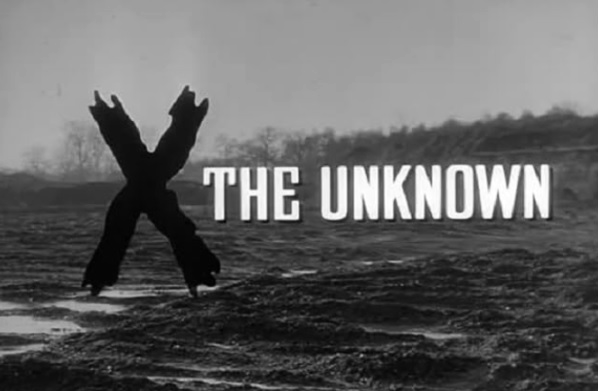
X the Unknown
Directed by Leslie Norman, 1956
X: The Man with the X Ray Eyes
Directed by Roger Corman, 1963
Jeanne Dielman, 23 Commerce Quay, 1080 Brussels
Directed by Chantal Akerman, 1975
LAWRENCE FREIESLEBEN tackles ‘X’
Many years ago, when I was a bit younger[i] than the boy, Willie, who trespasses in the marshy woods at 00:17:14[ii] in X the Unknown (1956) and at 00:18:45 meets the (unseen to us) monster (that’s what comes of playing outside when you should be in bed!), the old Welsh Headmaster (who doubled as maths teacher at the local council school), accused me (again) of being “BORN AWK-ARD”. Whether I was questioning the relevance of maths beyond basic shopping calculations, deliberately misunderstanding some unappealing formulaor persisting with wanting to know why X meant whatever, his strong adherance to Chapel teachings, cautions of hellfire and damnation and his hieratic manner of speech, undoubtedly magnified his allegation. At some level, I knew he was right. But whether awkwardness arises from nature or nurture . . . remains, like X, not quite knowable.
Perhaps because the older guard of teachers at Elmhurst Junior had pre-war roots and elements of a military attitude residual in the base of their skulls, it is easy to connect the geiger-counter training that opens X the Unknown (its army personel divided into bigwigs and disposable rabble – or officers and ranks, if you prefer) with the partly black and white school world of the late 1960s. But this world was definitely in transition, and it seems obvious now that the aging headmaster’s awareness of the upcoming generation of teachers (relatively approachable[iii] and dyed by more colourful, Education Through Art[iv] attitudes) pushed him to an obdurateness as long-standing as I now like to believe my awkwardness was whimsical. His frequent, rising claim in school assemblies that God could see us everywhere, might have amused the younger staff, but it angered me. To see this supposed creator as a voyeur or master spy (or in today’s terms, a kind of disembodied CCTV system) was not encouraging. In combination with my natural “awk-ardness”, the Headmaster’s ire (no doubt also triggered by his distrust of late 60s values) only made me come to view his God (or any god) as a kind of Orwellian Big Brother. By extension, as time went on and other would-be authority figures (clothed in seemingly harmless, wishy-washy cardigans or behind pipes[v] or toothy grins[vi]), took to the stage, I came to view not just politicians but the majority of science and technology, in fact, the entire “white heat of this scientific revolution”[vii] as (predominantly, but not exclusively) part of the paternalistic control system driving society (with plenty of heat but not much light) largely in the wrong direction.
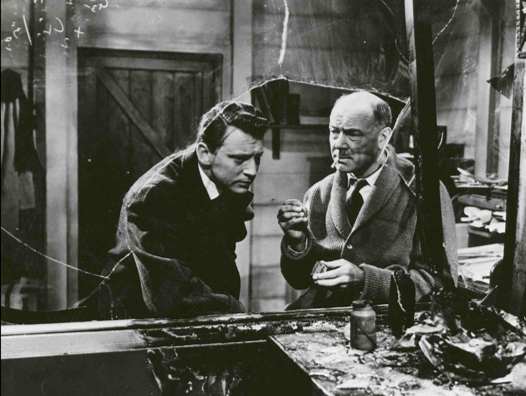
Sure enough, in X the Unknown, poor Willie dies of radiation burns, and soon afterwards, his grieving father makes the clear and generally valid distinction (00:31:20): “You’re a Scientist not a Doctor. You don’t care for the sick, you meddle with things that kill . . . letting off bombs you can’t control. You’re not safe! You’re a murderer!” After being subjected to this understandable rant, Dr Adam Royston, (Dean Jagger) walking dejectedly away down a corridor, at 00:31:20 reflects lamely to Inspector McGill (Leo McKern) : “we all try to create not destroy”.
In X the Unknown, Jagger’s character seems a friendly, mild figure, absent-minded in the way professors are often stereotypically humanised. Unfortunately, in reality, whenever science discovers something that can be exploited for war or profit, scientists tend to get pushed aside, their work misrepresented, twisted or ransacked. Alternatively, as the common trope of fiction would have it, they become ambitious or power-crazed.
By contrast, in X the Unknown, Dean Jagger’s Dr Adam Royston, is very sympathetic and shows no sign of megalomania. Since Jagger was also considered amenable in person, it came as a surprise to discover that he held virulently McCarthyite, anti-communist opinions and became adamant that Losey[viii], (who under his blacklist alias of Joseph Walton had begun the pre-production and initial shooting), should be replaced. To cover the later, highly acclaimed[ix], director’s departure, poor health was blamed[x]. He was replaced by a reluctant Leslie Norman[xi].
Post-war idealism may have camouflaged the hubristic dead-end of nuclear power in optimistic science-fiction shapes and colours[xii], offering naïve or deceitful sentiments[xiii] and never-to-be-achieved economic benefits[xiv], yet underlyingly, all the monsters remain, boiling away deep underground – as turns out to be literally the case depicted in X the Unknown. In an internet post about the film from October 2023[xv], Colin McGuigan notes: “While I wouldn’t quite categorize it as an early Eco-thriller, it does raise questions about our symbiotic relationship with the planet itself.”
Considered “vulgar and shocking”[xvi] on its release in 1956, I didn’t remember X the Unknown as a exceptional film, but it was a memorable one, one which tapped into an almost universal distrust of rampant science and technology: science as a kind of witchcraft or Pandora’s Box; science which cannot control the forces it releases. Sadly, applied to nuclear power and weapons, and now more insidiously in the fields of mobile devices, the internet and A.I., this theme of toys or tools out of control, is obviously becoming the massive writing on the wall for all of us. Writing which it seems society is too unimaginative to notice or consider and too exhausted to heed.

In the other ‘X’ film I well-remember, Roger Corman’s X: The Man with the X Ray Eyes, (1963), Doctor Xavier (Ray Milland – whose salary justifiably consumed much of the budget) is irritated that the human eye can see only 10% of the light spectrum[xvii]. Determined to force more from the retina or brain, before long, a lab monkey is sacrificed – Xavier’s miracle compound dripped into the poor creature’s eyes. What does he really want to see? Next, Xavier is, more fairly, experimenting on himself . . . but why not stick to one eye? – then perhaps he might have had the ‘best’ of both worlds?
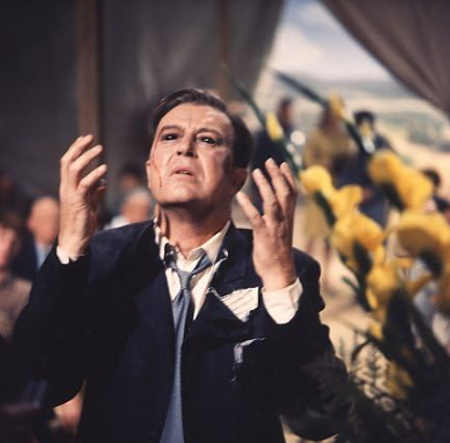
Extremely effective as both an attack on (un)scientific meddling and a parable about hubris[xviii], in prismatic Spectorama[xix], X: The Man with the X Ray Eyes, fractionally anticipated psychedelia and the wider use of LSD. While some of its attitudes have dated, it begins with serious (if absurd) intent, before inevitably lapsing into mild exploitation and action, but returns to a once-shocking denouement in a desert preacher’s tent. Here, rather than staggering up to confess his sins, Xavier says: “I’ve come to tell you what I see. There are great darknesses. Farther than time itself. And beyond the darkness . . . a light that glows, changes . . . and in the centre of the universe . . . the eye that sees us all.”So, after reminding us perhaps of that voyeur God, in an emotionally ecstatic U.S. version of my old Welsh headmaster, the preacher paraphrases Matthew 5:29: “If thine eye offend thee, pluck it out.” Dr Xavier does just that, the image freezing on his black empty sockets[xx].
In contrast to Zabriskie Point (1970)[xxi]asthere may be less to say about these two relatively conventional films, am I persisting out of “awk-ardness”? A friend joked that my fervour for digression will eventually lead me to write something less than a page long accompanied by a encylopedia of references and notes . . . which is an interesting challenge. But escalating attention (obsession?) detail (pedantry?) and subtlety (obscurity or whimsicality?) through notes, forking or parallel pathways, is hardly new. Melville’s Moby Dick (1851) is an indelible monument to a fascinating and complex addiction . . . while in the not-quite-opposite Beckettian[xxii] world of saying a lot about very little, arises perhaps, Don DeLillo’s novella, Point Omega, (2010) in which a character at the beginning and end is obsessed by Douglas Gordon’s real art installation entitled 24 Hour Psycho[xxiii]. Showing at the Museum of Modern art in New York during the summer of 2006, Hitchcock’s notorious film was slowed down to play once every 24hours. Appropriation or homage? Valid conceptual generator of attention, or gimmick?
Even if the supposedly Scottish wasteland[xxiv] adjoining the Atomic Energy Establishment of Lochmouth or the gaping fissure of X The Unknown, would make excellent settings for Waiting for Godot, it seems unlikely that the 1956 film could be mistaken for anything either as potentially complex or inspiring as Moby Dick or as potentially gimmicky as 24 Hour Psycho. But wait! Maybe it could help humanity on an altogether different level? Think of the synopsis! An older lifeforce bursts from the centre of the Earth in the form of a growing, glowing radioactive porridge, to eat particularly anything radioactive. Come back heartless lava – all is forgiven! – save those living on the earth’s crust from their nuclear dead-end nightmare . . . revive our naïve post-war scientist-hero fantasies worthy of cutaways, children’s cereal-boxes and sci-fi annuals . . .
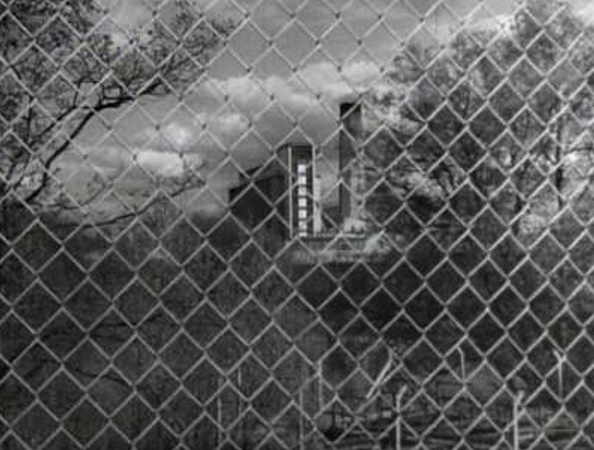
Close imaginative or speculative observation, observation straining or stretching consciousnessness or attention in the manner of ‘slow cinema’[xxv] (or such as could be stimulated by, for example, the process of watching Psycho slowed to run once every 24 hours), perhaps replicates in essence the hopeful idea behind the opening stanza of Blake’s Auguries of Innoncence[xxvi]: “To see a world in a grain of sand / And a heaven in a wild flower, / Hold infinity in the palm of your hand / And eternity in an hour.”
Blake’s lines may seem purely hypothetical to those who live within the claustrophobic confines of our technocracked, supposedly rational society, or within the accepted codes or fantasies of ‘progress’. But to anyone open to the fuller world – anyone who doesn’t have Doctor Xavier’s expectant demands – such transcendent escalation often occurs quite naturally. Even the artist Graham Sutherland’s less exacting echoes of Blake, seeing landscapes in miniature on a Pembrokeshire beach, can have an almost visionary effect on those not used to regularly thinking in such a way.
Going back to the idea of artists falling from art’s vital tightrope into formula and gimmick, more than a few ‘successful’ artists have founded lucrative careers upon stunts and repetition – I won’t name names – but this complacence, despite a concomitant facility which inevitably grows over the years, is not worthy of respect once detached from some wider or deeper quest. Although it may be unfashionable to say that art, music, writing, film and so on should be about enlightenment, I will say it anyway.
X the Unknown is an effective black and white entertainment, but apart from considering fears of the time, does it have any aspects of enlightenment about it? Unease even dread, fills many of its frames. Elemental mystery evoked in ways which we may be used to but remain unsettling: the misty woods and fear through a child’s eyes. Hammer’s usual paranoid music, insidious, unearthly, is always likewise always potent. It scratches at the nuclear trick in a way that is wholly justified, since the essence of nuclear research was always about destruction. The idea of free power (ha ha) only stemmed from the loop of annihilation it still freely offers.

Lochmouth may be imaginary but Windscale unfortunately was not, and the fire of 10 October 1957 was the worst nuclear accident in UK history. On the International Nuclear Event Scale, it remains one of the worst in the world, in severity ranked at level 5 out of 7. That is when the whole nuclear fantasy should have been terminated.
Despite undercurrents of dissent, X the Unknown probably had little choice but to show the scientists, ultimately, as heroes, leaving the military personel, managers and ministry men to smoulder the torch of that beloved film type, the stock idiot. One officer, comments at 00:48:08, that the “trouble with some of these scientific types is that they can’t see the easy way out of anything. It’s got to be complicated if it’s going to work.” The classic military way of course, is to blast and raze the fissure with high explosves and flame-thowers and then concrete it all up! Leslie Banks as Colonel Holland in Powell and Pressburger’s The Small Back Room (1949) might have been a blimpish caricature intended partly humorously, but underlyingly he was both shrewd and honest.
Predictably, Spider (Anthony Newley), Haggis (Ian MacNaughton) and Private Lansing (Marty Hopkirk of the white suit/Kenneth Cope) all become victims to the as yet unseen monster from the centre of the earth. By his petulant comments and irritation at being bypassed as boss of his “nuclear pile”, manager John Elliott (Edward Chapman) seems, at 00:42:50, to be the next victim in line . . . but miraculously survives, shortly to become the recurring martinet, Mr Grimsdale or equivalent, in five Norman Wisdom comedies[xxviii].
Learning of the approach of the radioactive sludge intent on scoffing the energy source at the dubious establishment, the cast and crew are all frantic to get the cobalt pile, a great big block, presumably radioactive, loaded onto an open flatbed truck. No precautions taken. Radioactivity is fine. Just keep a little distance and brush your hands off. Meanwhile for some baffling reason all the village flock are herded into the church by their vicar – as if the monotonous mass which can melt through solid blocks of lead is going to be put off by a couple of oaken doors or the animosity of a voyeur God who sees eveything. Naturally, a small girl child is left outside and soon runs chuckling and friendly towards the sparkling bread dough pouring over the churchyard wall. Rescued in the nick of time by the vicar, she seems unharmed despite her proximity.
Soon though, the expanding dough is heading towards the “experimental nuclear station”. Darn things are all over the place – even now. Costly misdirections still cooking 70 years later – I chanced upon one back in June just north east of Preston[xxix]. This blot on the landscape one has been “making nuclear fuels since the mid-1940s. The site is notable for being the first nuclear plant in the world to produce Magnox fuel for a commercial power station”.[xxx]

The final section of X the Unknown, involes lots of moving about of vehicles and unspecified equipment to recreate Dr. Royston’s unpredictable MeccanoTM experiment. As with the recent epic blockbuster Project Hail Mary (2026), the need for urgency vaults every hurdle, and Wallace and Gromit save the day. Or have they? “You should be proud. It has worked” X says to Y, before another unexpected explosion follows. Royston/Jagger looks baffled and the camera backtracks, implying space for a sequel.
In the excellent 2003 commentary recorded by Marcus Hearn and Jimmy Sangster (1927-2011), Sangster says that the anti-nuclear aspects were accidental, or rather that they were exploiting a common fear of the time. Meanwhile, at the BBFC or censorship office, John Trevelyan was reportedly concerned about X the Unknown’s “dangerous cocktail of sex and horror”. The tryst between radiographer and nurse in the Radiation Room could be seen as an example of this – their potential lust swiftly curtailed by the unsentimental monster at 00:34:00. I’m not sure why the victims of the monster don’t simply run away, like Willie does at the beginning, not that it did him any good. It might be difficult in confined spaces such as the Radiation Room, but some of the soldiers seem inordinately stupid, repeatedly firing their guns into what must have appeared to them as a kind of lava. Primary producer for Hammer, Anthony Hines, told the censorship board that the monster wouldn’t look as nasty as the script described, since they were intending to represent it with “chocolate mousse”.
One censor complained that X the Unknown was “scientific hokum and sadism in equal parts; a wretched exploitation of the X certificate”. The script was also described as “the work of an insane but precocious schoolboy!” which writer, Jimmy Sangster, on the commentary, doesn’t seem to mind at all for what he calls his “B and a half movie”. The fairly low budget is illustrated when Dr Royston visits a local church to question Willie’s schoolfriend about what they were doing on the night Willie received his radiation burns. To set the scene, the establishing shot used (below) was taken from Whisky Galore! (1949)[xxxi].

“X the Unknown” wrote Monthly Film Bulletin: “intriguingly suggests a new addition to the science fiction repertoire of Things, but after a series of prolonged climaxes, with its potential victims staring directly into the camera and shaking with fright, the ‘Unknown’ finally emerges as a type of rolling rubber mattress, disappointingly unhorrific in content and appearance.”
* * * * * * *
Perhaps it is only fitting in the days of obvious climate change, of psychopathic omnicidal world leaders, of narcissistic megalomaniac billionaires, of futile weathercasting and forlornly relativist cultural opinion, that the idea of a canon of film has more than somewhat self-destructed. For a decade or two, I maintained a constantly shifting top 100 of films, films largely chosen for their searching depth and quality but also allowing, overall, for enjoyment and entertainment as well as hopeful and inspirational[xxxii] elements. This was a kind of desert island list, indebted therefore to Roy Plomley’s[xxxiii] radio program[xxxiv], imagining 100 films that would stand being watched and watched again if you were shipwrecked but somehow had a projector and 100 films – or a massive TV, DVD player and 100 DVDs (the whole concept would be seriously diminished if the delivery system were smaller). Although I would probably stand by at least half of the films which made it into the more stable top ten[xxxv] of this 100, I began to abandon the overall idea when I realised that I had over 200 films in my top 100.
List-making remains a societal disease; can it have fundamental positives? Despite its prolific passion for lists, the film magazine, Sight and Sound, remains great, thanks perhaps to Mike Williams – an editor with principles. In a world steeply dumbing down, are lists a commercial necessity? One recent specimen: “21st-Century Sci-Fi Cinema,”[xxxvi] chose a film from each year since 2000. Across the page from 2001’s exceptional Donnie Darko (2001), was Sam Wrigley’s choice (presumably, Sam was born “awk-ard”) I.K.U. (2000) a film I struggled to track down and which proved to be of almost no value whatever (though it’s not much worse than Titane, 2021, which won the Palme d’Or at Cannes). Apex of all these short-attention span lists is the once-a-decade “Sight and Sound Greatest Films of all Time”[xxxvii]. Yes, the title is ludicrous. It reminds me of playing a very loose version of cricket with my children around the turn of the Millenium in rural, middle-of-nowhere, North Devon. Increasing in absurdity, The Supreme Universe Cricket Cup, eventually involved 124 invented teams. Some of these merely named the team: e.g. Flash [Gordon] and the Showoffs – a particularly reckless mob who in swashbuckling style tried to turn every ball into a 6 over the house or trees. Other teams were serious and well-characterised. My son’s Star Wars squad, featured carefully inscribed players, all of whom played or failed to play as Star Wars fans (him) might expect (although Yoda was not the best, being too calm and inclined to sitting). I can’t remember how often Darth Vader got into an argument with Han Solo, or whether team loyalty superseded Good and Evil . . . or rather Light and Dark? Perhaps Darth eventually formed a breakaway team to challenge the light side of the Force? I’m not even sure which teams made it to the final – though I have an entire scoresheet somewhere. Possibly, it was Star Wars versus The Artist, Writers and Characters (featuring all-rounders Paul Nash, Graham Sutherland, Herman Melville, Emma Peel and Wolf Solent with Cecil Collins and Orson Welles bowling off breaks – not difficult in a lumpy garden) . . .
For all their atmosphere and entertainment value, neither X the Unknown, nor X: The Man with the X Ray Eyes, would have made my top 100, though they are no better or worse than Sight and Sound’s current “Greatest Film of All Time” Jeanne Dielman, 23 Commerce Quay, 1080 Brussels. (1975). Largely a depressing tableau of interiors – Jeanne Dielman’s unmoving camera provides mesmerizing but tedious focus, observing like a coldly voyeuristic god! A cross between slow cinema’s occasionally valid lean towards transcendence and a kitchen sink (or living-room settee) realism of dreary daily routines, obsessively, neurotically, carried out . . . ultimately, this is a film about futility. For Jeanne Dielman, everything has a place. Dispiriting rather than inspiring, it is intensely claustrophobic. By the long overdue end, you feel like killing yourself. A suddenly fashionable or unfairly despised token of a film, it seems plucked arbitrarily from Chantal Akerman’s valuable oeuvre. It is not her best work and as Andreas Babiolakis points out in his useful filmography[xxxviii], winning the poll did it no favours. Try, Portrait d’une jeune fille de la fin des années 60 à Bruxelles (1994) or Je, Tu, Il, Elle (1974). Or take a look instead at the superior Riddles of the Sphinx[xxxix] written and directed by Laura Mulvey and Peter Woollen.
Jeanne Dielman’s air of joylessness is crushing. “My youth was but a gloomy storm” reads out Jeanne’s 25-year-old son, quoting Baudelaire – and even this brief line conveys a sudden wild cloudscape to dismiss the robotic routine Jeanne Dielman presents. What a relief when the camera or the characters go outside!
The only brief joy for Jeanne appears to be remembering the end of the war . . . and the son never rebels against her rules or routine. At 01:05:16 we are briefly outdoors again: any light, any air, is like an oasis in the desert! Naturally, the period atmosphere is now worth looking at, with an un-poshed-up Brussels, the sometimes slightly misty yet translucent winter streets, the proper cars . . . instead of existing as a film, Jeanne Dielman might work well as a chain of still images of dated rooms, streets and stores.
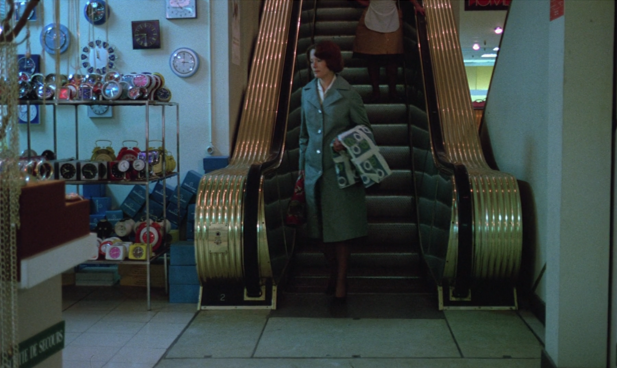
Jeanne shops, cleans and rearranges to a pattern . . . yet does manage, once in a while to smile: in the wool shop (01:29:56), in a café at Giselle (01:30:47) which she misses on her next visit – clearly discomforted by having to sit in a different seat (03:01:46). By this point however, she is starting to visibly crack, albeit in a more measured way than Carol Ledoux (Catherine Deneuve) in Repulsion (1965).
Somehow, even the perfunctory prostitution Jeanne practices, seems part of a general process – which of course may be one of the film’s points: the way we prostitute ourselves to futile modes of life. The way we try to evade alarms and surprises. That respectability is a farce . . .
Occasionally, even the less illuminated sections of Andrei Tarkovsky, can suffer from a form of Jeanne Dielman disease – a drawn-out atmosphere that (charitably) aims to alienate or mind-numb us via demoralising thought into a search for positivity or meaning. Desperate for import, eventually we grow weary, fall into a different zone, or manufacture meaning for ourselves. Which is fine under different circumstances, but Jeanne Dielman can make you long for a mindless Euro-spy thriller[xl] or a Morecambe and Wise feature film such as: The Intelligence Men (1965) or That Riviera Touch (1966)! Jeanne’s mind-suicide of repression can’t last; her life of quiet desperation begins to crumble towards the 3-hour mark as she starts to fumble and drop things . . .

Her suffocation under the final man (above) resembles how you feel all the way through the film – and it ends in a strike for freedom which fails . . . But perhaps I am forcing my own desire for Jeanne to E S C A P E upon the film? “Jeanne Dielman’s defences had snapped and I wanted to demonstrate that with the strongest sign of her oppression: prostitution… Jeanne Dielman kills to regain her order” Akerman herself said[xli]. Perhaps Jeanne’s repressive order is as close as she can get to the concept of freedom – which may only be a concept anyway, however we interpret or attempt to live or avoid it?
Even if Jeanne Dielman doesn’t justify this much attention as a film (rather than as “the first masterpiece in the feminine in the history of the cinema”[xlii]) Chantal Akerman was undoubtably a worthwhile artist and the film must work on other levels to be so highly rated. Perhaps viewers identify with it as a kind of psychological case history? Is it unfair to know or remember that aspects of Jeanne’s behaviour were based upon Akerman’s mother’s daily routines and that her mother was an Auschwitz survivor? This cannot help but affect both viewer and critic, making Jeanne a martyr by association. A more concise and intense film to which Jeanne Dielman could be very loosely related is Dušan Makavejev’s Love Affair, or The Case of the Missing Switchboard Operator (Ljubavni Slucaj ili Tragedija Sluzbenice P.T.T.) of 1967. But Eva Ras (as Izabela, telefonistkinja or switchboard operator) seems very much alive although dead, while Delphine Seyrig (as Jeanne) is obliged to play dead whilst alive . . .
In the end, however, my intolerance towards Jeanne Dielman, 23, quai du Commerce, 1080 Bruxelles, could be partly physiological. Owing to the tunnels and ventilation shafts the workers have to crawl through in Under Night Streets (1958)[xliii], one of my previously favourite BTF films has become difficult to tolerate. It triggers my claustrophobia. Jeanne Dielman is similarly stifling. Watching it is like being buried alive . . .
I only have to pass under the shadow of a tree in some inconsequential suburb to feel a sudden desire to watch and ponder Vertigo[xliv] again. Yet Vertigo’s overall enigma surpasses its individual scenes and my memory (or mis-memory) of the profoundest passages can be so essential and heightened, that sometimes the actual film itself can be a distraction. Many films have this effect, but Jeanne Dielman does not. In fact, you would have to pay me to watch Jeanne Dielman for a fourth time. Rather than being hauntingly tragic, what Jeanne Dielman perhaps does best, is reflect the increasingly robotised captivity of society – a society far more closely circumscribed by technology now than it was in 1975. Forget rampant lava or psychedelic eye drops, it’s the tools that have taken over. The tools and their android oligarchy of selfish owners. These are the real monsters.
© Lawrence Freiesleben
Notes
[i] At 13 or 14, the actor, Michael Brooke (1942-2014) was older than he looked in the film
[ii] All the timings from X The Unknown come from my 2005 Hammer DVD
[iii] Though one teacher did lift me up by my ears (not off the ground, and I probably deserved it) while another used to make wrongdoers do handstands against a wall all through playtimes
[iv] archive.org/details/education-through-art-herbert-read-compressed/page/4/mode/2up
[v] en.wikipedia.org/wiki/Harold_Wilson
[vi] en.wikipedia.org/wiki/Edward_Heath
[vii] theguardian.com/science/political-science/2013/sep/19/harold-wilson-white-heat-technology-speech
[viii] en.wikipedia.org/wiki/Joseph_Losey
[ix] Particularly after the release of The Servant in 1963
[x] bfi.org.uk/features/why-i-love-x-unknown by Vic Pratt: “American star Dean Jagger was signed up to star, and blacklisted Joseph Losey – who would go on to shoot The Damned (1961), another seriously spooky sci-fi film – was enlisted to direct, but there was further trouble ahead. Losey left the production somewhat abruptly – supposedly with pneumonia, but, according to [Jimmy] Sangster, removed from the project owing to star Dean Jagger’s reluctance to work with a ‘red’ director.”
[xi] imdb.com/title/tt0049967/trivia/: “It has also been reported that Losey simply didn’t want to make the film and left the project, to be replaced by Norman, who also didn’t want to make the movie.”
[xii] A false picture that still clings on 70 years later – another corpse inadequately staked!
[xiii] See Atomic Achievement (1956) youtube.com/watch?v=ToVsb_AhrlM Observing the scientists and minions featured is like watching toddlers play with broken glass:
internationaltimes.it/first-principles/
[xiv] Sheer awkwardness or pigheadedness continues to throw good money after bad despite there being no safe solution to the disposal of waste which remains dangerously hot and highly radioactive for thousands of years.
[xv] livius1.com/2023/10/14/x-the-unknown/
[xvi] Marcus Hearn’s words in an absorbing 2003 commentary to the film with Jimmy Sangster, the writer and production manager.
[xvii] For what it’s worth, this figure has since been scientifically reduced to less than 1%.
[xviii] It was a vivid memory of the end of X: The Man with the X Ray Eyes, that etched the biblical (mis)quote from Matthew 5:29 into my head: “If thine eye offend thee, pluck it out.” internationaltimes.it/first-principles/
[xix] The Spectorama technique was employed by Cinematographer Floyd Crosby to suggest what Dr. Xavier sees as his vision expands the normal human spectrum.
[xx] In his book Danse Macabre, Stephen King, noted rumours which claimed “the ending originally went further, with Milland crying out “I can still see” after gouging out his eyes. Corman has denied the existence of that ending but expressed enjoyment with the idea, saying “Now it’s interesting. Stephen King saw the picture and wrote a different ending, and I thought, ‘His ending is better than mine.'” See: en.wikipedia.org/wiki/X:_The_Man_with_the_X-ray_Eyes
[xxi] brazen-head.org/?s=zabriskie+point
[xxii] en.wiktionary.org/wiki/Beckettian
[xxiii] theguardian.com/books/2010/feb/27/don-delillo-point-omega
[xxiv] This recurring location was actually filmed (as were other film and TV productions including episodes of Doctor Who) at Gerrards Cross Sand and Gravel Pits in Bucks which looks, in pictures, though not in the film, to be very similar to the Leighton Buzzard Sand Quarries which so inspired me from the 1970s: brazen-head.org/?s=zabriskie+point As the film was made in the winter, filming day for night was not considered possible since it requires bright sunlight, necessitating working at night in very cold January and February temperatures.
[xxv] en.wikipedia.org/wiki/Slow_cinema
[xxvi] Presumed to have been written in 1803, but not published until 60 years later.
[xxvii] en.wikipedia.org/wiki/Windscale_fire
[xxviii] www.imdb.com/name/nm0152361/?ref_=tt_cst_t_2 Chapman also remains indelible as a church deacon in Powell and Pressburger’s Gone To Earth (1950), when at 00:31:46, after the vicar has said Grace: he declares: “I have not received tartlets… I am not thankful!”
[xxix] westinghousenuclear.com/uknuclear/springfields/
[xxx] en.wikipedia.org/wiki/Springfields
[xxxi] As Peter Faizey noted here: www.reelstreets.com/films/x-the-unknown/ the church, Our Lady Star of the Sea, is on the Isle of Barra, Castlebay, Scotland. The other church used is St Michael’s Church, Bray, which apparently also appears in Paranoiac (1963), Four-Sided Triangle (1953) and There’s a Girl in My Soup (1970).
[xxxii] Even the darkest (and best) film noir: Out of the Past, 1947, (my number 4 film since the late 1980s) has fleeting lights of hope.
[xxxiii] en.wikipedia.org/wiki/Roy_Plomley
[xxxiv] bbc.co.uk/programmes/articles/59YrnYM0Tw8J7WJ0MGKVfh7/the-history-of-desert-island- discs
[xxxv] Although I would “stand by” these films, there would probably be a hundred others I’d now wish to cram into the top ten, since much of the list predated my wider experience of European and world cinema – particularly of Italian and Japanese films. The Japanese New Wave (Nuberu bagu) is every bit as vital as the better-known French Nouvelle Vague
1) A Canterbury Tale (1944)
2) Solaris (1972)
3) The Ghost and Mrs. Muir (1947)
4) Out of the Past (U.K. title: Build My Gallows High (1947)
5) Stalker (1979)
6) Leave Her to Heaven (1945)
7) Kiss Me Deadly (1955)
8) Vertigo (1958)
9) Ivan’s Childhood (1962)
10) Le Samouraï (1967)
[xxxvi] Sight & Sound, Summer 2026, Volume 36, issue 6
[xxxvii] bfi.org.uk/sight-and-sound/greatest-films-all-time
[xxxviii] filmsfatale.com/blog/2026/3/5/filmography-worship-ranking-every-chantal-akerman-film
[xxxix] www.imdb.com/title/tt0076625/
[xl] en.wikipedia.org/wiki/Eurospy_film
[xli] bfi.org.uk/sight-and-sound/features/keeping-distance-chantal-akermans-jeanne-dielma by Janet Bergstrom – updated 15th October 2015 from the November 1999 magazine.
[xlii] Le Monde, January 1976
[xliii] imdb.com/title/tt0991286/?ref_=nv_sr_srsg_0_tt_1_nm_1_in_0_q_under%20night%20streets
[xliv] Vertigo preceded Jeanne Dielman… as number one in the Greatest Films of all Time list. Naturally, the critical/appreciative paths around it are thoroughly trodden.

LAWRENCE FREIESLEBEN, Film & Television Editor of The Brazen Head, has been an artist and writer as long as he can remember – cycling away at weekends from the council estate where he grew up, to paint the countryside as an escape from the restrictive tedium of the school week. Leaving home at 16, he has lived in 17 different areas of the UK – from Devonshire to Northumberland – painting and writing, always vigilantly questioning the interior light of landscape, cityscape and wider atmosphere. Living virtually off-grid with his large family, both remote locations and urban visits have formed the backscene to a passion for film which has intertwined with art and writing throughout his career. Films remain a key creative focus since childhood, resulting in encyclopaedic folders and clippings as well as a constant stream of home-made film festivals. He currently lives in a dilapidated Lancashire seaside town