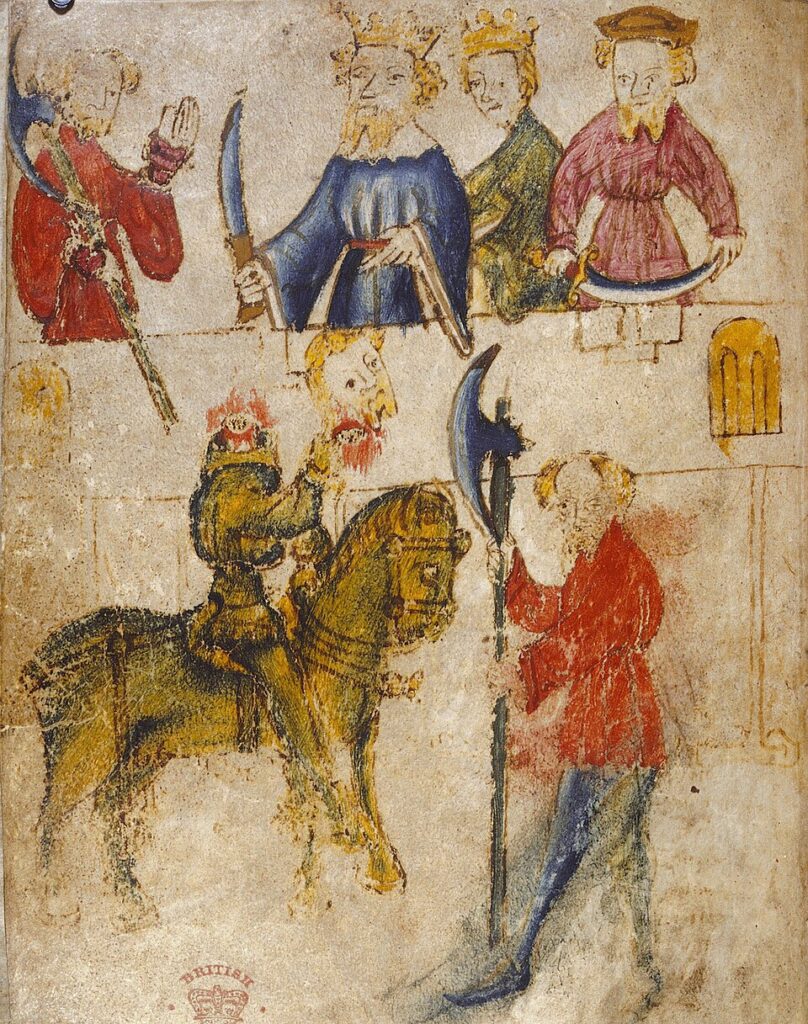
JOSH SIMON HARRIS has recently completed a translation of the Middle English Sir Gawain and the Green Knight. Brazen Head poetry editor LIAM GUILAR asked him about it.
Tell us a little about your language background and your day job. What brings a scientist to translation? Which other texts have you translated, are translating?
I’ve always been interested in language and poetry; I wrote my first poems in third grade (I would have been about eight or nine years old), inspired by the great poets of my childhood like Dr. Seuss and Shel Silverstein. At the same time, I was always good at math as a kid, and when I took my first Physics classes in high school, I was blown away at how precisely the natural world can be described by mathematical models. In college, I kept up both interests; I was a double major in English and Materials Science and Engineering. It was there that I first fell into translation. I had taken a bit of Spanish, and I really liked Pablo Neruda’s poem, “Puedo escribir” (Poem 20 in his collection, Twenty Love Poems and a Song of Despair). I had heard it in Spanish without fully understanding all the words, and I was struck by how much better it sounded in Spanish than in translation. I wrote my own translation of it (which likewise doesn’t hold a candle to the Spanish original), and eventually translated the whole collection over the course of a summer (I wasn’t able to publish it until a few years later when it entered the public domain, and even now, it is only available in the United States due to copyright).
At some point in college, I also took a World Literature class where we read Homer and Dante, among other authors. I’ve had a fascination with Greek and Roman mythology ever since I was a kid (I used to love this book, D’Aulaires’ Book of Greek Myths, which is more or less Ovid for children; I’ve been reading it again with my son recently), so of course Homer and Dante pulled me right into the deep end. We talked in class about terza rima, the rhyme scheme of Dante’s Commedia, but the translation we were using didn’t rhyme at all. I thought it would be fun to write a translation in the original rhyme scheme, and my professor agreed to let me try my hand at the first canto instead of writing a final essay. I ended up translating the first five cantos. I didn’t know any Italian at the time, but I knew a little Spanish; and with a combination of online resources like Wiktionary and existing translations, I was able to pick it up readily enough. From there, I just got sucked in.
I had no idea what I was getting into, of course. To translate Dante, I essentially had to become an amateur Dante scholar. While translating, I read countless commentaries, essays, biographies, and translations of Dante’s other works and primary sources. It took me about ten years to finish the Inferno. During that time, I graduated college, wrote a novel based on the Greek tragedy Philoctetes (which probably about a dozen people have read), went to grad school for Computational Materials Science, met my ex-wife, had a kid, got married, got my PhD and got accepted for a postdoc position. Dante shadowed me through all these major milestones of my life; as Virgil guided Dante through the Inferno, so Dante guided me in my journey to become a better poet, translator and human being.
I can’t even explain how it felt when I finished the Inferno. It was like a breath of fresh air that is still somehow suffocating—relief and regret at the same time. I was about halfway through translating Dante’s Vita Nuova, a shorter, earlier work of prose and lyric poetry; but I had to get away from Dante for a while. I started translating Homer because I wanted to try writing in the epic hexameter (and became convinced that I could after reading Longfellow’s Evangeline). But the problem with the Iliad is that it is very, very long, and I also wanted a project that I could finish on a reasonable timeline. That, plus an interest in alliterative verse, is what led me to Sir Gawain and the Green Knight, and here we are. Along the way, I have also translated a lot of shorter poems from various languages and poets (Sappho, Bertran de Born, an anonymous Old English poet). I even translated a Norwegian short story for a contest (I didn’t win, but the translation that won was better than mine anyway). Now that I’m done with Gawain, I’ll get back to translating the Iliad, and I will eventually make my way back to Dante. I’m also working on a second novel, which is a science fiction story with inspiration from biblical mythology (sounds a bit like Dune when I put it that way, but it’s not).
Today, I’m still a scientist for my day job; I work at a small pharmaceutical company using AI and machine learning for drug discovery and toxicology (essentially making models to predict whether a molecule might be toxic or might have therapeutic effects). I remain intensely interested in science and mathematics, and for now it pays the bills better than poetry. But creative writing and science are both deeply ingrained in my soul. I’ll always do both.
Why alliterative verse? And while we’re here were you ever tempted to translate Sir Gawain or Saint Erkenwald into another, perhaps more modern verse form?
Verse form is one of my favorite things about poetry. Even in free verse, form is what distinguishes poetry from prose. Part of the fun of translation, for me, is the challenge of translating a poem into a new language while keeping the verse form intact. With Dante, it was terza rima; with Homer, it’s dactylic hexameter; and with Gawain, it’s alliterative verse (and the “bob and wheel” at the end of each stanza, of course). I became interested in alliterative verse purely for this reason. I translated a short Old English alliterative poem, “The Wanderer,” and I really enjoyed it; alliteration requires a different kind of mindset from meter and rhyme. After writing a lot of alliterative verse, I also noticed how prevalent alliteration is in our language and in a lot of my favorite books (Tolkien is a great example).
I haven’t really been tempted to translate Gawain or Erkenwald into another verse form, but I think it’s a really interesting idea. This is essentially what Pope did with Homer (he translated Homer into heroic couplets). Likewise, Dante translated the Lord’s Prayer into Italian in terza rima in order to fit it into the Comedy. There are a couple of Sappho poems that I’ve translated into a different form than the original, essentially because there is no good English equivalent of their original meter; it is kind of fun to try to fit a poem into a new box in that way. So I think it’s worth considering.
Why Sir Gawain? From your Introduction it seems you hadn’t read the poem before you started translating it? Is that correct? And how did you feel about the poem when you’d finished? Impressed? Disappointed?
That’s right. I had heard of Sir Gawain, and I knew other people who had read it, but I had never read it myself before I started translating it. As I mentioned, I had already done an alliterative verse translation of “The Wanderer,” and I really wanted to try a longer alliterative poem. The obvious choice in Old English would be Beowulf, but I was never a big fan of Beowulf, so I wasn’t thrilled at the prospect of devoting a chunk of my life to it. Besides, Seamus Heaney’s translation of Beowulf is pretty much as good as it is ever going to get, in my opinion (I really love the poetry in his version, even though I find the narrative kind of dull). So Old English was out. What about Middle English? I did a bit of research into alliterative poetry, and the general consensus seemed to be that Sir Gawain and the Green Knight was the best alliterative poem in Middle English. I didn’t read the poem first, I just took a leap of faith and started translating. I was kind of looking for something quick and easy after working with Dante and Homer, and I thought a Middle English Arthurian romance would be sort of a light and fun adventure. I wasn’t expecting great depth and complexity—man, was I surprised. The poem was way, way more impressive than I thought it would be; it exceeded my expectations in almost every way. The Gawain poet is deeply concerned with form and symmetry, and it comes across in each line, each stanza, the structure of the poem as a whole, and the structure of the narrative. On top of that, his characters (particularly Gawain and the lady of the castle, whom he meets) have rich inner minds in a way that is unusual for old Arthurian tales; the poet explores emotion and psychology in surprisingly modern ways. So I think it’s fair to say I was impressed.
How do you translate? What’s your process? Is translating Gawain different from how you might approach Homer?
My translation process has evolved over time, and it is definitely different depending on the text. With Dante and Homer, I first translate the original text word by word into a kind of pidgin language with English words but the original syntax; the pidgin language reads like a kind of code, with symbols indicating certain things to me about the original language. To do this, I use a combination of online dictionaries (Wiktionary is a good general resource with etymologies, etc.; and there are specific dictionaries for Ancient Greek and Middle English), plus other resources if there is a unique word or context that is unclear or perplexing. With Dante, I’m also reading Singleton’s commentary while writing the pidgin translation, keeping notes on anything relevant (e.g. if Dante’s word choice alludes to something famous, I want my word choice to do the same). With Homer, I’m checking for repetition, because I want to make sure that if Homer repeats a phrase verbatim, I do the same (repetition is very important in Homer, since it derives from semi-improvised oral poetry). After completing the pidgin-language version, I go through and write my translation in verse (still referring to the original text as well as the pidgin text, and often consulting other translations and commentaries).
With Gawain, because the original language is Middle English, I don’t bother with writing the pidgin text first. When you get the hang of it, you can more or less read big chunks of the Middle English text without a dictionary; I still look up most of the words, since the meaning of several words has changed over the centuries, but it is easier for me to scan through than Italian or Ancient Greek. As I write, I also consult other translations and commentaries to make sure I’m getting the correct meaning (and not missing any subtext or anything). So the common thread of my translation process is that I am essentially close-reading the text as I write, looking up each word individually while considering the passage as a whole.
Were there parts of the story that gave you problems, were more difficult to translate, made you wish you could do a little editing?
Oh, there were many. Sometimes, especially with Middle English (where the words can often be quite close to Modern English), you find yourself just rolling along without any problems. But when you bump into a challenging passage, you might be stuck for a day or longer trying to find a solution. It’s hard for me to think of specific examples after the fact, though. I ended up happy with most of the alliterative lines, because there is a lot of freedom to render them in different ways. If there are some rough edges on the translation, they would probably be in the “bob and wheel” sections, the five lines of rhyming verse at the end of each stanza. Those lines can be very difficult to translate, given the short lines combined with the tight rhyme scheme. As always, translation is a compromise between several conflicting ideals.
Were there any parts of the original that I wished were different? Of course. While the poem is surprisingly modern, the medieval sensibilities of its author often show up in unexpected ways. But it’s not my job as a translator to edit the original, it is my job to bring it into Modern English. So I stayed as faithful as I could to the original text.
Gordon and Tolkien in their introduction to their edition of the poem thought the story was almost perfect but the three hunting episodes were excessive. What do you think of them?
On my first reading, I might have agreed that the three hunting scenes were excessive—after all, the same sequence of five scenes is essentially repeated three times in a row: the lord goes hunting, the lady tries to seduce Gawain, the lord’s men carve up their quarry, Gawain and the lord exchange spoils, and finally, Gawain and the lord renew the terms of their game. But when I was working on the notes, I realized that this repetition of five scenes mimics the shape of the pentagram (a five-pointed star): to draw a pentagram, you draw a sequence of five overlapping lines, and the fifth line brings you back to the start. The pentagram is thematically important to the narrative—it is represented on Gawain’s coat of arms, and the poet links it explicitly to Gawain’s virtues (he calls it a “token of truth”). The poet very cleverly mirrors the structure of the pentagram in the structure of his verse. But the thrice-repeated sequence of scenes is not exactly the same each time; there is a progression in which Gawain’s virtue slowly breaks down, and at the end of it the structure of the pentagram is broken too. I talk about this in more detail in the notes, of course.
What is your take on the ending? Gawain is mortified and thinks he’s failed. The people at Arthur’s court reject this and insist on wearing what he thinks is a badge of shame as a badge in his honour. What do you think?
I love the ending. I think it is an uplifting reminder of the importance of being part of a supportive community. In the first half of the poem, Gawain does not grow as a character—he is presented as a knight already at the peak of perfection (in terms of chivalric virtue, anyway). He readily trades his own life for his king’s, he bravely goes on a quest that will almost certainly end in peril for him, and he defeats ogres and dragons along the way as if they were a mere inconvenience. But nobody is perfect. The poet puts Gawain in a situation where even his chivalric virtues cannot sustain him, and Gawain fails. It is a small failure, really, but he takes it hard. When he comes home, he confesses everything to Arthur and his courtiers; but instead of shaming him, they completely turn it on its head. His imperfection is not shameful, it is only human; his shame is excused by the mere fact that he is ashamed, that he continues to strive to be virtuous. Perfection may be the ideal of knighthood, but no knight is perfect in practice.
How would you sell your translation to a possible buyer? What will they get from your translation they can’t get from any of the existing ones?
Probably the biggest thing that distinguishes my translation from others is that I adhere to the original form of the poem using natural-sounding language (not using awkward diction, syntax inversions, etc.), while still staying true to the meaning of the text. The verse form of the Middle English original is really interesting: each stanza consists of (on average) twenty lines of alliterative verse, capped off by a short five-line rhyming section. Other translators have certainly carried this verse form into Modern English; but often they sacrifice clarity, or a good word choice, or (worse) the mood of the poem in order to pull it off (I certainly don’t want to judge too harshly; there are a number of good translations already out there). Not that I never make any sacrifices; translation is all about making choices to balance the meaning, form, and emotion of the original text. But I like to think that my translation strikes a pretty good balance.
Additionally, I have included lots of goodies besides the poem itself. Instead of line-by-line notes (which are common enough in translations of classic poetry), I opted to write commentary in the form of a conversational essay in which I’m walking through the poem along with the reader. I analyze the text of course, but also provide some historical background, discussion of the poetics, etc., in relevant places as I go along; I think readers who enjoy the poem will find the commentary interesting and worthwhile. I also have a bibliography intended more for readers and enthusiasts than scholars; a pronunciation glossary with names, places, and medieval titles, arms and armor; King Arthur’s family tree; a timeline of the narrative; a historical timeline of events relevant to the poem; and several hand-drawn images (a map of Gawain’s journey through England and Wales, a drawing showing the armor of a medieval knight, and more). Finally, I’ve capped off the book with an original poem which has a rather interesting verse structure (it’s complicated, but it is based on the shape of the pentagram, which is central to the themes of the narrative). There’s also a link in the back of the book to a project I’m working on, which is a “choose your own adventure”-style version of Sir Gawain and the Green Knight (I’m putting it online as I write it; it is not nearly complete yet).
Your book has an extensive section of commentary and notes. What do you think a reader will learn from them that is new?
Most works of classic literature have editions with notes or commentary, but I’ve found that the commentary is sometimes rather dry and uninteresting to anyone but scholars (this is certainly not always the case, but it is common enough). I wanted to keep my own commentary engaging throughout. When I’m out driving or doing chores, I like to listen to podcasts that walk through narrative poems, films and video games while providing commentary and analysis along the way. Inspired by that format, I wrote my notes in something of a conversational style; I basically walk through the narrative discussing everything I find interesting along the way. I consulted the notes of several different Gawain translations as well as online resources to ensure I didn’t miss anything important. My commentary is designed so that it can be read on its own after reading the poem, without flipping back and forth to see what lines I’m referring to. In this way, I get to do a close reading of the poem with the reader. I’m not familiar enough with the full body of Gawain scholarship to know how novel my commentary really is, but it isn’t meant to be a work of rigorous scholarship anyway. I can say with confidence that there’s a lot that you won’t find in the notes of other translations. Above all, I think (I hope) readers will find it interesting and thought-provoking.
The poet is anonymous but generally regarded as one of the great poets of Middle English. You’ve spent a long time in his company. Do you have a sense of ‘The Gawain Poet’?
The Gawain poet lived in the late fourteenth century in the northwest part of the English Midlands (scholars deduce this from his dialect). He has a strong voice and occasionally inserts himself into the narrative, providing a little clarification or observation in first person. He’s obviously intelligent and well-read, and he seems to have a good deal of familiarity with matters of both church and court. On the one hand, he is learned in Latin, theology, and ecclesiastical rites, suggesting an education in the Church; on the other, he displays an intimate knowledge of chivalry and courtly affairs, suggesting some role in the English court. And yet, he doesn’t seem like a man tied too tightly to the cloth or the crown; he doesn’t shy away from low language and bawdy humor, and he seems unusually attuned to the inner minds and outward concerns of people from many different backgrounds. As a historical person, he is an enigmatic figure; and yet, his personality often shines through in his writing. He is passionate, curious, fair-minded, empathetic, intelligent, and a deep thinker in all sorts of subject areas. He’s funny when he wants to be, and somber when he needs to be. Overall, he’s just a fantastic writer. So yes, I feel like I do have a sense of who the Gawain poet is—even if, paradoxically, we may never know his true identity.
I just want to say thank you for giving me the opportunity to discuss my translation of Sir Gawain and the Green Knight. I spent a lot of time working on this in solitude, so it’s wonderful to finally share it with other people. Thank you!
Publication information
Sir Gawain and the Green Knight
Anonymous, J. Simon Harris (translation and commentary)
Nostra Vita Books
To be published 9 November 2026

LIAM GUILAR is Poetry Editor of The Brazen Head, and the author of several poetry collections, including the series A Man of Heart, Presentment of Englishry and The Fabled Third (Shearsman), set in post-Roman Britain. His most recent publication is a translation of the Mabinogion folk-tale How Culhwch Won Olwen (Shearsman, 2026)